
Published: March 2020 | Last Updated:January 2026
© Copyright 2026, Reddog Consulting Group.

Paid search advertising is how you get your business in front of customers at the exact moment they’re searching for what you sell. Instead of waiting months for your website to climb the organic rankings, you can pay search engines like Google to place your ads right at the top of the page.
Essentially, you're buying immediate visibility to connect with high-intent shoppers ready to make a move. For any brand focused on measurable growth, it’s one of the fastest, most direct ways to drive qualified traffic to your products and retail channels.
Think of the internet as a massive, sprawling city, and search engines as its main boulevards. Paid search advertising is like renting a prime billboard at the entrance to the busiest shopping district. When a customer searches for "women's waterproof hiking boots," your ad for those exact boots appears first, capturing their attention before they see anything else.
This is a world apart from organic search (SEO), which is all about earning a free spot over the long haul. Paid search delivers instant placement, letting you jump the line and get in front of motivated customers today. To really get this, it helps to understand the difference between Search Engine Marketing vs SEO, since paid search is a key part of the bigger SEM picture.
To help you get a clear picture of how paid search fits into an omnichannel growth strategy, we've broken down the key components and why they matter for driving measurable results.
| Component | What It Is | Why It Matters for Growth |
|---|---|---|
| Keywords | The specific phrases people type into search engines. | Connects your products directly to customer intent, ensuring you show up at the exact moment of need. |
| Bids (PPC) | The maximum amount you'll pay when someone clicks your ad. | Controls your ad spend and is a key lever for maximizing Return on Ad Spend (ROAS). |
| Ad Copy | The text of your advertisement. | Grabs attention and convinces shoppers to click your ad over a competitor's, driving qualified traffic. |
| Ad Auction | A real-time bidding process for ad placement on search results. | A higher bid doesn't guarantee a win; relevance and quality are crucial for efficient spending. |
| Targeting | The ability to show ads based on location, demographics, and more. | Ensures your ad budget is spent on the most qualified, high-intent buyers, improving conversion rates. |
Mastering these elements is the key to turning clicks into customers and building a scalable revenue stream for your brand across all its channels.
At its core, paid search runs on an auction system. But it’s not just about who pays the most; it's about who offers the most relevant result. Getting this right is the first step in our growth framework: Foundation → Optimization → Amplification.
Three main levers drive every campaign:
When you align these three elements perfectly, you create a direct bridge between a customer's intent and your product. You're meeting demand the second it appears, turning a simple query into a real, measurable sale.
This high-intent environment is precisely why paid search is a non-negotiable for any brand serious about growth. It puts you directly in the path of shoppers who have already raised their hands and said, "I'm ready to buy."
It’s a common myth that winning in paid search is all about having the deepest pockets. While your budget matters, the reality is far more interesting. The paid search auction is a real-time system where relevance and quality are just as valuable as the bid itself.
Think of it less like a traditional auction where the highest price wins and more like a talent show where performance counts.
At its core, the auction runs on a formula called Ad Rank. This score is what determines your ad's position on the search results page. In simple terms, the formula looks like this:
Ad Rank = Your Bid x Your Quality Score
This simple equation changes everything. It means a brand with a world-class user experience can actually outrank a competitor with a much bigger budget. This is the heart of the Optimization phase in our growth framework—making every dollar work smarter, not just harder.
The visual below breaks down the core components that feed into this powerful auction system.
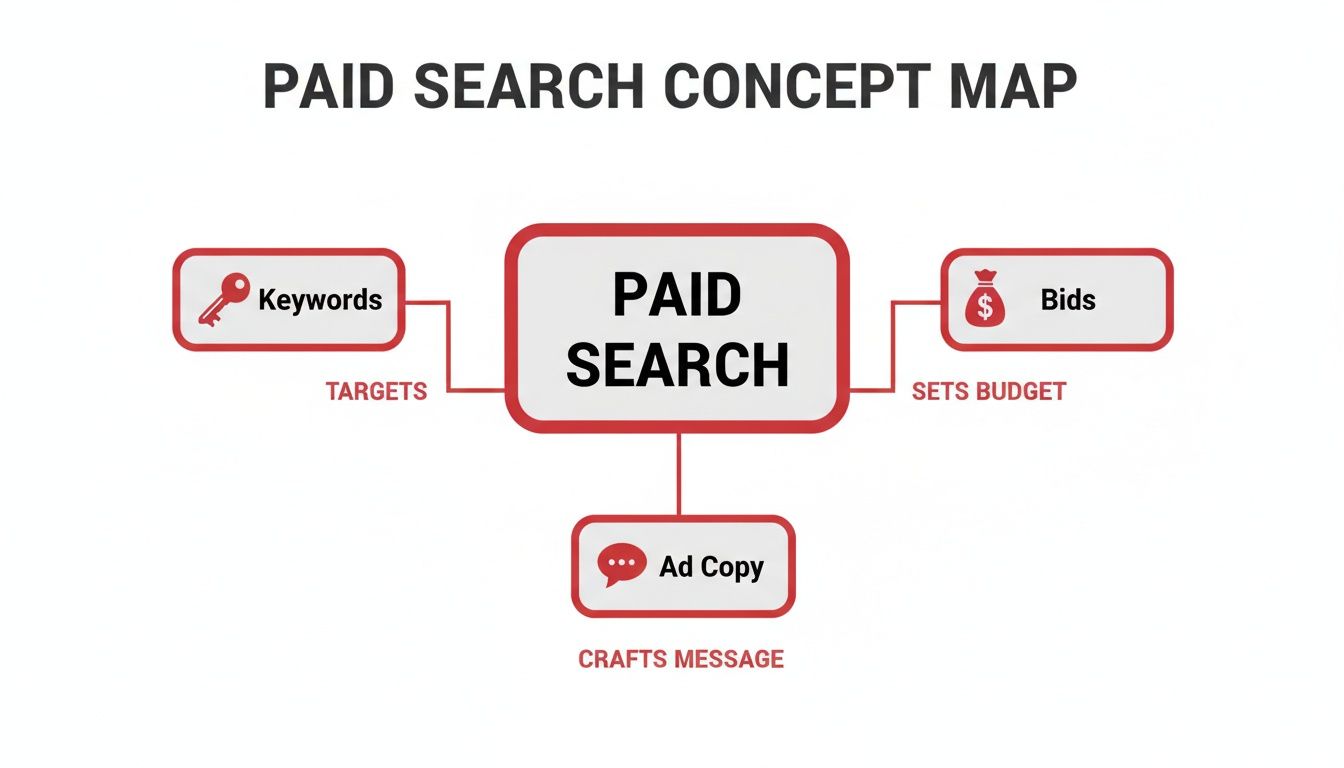
As you can see, keywords, bids, and ad copy are all interconnected pillars of a successful paid search strategy, and they all influence the auction's final outcome.
So, what exactly is this powerful metric? Quality Score is Google’s rating of the overall quality of your ads, keywords, and landing pages. It’s a score from 1 to 10, and a higher score leads to lower prices and better ad positions.
It’s the search engine’s way of rewarding advertisers who provide a great user experience.
Three main ingredients determine your Quality Score:
A high Quality Score is a direct signal to search engines that you are providing value. In return, they reward you with better visibility at a more efficient cost—which is absolutely crucial for maximizing your return on ad spend and driving profitable brand growth.
Let's look at a real-world example. Imagine two online stores, "Zenith Apparel" and "Apex Wear." They're both bidding to show up for the keyword "women's merino wool sweater."
Even with a lower bid, Zenith Apparel wins the top ad spot simply because they provided a better user experience. This isn't just theory; it’s the fundamental mechanic that allows smart, optimized brands to compete and win.
This is exactly why building a solid Foundation is the first step toward profitable growth. The massive investment in this channel proves just how important it is. Paid search advertising represents a huge piece of the digital ad economy, with companies spending an incredible $211.76 billion on search ads in 2024 alone. Projections show this spend climbing to $260.97 billion by 2028, proving brands are betting big on capturing high-intent shoppers right in the search bar. You can discover more trends about organic vs paid search to see the full picture.
Once you’ve established your foundation and understand how the ad auction works, it's time to open up the throttle. This means going beyond simple text ads and choosing the right ad types and platforms that align with your omnichannel growth goals. Paid search is so much more than just the classic blue links on a Google page.
If you’re running an omnichannel brand—selling on your own eCommerce site, on Amazon, and in physical retail stores—you need an integrated strategy. The goal is to show up wherever your customer is looking. That requires a smart mix of ad formats built for every step of their journey, from online browsing to in-store purchasing.
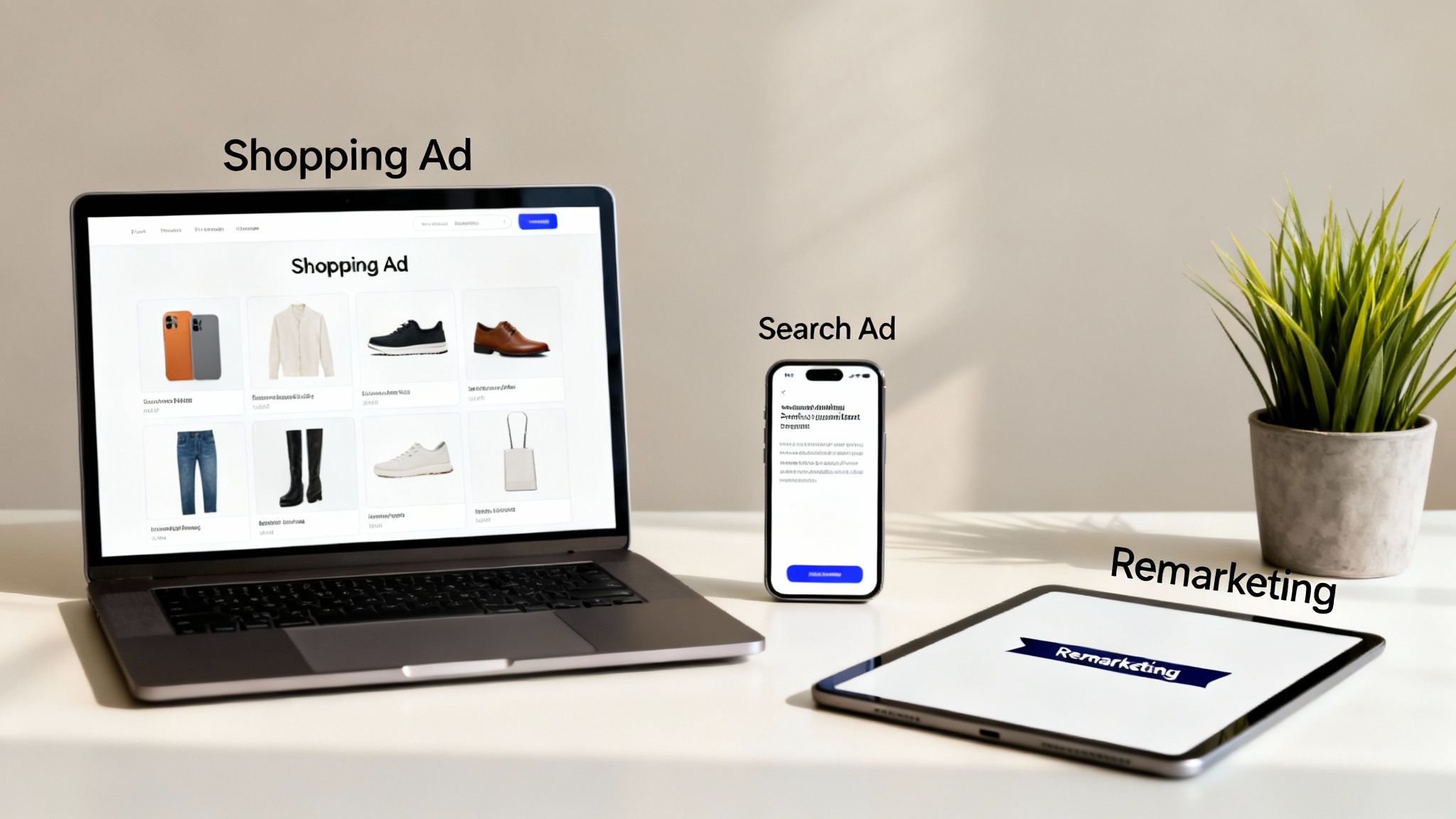
Allocating your budget this way is becoming more critical than ever. Data shows the entire advertising world is tilting toward digital. Forecasts show that by 2026, nearly 80% of all ad budgets will pour into retail media, paid search, and social platforms. Retail advertising alone—a huge piece of the pie on sites like Amazon and Walmart—is set to hit over $190 billion in 2026. You can learn more about this massive shift in global ad spend to see just how big this trend is.
To build a powerful omnichannel presence, you need the right tools for the job. Different ad types serve different purposes, whether it's grabbing initial interest or sealing the deal.
Here are the must-have formats every growing brand should master:
While Google Ads is the undisputed giant, a truly integrated strategy looks beyond just one platform. Each channel offers unique advantages and connects you with different segments of your audience.
An effective omnichannel strategy isn't about being on every platform; it's about being on the right platforms with a message that fits the context and the customer's mindset.
Deciding where to invest your ad spend is a big decision. This table breaks down the key players to help you determine where your budget will drive the most growth.
| Platform Feature | Google Ads | Microsoft (Bing) Ads | Amazon Ads |
|---|---|---|---|
| Primary Audience | Broadest reach, covering a massive, diverse user base actively searching for information and products. | Tends to reach a slightly older, more affluent demographic with higher household incomes. | Shoppers with extremely high purchase intent, actively browsing and buying on the marketplace. |
| Key Advantage | Unmatched search volume and a wide array of sophisticated targeting tools and ad formats. | Often features lower competition and Cost-Per-Click (CPC), delivering a higher ROAS for certain niches. | Directly targets customers at the final point of purchase, capturing sales right on the product page. |
| Best For | Driving top-of-funnel awareness and capturing broad search demand for your DTC site and physical stores. | Reaching a valuable audience segment that may not use Google, often at a more efficient cost. | Dominating visibility on the world’s largest eCommerce platform and protecting your brand space from competitors. |
For a modern running gear brand, a winning strategy would use Google Ads to drive traffic to their eCommerce site, Microsoft Ads to capture an untapped customer base, and Amazon Ads to win sales directly on the marketplace. To dig deeper into this, check out our guide on effective Amazon Ads management.
Ultimately, an integrated approach ensures you cover all key touchpoints. It Amplifies your brand's presence and drives real, measurable growth across every channel you sell on.
A high click-through rate feels great, but it means very little if those clicks don’t turn into sales. To move from spending money to making money, you must shift your focus from vanity metrics to the key performance indicators (KPIs) that measure true profitability. This is where your paid search strategy transitions from basic setup to genuine, data-driven Optimization.
This is the only way to know if your ad spend is truly working. Are you acquiring new customers at a sustainable cost? Is every dollar you put into ads bringing back two, three, or even ten dollars in revenue? Answering these questions is the key to scaling your brand profitably.

The first step in measuring what matters is tracking the actions that drive your business forward. In paid search, we call this a conversion—any valuable action a user takes after clicking your ad.
For an eCommerce brand, the ultimate conversion is a sale. But other valuable actions can include:
Tracking these actions gives you a clear line of sight into how your ads influence customer behavior. The percentage of users who complete one of these desired actions after clicking your ad is your Conversion Rate, a critical health metric for any campaign.
While there are dozens of metrics you can track, only a few directly measure the financial health of your paid search efforts. Mastering these three will give you the clarity needed to make smart decisions and drive sustainable growth.
This is the single most important metric for any eCommerce business. ROAS answers one simple question: "For every dollar I spend on ads, how many dollars do I get back in revenue?" It connects your ad spend directly to top-line growth.
The formula is straightforward:
ROAS = Total Revenue from Ads / Total Ad Spend
For example, if you spent $1,000 on a Google Shopping campaign and it generated $4,000 in sales, your ROAS would be 4:1. A "good" ROAS varies by industry and profit margins, but a common benchmark is a 4:1 ratio—$4 in revenue for every $1 spent. We break this down further in our complete guide on how to calculate Return on Ad Spend.
Beyond basic clicks, understanding your Cost Per Acquisition (CPA) is vital for measuring the true profitability of your campaigns. This metric tells you exactly how much it costs, on average, to acquire one new customer through your advertising.
The formula is:
CPA = Total Ad Spend / Number of New Customers (or Conversions)
If you spend $1,000 and acquire 50 new customers, your CPA is $20. Knowing this number helps you set realistic budgets and determine if your campaigns are sustainable long-term.
Your target CPA must be lower than your customer's average lifetime value (LTV). If it costs you $50 to acquire a customer who only spends $40, you have a leaky bucket. If that customer spends $400 over their lifetime, that $50 CPA is a fantastic investment in brand growth.
As mentioned, your Conversion Rate is the percentage of ad clicks that result in a desired action. It’s a direct measure of how persuasive your ads and landing pages are.
The formula is:
Conversion Rate = (Number of Conversions / Total Clicks) x 100
If your ad gets 1,000 clicks and results in 50 sales, your conversion rate is 5%. Improving your conversion rate is one of the fastest ways to improve profitability without increasing your ad spend.
Recent data shows just how important these metrics are for success. For example, the average cost per lead (CPL) in Google Ads is expected to be $70.11 in 2025. While that sounds high, conversion rates are also improving, with 65% of industries seeing better performance. For sellers on Amazon and Walmart, this data is gold, especially as platforms like Bing Ads boast an impressive 2.83% average conversion rate. You can discover more insights about these industry benchmarks on Wordstream.com. This proves that a refined, data-driven strategy is rewarded.
Knowing what not to do is just as important as knowing what to do. Launching a paid search campaign without understanding the common pitfalls is like setting sail without a map—you’ll burn through your budget and end up nowhere fast. Many promising campaigns fail not because of a bad product, but because of simple, avoidable errors that drain cash and kill momentum.
These mistakes usually come from a "set it and forget it" mindset, which is a death sentence in paid search. Real growth comes from constant Optimization and a sharp eye for what’s working. By dodging these common blunders, you can ensure your investment drives measurable results.
One of the quickest ways to waste money is by bidding on overly broad, generic keywords. Targeting a term like "shoes" might seem like a great way to get a ton of traffic, but it's incredibly inefficient. You'll pay for clicks from people looking for everything from baby booties to ballet slippers when you only sell men's athletic gear.
The practical takeaway: Get specific. Instead of "shoes," a much smarter keyword would be "men's leather running shoes size 11." This is what we call using long-tail keywords, and it attracts shoppers who are much closer to buying. They know exactly what they want, and their click is far more valuable, leading to higher conversion rates and a much better ROAS.
Every click from an irrelevant search term is wasted ad spend. A precise keyword strategy isn't just a best practice—it's the foundation of a profitable campaign that puts you in front of the right customer at the right time.
Just as you tell search engines which keywords to target, you also need to tell them which ones to avoid. This is where negative keywords come in. Without them, your ads can show up for searches that are related but totally irrelevant, leading to wasted clicks and messy performance data.
For a brand selling premium running shoes, practical negative keywords to add would include:
Regularly checking your search term reports to find and add new negative keywords is a simple but powerful optimization tactic. It tightens your targeting, makes your ads more relevant, and stops your budget from leaking out on unqualified traffic.
Finally, a huge mistake is pouring all your energy into the perfect ad, only to send users to a generic homepage. This is a massive missed opportunity and a recipe for terrible conversion rates. Your landing page needs to be a seamless extension of your ad, delivering exactly what the user was promised.
If your ad promotes a "25% off sale on trail running shoes," the landing page must feature those exact shoes with the discount clearly displayed. A clunky experience forces the user to go hunting for the deal, and most won't bother—they'll just leave.
A well-optimized landing page must have:
By avoiding these common mistakes, you shift from just running ads to strategically investing in growth. You’ll build a stronger Foundation, optimize for profit, and create the momentum needed to Amplify your brand everywhere.
Figuring out how to manage your paid search is a critical decision in your brand’s growth story. Do you keep it in-house and learn the ropes yourself, or is it time to partner with an agency to amplify your results?
The right answer depends on your current scale, campaign complexity, and long-term growth goals. A DIY approach can work wonders when you're starting out, but knowing the right moment to call in experts is how you scale without stalling out.
Running paid search on your own is a practical option in a few key situations. If you're just getting started, getting your hands dirty is a fantastic way to learn the fundamentals of digital advertising from the ground up.
Consider the DIY route if you:
As your business grows, the complexity of managing paid search doesn't just increase—it explodes. The skills that got you your first sales are rarely the ones that will propel you to the next level of brand growth. This is the Amplification stage, where an expert omnichannel strategy is no longer a "nice-to-have" but a necessity.
It’s probably time to hire an agency when you find yourself:
Partnering with a growth-focused agency isn't an expense; it's an investment in scalable, predictable revenue. It allows you to move from simply running ads to building an integrated, profit-driven marketing engine that fuels your entire brand.
At the end of the day, the goal is to build a foundation that can support real, long-term growth. When you’re ready to move past the basics and unlock what your brand is truly capable of across every channel, it’s time to find a partner who lives and breathes omnichannel growth.
Ready to amplify your results? Let's Talk Growth.
Even after you get the basics down, a few questions always pop up. It’s natural. Here are the quick, clear answers to the most common questions we hear from brands ready to drive growth.
Paid search is fast. Unlike SEO, which is a long game, you can start seeing traffic almost the second your campaign goes live. Your ads show up, people click, and you get visitors.
But let’s be clear: "traffic" isn't the same as "profit." The practical takeaway is to think of the first 1-3 months as your Foundation and Optimization phase. This is when you're gathering critical data, discovering which keywords actually convert, and fine-tuning your bids to achieve profitability. This initial period is all about setting the stage for stable, predictable growth.
There’s no magic number here—it depends on your industry's competitiveness and your growth objectives. The smartest approach is to work backward from your target Cost Per Acquisition (CPA).
For a smaller business just testing the waters, a daily budget of $25-$50 is often enough to start collecting meaningful data. The key is to start with a budget you’re comfortable learning with. Once you find a winning formula and can prove a positive return on ad spend, you can scale your investment with confidence.
Paid search ads won’t directly boost your organic rankings—Google maintains a firm wall between them. However, they provide powerful indirect benefits that can supercharge your SEO efforts.
Paid search and SEO aren't competitors; they're two sides of the same coin, working together to dominate the search results page. A smart, integrated strategy creates a powerful growth engine that drives both immediate sales and long-term brand equity.
Think of your paid search campaigns as a data-gathering machine for your SEO strategy. Here’s how they support each other:
Ready to build an integrated growth strategy that turns clicks into customers? The team at RedDog Group has the expertise to connect your paid search efforts to every channel, driving measurable results that move the needle. Let’s Talk Growth.
Leave a comment: