
Published: March 2020 | Last Updated:November 2025
© Copyright 2026, Reddog Consulting Group.

What exactly is an Amazon PPC agency? Think of them as a strategic partner dedicated to managing your brand's paid advertising on the Amazon marketplace. They handle the complex details—from keyword research and bid management to campaign creation and performance analysis—all with the goal of turning your ad spend into measurable, profitable growth.

Before you can choose the right partner, you need to understand what a top-tier Amazon PPC agency brings to the table. They aren’t just "ad managers." They’re growth strategists who understand how to convert your advertising budget into profitable, long-term sales that benefit your entire brand.
A practical way to think about it is like having an expert portfolio manager for your brand on Amazon. They don't just "buy" ad space; they build a cohesive strategy using Amazon’s entire suite of tools to engage customers at every stage of their buying journey. This means taking a methodical approach to managing your advertising investment, ensuring every dollar is accountable and driving toward a specific business goal.
A truly skilled agency goes far beyond launching campaigns. Their job is to architect a system that grows with your brand. This involves constantly digging into the data, refining keywords, and adjusting bids to stay ahead of market trends and competitors.
Here's a practical look at what that means:
To get a better feel for the operational side, resources like Ad Reform's Use Cases for Agencies can offer valuable context on the tools and workflows that power these efforts.
At RedDog Group, we don’t use guesswork. Our process is built on a proven, three-stage framework designed to deliver measurable results and sustainable scale. This methodical approach ensures we build success from the ground up, rather than just chasing short-term wins.
Foundation → Optimization → Amplification
This isn't just a slogan; it's our operational blueprint. It ensures every action we take is deliberate, backed by data, and directly tied to your growth—both online and offline.
This framework ensures a methodical approach that leads to predictable, powerful results.
A top-tier Amazon PPC agency does more than set up a few campaigns. Their services are an integrated system designed to build a strong foundation, relentlessly optimize performance, and amplify your brand’s voice across Amazon. These aren’t just checklist items; they're interconnected parts of a machine built to hit your business goals, making sure every dollar spent is a strategic investment in growth.
Think of it this way: launching a PPC campaign without a clear strategy is like trying to build a retail store without a blueprint. A great agency provides the blueprint, the tools, and the experienced crew to navigate the complex world of Amazon advertising, ensuring you achieve your brand's objectives.
Everything starts with getting the foundation right. An agency's first move is a deep dive into research and meticulous structuring to set your campaigns up for long-term success. This is the most critical phase—any cracks here will undermine future efforts.
The core foundational services include:
This structured setup is non-negotiable for clear data interpretation and strategic pivots down the line.
Once the foundation is solid, the real work begins. The agency shifts from building the machine to fine-tuning it for maximum efficiency. This is a constant cycle of testing, learning, and refining based on real-time performance data.
A key part of this process is implementing negative keywords, often with the help of specialized negative keyword tools. This simple-sounding step is crucial—it stops your ads from showing for irrelevant searches, which immediately cuts wasted spend. For instance, if you sell premium leather wallets, you'd add "cheap" and "fabric" as negative keywords.
Here's a typical view of the Amazon Ads Campaign Manager, where an agency tracks performance details.
This dashboard provides a bird's-eye view of spend, sales, and ACoS, which they use to make informed decisions on everything from bid adjustments to budget allocation.
An agency’s real value isn't just in setting up ads; it's in the relentless, data-driven optimization that turns an average campaign into a high-performing growth engine.
Leading agencies also use advanced methods. They combine artificial intelligence with human expertise to win PPC auctions, manage sophisticated demand-side platform (DSP) campaigns, and build off-Amazon funnels that drive targeted traffic back to your listings. This holistic approach also includes boosting conversion rates through content improvements and winning the Buy Box, creating a powerful, self-reinforcing growth loop.
Finally, a crucial service is turning raw data into a clear story about your brand's growth. Transparent, actionable reporting is the hallmark of a true partner. You shouldn't just get a spreadsheet; you should get a clear analysis of what happened, why it happened, and the strategic plan for the next month.
For a deeper understanding of this process, check out our guide on Amazon advertising management. These insights empower you to make smarter business decisions that extend far beyond advertising.
To get the most from an Amazon PPC agency, you need to speak their language—and that language is data. Understanding key performance indicators (KPIs) isn't just about learning acronyms; it’s about reading the story your campaigns are telling. This is how you hold an agency accountable and see the real return on your investment.
Think of these metrics like the dashboard in a cockpit. Each gauge provides critical information, but you must read them together to know if you're flying in the right direction. A great agency doesn’t just report the numbers; they interpret them to chart a course for profitable growth.
While there are dozens of data points to track, a handful of core metrics tell you almost everything you need to know. Any competent Amazon PPC agency will build its strategy and reports around these essential numbers.
Here are the key metrics to master:
Advertising Cost of Sale (ACoS): This is the go-to metric for campaign efficiency. It tells you what percentage of sales revenue you spent on ads. The formula is: (Ad Spend ÷ Ad Sales) x 100. If you spent $50 on ads and made $200 in sales from those ads, your ACoS is 25%.
Return on Ad Spend (ROAS): This is the inverse of ACoS, measuring how many dollars you earn for every dollar spent on advertising. The formula is Ad Sales ÷ Ad Spend. Using the same example, a $200 return from a $50 spend gives you a ROAS of 4.0. Many find this metric more intuitive.
Click-Through Rate (CTR): This shows how often shoppers click your ad after seeing it. It’s calculated as (Clicks ÷ Impressions) x 100. A high CTR is a strong signal that your ad creative, keywords, and targeting are resonating with your audience.
Conversion Rate (CVR): This is the percentage of clicks that turn into a sale. Calculated as (Orders ÷ Clicks) x 100, your CVR reveals how effectively your product detail page converts visitors into customers.
Data-driven insights give these numbers context. According to recent reports, the average cost-per-click (CPC) on Amazon is around $1.04, but the platform’s average conversion rate is a remarkable 9.96%. New sellers are often advised to aim for an ACoS around 29% to balance growth and profitability. You can dive deeper into these Amazon advertising stats and what they mean for your strategy.
While ACoS is a great starting point, it only tells part of the story. It measures ad efficiency in a silo but misses their impact on your total business health. This is where a more powerful metric comes into play.
Total Advertising Cost of Sale (TACoS) is the true north star for measuring the long-term health of your Amazon business. It measures your ad spend against your total revenue—including organic sales.
The formula is (Ad Spend ÷ Total Sales) x 100. Why is this so important? The real goal of PPC isn't just to generate ad-driven sales. It's to use advertising to boost your organic ranking and create a sales velocity that builds on itself over time.
A declining TACoS, even if your ACoS stays flat, is a massive win. It’s a clear sign your ads are creating a "halo effect" that lifts your entire brand. This is a core concept in our Foundation → Optimization → Amplification framework.
This infographic shows how a solid foundation leads to optimization and, eventually, amplification—a journey best measured by TACoS.
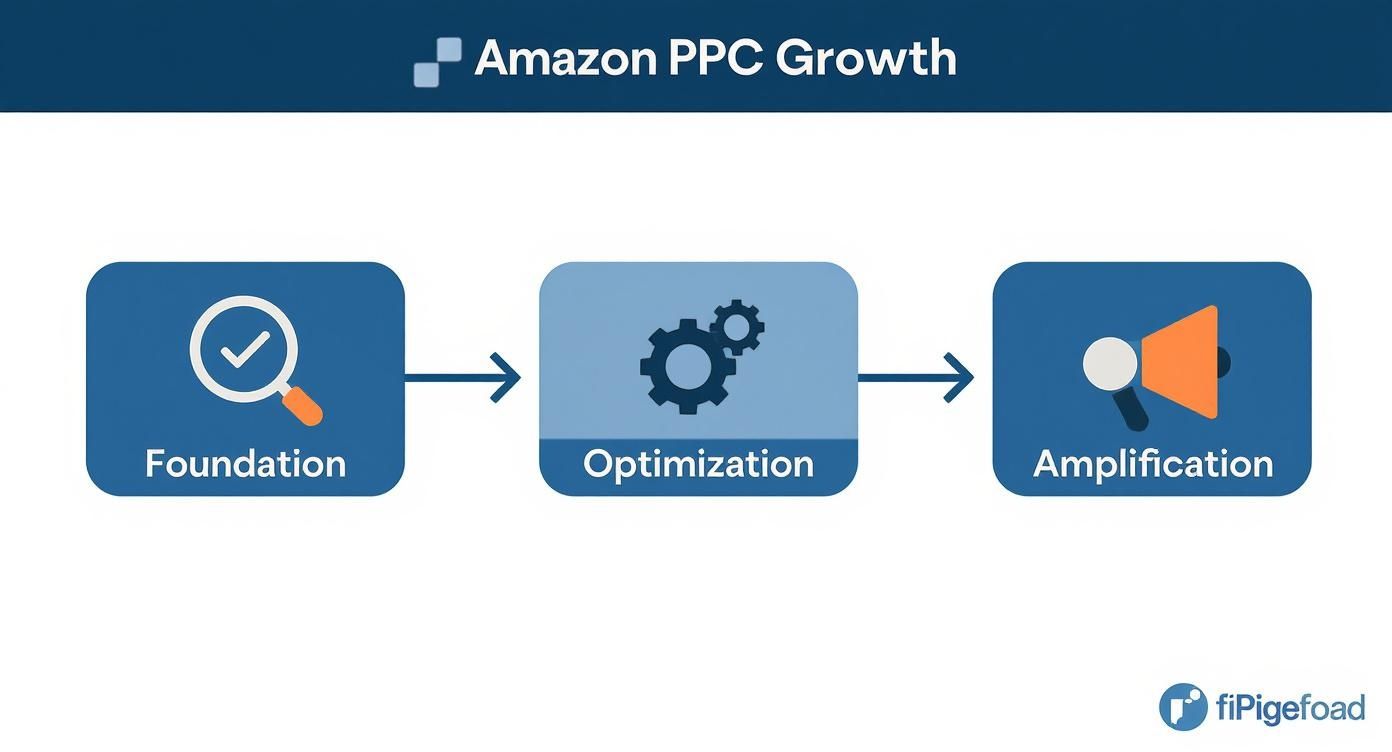
The visual flow makes it clear: each stage builds on the last, with the ultimate goal being broad, sustainable growth across all sales channels.
This dynamic is key to omnichannel growth. Your Amazon PPC efforts don’t exist in a vacuum; they influence brand perception and drive sales on your website and even in retail stores. To see the full picture, it's worth your time understanding what is omnichannel attribution and how it reveals the true value of your marketing spend.
Choosing an Amazon PPC agency is one of the most important decisions you’ll make for your brand's growth. The right partner is more than a service provider—they become an extension of your team, helping you navigate an increasingly complex marketplace.
A bad partnership, however, can burn through your ad budget with little to show for it, leaving you with frustrating reports and more questions than answers. To find a true partner, you must cut through the sales pitch and understand their process, communication style, and strategic thinking. This isn't about hiring someone to just manage bids; it’s about finding a team whose approach aligns with your long-term goals of building a profitable, defensible brand that grows both on and off Amazon.
Before signing a contract, you need to do your homework. Treat this process like a high-stakes interview, because that’s exactly what it is. Their answers will reveal their true level of expertise.
Here are the non-negotiable questions to ask:
Their answers should demonstrate a clear, repeatable process built on data, not just a recitation of generic "best practices."
Knowing what to look for is only half the battle; you also need to know what to avoid. Some agencies excel at sales but fall flat on execution. These warning signs can help you dodge a bad partnership.
A common red flag is a "one-size-fits-all" approach. If an agency presents a generic strategy without first doing a deep dive into your account and business goals, they are prioritizing their own efficiency over your brand's unique needs.
Here are a few other major red flags:
PPC is just one piece of the puzzle. An agency’s strategy must work in sync with your inventory, pricing, and product listings. In fact, a skilled agency will often provide feedback on improving your product pages to boost conversions. You can get ahead by learning about optimizing Amazon product listings for maximum growth and see how it all connects back to ad performance.
To find the right Amazon PPC agency, look beyond their sales pitch and dig into how they get paid. Their pricing model isn't just an invoice line item—it reveals how their incentives align with yours. The right structure ensures your agency is motivated to grow your bottom line, not just increase your ad budget.
Choosing a model is a strategic decision that should match your brand's current stage. Are you a startup watching every dollar, or an established player ready for aggressive growth? Let’s walk through the most common models to find the right fit.
Here’s an overview of typical agency fee structures to help you determine the best fit for your brand's budget and growth objectives.
| Pricing Model | How It Works | Best Suited For | Potential Downside |
|---|---|---|---|
| Flat Monthly Retainer | You pay a fixed fee every month, regardless of ad spend or revenue. | Brands needing predictable costs for budgeting and stable, consistent ad spend. | If ad spend drops significantly, the fee can feel high. Requires trust that the agency is actively optimizing. |
| Percentage of Ad Spend | The agency's fee is a percentage of your total monthly ad spend, typically 10%–20%. | Aggressively scaling brands with growing ad budgets who want an agency motivated to find new growth opportunities. | Can create a conflict of interest if the agency is incentivized to increase spend without focusing on profitability. |
| Hybrid Model | A combination of a base flat fee plus a smaller percentage of ad spend or revenue. | Brands looking for a balance—the agency gets stability but is also rewarded for profitable scaling. | Can be more complex to track and budget for than a simple flat fee. |
| Performance-Based | The fee is tied directly to hitting specific KPIs, like revenue targets or a goal ACoS. | Established brands with clear, measurable goals who want to directly tie agency compensation to results. | Goals must be clearly defined and realistic; otherwise, it can lead to disputes or short-sighted strategies. |
The best pricing model fosters transparency and a shared definition of success. A true partner will be open about their fee structure and explain exactly how it aligns with helping your brand achieve profitable, long-term growth.
The flat monthly retainer is as straightforward as it gets. You pay the same fixed fee every month, regardless of fluctuations in your ad spend or sales.
This model is ideal for brands that need predictable expenses for budgeting. It allows the agency to focus on the big picture—like improving your overall profitability (TACoS)—instead of feeling pressured to simply spend more. The downside? If your ad spend is unusually low one month, the fixed fee might feel steep. This model runs on trust, so you need to be confident your agency is putting in the work.
This is one of the most common models. The agency takes a cut of your monthly ad spend, usually between 10% and 20%. So, if you spend $20,000 on ads and their fee is 15%, you’ll pay them $3,000.
It’s a great fit for brands in aggressive growth mode, as the agency is directly incentivized to find new ways to scale your campaigns.
Practical Tip: A good agency will only recommend increasing ad spend when there’s a clear, data-backed opportunity to drive more profitable sales. If they’re just pushing to spend more without a solid reason, that’s a red flag.
The risk here is a potential misalignment of goals. A less reputable agency might be tempted to bloat your ad spend just to inflate their management fee, sending your ACoS soaring.
To get the best of both worlds, many agencies use hybrid models. A popular version combines a modest base retainer with a small percentage of ad spend. This structure gives the agency financial stability while still rewarding them for scaling your campaigns effectively.
Another option gaining traction is a performance-based model, where the agency’s fee is directly tied to results. This could be based on hitting a certain revenue target or maintaining a specific ACoS.

Once you’ve signed with an Amazon PPC agency, the real work begins. A structured, transparent onboarding process isn’t just a formality—it’s the blueprint for a successful partnership. It ensures both teams are aligned on goals, expectations, and the strategic path forward from day one.
Think of the first 90 days as building and launching a rocket. You can’t just light the fuse and hope for the best. Success requires a methodical sequence of events, starting with a solid launchpad.
The initial month is dedicated entirely to discovery and setup. This is the Foundation phase, where your new agency partners get to know your brand, account, and customers on a deep level. It’s methodical, meticulous, and absolutely essential for long-term success.
This stage typically includes:
With a solid foundation in place, the second month shifts into the Optimization phase. Now, the agency begins the rigorous process of gathering data and fine-tuning your new campaigns. This period is all about testing, learning, and making data-driven adjustments to improve efficiency.
During this time, your agency will be actively managing bids, harvesting high-performing keywords from search term reports, and adding negative keywords to eliminate wasted spend. They'll test different ad copy and targeting strategies to see what resonates most with your audience. Patience is key here, as it takes time to gather enough data to make meaningful decisions.
A disciplined agency knows that a successful Amazon strategy isn’t built on quick wins. It’s built on a cycle of methodical testing and relentless optimization that turns initial data into consistent, profitable growth.
By the third month, your campaigns have a solid performance history. This is when the Amplification phase truly begins. Armed with two months of performance data, your agency can now confidently scale ad spend on proven strategies and expand your reach.
This is where you’ll start seeing a meaningful impact on your total sales and market share. The competitive landscape on Amazon is intense—third-party sellers now account for around 61-62% of all paid units sold, making expert management crucial. You can learn more about the competitive necessity for expert PPC management on eva.guru.
This structured 90-day roadmap is designed to build momentum that systematically improves your brand's position in a crowded marketplace, setting the stage for sustained growth.
When considering partnering with an Amazon PPC agency, many questions come up. It's a big decision. Here are clear, practical answers to the questions we hear most often.
While you'll likely see initial improvements in campaign structure within the first 30 days, meaningful, measurable results typically start appearing around the 60-90 day mark. This timeline allows for gathering enough clean data to make smart, strategic moves.
The first month is dedicated to laying the Foundation—auditing your account, fixing issues, and building campaigns for long-term success. The following two months are for Optimization, where the agency tests, learns, and refines the strategy. This methodical approach is what drives sustainable growth, not just a temporary dip in ACoS.
This is one of the most important distinctions in Amazon advertising and separates basic ad management from a true growth strategy.
A falling TACoS is the ultimate goal. It proves your ads aren't just making sales—they're driving organic sales, boosting keyword rankings, and creating a powerful halo effect that lifts your entire business across all channels.
No reputable agency should. The Amazon marketplace is too unpredictable, with competitors changing tactics and algorithms constantly updating. Any agency promising a specific number is waving a massive red flag.
A trustworthy partner will set realistic performance targets based on your historical data and business goals. They’ll focus on a transparent process to hit those targets, not on making empty guarantees to secure your business.
The best agency relationships are true partnerships, not set-it-and-forget-it services. While your agency will handle the day-to-day PPC management, your input is what makes the strategy truly effective.
You are the expert on your brand—you know your inventory levels, upcoming promotions, and profit margins better than anyone. Regular, open communication ensures the ad strategy is always aligned with your broader business objectives, creating a unified and powerful approach to growth.
Ready to build a data-driven PPC strategy that delivers measurable results across every channel? The expert team at RedDog Group is here to help. Let's Talk Growth.
Leave a comment: