
Published: March 2020 | Last Updated:November 2025
© Copyright 2026, Reddog Consulting Group.

What exactly is Amazon advertising management? It’s the strategic system for planning, executing, and refining your ad campaigns to drive sales and grow your brand on the platform. This goes far beyond simply “turning on” ads; it's a disciplined process that transforms ad spend from an expense into a high-return investment. In a marketplace this crowded, a managed, data-driven approach is the only way to cut through the noise.
Amazon's advertising platform didn't just appear overnight—it evolved from a minor seller feature into a global media powerhouse, rewriting the rules for how brands compete. What was once an optional tool is now an essential channel for any brand serious about omnichannel growth. Advertising has become a core pillar of Amazon's business, which tells you everything you need to know about its power.
To put its scale into perspective, Amazon's advertising business is on track to surpass $60 billion annually by 2025. This isn't a side project; it accounts for nearly 10% of Amazon's total revenue and is a massive driver of their profitability.
This fundamental shift means mastering Amazon advertising management is no longer a "nice-to-have." To win, you need a structured, repeatable system that builds momentum. It’s less about flipping switches and more about piloting a high-performance engine through a competitive digital landscape.
At RedDog Group, we structure our omnichannel growth strategies around a proven, three-pillar framework designed for sustainable, long-term results. It's a clear, effective methodology for building brand equity.
This guide will walk you through each of these pillars, providing practical, actionable takeaways to transform your advertising. The goal isn't just to generate short-term sales—it's to build a system that enhances organic rank and builds measurable, long-term brand equity.
Before you can build, you need to understand the tools. A great starting point is to explore different Amazon Advertising Strategies to get a feel for the landscape. Our framework provides the map to navigate this complexity and unlock real results. Let's begin.
A winning Amazon advertising strategy doesn’t start with complex bidding tactics or a massive budget. It begins with a strong, intentional foundation—understanding your core tools and how to make them work in concert.
Think of Amazon's ad types not as a random menu of options, but as a coordinated toolkit. Each tool has a specific job in building your brand and driving sales, from capturing immediate demand to building long-term awareness.
Choosing the right ad type means matching the tool to the task. Are you targeting a customer ready to buy right now? Or are you introducing your brand to someone just starting their search? Each scenario requires a different approach, and a solid strategy uses all of them in harmony.
This infographic shows how we structure our growth framework, starting with a solid foundation before moving to advanced optimization and scaling.
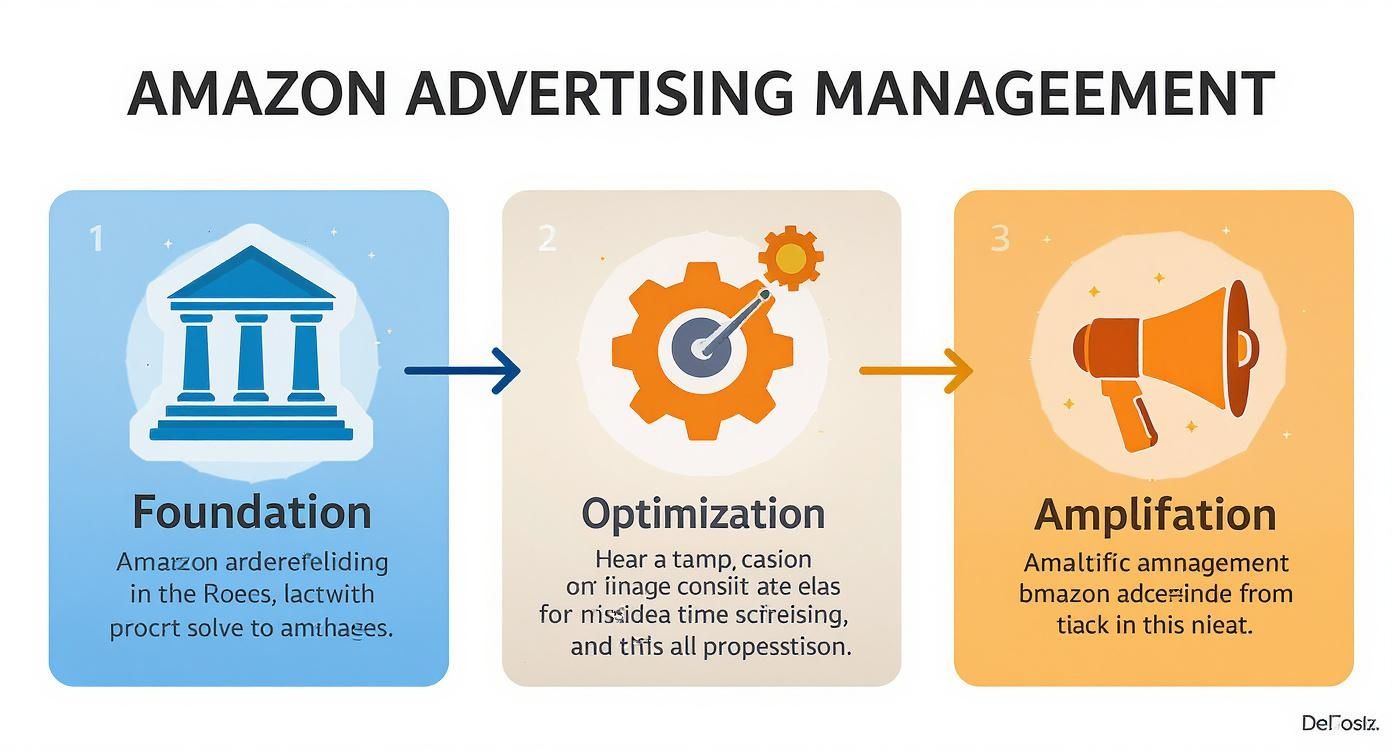
As you can see, long-term success isn’t about a single action. It’s a repeatable process that builds momentum over time, and the 'Foundation' is the critical first step that enables all future growth.
Sponsored Products are the frontline of your advertising strategy. These are the ads you see directly in search results and on product detail pages, aimed at shoppers with high purchase intent.
When a customer searches for "waterproof running shoes," your Sponsored Product ad can place your product directly in their path at the exact moment they're looking to buy. Their primary function is conversion.
Because they are so closely tied to specific products and search terms, they are incredibly effective at driving immediate sales. This direct sales impact also creates a powerful halo effect, boosting your product's organic ranking over time. A well-run Sponsored Products campaign is non-negotiable for success.
Of course, for these ads to work, the landing page must seal the deal. You can learn more about optimizing Amazon product listings for maximum growth in our detailed guide—it's a critical piece of the puzzle.
While Sponsored Products zero in on individual items, Sponsored Brands are about building brand awareness and loyalty. Think of them as the digital equivalent of a prominent end-cap display or a storefront banner.
These ads typically appear at the top of search results, featuring your brand logo, a custom headline, and a collection of products. Their goal is broader than a single sale.
Sponsored Brands help you:
A shopper might search for "organic dog food," and your Sponsored Brand ad can introduce them to your entire line of natural pet products. This builds brand recognition that pays dividends long after the initial click.
Sponsored Display ads take your strategy beyond Amazon's search results. Their unique power lies in their ability to reach relevant audiences both on and off Amazon, making them essential for retargeting and audience building.
Imagine a shopper views your product but doesn't buy. With Sponsored Display, you can serve them a relevant ad later while they browse another website or use a mobile app. It’s a subtle reminder that reconnects them with their interest and brings them back to complete the purchase.
This ad type allows you to engage customers across their entire buying journey, from initial awareness to post-purchase loyalty. It’s the final piece of your foundational toolkit, ensuring your brand stays top-of-mind wherever your ideal customers spend their time online.
Selecting the right ad format becomes simple when you align the ad’s purpose with your business goal. Are you driving immediate sales, building brand recognition, or re-engaging past visitors? Each objective has a corresponding ad type.
The table below breaks down the three core ad types to help you decide which tool to use for any given situation.
| Ad Type | Primary Goal | Best For | Key Metric |
|---|---|---|---|
| Sponsored Products | Immediate Sales | Driving conversions on specific items and targeting high-intent keywords. | ACoS / ROAS |
| Sponsored Brands | Brand Awareness | Introducing your brand and product line to new audiences at the top of search. | New-to-Brand Metrics |
| Sponsored Display | Retargeting & Reach | Re-engaging shoppers who viewed your products but didn't buy, both on and off Amazon. | Clicks / Conversions |
Ultimately, the most powerful strategies don't just pick one ad type—they use all three in a coordinated effort. Sponsored Products capture immediate demand, Sponsored Brands build brand equity, and Sponsored Display ensures you re-engage interested shoppers. This is how you build a complete, resilient advertising foundation.
With your advertising foundation built, the real work begins. This is the optimization phase—the continuous cycle of refining, testing, and adjusting your campaigns to turn good results into exceptional ones.
Think of it as tuning a high-performance engine. The initial build is critical, but continuous adjustments win the race. Effective Amazon advertising management is never a "set it and forget it" activity. It's an active loop of analysis and action that keeps your ad spend efficient and your growth curve pointing up. This means getting under the hood of your campaigns—from structure to keywords—and making data-driven decisions daily.

The way you structure your campaigns is the blueprint for your entire optimization strategy. A disorganized setup leads to confusing data and wasted ad spend. A clean, logical structure provides crystal-clear insights and simplifies management.
Start by organizing campaigns around specific product lines, strategic goals (like a product launch), or performance tiers (top sellers vs. new items). This segmentation allows you to control budgets with precision and understand what’s working at a glance. For instance, creating separate campaigns for "Men's Running Shoes" and "Women's Trail Runners" prevents them from cannibalizing the same budget and lets you tailor keywords and bids to each specific audience.
This deliberate organization ensures your data tells a clear story, making it simple to identify winners, cut losers, and allocate your budget for maximum impact.
Your bidding strategy dictates how much you’re willing to pay for a click and is one of the most powerful levers for controlling performance. Amazon offers several options, but the choice should align with your campaign’s objective.
The competitive landscape has made smart bidding more critical than ever. The average cost-per-click (CPC) on Amazon now hovers around $0.99, but this figure varies significantly by category. For example, the Culinary category sees an average CPC of just $0.28, while the Health category can soar to $1.41. Understanding these nuances is key to setting a realistic budget and a winning bid strategy. You can explore more 2025 Amazon advertising statistics to see how your category stacks up.
Keywords are the bridge connecting your product to your customer. Effective keyword targeting acts as a high-powered filter, ensuring your ads appear only in front of the most relevant shoppers. This is managed through match types.
Think of match types as controls that determine how specific a customer's search must be to trigger your ad.
Broad Match: This is your widest net. Your ad might show for searches loosely related to your keyword, including synonyms. It’s great for discovery but requires close monitoring to avoid irrelevant clicks.
Phrase Match: A more controlled approach. Your ad appears when someone searches for your exact keyword phrase, with other words before or after it.
Exact Match: The most precise filter. Your ad will only show for searches that match your keyword exactly or with very slight variations. This typically delivers the highest conversion rates.
The real power of amazon advertising management comes from using these match types in conjunction with negative keywords. By adding a term as a negative keyword, you instruct Amazon not to show your ad for that search. If you sell premium leather wallets, adding "vegan" and "cheap" as negative keywords prevents wasting money on shoppers looking for something you don't offer. This continuous refinement is the core of successful campaign optimization.
Navigating advertising data can feel overwhelming. Effective Amazon advertising management isn’t about tracking every metric; it’s about focusing on the key performance indicators (KPIs) that reveal what’s working, what isn't, and where your business is headed. These numbers tell the story of your performance, but only if you know how to interpret them.
The goal is to move beyond surface-level data to understand the why behind the numbers. This enables sharp, strategic decisions that align with your business goals—whether you’re chasing aggressive growth, maximizing profitability, or launching a new product.
Two of the most fundamental KPIs in any Amazon advertising dashboard are ACOS and ROAS. They are two sides of the same coin, measuring the same thing from different perspectives. Understanding both is crucial.
For example, if you spend $20 on ads and generate $100 in sales, your ACOS is 20%, and your ROAS is 5x. These two metrics are your first-line indicators for campaign efficiency.
While ACOS is vital, it only tells part of the story by measuring the efficiency of ad-driven sales. But what about the impact on your organic sales? This is where TACOS provides a more complete picture of your brand's health.
TACOS (Total Advertising Cost of Sale) measures your ad spend relative to your total revenue—both ad-driven and organic sales combined. The formula is (Ad Spend ÷ Total Sales) x 100. This single metric offers a holistic view of your advertising's overall impact on your business.
Seeing your TACOS decline over time, even if your ACOS remains flat, is a significant win. It's a powerful signal that your ad spend is successfully boosting your organic rank, driving brand recognition, and creating a "flywheel effect." This is the ultimate goal of a mature Amazon advertising strategy and connects ad performance directly to your brand’s overall growth.
KPIs are just numbers until you apply context. A "high" ACOS of 50% might be a success for a new product launch where the goal is to gain market share and drive sales velocity. However, that same 50% ACOS could be a failure for a mature product where profitability is the priority. Your business goals dictate whether a metric is "good" or "bad."
This is precisely why Amazon advertising remains a top channel for brands; the high-purchase intent of shoppers on the platform drives exceptional performance. The average Amazon advertising conversion rate is a stunning 9.96%, far surpassing the typical eCommerce average of 1.33%. This built-in efficiency provides more flexibility in setting KPI targets, whether you're aiming for aggressive growth or steady profit.
Ultimately, these metrics are tools. Mastery comes from using them to understand the broader relationship between your paid and organic efforts. To deepen your understanding of this dynamic, explore our guide on understanding what is omnichannel attribution, which explains how to measure impact across your entire retail ecosystem.
Once your campaigns are optimized and consistently hitting targets, it’s time to accelerate. This is the 'Amplification' phase—moving beyond maintenance to strategically scale your reach. The goal shifts from pure efficiency to using stable, profitable campaigns as fuel for serious brand growth, without sacrificing profitability.
This is where you leverage hard-won data to make bigger, smarter investments. It’s about taking calculated risks, backed by solid performance insights, to capture new market share, re-engage past customers, and build a powerful growth engine. Amplification separates good advertising management from great.

One of the most powerful amplification methods is creating a feedback loop between automatic and manual campaigns. Think of auto campaigns as your R&D department; they allow Amazon’s algorithm to discover new, high-converting search terms you might have missed.
Your auto campaigns are like prospectors panning for gold. Each week, you should be analyzing your search term reports to find the "nuggets"—the exact customer search terms driving clicks and, more importantly, sales at a profitable ACOS.
Once you’ve identified these proven winners, you "harvest" them by moving them into a dedicated manual campaign. This provides greater control, allowing you to:
This harvesting process transforms a discovery tool into a high-powered sales engine, ensuring your ad spend becomes progressively smarter and more focused on what works.
Scaling isn't just about doing more of the same. True amplification means reaching customers at different stages of their buying journey with more sophisticated ad formats, moving beyond the search results page.
Sponsored Brands Video is a game-changer for this. A short, eye-catching video at the top of search results can stop a shopper in their tracks. It's an opportunity to tell a quick brand story or demonstrate your product’s value in a way a static image cannot, creating an emotional connection that builds brand preference.
Simultaneously, Sponsored Display lets you expand your reach both on and off Amazon. You can use it to re-engage shoppers who viewed your product but didn't convert, reminding them of their interest as they browse other websites or scroll through product pages. This tactic is crucial for closing the loop with high-intent shoppers and maximizing the value of every click.
Data-Driven Example: A brand selling high-performance blenders sees its automatic Sponsored Products campaign converting well for "smoothie blender for athletes." They harvest this keyword and launch a new manual campaign targeting it with a more aggressive bid.
To amplify that success, they then create a Sponsored Brands Video ad showing an athlete making a post-workout smoothie, targeting the same keyword. To top it off, they launch a Sponsored Display campaign to retarget anyone who visited their product page in the last 30 days. This integrated strategy creates multiple touchpoints, reinforcing their brand message and capturing sales across the entire funnel.
This is how data from one successful campaign can de-risk and inform expansion into others. To get ahead of the curve, you can go a step further by using advanced analytics to anticipate future trends and guide these bigger strategic moves. You can learn more about how predictive and prescriptive analytics can shape these larger growth strategies.
Deciding who steers your Amazon advertising ship is a major business decision. Should you build an expert crew in-house, or partner with a specialized agency that navigates these waters daily? Each path has its own advantages and trade-offs, and the right choice depends on your brand’s resources, goals, and ambition for scale.
Handling Amazon advertising management internally provides total control and a team that lives and breathes your product. This can translate into highly authentic campaigns. However, this route demands a serious investment in both talent and time.
To succeed in-house, you’re not just hiring one person. You’re building a multi-talented team.
This is a significant commitment, involving salaries, ongoing training, and expensive software subscriptions. For many brands, the cost and complexity of assembling a top-tier internal team are prohibitive.
Partnering with an agency offers a different model built on specialized expertise and immediate horsepower. An experienced agency provides instant access to a full team of specialists who manage diverse accounts, giving them broad market perspective and access to advanced strategies you might never discover alone.
An agency partnership transforms a significant fixed cost—like hiring a full-time team—into a more flexible variable expense. This allows you to tap into enterprise-level expertise without the long-term overhead, making it a powerful growth lever for ambitious brands.
Agencies also come equipped with their own tools and a deep understanding of the platform's constant updates, saving you from a brutal learning curve. The right partner acts as an extension of your own team, bringing a proven framework—like our Foundation, Optimization, and Amplification model—to accelerate your growth from day one. When weighing this option, it helps to start by understanding the role of digital marketing agencies in the broader context. That clarity helps you select a partner that aligns with your growth ambitions.
When you're deep in the weeds of Amazon advertising, questions arise. Here are a few of the most common ones, with straightforward answers to help you navigate your own campaigns.
This is a common question, but the honest answer is: it depends. There’s no single "good" ACOS because it’s tied directly to your product’s profit margin and your campaign objective. While a 25-35% ACOS is a common benchmark for established products, it is not a universal rule.
For a new product launch, a high ACOS—even 50% or more—can be a smart investment in visibility and sales momentum. Conversely, for a mature product where profit is the primary goal, your ACOS should sit comfortably below your break-even point.
The first step is to calculate your break-even ACOS. This is the point where you are not making or losing money on ad spend. Once you know that number, you can set a realistic target based on whether your goal is aggressive growth or immediate profitability.
You will see initial data like clicks and impressions almost immediately, but resist the urge to make major changes right away. A campaign needs to run for at least two to four weeks to collect enough meaningful data to inform smart optimization decisions.
As for seeing a measurable impact on organic sales and keyword rankings, that typically takes two to three months of consistent, hands-on management. Patience is key. Quick, reactive adjustments based on a few days of data will almost always do more harm than good.
You shouldn't choose one over the other—the best strategies use both in a continuous feedback loop. Think of it as a discovery and refinement engine.
This cycle—discover with automatic, control with manual—creates a powerful system that keeps your advertising sharp, relevant, and profitable over time.
At RedDog Group, we don't just run ads; we build, manage, and scale advertising systems designed for measurable growth. If you’re ready to move beyond guesswork and implement a framework that drives results, we should talk.
Leave a comment: