
Published: March 2020 | Last Updated:December 2025
© Copyright 2026, Reddog Consulting Group.

Effective Amazon ads management is more than launching campaigns; it’s the strategic planning, execution, and optimization of every ad to drive measurable sales and brand growth. It’s a complete process, from account setup to deep performance analysis, ensuring every dollar spent is a smart investment. For direct-to-consumer (DTC) brands, mastering this isn’t optional—it’s how you build a scalable, profitable presence on the world's largest eCommerce platform.

Before spending a single dollar on ads, you need a solid foundation. This is the first and most critical pillar of growth. A well-structured Amazon advertising account isn't just about organization; it’s the strategic framework that determines whether you can scale, gather clean data, and make profitable decisions.
Without a thoughtful structure, you’re flying blind. Campaigns become a tangled mess, making it impossible to tell what’s working, what isn’t, and where your money is actually going. The goal is to build an architecture that aligns perfectly with your business objectives from day one.
Many sellers start by structuring campaigns around their product catalog—one campaign per product or category. While intuitive, this approach often falls short as a brand grows. A more sophisticated method is to organize campaigns based on strategic business goals.
Consider these advanced structures:
A thoughtful campaign structure transforms your ad account from a simple sales tool into a strategic asset. It provides the clear, actionable data needed to connect ad spend directly to measurable business growth, preventing wasted budget and paving the way for effective optimization.
This foundational approach ensures every decision is backed by data. A clean structure makes it simple to analyze performance, allocate budgets for maximum impact, and truly understand the return on your ad spend (ROAS).
Your foundation isn't complete without understanding the market. Sponsored Products, the ads you see in search results, are the heart of Amazon’s advertising ecosystem. They account for about 68% of Amazon’s ad revenue, showing how much ad spend is tied directly to a shopper’s intent to buy.
It's also a crowded space. Third-party sellers are a dominant force, representing roughly 62% of total units sold. This means you're competing in a marketplace where independent sellers generate most of the sales volume, making a sharp, data-driven ad strategy essential to stand out. You can explore more Amazon statistics and market trends on Salesduo.com.
Finally, before launching any ads, your product listings must be "retail-ready." A great campaign can drive traffic, but a weak product detail page won't convert. Ensure your listings have compelling titles, high-quality images, informative bullet points, and a healthy number of positive reviews. This connection between ad performance and listing quality is non-negotiable.
For a deeper dive, check out our guide on complete Amazon listing optimization. A strong foundation sets you up for everything that follows.
Effective Amazon advertising comes down to choosing the right tool for the job. Amazon provides a powerful suite of campaign types, but without understanding the unique role each plays in a shopper's journey, you're just spending money. Think of it like a toolbox: you wouldn't use a hammer to turn a screw.
Sponsored Products, Sponsored Brands, and Sponsored Display each serve a specific function. Mastering them means you can launch a new product, defend your brand from competitors, or re-engage shoppers who navigated away. It’s all about matching the ad type to a clear, measurable goal.
Sponsored Products are the ads appearing directly in search results and on product detail pages. They are the frontline of your advertising, built to capture high-intent shoppers the moment they’re looking for something you sell.
Their primary job is to drive conversions. When a customer searches for "waterproof running shoes," a Sponsored Product ad places your shoe directly in their path. This makes them essential for:
Imagine a DTC brand launching a new organic coffee blend. They would lean heavily on Sponsored Products to target keywords like "fair trade whole bean coffee." The goal is clear: get the new product in front of active buyers to kickstart sales velocity and begin climbing the organic ranks.
While Sponsored Products focus on a single item, Sponsored Brands promote your brand as a whole. These are the banner ads at the top of search results, often featuring a logo, a custom headline, and several of your products.
This format is less about a single transaction and more about telling your brand's story. An outdoor gear company could run a Sponsored Brands ad with the headline "Built for Any Adventure," showcasing their top-selling tent, backpack, and sleeping bag. This doesn’t just sell products; it reinforces their brand identity.
Use Sponsored Brands to:
Sponsored Brands shift the focus from a single transaction to building a lasting customer relationship. They allow you to control the narrative around your brand, driving both immediate sales and long-term loyalty.
Sponsored Display ads extend your reach beyond Amazon's virtual aisles. They let you retarget shoppers who have viewed your product pages (or similar ones) and follow them with relevant ads—not just on Amazon, but across a vast network of third-party websites and apps.
This is your re-engagement engine. Say a shopper views your high-end kitchen mixer but doesn't buy. With Sponsored Display, you can serve them an ad for that mixer a day later while they're browsing a recipe blog. It’s a powerful reminder that often closes the sale.
This ad type is perfect for:
Understanding which ad type aligns with your goals is crucial. This table breaks down the core functions to help you make the right call.
| Ad Type | Primary Goal | Best For | Key Metric (KPI) |
|---|---|---|---|
| Sponsored Products | Direct Sales & Conversions | Launching new products, driving sales for bestsellers, capturing high-intent shoppers. | ACoS, RoAS, Conversion Rate |
| Sponsored Brands | Brand Awareness & Discovery | Defending brand keywords, showcasing a product line, driving traffic to a Brand Store. | New-to-Brand Metrics, Impressions, Click-Through Rate (CTR) |
| Sponsored Display | Retargeting & Reach | Re-engaging past visitors, cross-selling to existing customers, building top-of-funnel awareness. | RoAS, Viewable Impressions, Detail Page Views (DPV) |
Ultimately, a strong Amazon advertising strategy doesn't rely on just one ad type. It uses all three in concert, guiding the customer from initial awareness through to purchase and beyond.
Within Sponsored Products, you have two targeting methods: automatic and manual. The secret to success isn't choosing one over the other—it's using both together in a continuous feedback loop.
Automatic Campaigns (Discovery Phase): Let Amazon’s algorithm do the initial work. You provide your product, and Amazon automatically shows your ads against a wide range of search terms it deems relevant. Treat this as your research tool; it will uncover high-performing keywords you may not have considered.
Manual Campaigns (Optimization Phase): After your automatic campaigns gather data, you "harvest" the best-performing customer search terms and move them into a manual campaign. Here, you gain precise control. You can set specific bids for each keyword, allowing you to invest more in what’s working and cut what isn't.
This creates a powerful cycle: your auto campaigns constantly feed new, proven opportunities to your manual campaigns, which in turn drive efficient, profitable growth.
Once your campaigns are live, the real work of Optimization begins. This is the ongoing cycle of analyzing, tweaking, and turning raw data into profitable growth. Effective Amazon ads management is about actively steering your campaigns toward your goals, not "setting it and forgetting it."
This is the phase where you stop spending money on ads and start investing it. Every bid adjustment and budget shift becomes a calculated move to improve your Advertising Cost of Sale (ACoS) and drive a stronger return. It’s how you transform campaign data into a reliable engine for scaling your brand.
Your bids and budgets are the two main levers for controlling campaign performance. A bid is what you’re willing to pay for a single click, while your daily budget is the maximum a campaign can spend in a day. Getting this right is a constant balance between visibility and profitability.
Amazon offers several dynamic bidding strategies to help:
A common mistake is letting a high-performing campaign run out of budget by mid-afternoon. This not only caps your daily sales but also signals inconsistency to Amazon’s algorithm. If a campaign is consistently hitting its daily limit, give it more room to run—even a 10-20% increase can maintain momentum.
This flowchart visualizes how different ad campaigns serve distinct purposes—from building visibility to defending your brand and retargeting interested shoppers.
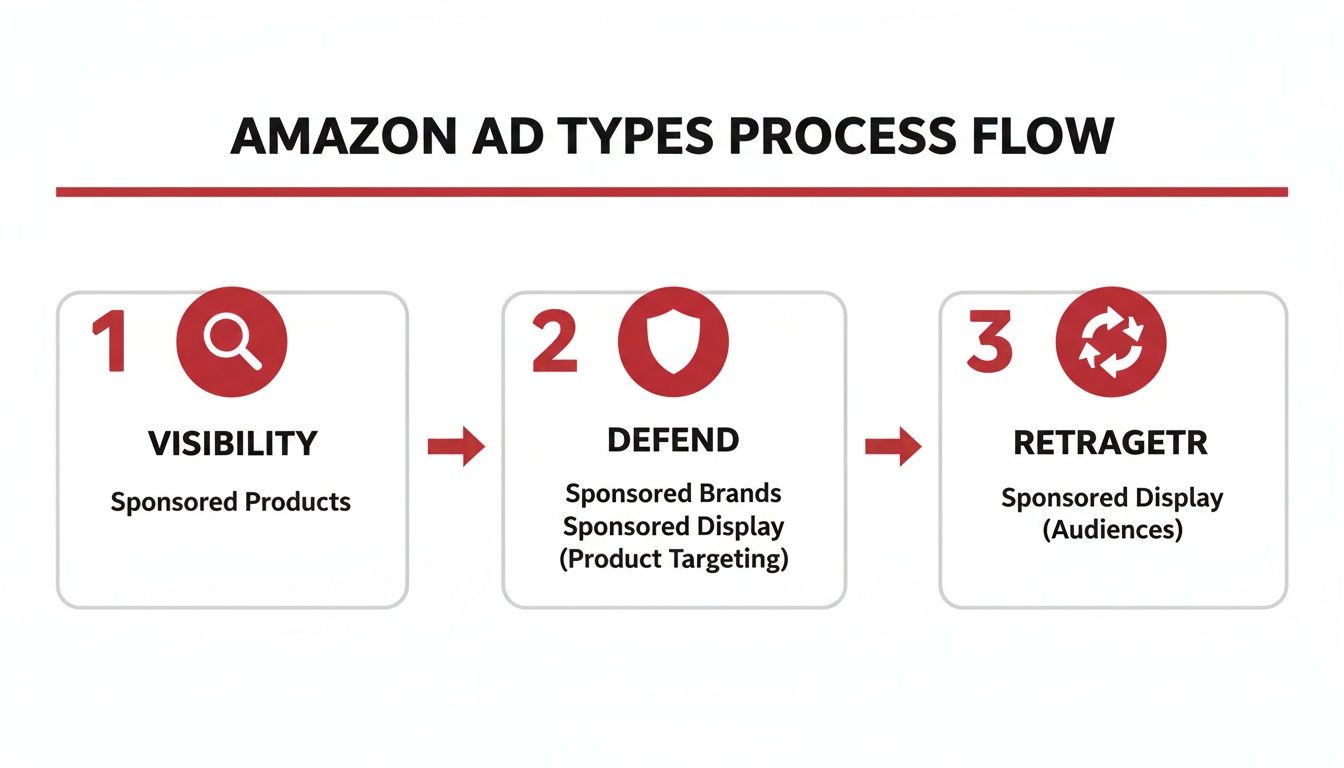
Each of these stages requires a unique optimization strategy. Your bids and budgets should align with the campaign’s specific goal, whether it’s aggressive growth, efficient retargeting, or brand defense.
If there’s one tool you must master, it's the Search Term Report. This report reveals the exact search queries customers used before clicking your ad. For anyone serious about Amazon ads, analyzing this data is non-negotiable.
Your goal is simple: find the winners and eliminate the losers.
Here’s a practical example: you sell "leather dog collars." Your search term report shows you're paying for clicks from shoppers searching for "vegan dog collars." By adding "vegan" as a negative phrase match, you immediately improve campaign efficiency.
Smart optimization is built on understanding key performance benchmarks. The Amazon marketplace is incredibly competitive, with the average cost-per-click (CPC) hovering around $1.12. When you factor in a typical conversion rate between 9% and 15%, the math for staying profitable gets tight.
This is why understanding your ACoS is so important. A "good" ACoS is entirely relative—it’s tied directly to your product’s profit margin. The first step is to calculate your break-even ACoS, the point where you're not making or losing money on an ad-driven sale. Any ACoS below that number is profit. For a detailed walkthrough, check out our guide on mastering ACoS on Amazon for brand growth.
Once you establish that baseline, you can set realistic goals. A new product launch might require a higher, break-even ACoS to gain traction. In contrast, a mature, best-selling product should be optimized for maximum profitability. This data-first approach removes guesswork and aligns your ad spend directly with your business's financial goals.
Once your foundational campaigns are stable and profitable, it's time for the Amplification stage. This is where you graduate from simply capturing existing demand to actively creating it.
Smart Amazon ads management isn’t just about winning the immediate sale. It’s about building a brand that customers intentionally seek out and return to.
This phase is about expanding your influence. You'll use advanced ad types to tell a cohesive brand story, re-engage past shoppers, and reach new audiences both on and off Amazon. The goal is to build brand equity that pays dividends long after the initial click.
Sponsored Products are essential for capturing high-intent shoppers, but their reach ends at the search bar. To truly scale, you need tools that find potential customers wherever they are. This is what Sponsored Display and Amazon DSP were built for.
Sponsored Display for Retargeting: This is your go-to for re-engagement. Create audiences of shoppers who viewed your product but didn't buy, or even those who viewed a competitor's listing. Serving them a relevant display ad a day later while they're browsing another site is a powerful reminder that often closes the sale.
Amazon DSP for Full-Funnel Reach: For brands ready for a larger investment, Amazon DSP unlocks programmatic advertising across the web. You can tap into Amazon's massive first-party data to reach shoppers who fit your ideal customer profile, even if they've never heard of you. This is true top-of-funnel marketing, designed to build awareness and feed your sales pipeline.
Amplification is also about turning individual transactions into a unified brand experience. Your presence on Amazon should feel like a destination. Your Amazon Brand Store and Sponsored Brands campaigns are the cornerstones here.
Sponsored Brands let you own the real estate at the top of search results with custom headlines and curated product collections. Instead of just showing one product, you tell a story. A skincare brand, for instance, could run a Sponsored Brands ad with the headline "Your Complete Morning Routine," directing shoppers to their Brand Store.
Your Amazon Brand Store is your brand's home on the platform. It's a multi-page, immersive storefront where you control the narrative, showcase your entire catalog, and build a direct relationship with your customers away from the noise of competitor ads.
By linking your Sponsored Brands campaigns to your Store, you create a powerful funnel. You capture attention with a compelling ad, then guide customers to an environment that reinforces your brand values, encourages browsing, and ultimately drives larger orders.
The data from your Amazon ads is incredibly valuable, but it becomes exponentially more powerful when connected to your broader marketing efforts. The search terms driving sales on Amazon should inform your Google Ads keywords or the content for your next social media campaign.
This integration builds a true omnichannel engine. Amazon Advertising’s explosive expansion, growing from roughly $31.2 billion in 2020 to a projected $56.2 billion by 2024, highlights its critical role as a source of rich customer behavior data.
For example, if your Sponsored Display retargeting ads are performing well with a specific audience segment, create a lookalike audience for your Facebook ad campaigns. This ensures your brand story is consistent at every touchpoint, creating a seamless customer journey that strengthens loyalty and drives repeat business.
To amplify further, consider strategies like finding influencers on Amazon who can introduce your products to their followers. When you connect the dots between your on-Amazon and off-Amazon activities, you build a growth flywheel that accelerates over time.
The right partnership can take you from simply running campaigns to executing a strategic growth plan. The decision to outsource your Amazon ads management often boils down to the classic in-house vs agency marketing debate—trading some control for deep, specialized expertise. Recognizing when you've reached the limits of your internal bandwidth is the first step.
Performance plateaus are the most common red flag. Your campaigns might be profitable, but you can't seem to break through a certain revenue ceiling, or your ACoS has stalled. This usually means you’ve exhausted basic tactics and need more advanced strategies to keep growing.
Another sign is complexity. You started with a few Sponsored Products campaigns, but now you’re juggling Sponsored Brands, Sponsored Display, and various targeting types. When the sheer volume of campaign management prevents you from focusing on the big picture, it’s time to seek help.
Finally, consider the opportunity cost. Every hour you spend in search term reports is an hour you’re not spending on product development, supply chain, or high-level business strategy. If ad management is pulling you away from other critical growth areas, it's costing you more than you think.
An in-house team lives and breathes your brand, offering unparalleled product knowledge. The limitation? They may lack the broad, cross-category experience that comes from managing dozens of accounts, which can lead to a narrow perspective.
An agency, on the other hand, brings a wealth of specialized expertise. They have access to advanced tools, beta programs, and a deep understanding of what works across different industries. This diverse experience allows them to spot trends and apply winning strategies from one category to another, accelerating growth in a way that’s hard to replicate internally.
The core benefit of a great agency partner is perspective. They see marketplace trends in real-time across a wide client base, allowing them to apply proven, data-backed strategies to your account far faster than an in-house team could learn them from scratch.
Choosing the right partner is a critical decision for your brand's growth. When vetting agencies, dig deeper than surface-level performance metrics. It's about finding a team that understands your holistic, omnichannel vision. For a detailed checklist, our guide on finding a great Amazon PPC agency provides a comprehensive framework.
Start with these essential questions:
Their answers will reveal whether they are simply campaign managers or true growth partners.
When it comes to the day-to-day of Amazon advertising, the same practical questions often arise. Even with a great strategy, you need to know the right benchmarks and routines for your campaigns. Let's tackle some of the most common questions brands ask about Amazon ads management.
The answers aren't always a simple number; they depend on your specific goals, products, and market competitiveness. However, understanding the frameworks behind the answers will give you the confidence to make smart, data-driven decisions.
There's no magic number. The smartest approach is to work backward from your product’s profitability. A common starting point for many brands is allocating 5-15% of total revenue to advertising, but this can vary widely based on your goals.
When launching a new product, view your initial spend as an investment in data. You'll likely need to spend more aggressively at the start, even if it means a high ACoS. This initial push teaches Amazon's algorithm where your product fits and gathers the performance data needed for optimization.
For established products, your budget should be tied directly to hitting a specific Return on Ad Spend (RoAS) target.
Your initial ad spend isn't just a cost—it's tuition for market intelligence. You're paying to learn which keywords actually convert, how real customers search for your product, and where you really stand against the competition. That data is gold for long-term growth.
A "good" ACoS is entirely relative to your profit margins. Before setting a target, you must calculate your break-even ACoS. This is the point where your ad spend equals your pre-ad profit margin, meaning you’re not making or losing money on that sale.
Break-Even ACoS = Pre-Ad Profit Margin
Any ACoS below that number is profitable. From there, your target ACoS should adapt to your objective:
Managing Amazon ads requires a structured routine, not a chaotic "fix-it-when-it's-broken" approach. We've found that a weekly and monthly review cycle is the most effective way to stay on top of performance without getting overwhelmed.
Your Weekly To-Do List:
Your Monthly Check-In:
Sticking to this rhythm ensures you’re making both the small tactical adjustments and the big strategic decisions needed for sustained growth.
Ready to turn questions into a clear, data-driven growth strategy? The team at RedDog Group builds and executes Amazon advertising strategies that connect every ad dollar to a measurable result. Let’s Talk Growth and see how our Foundation → Optimization → Amplification framework can help scale your brand. Learn more at https://www.reddog.group.
Leave a comment: