
Published: March 2020 | Last Updated:December 2025
© Copyright 2026, Reddog Consulting Group.

Amazon listing optimization is the process of refining your product pages to rank higher in search results, attract more clicks, and drive more sales. It’s a strategic blend of data-driven keyword research, persuasive copywriting, high-impact visuals, and backend fine-tuning—all designed to win over both shoppers and Amazon's A10 algorithm.
Before diving into keywords or ad campaigns, you need a solid foundation. Many brands jump straight to tactics, which is like building a house without a blueprint. The results are often shaky, temporary, and never deliver sustainable growth.
The real goal isn't just to "game" the algorithm; it's to build a listing that puts the customer first. When you create a seamless and trustworthy shopping experience, you naturally send all the right performance signals to Amazon.
A top-performing product page stands on three core pillars that create a powerful, self-reinforcing loop. Getting these right is the first step toward building a scalable, profitable brand on the platform.
At RedDog, we follow a proven framework for omnichannel growth: Foundation → Optimization → Amplification. These three pillars are the bedrock of that foundation.
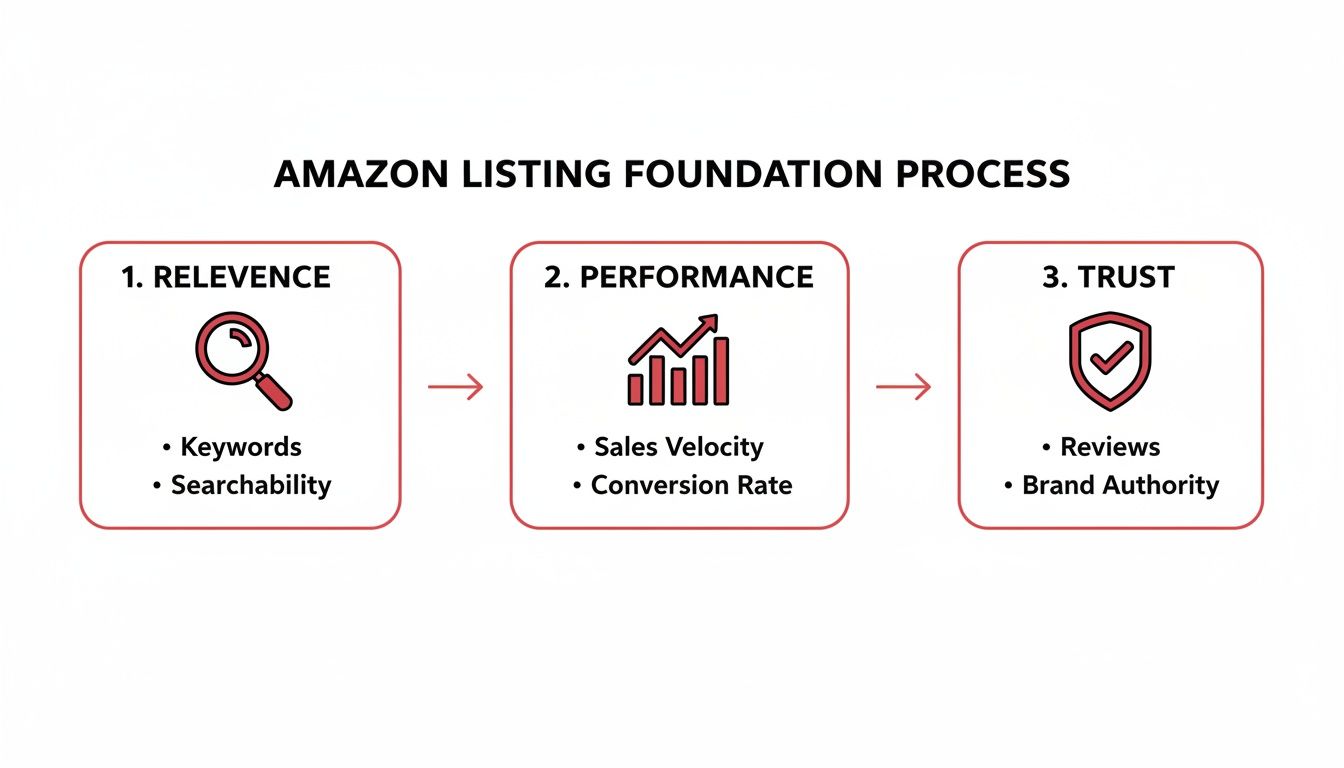
Each pillar directly strengthens the others. A highly relevant listing drives better performance (higher conversion rates), which in turn builds the trust required for long-term brand growth.
Focusing on these pillars creates a listing that is resilient and effective. A page that is relevant, performs well, and inspires trust will naturally rank higher because it delivers an exceptional customer experience—which is precisely what Amazon wants to promote.
Think of it as a growth flywheel. A customer lands on your page and finds what they need. They make a purchase. That sale boosts your performance metrics, helping you rank higher and gain more visibility. As more satisfied customers leave positive reviews, your trust pillar becomes even stronger.
A strategically built listing is a flywheel for growth. It converts traffic more efficiently, which lowers your advertising costs and increases your organic ranking, creating a self-sustaining cycle of success.
This foundational work is critical before you spend a single dollar on ads. For brands ready to make a strong entrance, our guide on how to launch a product on Amazon maps out the entire process for building this momentum from day one. When you get these core elements right from the start, every optimization you make later becomes far more powerful.
Effective Amazon listing optimization blends smart, data-driven research with compelling copywriting. It’s not about stuffing keywords onto a page; it’s about understanding customer search intent and crafting copy that persuades them to click and convert.
This requires speaking two languages at once: you need to provide the Amazon A10 algorithm with the structured data it requires for indexing, while also telling a story that connects with a real person's needs. When you achieve this balance, both the algorithm and the shopper are satisfied.

Your entire on-page strategy is built on thorough keyword research. To find customers who are ready to buy, you must go deeper than obvious, high-level terms.
For example, a shopper searching for "blender" is likely browsing. But someone searching for a "quiet personal blender for morning smoothies"? That person has a specific need and high purchase intent. These multi-word phrases are called long-tail keywords. While they have lower search volume, their conversion rates are significantly higher.
To build a comprehensive keyword list, think from multiple angles:
Using a mix of these keyword types ensures you capture customers at every stage of their buying journey, from initial problem awareness to the final purchase decision.
Once you have your target keywords, you must place them strategically. Amazon's algorithm weighs different sections of your listing differently. Correct placement signals relevance without sacrificing readability.
The product title is your most valuable SEO real estate. It has the greatest impact on ranking and is the first thing a shopper sees in search results. A strong title is clear, benefit-driven, and—most importantly—features your main keywords at the very beginning.
Here’s where to focus your keyword placement efforts:
| Listing Element | Primary Purpose | Keyword Strategy |
|---|---|---|
| Product Title | Ranking & Clicks | Place your top 2-3 most critical, high-volume keywords at the front. |
| Bullet Points | Conversion & Detail | Weave in long-tail and secondary keywords while highlighting key benefits and features. |
| Product Description | Information & SEO | Use this space for brand storytelling and to incorporate any remaining relevant keywords naturally. |
| Backend Keywords | Indexing & Visibility | Use this hidden field for synonyms, common misspellings, and relevant foreign language terms. |
Your on-page content should anticipate and answer customer questions. Use your bullet points to solve their immediate problems and the description to build trust, all while your keywords work behind the scenes to improve your ranking.
A powerful title doesn't just rank—it stops the scroll. It must instantly signal to the shopper that your product is exactly what they're searching for.
For instance, instead of a generic title like "Yoga Mat," an optimized title would be: "Extra Thick Yoga Mat for Women & Men, Non-Slip TPE Material, 6mm Comfort for Pilates & Floor Exercises." This version is packed with keywords but also clearly communicates core benefits: thickness, material, and ideal uses.
Your bullet points are where you close the sale. Each point should lead with a benefit, then support it with the feature that makes it possible.
This approach speaks directly to what the customer cares about. For a deeper dive into crafting persuasive copy, see our guide on how to write product descriptions that convert. This is how you turn clicks into conversions and build a listing that performs.
Once your keywords are in place, it’s time to focus on what earns the click and secures the sale: your visuals. On Amazon, your images act as your digital salesperson. They must tell a story, build trust, and answer questions in an instant. High-quality visuals are arguably the most critical element for converting browsers into buyers.
A strong visual strategy is about more than just showing off your product. It’s about creating an experience that guides the customer from their first glance in search results to a confident purchase. This is your opportunity to bring your brand to life.

Think of your image block as a visual narrative, not just a gallery. Each of the seven to nine available image slots has a specific job. From the hero image that captures attention to infographics that clarify features, every visual must work together to make a compelling case for your product.
Your main or "hero" image has the most important role. It's your first impression and must be crystal clear, pop against a pure white background, and be instantly recognizable as a small thumbnail. Amazon has strict image requirements, so mastering professional background removal is essential for compliance and standing out.
Beyond that first shot, your supporting visuals must tell the rest of the story. A well-rounded image stack is essential for building trust and driving sales.
| Image Slot | Purpose | Best Practice Example |
|---|---|---|
| Image 1: Hero | Grab attention in search results with a clean, high-res shot on a pure white background. | A perfect, front-facing photo of your product, filling 85% of the frame. |
| Image 2: Lifestyle | Help customers visualize the product in their own lives, creating an emotional connection. | A person happily using your product in a realistic, relatable setting. |
| Image 3: Infographic | Quickly communicate key features and benefits to skimmers. | An image highlighting 3-5 core benefits using icons and minimal, bold text. |
| Image 4: Feature Callout | Zoom in on specific details and explain the "why" behind them. | A close-up of a unique feature with an arrow and text explaining its advantage. |
| Image 5: Comparison | Show why your product is superior to the competition. | A simple chart comparing your product's key features against a generic competitor. |
| Image 6: Before & After | Provide powerful, undeniable proof that your product works. | Side-by-side images showing a clear, positive transformation. |
| Image 7: How-To/Size | Answer common questions about usage or scale to reduce returns and build confidence. | A simple graphic showing product dimensions or a 3-step usage guide. |
This combination of image types caters to every kind of shopper—from the detail-oriented researcher to the quick-glancing buyer—providing the exact information they need to make a decision.
For brand-registered sellers, A+ Content is a game-changer. It allows you to replace the standard text-only product description with a visually rich experience. Think of it as a mini-website on your product page, where you can dive deep into your brand story, product features, and unique value proposition.
Well-executed A+ Content is proven to boost conversion rates by communicating benefits more clearly and overcoming purchase objections. You can use a mix of modules—like full-width image headers or detailed comparison charts—to create a page that is both engaging and informative. It’s your best opportunity to solidify your brand identity and differentiate yourself from competitors.
A+ Content isn't just about aesthetics. It’s a strategic tool to build brand equity, reduce return rates by setting clear expectations, and ultimately, drive more sales. It transforms your product page from a simple listing into a rich brand experience.
Optimizing visuals for mobile is no longer optional; it's essential. Well over half of Amazon's traffic now comes from mobile devices, a fundamental shift that impacts how products rank and convert. Amazon's algorithm now favors listings designed for quick mobile scanning. For example, top-performing listings often use hero images that communicate the product's identity in under 0.3 seconds.
This means your images and A+ modules must be legible and impactful on a small screen. Keep text on infographics large and concise. Use bold, high-contrast imagery that is easy to understand at a glance. Before publishing, always preview your listing on a phone to ensure the experience is seamless.
Don't forget the backend. When uploading A+ Content, you can add keyword-rich alt-text to your images. While most shoppers won't see it, this text is indexed by Amazon and Google, giving your SEO an additional boost. It’s a simple but often overlooked step that improves discoverability.
Driving traffic to your listing is only half the battle. The ultimate goal is to convert those clicks into sales. This is where we shift focus to Conversion Rate Optimization (CRO)—the science of making your offer so compelling that shoppers don't hesitate to click "Add to Cart."
A high conversion rate does more than just increase revenue. It fuels your sales velocity, which is the speed and volume of your sales over time. This is one of the most powerful ranking signals you can send to Amazon’s A10 algorithm. Strong sales velocity tells Amazon your product is popular, and the platform rewards you with greater visibility.
Pricing on Amazon is about psychology, not just numbers. Your price tag instantly communicates value and positions your brand against competitors. The key is finding the sweet spot that protects your margins while still feeling like a great deal to shoppers.
Your everyday price is just the starting point. Promotions are a powerful tool for creating urgency and boosting sales velocity, especially during a product launch or a major shopping holiday.
Use these promotional tools with a clear objective. Constant discounting can devalue your brand, so tie your promotions to specific goals, like clearing out old inventory or pushing to rank for a new keyword.
On Amazon, social proof is paramount. Since customers can't physically interact with your product, they rely heavily on the experiences of others to feel confident in their purchase. Your reviews and the "Customer questions & answers" section are where you build that trust.
You cannot afford to ignore this part of your listing. Answering customer questions promptly and professionally shows that you are an engaged seller. It also gives you an opportunity to address common hesitations and highlight benefits you may have missed in your copy.
Your reviews and Q&A section are a direct line to your customers. Monitor them closely not just to manage your reputation, but to mine for valuable insights about how people use your product and the language they use to describe it. This is free, high-impact market research.
This feedback is invaluable. If the same question appears repeatedly, it’s a clear sign that your listing is missing critical information. Use that insight to add a new image, an infographic, or another bullet point to address the concern proactively.
Product variations, or "parent-child" listings, allow you to group different versions of a product—like colors, sizes, or scents—onto a single detail page. This is one of the most underutilized strategies for building sales momentum.
When set up correctly, variations deliver two major benefits:
Structuring your variations correctly is a technical but critical piece of a comprehensive optimization strategy. It makes your offer more appealing to both shoppers and the Amazon algorithm.
A well-rounded optimization effort delivers real, measurable results. We often see sellers get an initial lift in organic visibility and ad performance within just 4-6 weeks. In one case, a fully optimized listing saw a staggering 156% increase in conversion rate in only 60 days. That surge moved it from the depths of page three to a dominant page one position for its most valuable keywords. You can find more data-driven insights on how to optimize listings for 2025 success. This proves that focusing on conversions is a direct path to higher rankings and sustainable growth.
You’ve built a perfectly optimized Amazon listing. Now it’s time to amplify its reach. This is the Amplification stage, where your foundational work fuels a powerful, data-driven growth loop between your organic and paid strategies.
Think of your listing as a high-performance engine and your advertising campaigns, like Pay-Per-Click (PPC), as the fuel. When that engine is finely tuned, every dollar you spend on ads generates maximum power, pushing you past competitors with greater efficiency.
A strong listing gives your ads a significant advantage. Amazon’s ad algorithm considers not just your bid but also your product's relevance to a shopper's search. A well-optimized page—with the right keywords, compelling images, and a strong conversion history—signals high relevance. Amazon rewards this with better ad placements and a lower cost-per-click (CPC), improving your return on investment.
Amazon advertising is more than a sales tool; it’s a powerful research machine. Your PPC campaigns generate a wealth of real-world data on what shoppers are actually searching for and, more importantly, which keywords are driving purchases.
This is where the strategy becomes truly integrated.
By analyzing your ad reports, you can uncover new, high-intent keywords you may have missed in your initial research. Once you identify these proven converters, you can strategically incorporate them into your product title, bullet points, and backend search terms. This tactic directly boosts your organic ranking for those valuable phrases.
This feedback loop is what separates good sellers from great ones. You use paid ads to discover what works, then feed those insights back into your organic listing to improve its core performance. This strengthens your organic presence and makes your future ad campaigns even more efficient.
The Amazon marketplace is constantly evolving. Today, PPC-driven sales are a primary driver of search rankings, often carrying more weight in the algorithm than organic sales. While reviews remain critical for building trust, their direct SEO impact has diminished.
This shift highlights Amazon's focus on purchase intent and performance. To succeed, you need a layered advertising strategy that uses Sponsored Products for direct response, Sponsored Brands for awareness, and Sponsored Display for retargeting. These campaigns provide priceless insights for content optimization that leads to cheaper clicks and higher ROAS.
Your work isn't done after launching your ads. The final piece is ongoing analysis. Tools like Amazon Brand Analytics are essential for understanding customer behavior and fine-tuning your entire omnichannel strategy.
These dashboards provide insights that go beyond simple sales numbers:
This data allows you to make informed decisions instead of guessing. For example, a high click-through rate but a low conversion rate on a specific keyword suggests your main image is effective, but your listing content isn't closing the sale. That is actionable intelligence you can use to refine your approach.
For a deeper dive into maximizing your advertising ROI, our comprehensive guide on Amazon advertising management provides a complete roadmap.
When you connect listing optimization with a smart, data-backed advertising strategy, you create a self-sustaining cycle of growth. Each element feeds the other, amplifying your reach, maximizing your ad spend, and scaling your success on the platform.
Even with a solid strategy, the world of Amazon listing optimization has nuances that can challenge even experienced sellers. As you scale, you will likely encounter common questions. Here are clear, practical answers to help you stay on track.
This is your quick-reference FAQ for keeping your strategy sharp, allowing you to make informed decisions and get back to growing your brand.
For most products, a quarterly review is a solid cadence. This is frequent enough to stay current with trends but allows enough time to gather meaningful performance data. Avoid making constant, reactive changes, which can confuse the A10 algorithm and obscure performance insights.
However, certain situations require more immediate updates:
Avoid the trap of making small, daily tweaks. Instead, batch your changes, deploy them, and then monitor performance. Allow at least two to four weeks for the algorithm to re-index your listing and for you to get a clean read on the impact of your updates.
The short answer is no. Amazon discontinued support for basic HTML tags (like <br> or <b>) in standard product descriptions years ago. Attempting to use them now will result in broken, unprofessional text that harms the customer experience and your conversion rate.
The modern and far more powerful alternative is A+ Content. For brand-registered sellers, this tool is essential. A+ Content replaces the plain text description with a rich, module-based layout where you can add high-quality images, comparison charts, and brand stories.
This is more than a cosmetic upgrade; it's a significant conversion driver. Effective A+ Content helps you visually tell your product’s story, answer questions proactively, and build a brand connection that plain text cannot achieve.
If you could only focus on two elements, they would be the Main Image and the Product Title. These two assets do the heavy lifting to get a shopper to click on your product in a crowded search results page.
Consider the customer’s journey. They type a search query and are presented with a sea of small images. Your main image has a fraction of a second to capture their attention and earn the click. It must be clean, compelling, and professional enough to stop the scroll.
Simultaneously, Amazon’s algorithm is scanning your title. The title carries the most weight for keyword ranking, telling Amazon what your product is and which searches it is relevant for. A weak title means you won't even appear for the right shoppers to see your excellent main image.
If you get these two things wrong, nothing else matters. The most persuasive bullet points and beautiful A+ Content are useless if no one clicks through to see them. Nailing the title and main image is the foundational step to giving your product a chance to succeed.
Ready to move beyond questions and start seeing real, measurable growth on Amazon and beyond? The team at RedDog Group has the omnichannel expertise to turn your listings into powerful sales engines. Let's Talk Growth.
Leave a comment: