
Published: March 2020 | Last Updated:December 2025
© Copyright 2026, Reddog Consulting Group.

To write a product description that actually drives sales, you need to shift your perspective. Stop listing features and start solving problems. The key is to understand why a customer is buying your product and frame it as the perfect solution to their needs—whether they're shopping on your website, Amazon, or in a physical store.
A great product description bridges the gap between a casual browser and a loyal customer. It speaks directly to their goals and motivations, building the confidence they need to make a purchase.

Before you write a single word, you need a solid strategy. This is the first pillar in our Foundation → Optimization → Amplification growth model, and it’s where you define the "why" behind your product.
If you skip this foundational work, even the most creative copy will fall flat. You’ll fail to connect with your audience, and you won't see measurable results.
The process starts with a simple but powerful shift in thinking. Instead of asking, "What does our product do?" you need to ask, "What job does our customer hire this product to do?" This is the core idea behind the "Jobs to Be Done" (JTBD) framework, a game-changer for understanding what truly drives a purchase.
People don't buy a drill because they want a drill; they buy it because they want a hole in the wall. The hole is the job, and the drill is the tool they "hire" to get it done. This logic applies to everything, from high-tech software to a simple bar of soap.
Consider these real-world scenarios:
Your first task is to uncover the functional and emotional "jobs" your product fulfills. This means digging deeper than surface-level features to find the real pain points your ideal customer is trying to solve. This foundational work is critical for creating a strong brand message. To see how this fits into the bigger picture, check out our guide on the essentials of brand positioning.
Once you know the customer's job, you can position your product as the only logical solution. For every pain point, your product description should offer a clear, compelling benefit.
Before you start writing, it’s helpful to map out the core components that make a product description effective. These elements form the backbone of copy that engages, persuades, and converts across all channels.
Here's a breakdown of the essential elements every winning product description needs.
| Component | Objective | Example Snippet |
|---|---|---|
| Hooking Headline | Grab attention and state the primary benefit immediately. | "The Last Travel Mug You'll Ever Need." |
| Benefit-Oriented Bullets | Quickly communicate key advantages and solve problems. | "Stays hot for 12 hours, so your coffee is ready when you are." |
| Emotional Connection | Tap into the customer's feelings and aspirations. | "Start your morning feeling calm and in control." |
| Feature-to-Benefit Bridge | Explain how a feature delivers a specific benefit. | "Our double-wall vacuum insulation (feature) keeps drinks at the perfect temperature all day (benefit)." |
| Social Proof/Credibility | Build trust with reviews, awards, or expert endorsements. | "Join over 50,000 happy commuters who've upgraded their daily brew." |
| Clear Call-to-Action | Tell the shopper exactly what to do next. | "Add to Cart and transform your morning routine." |
Getting these components right ensures your copy isn't just descriptive—it's persuasive. It lays the groundwork for a connection that turns interest into a sale.
Key Takeaway: The most persuasive product descriptions don't sell products; they sell outcomes. They show you understand the customer's struggle and present your product as the best solution.
This approach directly impacts your bottom line. Data shows that product descriptions are a huge factor in purchase decisions. Surveys consistently find that up to 82% of online shoppers say clear product content and benefits are top influences on their choice.
Conversely, poor descriptions are a liability. Retailers report that inaccurate or unclear information is responsible for up to 25% of all returns. This foundational step ensures every word you write has a purpose. It’s not just about describing an item; it’s about building a connection and proving your value.
To truly master the craft, explore this comprehensive guide on writing product descriptions that drive sales.

With a solid strategy in place, it's time to optimize. A brilliant, customer-focused product description is useless if nobody can find it. This is where we integrate persuasive copy with the technical mechanics of search engine optimization (SEO).
The goal is to write for two audiences simultaneously: humans and algorithms. Your copy must instantly answer a shopper's questions, but it also has to send the right signals to search engines like Google and marketplace algorithms on Amazon or Walmart.
This isn’t about clumsy keyword stuffing. It’s about understanding what your customers are actually searching for and embedding those terms into compelling, easy-to-read copy that drives both visibility and sales.
First, you need to identify the exact words and phrases your customers use. This is keyword research, but don't let the term intimidate you. It's really just about listening to your audience.
Focus on more than just broad terms. For example, instead of targeting "backpack," you’ll likely find customers searching for things like "waterproof commuter backpack for laptop" or "lightweight hiking daypack with water bottle holder." These longer phrases, known as long-tail keywords, are gold. They signal higher purchase intent and face less competition.
Once you have your list of keywords, weave them in naturally:
Getting this right makes a measurable difference. Our clients have seen SEO-focused rewrites incorporating unique long-tail phrases produce organic traffic increases of 25–80% for key product pages. One retail study showed that replacing generic manufacturer copy with unique, keyword-rich descriptions led to a median organic impressions growth of +42% in just three months.
Modern online shoppers don't read word-for-word. They scan, hunting for key information to make a fast decision. If your product page is a dense wall of text, they’ll leave in seconds.
Optimizing for scannability means making your most important information impossible to miss. You're respecting the customer's time, which improves their experience and directly leads to higher conversion rates across both online and offline touchpoints.
Key Takeaway: Your product description must be designed for impatient eyes. Use formatting as a tool to guide the shopper to the exact information they need, as quickly as possible.
This isn't just about aesthetics; it's about structuring information to remove friction from the buying process.
Strategic formatting is your best friend for creating scannable, engaging product descriptions that work everywhere—from your Shopify store to your Amazon listings. Here are a few simple techniques that deliver results:
For a deeper dive into applying these principles across your entire eCommerce presence, check out our guide on 10 eCommerce SEO best practices for measurable growth.
Let’s look at a real-world example for a high-performance blender.
Before (A Wall of Text):
Our new blender is equipped with a powerful 1500-watt motor that can easily crush ice, nuts, and frozen fruit to create the perfect smoothie every time. The variable speed control gives you complete command over the texture, and all the components are dishwasher-safe, which makes cleanup a breeze.
After (Optimized for Scanners):
Effortlessly create the perfect smoothie, every single time. Our high-performance blender is designed for power and convenience.
The "after" version provides the exact same information but is faster to process and more persuasive. This is how you ensure all that great foundational copy you wrote actually gets seen, understood, and acted upon.
You've built the foundation and optimized the technicals. Now comes the amplification—the creative step that convinces people to buy by telling a compelling story.
This is where you stop talking about technical specs and start showing what your product actually does for a customer. Nobody wants a quarter-inch drill bit; they want the pride of hanging a family photo perfectly on the wall. They aren’t buying a waterproof jacket; they’re buying the freedom to enjoy a hike without constantly checking the weather.
It's a simple but powerful shift: Stop selling product features and start selling a better version of your customer's life. This is how you forge an emotional connection that a dry list of technical details never could.
Every feature your product has exists to deliver a real-world benefit. Your job is to connect those dots for the customer. The "Feature-to-Benefit Bridge" is our go-to framework for this.
First, state a feature. Let's use a smart coffee maker as an example. One feature might be its "app-controlled scheduling."
Next, ask "so what?" until you arrive at a genuine human benefit.
The feature is the what; the benefit is the why it matters. This storytelling layer transforms a transactional description into a persuasive one.
Key Takeaway: A feature is a fact about your product. A benefit is the positive outcome that feature provides your customer. Your copy must bridge the gap between the two.
This isn't just fluffy marketing talk; it has a direct, measurable impact on growth. Writing clear, benefit-focused product descriptions is a proven conversion driver. Industry case studies have repeatedly shown that replacing generic spec lists with benefit-led copy can lift product page conversion rates by 10–30%. One analysis of 12,000 SKUs even reported an average sales uplift of 18% from this shift alone.
Customers make buying decisions based on both practical and emotional needs. A great product description speaks to both, often in the same sentence.
Let’s break this down with a portable power bank.
Example: Portable Power Bank
Notice how the description starts with the technical feature but quickly translates it into a practical solution ("charge your phone four times") before connecting it to a deeper emotional need ("travel with confidence"). This layered approach speaks to both the logical and emotional parts of a buyer's brain. For a deeper dive on weaving these elements into your brand, check out our guide on the importance of storytelling in branding.
How you tell these benefit-driven stories is just as important as the stories themselves. Your brand voice is the unique personality that shines through in your writing. Are you witty and playful? Authoritative and expert? Or warm and reassuring?
This voice must be consistent across all channels, from your DTC site to your Amazon listings and in-store signage. It’s what makes your brand instantly recognizable and helps build the trust that keeps customers coming back.
Here’s a quick look at how different brand voices might describe the same feature (noise-canceling headphones).
| Brand Voice | Feature-to-Benefit Description |
|---|---|
| Playful & Energetic | "Finally, you can silence your chatty coworker, Dave. Our noise-cancellation tech creates your own personal focus bubble, so you can jam out to your playlist in peace." |
| Professional & Sleek | "Engineered with advanced active noise cancellation, these headphones eliminate ambient distractions, enabling you to achieve deep focus and unparalleled audio clarity in any environment." |
| Calm & Reassuring | "Gently fade out the noise of the world. Our sound-insulating technology lets you find your quiet place, whether you're on a busy train or in a bustling café." |
Each example nails the same core benefit—blocking out noise—but does it with a completely different personality. The right voice for your brand depends entirely on the audience you defined back in the Foundation stage. When you align your product’s benefits with a consistent and authentic voice, you create a powerful combination that doesn't just describe a product; it builds a brand.
Ever wonder why a killer product description from your Shopify store isn't converting on Amazon? It’s not that your copy is bad—it’s that you’re speaking the wrong language for the platform.
To achieve true omnichannel growth, you must recognize that every marketplace has its own rules, customer mindset, and algorithm. A shopper browsing your DTC site is in a different headspace than someone on a mission to buy on Amazon or Walmart. Your core brand message stays the same, but the delivery must adapt.
Ignoring this is like trying to fit a square peg in a round hole. The key is translating your core benefits for maximum impact, no matter where your customer finds you.
Selling on your own website gives you full control. On a marketplace like Amazon, you’re a guest in their house, and you have to play by their rules.
These rules aren't just suggestions; they’re hardwired into the algorithms that decide whether your product gets seen or buried. A title that’s perfectly branded for your DTC store might get cut off—or worse, suppressed—on Amazon if it’s one character over the category limit.
Omnichannel management is a balancing act: staying true to your brand voice while satisfying the rigid technical demands of each platform so customers can find and buy your products.
Think of your DTC site as your brand's home. It’s where you can tell your full story with rich visuals and emotional copy to build a deep connection with your audience. The goal is immersion.
Marketplaces are massive, bustling search engines for products. Shoppers arrive ready to buy and compare options at lightning speed. Your copy must be scannable, packed with relevant keywords, and optimized for one thing: conversion. The goal is clarity and speed.
To nail this translation, we use a simple framework that connects a product feature to a tangible benefit, and then wraps it in a compelling story.
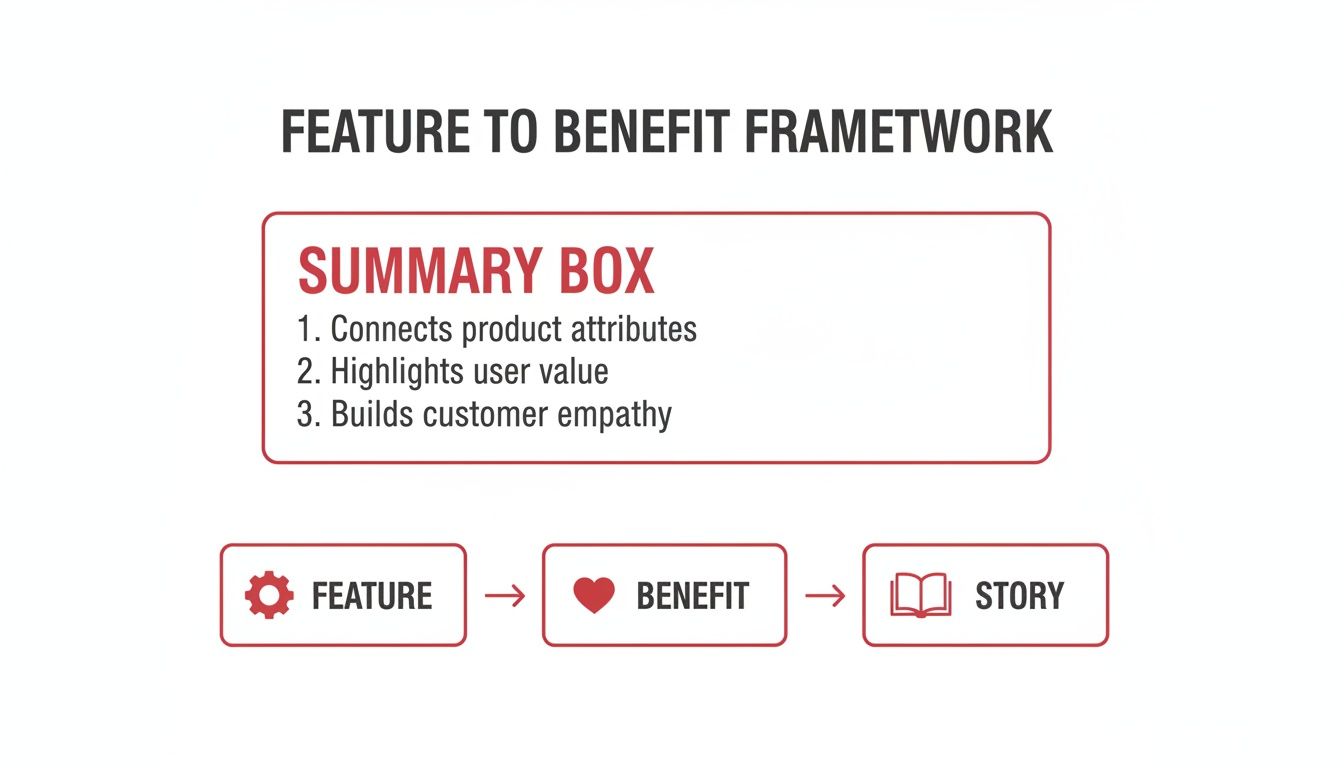
This process helps you understand what a product is (the feature), what it does for the customer (the benefit), and why they should care (the story). From there, you can adapt that core message to fit the constraints of any channel.
Key Takeaway: On your DTC site, you build a brand experience. On marketplaces, you compete for a click. Your copy must respect the context of where the customer is shopping.
For example, a customer on your website might love a narrative-style description. But that same person on Amazon wants to see the 5 most important benefits in the bullet points—immediately. They aren't there to read a novel.
Knowing the specific character counts and best practices for each platform is essential for omnichannel success. These rules can change, but the core structural differences are something every brand needs to master.
Here’s a quick-reference guide comparing the content guidelines for major online channels.
This table breaks down the key differences in how you should approach your copy for the three major selling environments. Think of it as your cheat sheet for omnichannel growth.
| Content Element | Amazon Guidelines | Walmart Guidelines | Shopify / DTC Best Practice |
|---|---|---|---|
| Title | ~150-200 characters (category dependent). Must be keyword-rich and highly descriptive. | 50-75 characters for optimal display. Prioritize clarity and the primary keyword. | No strict limit, but under 60 characters is best for SEO and readability. Focus on brand voice. |
| Bullet Points | 5 key feature/benefit points. Crucial for scannability and conversion. Often the most-read copy. | 3-10 bullet points. Use to highlight key selling propositions and answer common questions. | No strict rules. Can be used for specs, benefits, or breaking up longer paragraphs of text. |
| Main Description | Up to 2,000 characters. Supports basic HTML. Often secondary to A+ Content. | Up to 4,000 characters. Important for SEO and detailed information. | No character limit. Ideal for brand storytelling, detailed use cases, and rich media. |
| Rich Content | A+ Content. Allows for enhanced brand modules, images, and comparison charts. | Rich Media. Supports videos, 360-degree images, and interactive tours to boost engagement. | Fully customizable. Use high-res images, videos, customer testimonials, and user-generated content. |
The secret to winning everywhere is adapting your core product story to fit these different containers. When you do that, you're optimizing for both the platform's algorithm and the shopper's mindset, ensuring your message lands perfectly every time.
You’ve built a solid foundation, optimized your copy for search, and crafted a compelling story. But in eCommerce, hitting "publish" isn't the finish line. Your first draft is simply a strong hypothesis.
This brings us to the final, crucial step: testing and iteration. This is where you replace guesswork with decisions backed by real customer data.
By systematically testing different parts of your product descriptions, you can discover what really motivates your audience to click "add to cart." This continuous improvement loop is what separates brands that just get by from those that dominate their categories.
A/B testing, or split testing, sounds complex, but the concept is simple. You create two versions of your copy (Version A and Version B), show them to similar groups of shoppers, and see which one performs better.
The golden rule is to change only one significant element at a time. If you rewrite the headline, the first bullet point, and the call-to-action all at once, you’ll have no idea which change actually drove results.
Start by testing high-impact elements:
Most DTC platforms like Shopify have apps that make this easy, and marketplaces like Amazon offer built-in "Manage Your Experiments" tools for A+ Content.
When you start testing, focus on the metrics that directly reflect shopper behavior and drive revenue. Avoid vanity metrics like page views and zero in on the numbers that show your copy is persuading customers to take action.
Key Takeaway: The goal of testing isn't just to find a "winner." It's to gain deep, actionable insights into your customer's psychology—what language excites them, what benefits solve their problems, and what information they need to purchase with confidence.
Focus on these key performance indicators (KPIs) to measure the real-world impact of your copy tests:
By tracking these numbers, you can turn testing into a repeatable process for boosting sales and building a stronger connection with your audience.
Even with a solid framework, you're bound to run into tricky situations. Let's tackle some of the most common questions we get from brands looking to perfect their product copy.
Writer’s block usually stems from two issues: trying to write the perfect draft on your first attempt, or not having done enough foundational research.
The fastest way through it? Stop trying to write. Just start talking.
Record yourself describing the product to a friend. What’s the number one problem it solves? What gets you genuinely excited about it? Transcribe that recording, and you'll have a raw, authentic draft full of natural language.
Another practical tip is to shrink the task. Don't focus on the entire description. Just write five great bullet points. That’s it. Breaking the job into smaller, less intimidating pieces almost always gets the momentum going again.
There’s no magic number. The "perfect" length depends on the channel you're on and the complexity of your product.
Your goal isn't to hit a word count. It's to give a customer exactly the information they need to click "Add to Cart" without hesitation—no more, no less. Always prioritize clarity and scannability over sheer length.
Absolutely, but you have to use it strategically. Think of AI as your assistant, not your author. Tools like ChatGPT are fantastic for brainstorming benefit angles, generating different headline ideas, or creating a rough first draft to overcome a blank page.
But you can't just copy and paste the output. An AI doesn't understand your brand’s unique voice or the deep emotional triggers of your ideal customer.
Practical Takeaway: Use AI for what it's good at—generating variations and structuring information. Then, bring in your human expertise to inject personality, ensure accuracy, and forge a genuine connection with your reader. That hybrid approach is where the magic happens.
Let AI speed up the heavy lifting, but always be the final editor ensuring the copy speaks directly to your customer and sounds like your brand.
At RedDog Group, we turn great products into omnichannel success stories. If you're ready to move beyond just writing descriptions and start building a scalable growth engine for your brand, we should talk.
Leave a comment: