
Published: March 2020 | Last Updated:December 2025
© Copyright 2026, Reddog Consulting Group.

Your retail distribution strategy is the blueprint for getting your products into your customers' hands. It covers every step, from the moment a product leaves your warehouse until it's unboxed. This isn't just logistics—it’s a core part of your brand experience that directly shapes customer perception, satisfaction, and ultimately, your profitability.
A well-designed strategy ensures your products are on the right shelf (physical or digital) at the exact moment a customer is ready to buy. Getting this right is fundamental to brand growth.
Think of your distribution strategy like planning a road trip. You wouldn't just jump in the car and hope for the best. You'd choose the right vehicle (your sales channels), map the most efficient routes (your logistics), and decide which stops to make (your retail partners).
Without that map, you’re just burning gas and frustrating your passengers. In business, a poor strategy means wasted capital, missed opportunities, and unhappy customers—measurable results that directly impact your bottom line.

At its heart, distribution creates a seamless, integrated link between your brand and your buyers. It forces you to answer the critical questions that determine whether you scale or stall:
The answers define your market presence. A disjointed strategy leads to stockouts, late deliveries, and customer churn. A well-oiled machine, however, builds loyalty and drives repeat business.
At RedDog Group, we see a well-crafted distribution strategy as the essential Foundation for scalable growth. It’s not just an operational task; it’s a strategic asset that underpins every marketing and sales initiative, ensuring seamless integration between your online and offline channels.
The channels you choose directly impact how customers perceive your brand and how profitable you become. The right strategy reinforces your brand identity and supports your pricing power.
Take a luxury skincare brand. By selling only through its own website and a few select department stores, it cultivates an image of prestige and control. This selective approach guarantees a consistent, high-touch customer experience that justifies a premium price point—a clear, measurable result.
Conversely, a snack brand aiming to become a household name needs to be everywhere. Its goal is to secure shelf space in every possible supermarket, convenience store, and online marketplace. This intensive strategy prioritizes volume and accessibility over exclusivity.
Both are valid retail distribution strategies, but they serve entirely different brand and business goals. Nailing this alignment is the first, most critical step toward building a brand that lasts.
Now that we understand why you need a distribution strategy, the next step is deciding which path to take. Most strategies fall into one of three models: Intensive, Selective, or Exclusive. Each serves a different purpose and will shape everything from your brand’s public image to your operational costs.
Think of it this way: are you trying to become a corner store staple, a specialty shop discovery, or a rare luxury item? Your answer will point you toward the right model for growth.
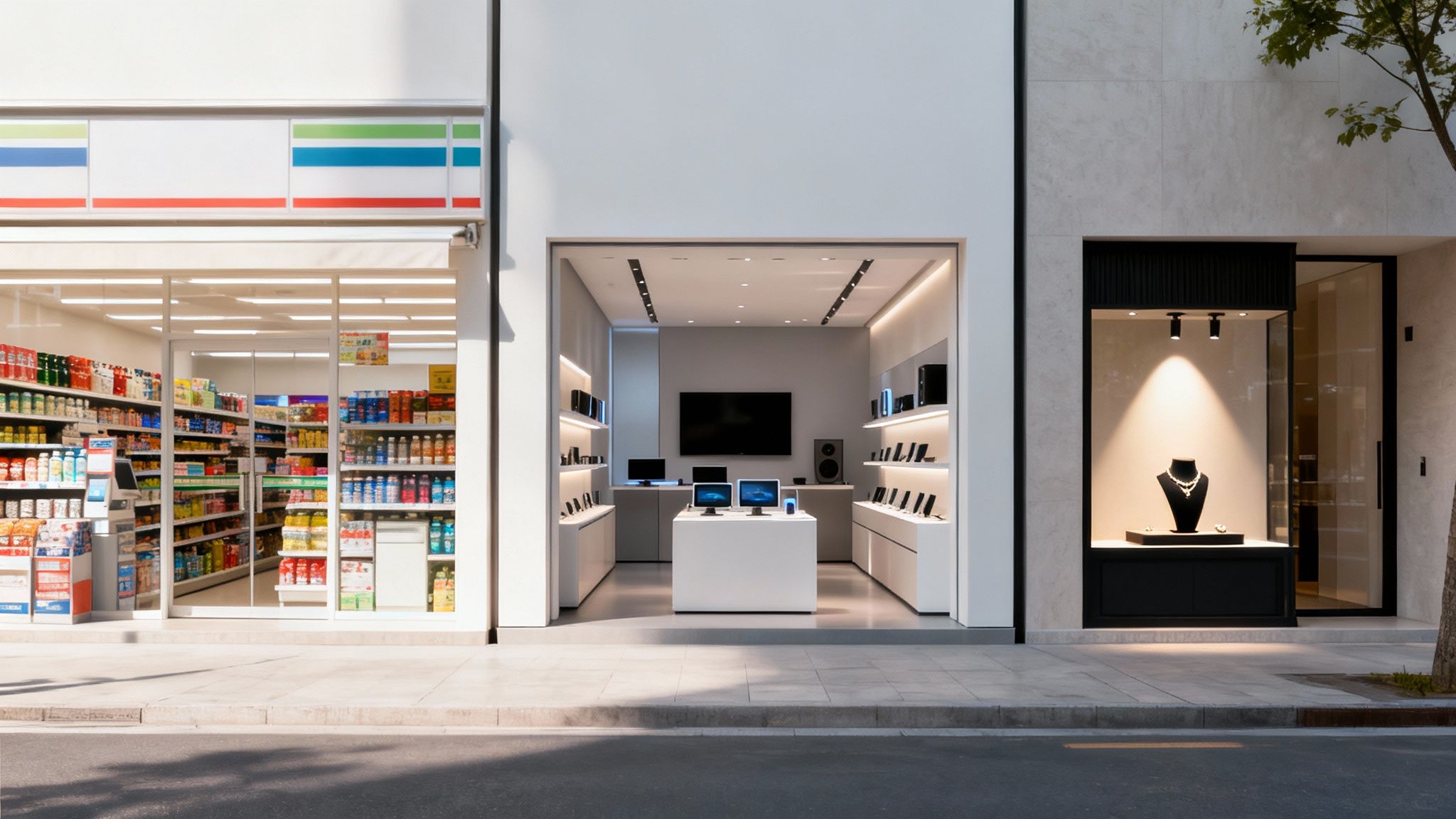
Intensive distribution is the "be everywhere" strategy. The goal is simple: achieve maximum market coverage and make your product so convenient that customers can't miss it. This approach is ideal for high-volume, low-cost goods where convenience is the primary driver of purchase decisions.
Coca-Cola is the quintessential example. You can buy one in a supermarket, gas station, vending machine, or restaurant. The brand’s objective is to ensure their product is always within arm’s reach. This model is built to drive sales volume and widespread brand awareness, not exclusivity.
Selective distribution strikes a balance between broad reach and brand control. With this model, you choose a limited number of retail partners in specific locations to carry your product. These partners are carefully selected to ensure they align with your brand image and can deliver a quality, integrated customer experience.
Consider premium electronics brand Bose. You won’t find their products in every convenience store. Instead, they sell through authorized dealers like Best Buy, specific electronics specialists, and their own branded stores. The strategy is to be in the right places, not all of them. This maintains a premium feel while still reaching a significant portion of the target market.
Exclusive distribution is the most restrictive model. It involves granting sole selling rights to a single retailer or a very small, elite group within a geographic area. This strategy is tailored for luxury goods, high-end fashion, and specialty items where scarcity and prestige are key brand pillars.
Luxury watchmaker Rolex exemplifies this approach. Their timepieces are available only through a handful of highly vetted, official jewelers. This scarcity fuels desire and exclusivity, which helps justify the premium price. The entire experience—from the store's ambiance to the salesperson's expertise—is tightly controlled to reinforce the brand's elite status.
To help you visualize where your brand might fit, let's compare these three models side-by-side. Each presents clear trade-offs between market reach and brand control.
| Strategy | Best For | Brand Control | Market Reach | Pros | Cons |
|---|---|---|---|---|---|
| Intensive | CPG, snacks, everyday items | Low | Maximum | High sales volume, wide brand recognition | Low margins, weak brand control |
| Selective | Appliances, apparel, premium goods | Medium | Moderate | Strong brand image, better margins, good reach | Potential for channel conflict, less market saturation |
| Exclusive | Luxury goods, art, high-end cars | High | Limited | Maximum brand control, premium pricing, high loyalty | Slower growth, limited sales volume, high dependency |
Choosing the right path is a foundational step that influences every subsequent decision. It’s also worth noting that modern models like dropshipping can fit within these frameworks, but they come with their own set of rules, especially for building a compliant dropshipping business for regulated products.
Each of these retail distribution strategies is a tool. The key is to select the one that aligns perfectly with your product, your customer, and your ultimate brand vision. Misalignment here leads to a diluted brand message and wasted resources—measurable negatives that hinder growth.
Choosing a distribution model is a critical first step, but a successful launch requires a repeatable framework to turn strategy into action. This is where your high-level vision translates into real-world execution.
At RedDog Group, we guide brands through our proven Foundation → Optimization → Amplification framework. It’s a clear, step-by-step approach that connects your goals to a powerful, scalable distribution plan.
This isn’t just a checklist; it’s a methodology that ensures every operational decision supports your brand’s growth. By building correctly from the ground up, you create a system that not only works at launch but is agile enough to evolve with your business.
Before shipping a single box, you need to do your homework. The Foundation stage is all about deep analysis and smart planning. Rushing this is like building a house on sand—it might look fine at first, but it won't withstand pressure.
This initial phase breaks down into three core activities:
For a detailed walkthrough of this critical phase, explore our guide on building a powerful go-to-market strategy for startups.
With a solid foundation, it’s time to build the engine that powers your distribution. The Optimization stage is where you translate plans into physical and digital infrastructure. It’s about creating efficient, repeatable processes that get products from your warehouse to your customers' hands reliably.
Think of this as building your operational core. Key decisions include:
A well-optimized operational engine doesn’t just move boxes efficiently; it creates a consistent and reliable brand experience. This is where you earn customer trust through flawless execution, turning one-time buyers into repeat customers.
Once your foundation is solid and your engine is running smoothly, it's time to accelerate. The Amplification stage focuses on strategic expansion and managing key relationships. This is where you grow your reach by thoughtfully selecting and nurturing your channel partners.
This final phase is about smart, sustainable growth. It involves:
This framework provides a repeatable path to building a distribution network that doesn’t just launch your brand—it sustains its growth for the long haul.
A winning framework provides the map, but success is achieved through execution. Different retail distribution channels require different tactics. How you succeed on Amazon is fundamentally different from how you win shelf space at Target.
Excelling in today's omnichannel world means mastering the unique playbook for each channel. Let’s break down the practical tactics needed to drive measurable growth across three critical arenas: Direct-to-Consumer (DTC), online marketplaces, and big-box retail.
Your DTC channel is the one place where you have complete control over your brand's narrative and customer experience. This is your home turf. The goal isn't just to sell a product; it’s to build a direct relationship that fosters loyalty and repeat purchases.
The key is to own the entire customer journey, from the first ad they see to the moment they unbox your product.
Selling on marketplaces like Amazon or Walmart.com grants you access to a massive, built-in audience. However, you're playing in their sandbox, by their rules. Success here is less about brand storytelling and more about algorithmic mastery and operational precision.
On a marketplace, you aren't just competing with other brands; you're competing for visibility within the platform's algorithm. Your primary job is to convince that algorithm that your product is the best solution for a customer's search.
To win, focus on what moves the needle for the marketplace flywheel:
The infographic below shows our framework for turning these channel-specific tactics into a cohesive go-to-market plan.
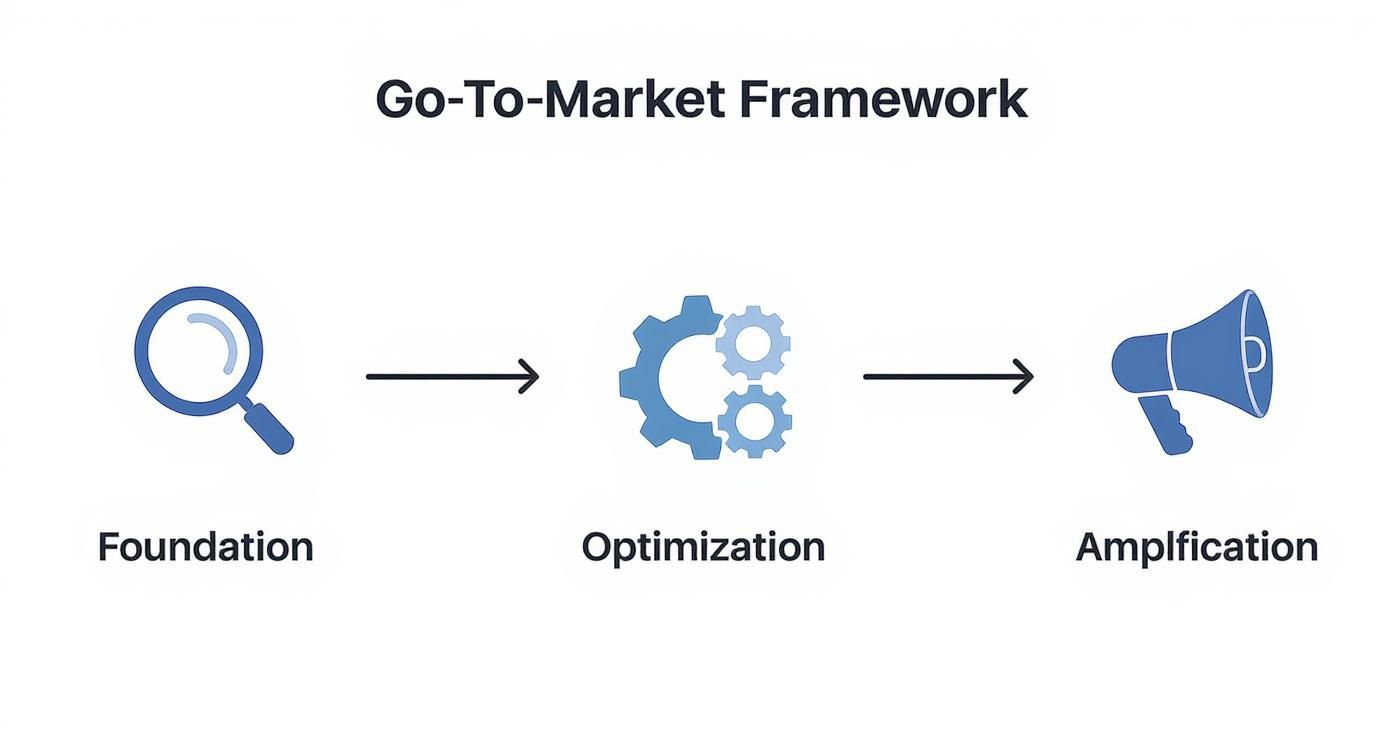
This process highlights how foundational research and operational optimization are essential before you can truly amplify your presence in any channel.
Getting your product on the shelves of a major retailer like Target or Walmart is a huge win, offering unparalleled volume and visibility. But this channel comes with a steep learning curve and strict operational demands.
Each channel presents unique opportunities, but all require dedicated strategies. Weaving these distinct approaches together is the core of a powerful omnichannel retail strategy that can boost your sales and build a resilient, profitable brand.
A great distribution strategy is only as good as the measurable results it delivers. To know if you’re winning, you must move beyond surface-level numbers and focus on the Key Performance Indicators (KPIs) that signal a healthy, profitable, and efficient distribution network.
This is about using data to continuously refine your approach. Tracking the right metrics transforms your strategy from a static plan into a dynamic, responsive system. It doesn't just tell you what happened—it explains why, empowering you to make smarter decisions that fuel brand growth.
Instead of getting lost in a sea of data, focus on the KPIs that directly measure the flow of your products and capital through your channels. Three of the most critical are Sell-Through Rate, Inventory Turnover, and Channel-Specific Profitability.
These metrics work together to provide a clear picture of your operational health:
Interpreting these metrics is where the real value lies. A low sell-through rate at a major retailer isn't just a sales problem; it could signal a need for a merchandising refresh, better promotional support, or a simple pricing adjustment. It’s an opportunity for data-driven optimization.
Understanding these numbers is the first step; acting on them is what drives growth.
For example, if your Inventory Turnover is sluggish, it’s a clear signal you’re either overstocked or demand has cooled. The solution isn't just to order less; it requires a strategic approach to how to streamline multichannel sales through inventory management to free up cash and improve efficiency.
This data-driven approach is becoming the standard in modern retail. A remarkable 73% of companies are making distribution channel optimization a top priority. This proves that distribution is no longer just about logistics—it’s about reaching customers quickly and cost-effectively.
With omnichannel approaches proving highly profitable—39% of retailers report sales increases over 20% after implementation—the need to integrate your online and offline channels has never been more critical. Discover more insights about these distribution marketing statistics on amraandelma.com.
Ultimately, measuring what matters allows you to fine-tune your retail distribution strategies for maximum impact, ensuring every channel contributes to your bottom line and overall brand growth.
If there’s one constant in retail, it’s change. A distribution strategy that works today could become a liability tomorrow. Future-proofing your plan isn’t about predicting the future—it's about building an agile, resilient system that can adapt to whatever comes next.
This means moving beyond rigid, one-size-fits-all playbooks. The best retail distribution strategies today are flexible, data-driven, and customer-obsessed. The goal is to build an ecosystem designed not just for this quarter’s sales, but for long-term, sustainable growth.
Recent years have taught a masterclass in the risks of putting all your supply chain eggs in one basket. From geopolitical shifts to shipping logjams, unexpected disruptions have made diversification a core survival skill. Over-reliance on a single country or region for manufacturing is no longer a viable strategy for any brand focused on growth.
This is forcing brands to rethink their entire supply chain. To mitigate risk, roughly 70% of retailers are planning to move more production onshore or to nearby countries ("nearshoring"). For instance, Steve Madden announced plans to slash its imports from China by up to 45% in a single year, shifting production to factories in India and North America. It’s a strategic move to balance cost with agility, creating a more durable supply network. You can read more about this in Bain's 2025 retail forecast.
The future of distribution is also being shaped by rapid shifts in technology and consumer behavior. To stay ahead, you need to keep a close eye on the trends that are connecting brands with customers in new, integrated ways.
Here are a few key trends to watch:
The key takeaway is that the best distribution strategies are never “finished.” They are living systems that require constant monitoring and adaptation. A forward-thinking, agile approach is your greatest asset for achieving lasting brand growth.
Your distribution network is the backbone of your brand. By building it with an eye on the future, you’ll be prepared to scale, navigate challenges, and meet your customers wherever they are headed.
Let’s Talk Growth
Even the best-laid distribution strategies encounter complex questions. As your brand grows, new challenges emerge that require clear, practical answers. Here, we tackle some of the most common hurdles brands face when navigating an omnichannel world.
Think of these as the essential "what-ifs" that can make or break your growth. Getting them right from the start will save you from major headaches down the road.
This is a critical question for any brand selling direct-to-consumer (DTC) while also partnering with retailers. The key is to establish a clear Minimum Advertised Price (MAP) policy from day one. This policy contractually prevents retailers from advertising your product below a set price, protecting your brand's value and avoiding a race to the bottom on price.
Your own DTC site should typically adhere to the Manufacturer's Suggested Retail Price (MSRP). This gives your retail partners room to run promotions without consistently undercutting your primary channel. Price consistency prevents channel conflict and ensures customers perceive a unified brand, no matter where they shop.
These terms are often used interchangeably, but their roles are distinct.
Think of a distributor as a proactive partner in your growth, while a wholesaler is more of a transactional player in your supply chain.
Making the leap from digital-only to physical shelves is a major milestone. The right time is when you have a proven product-market fit and a loyal customer base that provides a predictable sales baseline. Before approaching retailers, ensure your operations can handle the stringent demands of retail, such as EDI compliance and chargeback management.
The goal isn't just to get on the shelf; it's to have the data and operational muscle to stay on the shelf. A strong DTC foundation gives you the proof points needed to successfully pitch buyers and thrive in a competitive retail environment.
Building a distribution strategy that drives measurable growth requires expertise and a proven framework. At RedDog Group, we help brands navigate these complexities to scale profitably across every channel. Ready to turn questions into a growth plan? Let’s Talk Growth.
Leave a comment: