
Published: March 2020 | Last Updated:December 2025
© Copyright 2026, Reddog Consulting Group.

Launching a startup without a go-to-market (GTM) strategy is like setting sail without a map. You might have a great product, but you’ll have no clear direction. A GTM strategy is your action plan for introducing a new product to the market, connecting with the right customers, and securing a competitive edge. It’s the blueprint that transforms a promising idea into a market reality.
Countless promising products fail, and it's rarely because they are poorly made. It’s because they never connect with the right audience. The "build it and they will come" mindset is one of the biggest risks a new venture can take. A structured go-to-market strategy for startups replaces that guesswork with a clear, actionable plan to build measurable market traction from day one.
The data backs this up. A widely cited study revealed that 42% of failed startups pointed to "no market need" as the root cause. In other words, they built something nobody was willing to pay for. A GTM plan forces you to answer that critical question before you burn through your funding.
At RedDog Group, we don’t believe in guesswork. We approach growth with a proven, three-phase framework designed for intentional, omnichannel success. This isn’t a static checklist; it’s a dynamic system for continuous improvement.
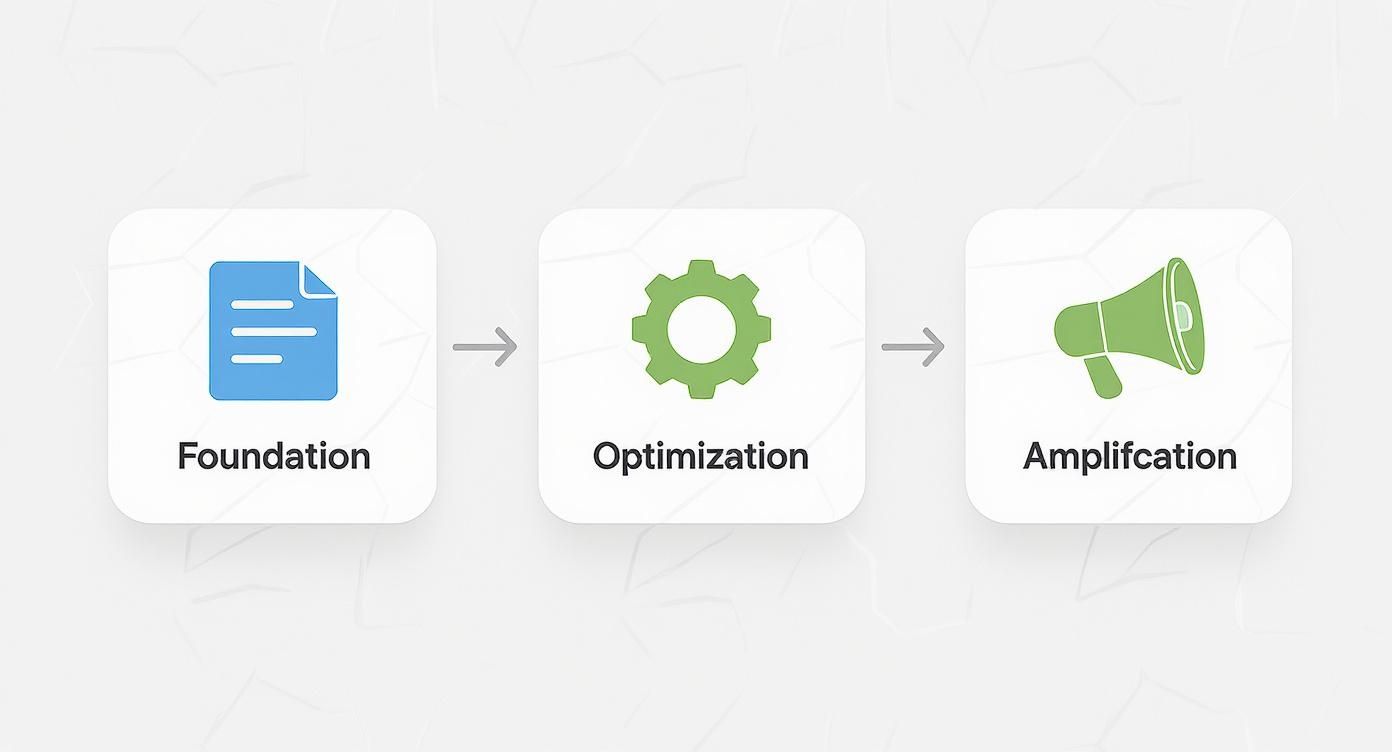
Each stage builds on the last, ensuring your growth is both measurable and integrated across every channel you use, whether online or offline.
A strong GTM strategy isn't just about launching; it's about building a repeatable engine for growth. It aligns your product, marketing, and sales efforts toward a single goal, creating the momentum needed for long-term business scalability.
This guide will walk you through building that engine. We'll cover everything from sizing up your market and profiling customers to prioritizing channels and planning your launch. For a deeper dive into the overall process, this essential go-to-market strategy guide is a great resource.
Our goal is to give you a practical blueprint that helps you weave your online and offline channels together from the very beginning. This creates a seamless customer experience and sets your startup on a clear path to success. Before we get into the weeds, it also helps to understand the core principles of growth, which you can explore in our complete overview of what business scalability is.
Let’s get your foundation built.
Before you think about launching, every startup must answer two make-or-break questions: Who are we actually selling to, and is this opportunity big enough to matter? Get this wrong, and your resources will vanish without generating results.
A solid go-to-market strategy starts here. Without a crystal-clear picture of your market and customer, you’re just guessing with your ad spend, product features, and sales strategy. This isn’t an academic exercise—it’s about deploying limited resources where they’ll deliver the biggest impact. The goal is to move from a vague idea of "our audience" to a laser-focused profile of the people who genuinely need what you're selling.
To get a real-world grip on your market’s potential, we use a simple framework: TAM, SAM, and SOM. Think of it as zooming in from the entire universe of potential customers to the ones you can realistically win. This approach helps you put real numbers to the opportunity.
Total Addressable Market (TAM): This is the big picture—the total global demand for a product like yours. For example, if you're launching a new plant-based protein powder, your TAM is the entire global sports nutrition market, worth billions. It’s your maximum potential.
Serviceable Available Market (SAM): This is your slice of that pie. It's the segment of the TAM your product actually targets and that you can realistically reach with your sales and distribution channels. For our protein powder startup, the SAM might be the online sports nutrition market in North America. Much more focused.
Serviceable Obtainable Market (SOM): This is your immediate target. It's the piece of the SAM you can realistically capture in the near future, given your team, budget, and competition. For instance, that might be 5% of the North American online market in your first two years.
Calculating these figures isn't just for a pitch deck. It gives your team and investors a data-backed picture of your growth potential, turning a big vision into a believable business case.
While TAM, SAM, and SOM tell you how many people you could sell to, your Ideal Customer Profile (ICP) tells you exactly who they are. An ICP is a detailed description of the person or company that gets the most value from your product—and in turn, provides the most value back to your business. This goes way beyond basic demographics like age and location.
An ICP isn't just a persona with a cute name and a stock photo. It’s a strategic tool describing the customer who is cheapest to acquire, has the highest retention rate, and is most likely to become a brand advocate.
Think of it like this: your SOM is your "beachhead market"—the specific, reachable group you'll target first. Your ICP is the detailed portrait of the perfect person within that beachhead.
For our protein powder brand, the ICP isn't just "health-conscious adults." It's "vegan millennials aged 25-35, who follow fitness influencers on Instagram, shop at Whole Foods, and have already bought from competitor brands like Garden of Life or Vega."
That level of detail informs everything:
A great ICP is built on a mix of real data and real conversations. You need both quantitative and qualitative insights for a complete picture.
Analyze Your Competitors: See who your competitors are targeting. Dig into their customer reviews, analyze their social media followers, and read their case studies. Identify the problems they solve and, more importantly, where the gaps are that you can fill.
Talk to Actual Humans: If you have early customers or beta testers, interview them. If not, find people who should be your customers and talk to them. Ask open-ended questions about their challenges, goals, and current solutions. The golden rule: don't sell, just listen.
Use Your Analytics: Dive into Google Analytics, social media demographics, and market research. Look for patterns in behavior, location, and interests. This hard data will either validate or challenge the assumptions from your interviews.
Once you combine this information, you'll have an ICP that acts as your true north. Every decision—from a new ad campaign to a product update—should be filtered through this question: "Does this help our ideal customer?" This relentless focus is how startups punch above their weight and win.
Once you know who you’re talking to, you need to define what to say. In a crowded market, a great product isn't enough. Your go-to-market strategy must clearly articulate why your solution is the only choice for your Ideal Customer Profile (ICP). This is where your value proposition and market positioning come in.
A strong value proposition is a clear, concise statement answering the one question every customer has: “Why should I choose you?” It’s not a clever slogan or a list of features. It's the core promise of value you deliver, aimed squarely at the pain points you uncovered while building your ICP. This is a critical piece of the Foundation phase in our growth framework. Get this right, and all subsequent marketing, sales, and product messaging will be consistent and effective.

A powerful value proposition is clear, highlights a specific benefit, and explains why you're better than the competition. Think of it as your elevator pitch, distilled to its most potent form.
For example, early DTC mattress brands like Casper didn’t just sell mattresses. Their value proposition was built on convenience and a risk-free experience—a direct response to the awkward, high-pressure environment of traditional mattress stores.
They promised:
This wasn’t just about the product; it was about the entire customer journey. This value-driven approach is a key part of the essential branding tips for startups seeking rapid growth we champion.
To achieve this clarity, the Value Proposition Canvas is an invaluable tool. It forces you to map your product’s features and benefits directly to your customer's biggest challenges and desired outcomes.
| Component | Description | Example (For a Fictional Meal-Kit Startup) |
|---|---|---|
| Customer Jobs | What tasks are your customers trying to accomplish? | "I need to cook healthy dinners for my family every week." |
| Pains | What annoys customers or prevents them from doing the job? | "I have no time for grocery shopping or meal planning." |
| Gains | What outcomes or benefits do your customers want? | "I want to feel good about what my family eats and spend more time with them." |
| Products & Services | What you offer that helps them complete their jobs. | Pre-portioned, fresh ingredient meal kits delivered weekly. |
| Pain Relievers | How your product alleviates customer pains. | Our kits eliminate grocery store trips and the stress of planning. |
| Gain Creators | How your product delivers the outcomes customers desire. | We provide chef-designed, nutritious recipes that are ready in 30 minutes. |
Working through this framework ensures your value proposition is a direct response to what your ideal customer actually needs and wants.
While your value proposition is customer-facing, your positioning statement is an internal North Star that guides your strategy. Once your value prop is locked in, this statement keeps your entire team aligned.
A proven framework looks like this:
"For [Target Customer] who [has this specific problem], our [Product/Brand Name] is a [Product Category] that [provides this key benefit]. Unlike [Primary Competitor], we [state your unique differentiator]."
Let's apply this to a fictional coffee brand:
"For eco-conscious students and young professionals who want great, ethically sourced coffee without going broke, GroundUp Coffee is a DTC coffee subscription that delivers premium, fair-trade beans at a fair price. Unlike Starbucks or other premium cafes, we cut out the retail markup to make sustainable coffee affordable for everyone."
This statement becomes your strategic anchor. It defines your audience, category, promise, and competitive edge, ensuring every decision—from marketing campaigns to product updates—reinforces your unique position in the market.
Once you've defined your value proposition, it's time to determine how you’ll get your product in front of the right people. This means selecting the sales and marketing channels that connect your product to your customers. A disciplined choice leads to efficient, scalable growth. A "spray and pray" approach is one of the fastest ways to burn through your budget with little to show for it.
The goal isn't just to be everywhere; it's to create a seamless omnichannel experience. Whether a customer finds you on Amazon, lands on your website, or sees your product in a physical store, the experience should feel like one cohesive brand journey. It’s about being in the right places, at the right times, with a message that resonates.
Going the Direct-to-Consumer (DTC) route with your own storefront on a platform like Shopify or BigCommerce puts you in complete control. You own the customer relationship, the branding, and—most importantly—all the data. For a new startup, that direct line to your audience is invaluable.
Every sale, site visit, and email signup provides precious first-party data. You can use these insights to fine-tune products, sharpen marketing, and truly understand customer behavior. The catch? You are 100% responsible for driving every visitor to your site. This requires a solid grasp of digital marketing, from SEO and content to paid social and email campaigns.
Key Takeaway: DTC is the ultimate channel for building a brand and gathering customer insights. It’s a foundational element for long-term growth, giving you a direct relationship that third-party platforms can’t offer.
Platforms like Amazon, Walmart, or niche sites like Etsy offer a shortcut to a massive, built-in audience. These are marketplaces full of high-intent shoppers actively searching for products like yours. For many new brands, this is the quickest path to securing crucial first sales.
But that instant access comes with trade-offs. You'll pay commission fees, have limited control over branding, and get almost no direct access to your customer data. You're essentially renting shelf space in someone else's store, which means you must play by their rules and are subject to their algorithm changes. A smart omnichannel strategy often uses marketplaces for volume and product validation while building a DTC presence in parallel.
For many product-based startups, seeing your product on a physical shelf is still a huge milestone. Retail offers a kind of brand legitimacy and discoverability that online channels can't always match. It gives customers the chance to touch, feel, and experience your product before buying.
The challenge is that breaking into retail is tough and expensive. It means convincing buyers, meeting strict logistical standards, and often spending on trade marketing to support your in-store presence. A common strategy is to start small with independent boutiques to build a sales history before approaching major retailers.
Here’s a simplified breakdown to weigh your options:
| Channel | Pros | Cons | Best For... |
|---|---|---|---|
| DTC (Your Website) | Full brand control, high margins, direct customer data. | You must generate all traffic, higher initial marketing costs. | Building a strong brand community and maximizing lifetime value. |
| Marketplaces (Amazon, etc.) | Massive built-in audience, high purchase intent, streamlined logistics. | Commission fees, no customer ownership, high competition. | Achieving rapid sales volume and validating product demand. |
| Physical Retail | High brand credibility, hands-on customer experience, new discovery opportunities. | High barrier to entry, lower margins, complex logistics. | Brands with products that benefit from in-person interaction. |
Picking the right channel mix from the start is fundamental. In fact, a recent industry analysis showed that while 79.5% of companies believe their product launches significantly impact revenue, 42.3% report that less than half of their target customers adopt a new product after launch. This gap highlights just how critical a precise channel strategy is. You can learn more about these B2C go-to-market findings.
Ultimately, approach your channel strategy with our Foundation → Optimization → Amplification framework. Start with a foundational channel like DTC to build your base. Once that’s performing well, you can amplify your reach by layering in marketplaces or retail partnerships as you scale.
Pricing is one of your most powerful growth levers, yet too many startups treat it as an afterthought. A successful go-to-market strategy moves beyond simple cost-plus models to embrace pricing as a strategic tool. It’s not just about covering expenses; it’s about communicating value, positioning your brand, and maximizing revenue from day one.
From there, we’ll map out a phased launch. Forget the myth of a single "big bang" event. Modern launches are about building momentum methodically to ensure your product enters the market with a strong, sustainable growth trajectory. This is where all your foundational work pays off.
Choosing a price isn't a one-time decision—it's an ongoing process of discovery. The right strategy must align with your product's perceived value, your brand positioning, and what your customers are willing to pay. Let’s break down a few common approaches.
Value-Based Pricing: This model ties your price directly to the tangible value or ROI your customer receives. If your B2B software saves a client $10,000 a year, charging $2,000 feels like a bargain. This approach demands a deep understanding of your customer's pain points and a clear way to quantify your solution's impact.
Competitive Pricing: Here, you anchor your price relative to competitors. This can work in a crowded market, but competing on price alone is a dangerous game. A better approach is to use competitor pricing as a benchmark, then adjust based on your unique differentiators.
Psychological Pricing: This leverages human psychology to make prices more appealing. Think pricing an item at $19.99 instead of $20.00 or offering tiered packages ("Basic," "Pro," "Enterprise") to create a clear value ladder and nudge customers toward a preferred option.
The most successful startups blend these models. A DTC brand might use competitive pricing as a baseline, apply psychological tactics with bundled deals, and reinforce it all with messaging that highlights the product's unique value.
Don’t just set a price; test it. Use A/B testing on your website to experiment with different price points. A small tweak from $49 to $59 might not seem like much, but it could dramatically increase your revenue without a significant drop in conversions.
A successful launch is a process, not a single event. Breaking it down into phases helps you build momentum, manage resources, and gather crucial feedback. Think of it as a rolling thunder approach rather than a single explosion.
This is where you warm up your audience. The goal is to build a waitlist of eager, high-intent customers before your product is ready to ship.
This is go-time. All the channels you pinpointed earlier should be activated in a coordinated push.
Your work isn't done once the product is live. The first few weeks are critical for gathering feedback, refining your messaging, and turning those first buyers into vocal advocates.
This phased approach transforms your launch from a high-stakes gamble into a strategic, data-driven process that sets the stage for long-term, scalable growth.
A great launch is just the starting line. Now, the real work begins: turning that initial splash into a repeatable growth engine. This is where we shift from building the Foundation to the Optimization and Amplification phases. It’s all about measurement, iteration, and continuous improvement.
To do this effectively, you need a clear view of what’s driving results. Forget vague goals like "increase sales." You need specific, measurable KPIs to guide every decision. This means building a GTM dashboard that tracks the handful of metrics that truly matter.
Think of your dashboard as your command center—a single source of truth that cuts through the noise and focuses your team on the numbers that move the needle. While exact metrics vary, a few are non-negotiable for any startup.
Getting a handle on these numbers is essential. For a deeper look at building a solid measurement framework, check out our complete guide to the role of analytics in business growth.
A GTM dashboard isn't just a report; it's a decision-making tool. It turns raw data into actionable insights, showing you exactly where to double down on your efforts and where to pull back.
With your core metrics in hand, you can run small, data-driven tests designed to systematically improve performance. These "growth experiments" aren't about reinventing the wheel; they're about making smart, incremental improvements that compound over time.
For instance, you could run an A/B test on your product page headline to see which version drives more add-to-cart clicks. Or, you might pilot a small referral program with your first 100 customers to measure its impact on CAC. The key is to test one variable at a time, measure the results against your baseline, and implement the winners. This iterative process builds a culture of continuous improvement, where launch insights directly fuel smarter, more efficient growth.
This data-first approach is a major differentiator. AI-native firms with a frictionless onboarding process see an average 56% conversion rate from trial to deal, while others lag at just 32%. It shows how a GTM strategy built around product-led growth and constant optimization can create a massive competitive advantage. You can discover more insights on GTM performance.

It's natural to have questions when mapping out your startup’s launch. Here are answers to some of the most common ones we hear from founders.
There’s no single answer, but a solid GTM plan typically takes 30 to 90 days to develop. Early-stage startups can often move faster, while companies with complex products or in crowded markets may need more time. The goal isn't speed; it's thoroughness. Rushing past crucial steps like customer interviews or competitive analysis will only lead to expensive mistakes later. Give yourself enough time to get the foundation right.
The most common and destructive mistake is building a product in a vacuum and then trying to find a market for it. The "build it and they will come" approach almost always leads to a solution that nobody is willing to pay for.
A winning go-to-market strategy for startups starts with the customer, not the product. It’s about validating that a real market need exists before you pour significant capital into development and marketing. You have to be sure you're solving a real problem for a specific group of people.
Your GTM strategy should be a living document, not something set in stone. It requires regular check-ins to remain effective. We recommend a quarterly review to:
This cycle of building, measuring, and refining is what turns a good launch into a repeatable engine for growth. It keeps you agile and ensures your decisions are based on real-world data, not assumptions.
Ready to build a go-to-market strategy that delivers real, measurable results? The team at RedDog Group brings the omnichannel expertise you need to connect your product with the right customers and create a scalable path to growth.
Leave a comment: