
Published: March 2020 | Last Updated:December 2025
© Copyright 2026, Reddog Consulting Group.

Retail merchandising is the art and science of creating a seamless, compelling customer journey that connects your online store to your physical aisles. Done right, it turns casual browsers into loyal customers by making it easy and intuitive to buy. This guide breaks down how to build a powerful merchandising strategy that drives measurable growth for your brand.
Merchandising is more than just arranging products on a shelf or uploading them to a website. It’s a strategic framework that shapes brand perception, guides the shopping experience, and ultimately drives sales. An effective strategy ensures the right product is in the right place, at the right time, and for the right price.
When you get merchandising right, you tell a unified brand story everywhere. A customer sees a promotion on social media, finds the same look and feel on your website, and walks into your store to find that exact product with ease. That consistent experience builds trust and removes the friction that kills sales. It's a non-negotiable for building a loyal customer base and growing your business in today's market.
To build a strategy that delivers measurable results, modern retailers structure their efforts around three core pillars:
This diagram illustrates how these three pillars build on each other to create a complete, growth-oriented merchandising strategy.
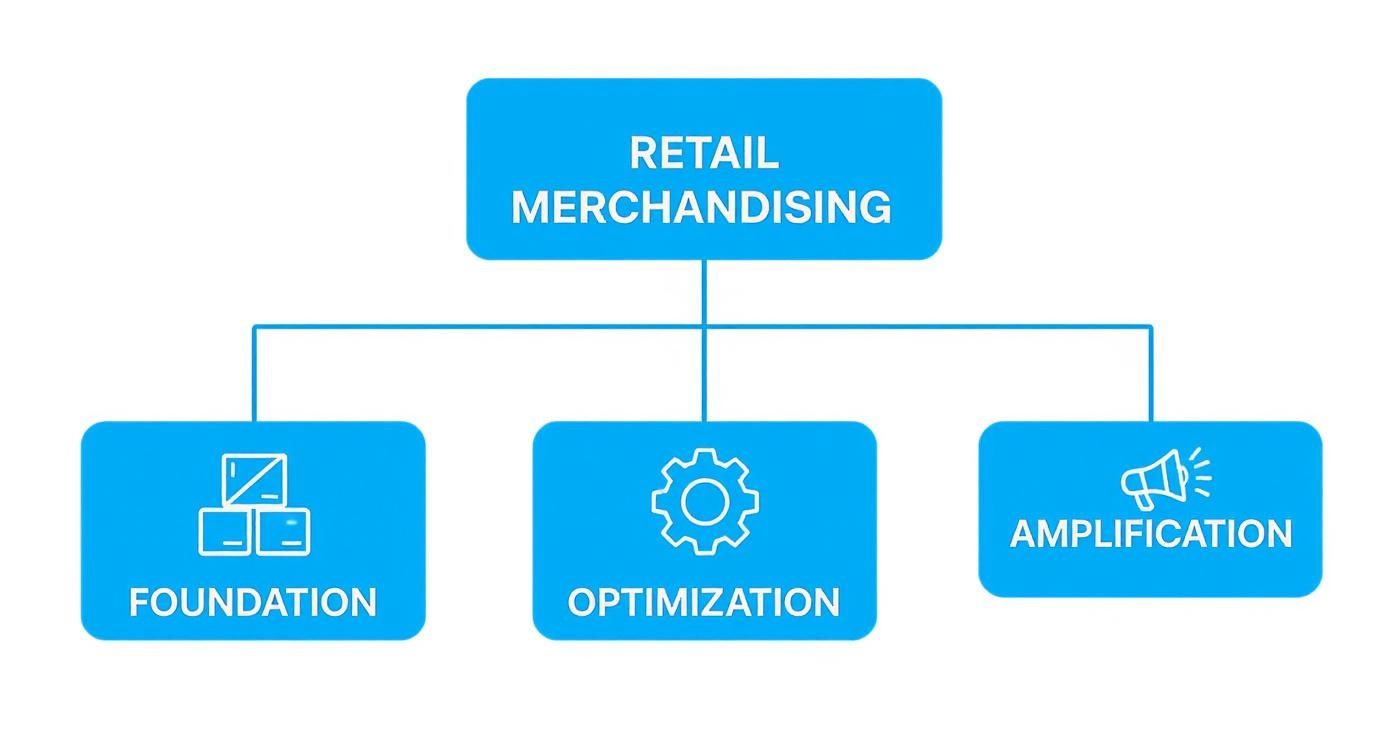
As you can see, a strong Foundation is what allows for effective Optimization. Once you've optimized the experience, you can then move on to successful Amplification, creating a powerful engine for omnichannel growth.
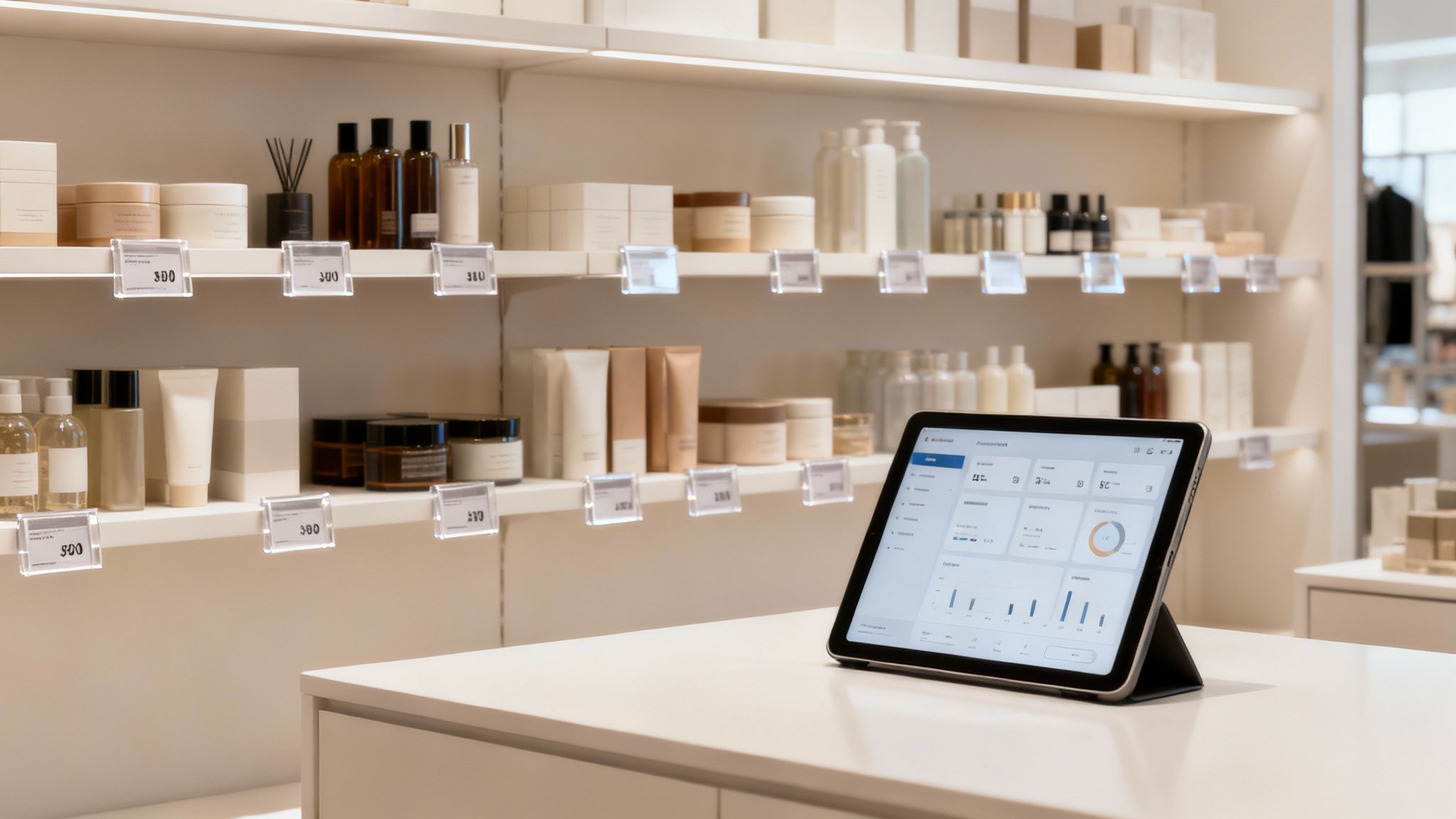
Before you can focus on growth tactics, you need to build the launchpad. A strong merchandising foundation isn’t about flashy displays or expensive tech—it’s about mastering the fundamentals so every other effort has a real chance to succeed. Think of it as the concrete slab your house is built on; without it, everything else is unstable.
The entire system rests on three pillars you can't ignore: smart product assortment, strategic pricing, and unified inventory management. Get these right, and your merchandising strategy will be built for performance from day one, setting you up for real, sustainable growth.
Your product mix is your brand story in physical form. It’s defined by what you choose to sell—and just as importantly, what you choose not to sell. Getting this right means moving beyond gut feelings and using data to understand what your customers truly want.
Start by analyzing your sales data. Identify your best-sellers, your slow-movers, and any hidden gems with untapped potential. Then, layer in market trend research and competitive analysis. The goal is to build a curated collection that feels both fresh and relevant to your ideal customer, driving sales and fostering loyalty.
Key Takeaway: A winning product assortment is not a random collection. It’s a carefully selected portfolio where every product has a job—whether that’s driving volume, boosting margins, or attracting new customers.
This data-first approach is becoming the new standard. A recent survey of 350 retailers found that 59% expect merchandising to become fully or partially centralized and powered by AI for inventory and pricing decisions. This shift helps brands make smarter, data-driven decisions that protect margins and allow them to react to market changes in real time.
Price is more than just a number; it’s a direct signal of your brand’s value. Your pricing strategy must strike a delicate balance between attracting customers and protecting your profit margins. Price too low, and you risk devaluing your brand. Price too high, and you send shoppers straight to your competitors.
Smart pricing is a function of three key factors:
By analyzing these elements together, you can deploy targeted strategies like value-based pricing or promotional pricing to achieve specific business goals. To learn more about how pricing fits into the bigger picture, explore the role of merchandising in ecommerce explained in our detailed guide.
In an omnichannel world, inventory is your greatest asset—and your biggest potential liability. A customer doesn’t care if a product is in a warehouse or a store backroom; they just want it to be available when and where they want it. A single, unified view of inventory is no longer optional.
When your inventory systems are siloed, you invite costly mistakes. You run out of stock on popular items (lost sales) and end up overstocked on products that aren't selling (tied-up cash). A centralized system provides real-time visibility, empowering you to:
Ultimately, a unified inventory system is the operational backbone of any great merchandising strategy. It ensures the right product is in the right place at the right time, delivering the seamless experience modern customers demand. To complement this foundation, creative retail window display ideas can also play a key role in driving in-store traffic and sales.
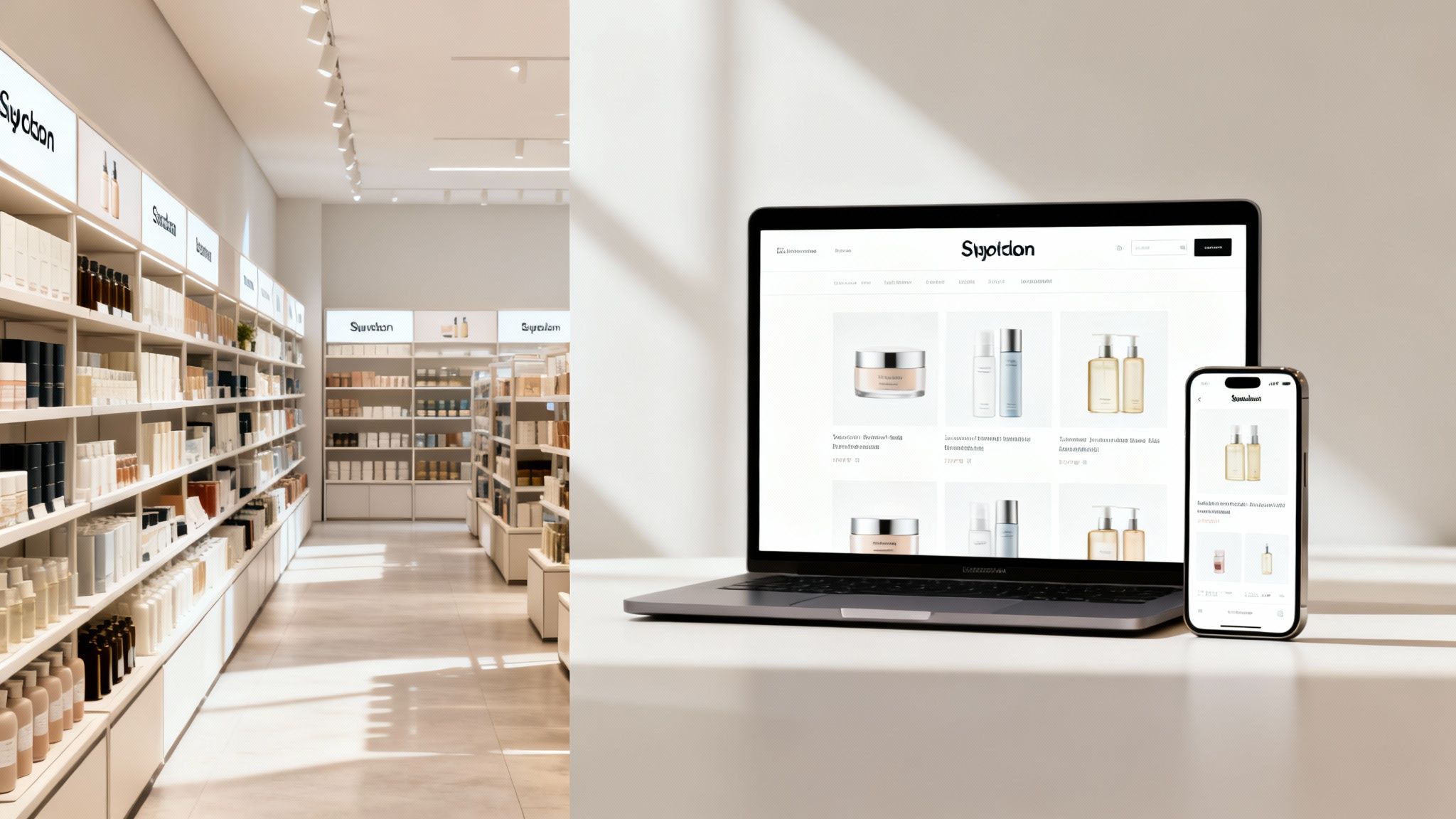
With a solid foundation in place, it’s time to shift from building to refining. This is the Optimization phase—where you polish every customer touchpoint to create a single, seamless brand journey, not a series of disconnected channels.
The goal is to eliminate friction. Your products should be easy to find, understand, and purchase, whether a customer is scrolling on their phone or walking down a store aisle. This consistency is the secret to building trust and driving sales in a world where shoppers move between online and offline without a second thought.
Your physical store is more than a point of sale; it's a stage for your brand's story. Smart in-store merchandising combines psychology and design to guide the customer journey, transforming a routine shopping trip into an experience that increases basket size and builds loyalty.
Think of your store layout as a roadmap. The path should feel intuitive, leading shoppers past high-margin items, new arrivals, and complementary products. A well-designed floor plan avoids dead ends and creates a natural flow that exposes customers to more of your assortment.
Key Insight: Your store’s visual merchandising is your silent salesperson. From lighting that highlights a product to a display that tells a story, every detail works to capture attention and communicate value without a single word.
To execute this effectively, focus on a few core elements:
Your e-commerce site is your digital flagship, and its merchandising deserves the same strategic attention as any physical location. The "digital shelf" must be visually compelling, easy to navigate, and persuasive enough to convert casual browsers into buyers.
First, high-impact product photography is non-negotiable. Since customers can't touch products online, your images must do the heavy lifting. Showcase items from multiple angles, use lifestyle shots to show them in context, and add video to demonstrate features and benefits.
Next, write product descriptions that sell. Move beyond technical specs and focus on the problems your product solves or the desires it fulfills. Use clear, benefit-driven language that speaks directly to your target customer and answers their questions proactively. For a deeper dive, check out our complete omnichannel retail strategy guide to boost your sales.
True omnichannel magic happens when your online and in-store experiences don't just align—they actively enhance each other. The critical link? Visual and brand consistency. Your logo, color palette, and brand voice must be identical everywhere.
A customer who discovers your brand on Instagram should feel that same energy the moment they walk into your store. This consistency builds powerful brand recognition and makes the entire shopping journey feel familiar and trustworthy, regardless of the channel.
This is where the two sides of the omnichannel coin work together. The table below breaks down how to align your merchandising efforts across both channels to ensure a smooth, consistent customer journey.
| Merchandising Element | In-Store Optimization Action | Online Optimization Action |
|---|---|---|
| Product Assortment | Ensure key online best-sellers are featured prominently. Use shelf space for discovery and impulse buys. | Offer an "endless aisle" with extended sizes, colors, and online-exclusive items. Use data to tailor recommendations. |
| Pricing & Promotions | Display clear, consistent pricing. Ensure in-store promotions are mirrored online and easily redeemable. | Sync all pricing and promotions with physical stores. Offer channel-exclusive deals (e.g., "online only"). |
| Visual Merchandising | Create compelling displays that tell a story. Use consistent branding, colors, and signage. | Use high-quality lifestyle photography, video, and a clean site design that reflects the in-store brand aesthetic. |
| Product Information | Use QR codes on shelves to link to detailed online product pages, reviews, and tutorials. | Write detailed, benefit-driven descriptions. Feature customer reviews, FAQs, and user-generated content prominently. |
| Inventory Visibility | Implement systems to show real-time stock levels for BOPIS (Buy Online, Pick-up In-Store). | Display local store inventory levels on product pages to drive foot traffic. Clearly communicate shipping times. |
| Customer Experience | Train staff to be brand experts who can assist with online orders. Offer easy in-store returns for online purchases. | Provide robust customer support via chat/email. Create a seamless mobile experience and an easy checkout process. |
By systematically checking off these actions, you ensure that a customer's experience feels like one continuous conversation with your brand. This cohesion is what turns one-time buyers into loyal advocates.
This is no longer a futuristic concept; it’s a core component of modern retail. In fact, 73% of consumers now use multiple channels during their shopping journey. By blending digital insights with physical execution—using tools like smart kiosks, QR codes, and real-time inventory sync—retailers are creating the unified experience customers have come to expect.

Once your foundation is solid and the customer experience is optimized, it’s time to turn up the volume. This is the Amplification phase, where your merchandising strategy shifts from passive presentation to active sales driver. Here, we transform your product displays into engaging, revenue-generating engines through smart promotions and powerful technology.
This part of the process is about creating buzz and giving shoppers a compelling reason to buy now. By blending classic promotional tactics with modern tech, you can build a dynamic retail environment that captures attention and boosts your bottom line across every channel.
A strong promotion is more than just a discount. It's a carefully planned event designed to achieve a specific business goal—whether that's clearing out seasonal inventory, increasing average order value, or rewarding loyal customers. Your promotional calendar is a core part of your retail merchandising strategies.
For a campaign to be effective, it must be merchandised consistently across every touchpoint. A customer should see the same offer, with the same look and feel, whether they are viewing an in-store endcap, a website banner, or a social media ad. This consistency builds trust and eliminates confusion.
Here are a few promotional tactics and how they translate across channels:
Technology is the ultimate force multiplier for your merchandising. It enables you to personalize offers, create immersive experiences, and close the gap between inspiration and purchase at scale. This is where your strategy truly comes to life.
Omnichannel retail is no longer a buzzword; it's a proven strategy. Retailers with effective omnichannel strategies see a 30% increase in customer lifetime value and 23% higher revenue growth. By integrating experiential elements like product demos and loyalty rewards, brands can boost in-store visits by 5-12%. It’s clear proof that blending digital tools with physical merchandising delivers results. You can explore how medium-sized retailers are adopting these trends for more data-driven insights.
Key Insight: Technology doesn't replace good merchandising; it amplifies it. The right tools can take a well-designed promotion and make it personal, interactive, and unforgettable.
Ready to start amplifying? Here are three technologies that are fundamentally changing how brands merchandise their products, both online and in-store:
By weaving these technologies into your strategy, you move beyond simply displaying products. You start creating active, engaging, and personalized shopping journeys that drive sales and build lasting loyalty.
A great strategy is only as good as the results it delivers. Merchandising without measurement is just guesswork. The key is to track a handful of key performance indicators (KPIs) that tell you if your efforts are actually moving the needle.
This isn’t about collecting data for its own sake. It’s about using specific metrics to understand what’s working, what isn’t, and where to focus your energy next. By connecting the dots between your in-store and online channels, you can get a complete picture of your performance and make smarter, data-driven decisions that fuel growth.
For your physical locations, success often comes down to how efficiently you use your space. You need metrics that show how well your floor plan and displays are converting foot traffic into revenue.
Start by tracking these foundational KPIs:
Online, the game shifts from physical space to digital attention. Your goal is not just to attract visitors but to guide them smoothly from a product page to checkout. Your KPIs must reflect this journey.
Focus on these critical online metrics:
Now, let's bring the most important metrics together in one place.
This table breaks down the essential metrics you should be tracking to evaluate the success of your merchandising strategies across both physical stores and your digital storefront.
| KPI | What It Measures | Channel (In-Store/Online/Both) |
|---|---|---|
| Sales Per Square Foot | The revenue generated for every square foot of sales space. | In-Store |
| Inventory Turnover | How quickly you sell through your entire stock within a specific period. | Both |
| Gross Margin Return on Investment (GMROI) | The profit returned for every dollar invested in inventory. | Both |
| Conversion Rate | The percentage of visitors who complete a purchase. | Online |
| Average Order Value (AOV) | The average amount customers spend per transaction. | Both |
| Cart Abandonment Rate | The percentage of shoppers who add items to their cart but don't buy. | Online |
| Customer Lifetime Value (CLV) | The total revenue a business can expect from a single customer account. | Both |
Monitoring these KPIs provides a clear, actionable report card on your merchandising efforts, helping you identify what's working and what needs adjustment.
The real power comes when you view these metrics not as separate lists, but as connected pieces of a single customer journey. For example, a spike in online "add to cart" rates for a specific product can inform which item you feature on an in-store endcap. This integrated approach creates a feedback loop where insights from one channel improve performance on the other.
Key Takeaway: Tracking core metrics helps you move beyond just looking at total sales. They reveal the underlying health of your operations, showing you whether your product assortment, store layout, and pricing strategies are working in harmony.
To build this unified view, you need to bring your data together. If you're ready to dive deeper, you can start by understanding the role of omnichannel analytics and how to centralize your data. The goal is to create a complete picture of customer behavior that helps you continuously refine your retail merchandising strategies.
Knowing the theory is one thing; putting it into practice is where the real growth happens. This is where we connect the dots, turning the concepts of Foundation, Optimization, and Amplification into a clear roadmap that delivers results. Think of this as your playbook for building a merchandising engine that works.
The key is not to try to do everything at once. A phased approach allows you to build momentum, test your ideas, and scale what’s proven to work.
To get started, treat the core framework—Foundation, Optimization, Amplification—as a sequential checklist. Each phase sets the stage for the next, ensuring your efforts are logical and built to last.
Solidify Your Foundation: Before anything else, get your operational house in order. This means analyzing sales data to audit your product assortment, ensuring pricing is consistent across all channels, and—most importantly—unifying your inventory management. A single, accurate view of your stock is the non-negotiable first step.
Optimize the Experience: Once your foundation is stable, shift your focus to the customer journey. Start by mapping out in-store planograms to guide shoppers effectively. Simultaneously, refine your digital shelf with high-quality photography and persuasive copy. The goal is total consistency; your brand should feel the same whether someone is on your site or in your store.
Amplify Your Efforts: With a seamless experience locked in, you can hit the gas. Plan your promotional calendar and leverage technology, like personalized email offers or interactive digital displays, to give your campaigns maximum impact.
Key Insight: The most successful brands don't achieve a perfect omnichannel strategy overnight. They start by mastering one thing—like unifying inventory—and then layer on new optimizations and amplifications over time. Progress always beats perfection.
The key is to begin with small, manageable tests. Instead of overhauling every planogram in every store, try a new layout in one or two locations and measure the sales lift. A/B test different product descriptions on your website to see what language resonates with your audience. For a deeper dive into maximizing your online potential, check out this ultimate guide to e-commerce optimization strategies.
This test-and-learn approach minimizes risk and provides the hard data you need to make bigger, more confident decisions. Once you find a tactic that works, document it and integrate it into your standard operating procedures. That’s how you turn a one-off experiment into a repeatable system for growth.
Ready to build a merchandising engine that delivers real results?
Let's Talk Growth
Even with a solid plan, questions are bound to arise as you move from strategy to execution. Here are straightforward answers to the questions we hear most often, designed to help you navigate the process.
If you're a smaller business, focus on consistency over complexity. You don't need a massive budget or sophisticated software to get started. You need a smart, cohesive plan.
Begin by ensuring your online product photos and descriptions perfectly match the look and feel of your physical store. The brand voice, the details—it all needs to align. Next, use the inventory system already built into your e-commerce platform (like Shopify or BigCommerce) to keep stock levels synced. When you run promotions, announce them across all channels using free tools like social media and email. The goal isn't to be everywhere at once; it's to create one unified brand experience wherever your customers find you.
The single biggest mistake is operating in silos—treating your online and physical stores like two separate businesses. When pricing, promotions, and branding don't match, you create a disjointed experience that erodes customer trust.
Key Takeaway: Today’s customers see one brand, not separate channels. A winning strategy tells the same story and offers a seamless journey no matter where someone interacts with you.
This disconnect is a common root cause of lost sales and frustrated shoppers. Aligning your teams and strategies isn't just a nice-to-have; it's the most critical step toward building a true omnichannel presence that grows your business.
There’s no one-size-fits-all answer—it depends on the part of the plan. Your high-level strategy should be reviewed quarterly. This is your opportunity to analyze KPIs, assess what's working, and make adjustments to stay aligned with your business goals.
The day-to-day execution, however, needs to be more agile:
This blended approach keeps your long-term vision steady while giving you the flexibility to react to customer behavior in real time.
Building a powerful, cohesive merchandising strategy is the key to sustainable growth. At RedDog Group, we specialize in turning these frameworks into measurable results, helping brands connect their physical and digital shelves to drive revenue. If you’re ready to move from planning to profitable action, we’re ready to help.
Leave a comment: