
Published: March 2020 | Last Updated:December 2025
© Copyright 2026, Reddog Consulting Group.

Over eighty percent of American ecommerce brands miss out on growth opportunities because they lack clear goals and ongoing performance analysis. In such a crowded and fast-paced market, guessing rarely pays off. When you define your American business objectives and monitor your real results, you turn vague ambitions into strategic action. This guide helps you unlock every step that leads to real revenue gains and smarter multichannel expansion.
| Key Insight | Explanation |
|---|---|
| 1. Set SMART ecommerce goals | Define specific, measurable objectives that align with your brand for effective growth planning. |
| 2. Choose high-impact sales channels | Analyze target demographics to prioritize sales channels that match your audience for optimal revenue potential. |
| 3. Optimize product listings carefully | Create detailed and visually appealing product presentations for improved discoverability and customer engagement. |
| 4. Launch data-driven marketing campaigns | Utilize audience segmentation for personalized marketing strategies that drive higher conversions and engagement. |
| 5. Continuously monitor and adapt strategies | Implement real-time performance tracking to identify trends and opportunities for ongoing ecommerce growth. |
Successfully launching an ecommerce growth strategy starts with crystal clear goal setting and rigorous performance evaluation. Your initial step involves creating precise, measurable objectives that align with your brand’s broader business vision and potential marketplace opportunities.
Begin by conducting a comprehensive performance audit across all your existing sales channels. Use analytics tools to extract key metrics like conversion rates, average order value, customer acquisition cost, and website traffic sources. Performance analysis requires systematic evaluation to understand your current standing and identify improvement opportunities. Focus on quantitative data points that reveal genuine insights about your online sales ecosystem.
Create specific goals using the SMART framework (Specific, Measurable, Achievable, Relevant, Time-bound). For instance, instead of a vague goal like “increase sales,” develop a precise target such as “increase monthly online revenue by 25% within the next six months by optimizing product listings and expanding marketplace presence.” These structured goals will serve as your north star, guiding strategic decisions and resource allocation across multichannel platforms.
Pro Tip: Always benchmark your performance against industry standards and your closest competitors. Understanding your relative market position helps calibrate expectations and identify realistic growth trajectories.
With clear goals and performance insights established, you are now prepared to develop targeted strategies for multichannel expansion and revenue growth.
Selecting the right sales channels is crucial for expanding your ecommerce reach and maximizing revenue potential. Your goal is to strategically identify and integrate platforms that align with your target audience and business objectives.
Multichannel data integration requires a comprehensive approach that goes beyond simply listing products across multiple platforms. Start by analyzing your target customer demographics and purchasing behaviors. Research which online marketplaces and sales channels your ideal customers frequently use. Consider popular platforms like Amazon, eBay, Etsy, social media marketplaces, and your own direct-to-consumer website. Evaluate each channel based on factors such as audience match, commission rates, setup complexity, and potential for brand visibility.
Prioritize channels that offer the best return on investment and align with your product type. Luxury goods might perform differently on platforms compared to mass-market items. The integration of sales channels directly impacts retail competitiveness and operational efficiency, so choose wisely and invest time in understanding each platform’s unique requirements and audience expectations.
Pro Tip: Before fully committing to a new sales channel, run small test campaigns to gauge performance and audience response. This approach minimizes risk and provides valuable insights into potential market opportunities.
With your high-impact sales channels identified, you are now ready to develop a strategic integration and optimization plan.
Optimizing your product listings and digital assets is a critical step in creating compelling online shopping experiences that drive conversions and enhance customer engagement. Your goal is to create detailed, visually appealing, and search-friendly product presentations across all sales channels.

Advanced database query integration can significantly improve product search accuracy, making your listings more discoverable and user friendly. Start by crafting comprehensive product descriptions that include key features, benefits, and unique selling points. Use high-quality images from multiple angles, ensuring they are professionally shot and optimized for web performance. Include detailed specifications, sizing charts, color options, and clear pricing information. Leverage keyword research to incorporate relevant search terms naturally into your titles, descriptions, and metadata.
User experience research demonstrates the critical role of listing optimization in driving customer decisions. Focus on creating clear, concise, and persuasive content that answers potential customer questions before they ask. Implement structured data markup to help search engines better understand and display your product information. Consider creating comparison charts, customer review sections, and video demonstrations to provide additional context and build trust.
Pro Tip: Regularly update your product listings based on customer feedback and performance analytics. What works today might need refinement tomorrow.
With optimized digital assets in place, you are now prepared to develop a strategic marketing approach to amplify your online presence.
Targeted marketing and sales campaigns are the powerhouse of multichannel ecommerce growth, transforming potential customer interest into measurable revenue. Your objective is to create strategic, data driven campaigns that connect with your ideal audience across multiple platforms.
Advanced machine learning models can help predict purchasing intent with remarkable accuracy, allowing you to develop more sophisticated marketing strategies. Begin by segmenting your audience based on demographics, past purchasing behavior, and engagement levels. Design personalized marketing messages that speak directly to each segment’s unique needs and preferences. Utilize a mix of channels including social media advertising, email marketing, retargeting campaigns, and platform specific promotional strategies.
Conversational recommender systems represent a cutting edge approach to pre sales engagement, enabling more interactive and personalized customer interactions. Develop content that addresses specific customer pain points, showcasing how your products solve real problems. Implement tracking pixels, utilize A/B testing for ad variations, and continuously monitor campaign performance metrics such as click through rates, conversion rates, and return on ad spend.
Pro Tip: Always allocate a small budget for experimental campaigns. What seems counterintuitive might become your most effective marketing strategy.
With targeted campaigns launched, you are now positioned to analyze results and refine your approach for sustained growth.
Successful multichannel ecommerce requires continuous performance tracking and strategic adaptation. Your objective is to develop a dynamic monitoring system that provides real time insights into your business performance across all sales channels.
Cross channel integration frameworks reveal critical insights into sales growth mechanisms, emphasizing the importance of comprehensive performance analysis. Implement robust analytics platforms that aggregate data from all your sales channels including website traffic, marketplace sales, social media engagement, and conversion metrics. Create a centralized dashboard that displays key performance indicators such as revenue per channel, customer acquisition costs, average order value, and return rates. Regularly compare your performance against predefined benchmarks and industry standards.
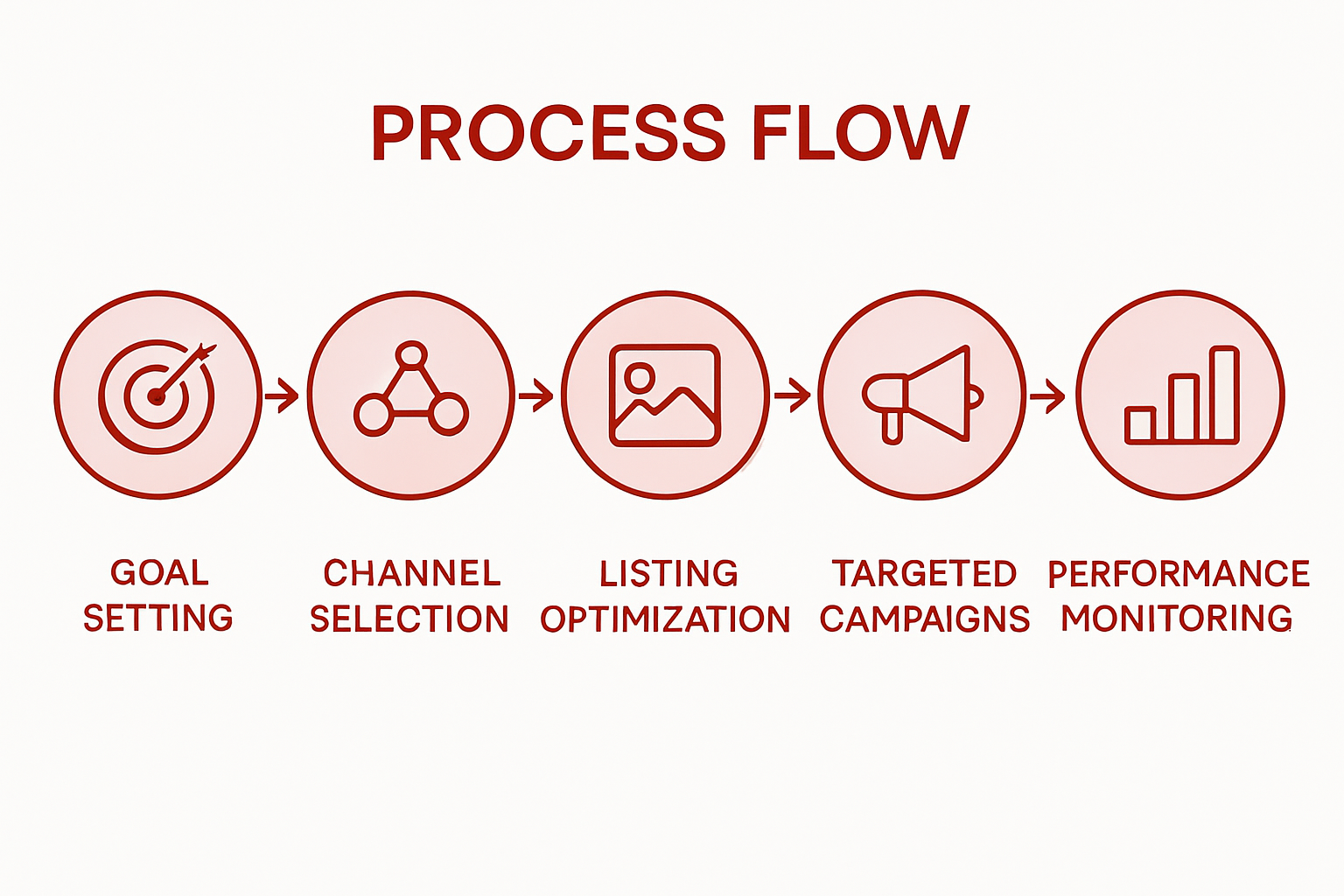
Multichannel commerce research highlights the significance of integrated performance monitoring, suggesting that successful businesses treat performance tracking as a continuous improvement process. Develop a systematic approach to analyzing performance data, looking for trends, anomalies, and opportunities for optimization. Set up automated alerts for significant performance fluctuations and schedule monthly or quarterly strategic review sessions to discuss insights and adjust your approach.
Pro Tip: Always maintain a forward looking perspective. Performance data is not just about understanding what happened but predicting and preparing for future market dynamics.
With a robust performance monitoring system in place, you are now equipped to make data driven decisions that will propel your multichannel ecommerce growth.
Navigating the complex process of ecommerce growth involves setting clear goals, integrating the right sales channels, and optimizing your product listings. This article highlights challenges like performance tracking and launching targeted campaigns that many businesses face when trying to expand multichannel success. If you are aiming to increase revenue, reduce customer acquisition costs, or improve your digital assets, these pain points require a specialized approach to achieve measurable growth.
At Reddog Group, we offer comprehensive Digital & Business Consulting Services by Reddog Consulting designed to tackle exactly these challenges. With our proven expertise managing thousands of SKUs and deep knowledge of omnichannel retailing, we help brand owners and retailers optimize marketplace presence, streamline inventory management, and launch tailored marketing campaigns with data-driven precision.
Discover how to turn your ecommerce ambitions into reality by partnering with experts who understand your market and goals. Visit our Home page to explore how our customized solutions can empower your business today. Don’t wait to enhance your multichannel success — take the next step now by visiting https://reddog.group and start growing your brand with confidence.
To initiate an Ecommerce Growth Workflow, clearly define your ecommerce goals and analyze current performance. Conduct a detailed performance audit across your sales channels, using metrics such as conversion rates and customer acquisition costs, to identify areas for improvement.
Use the SMART framework to set specific, measurable, achievable, relevant, and time-bound goals. For example, aim to increase monthly online revenue by 25% within six months through optimized product listings and expanded marketplace presence.
Consider your target audience demographics, purchasing behaviors, and the potential return on investment when selecting sales channels. Focus on platforms that align with your product type and where your customers are most active to maximize visibility and sales potential.
To optimize product listings, create detailed and visually appealing descriptions, and use high-quality images. Incorporate relevant keywords naturally into your titles and descriptions, while regularly updating listings based on customer feedback and performance analytics.
Segment your audience based on demographics and past behaviors to create personalized marketing messages. Utilize various channels like email and social media advertising, focusing your efforts on content that addresses specific customer needs to enhance engagement and drive sales.
Implement a robust analytics system to track key performance indicators such as revenue per channel and customer acquisition costs. Set up automated alerts for significant changes and schedule regular review sessions to analyze data and adjust strategies for continuous growth.
Leave a comment: