
Published: March 2020 | Last Updated:December 2025
© Copyright 2026, Reddog Consulting Group.

A successful product launch isn't a single event. It's the culmination of a deliberate strategy that begins months before a customer ever clicks "buy." This initial work—what we call the Foundation phase—covers everything from market research and supply chain logistics to defining what success actually looks like. It’s what separates a breakout product from an expensive flop.
Getting this right is the difference between scaling smoothly and scrambling to fix operational issues after you’ve already gone live. It’s about building a launchpad for sustained, measurable growth.
Every successful product launch is built on a solid operational and strategic foundation. This is the first pillar of our growth framework: Foundation. Before a single marketing dollar is spent, the heavy lifting of research, planning, and operational readiness must be complete.
Skipping this stage is like building a house on sand. It might look impressive on day one, but it won't withstand the pressure of a competitive market.
The goal here is to move beyond vanity metrics and define success with clear, measurable Key Performance Indicators (KPIs) tied directly to business growth, not just launch-day buzz. This is also where you conduct a competitive analysis that delivers a real edge. Go deeper than pricing. Analyze customer reviews to find pain points your product solves. Study their marketing to identify messaging gaps. Map their omnichannel distribution to see where you can win—whether on Amazon, your Shopify store, or in physical retail.
Before you sell anything, you must know exactly who you're selling to and how you'll measure success on each channel. A common mistake is creating a single, generic customer persona. In an omnichannel world, you need to understand your audience's mindset across different platforms.
An Amazon shopper seeking a quick, practical solution behaves differently than a brand loyalist browsing your Shopify site or an impulse buyer at Target. Your KPIs must reflect this reality.
A robust go-to-market plan requires this level of channel-specific detail. For a deeper dive, check out our guide on how to build a go-to-market strategy for startups.
To manage the complexity of an omnichannel launch, we use a 90-day countdown. This timeline transforms potential chaos into a structured, manageable process, ensuring all operational heavy lifting is completed well before the marketing push begins.
This visual timeline breaks down the essential milestones, from high-level legal and operational tasks at 90 days out to final marketing preparations at the 30-day mark.
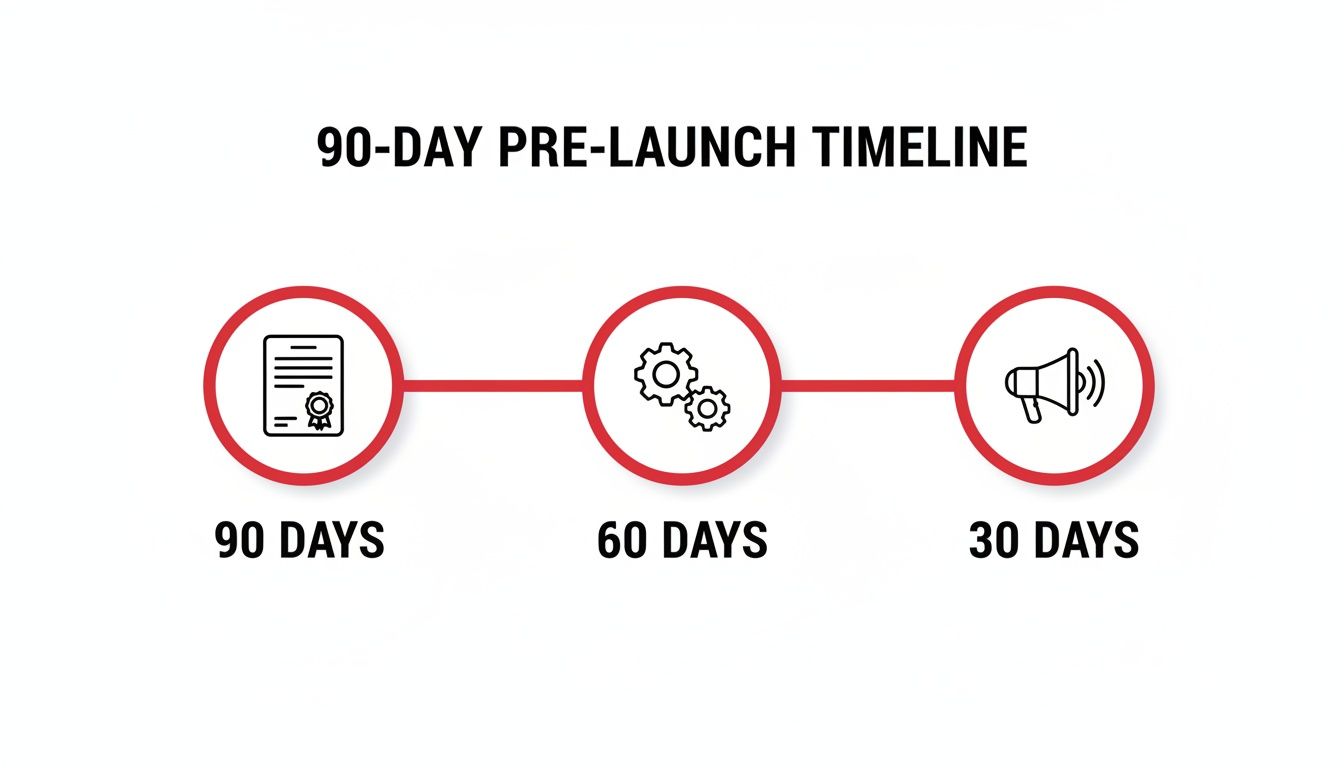
This structured approach prevents last-minute emergencies. By addressing foundational elements like supply chain logistics and legal trademarks early, you free up critical resources for Optimization and Amplification when it matters most—right before launch.
To provide more clarity, here’s a sample timeline we use to map out the essentials.
This table breaks down the 90-day countdown into actionable milestones, mapping key tasks across departments. It’s designed to ensure all foundational work is completed methodically, preventing last-minute scrambles and setting the stage for a smooth, successful launch.
| Timeframe | Key Milestone | Primary Channel Focus (e.g., Ops, Marketing, Legal) |
|---|---|---|
| 90 Days Out | Finalize product design and packaging. Secure official GS1 UPCs. File for necessary trademarks. Lock in manufacturing and 3PL partners. | Ops / Legal |
| 60 Days Out | First production run begins. Start initial creative development (photography, video). Build out product listings (Amazon, Shopify). Begin SEO keyword research for all channels. | Ops / Marketing |
| 30 Days Out | Finalize all marketing creative and ad copy. Set up paid media campaigns (e.g., Amazon Ads, Google Ads). Initial inventory arrives at 3PL. Plan influencer outreach and PR push. | Marketing |
| 1 Week Out | Final QA checks on all live listings and website pages. Confirm inventory levels are accurate. Schedule launch day emails and social media posts. Prepare customer service team for influx. | Marketing / Ops |
By following a timeline like this, you ensure that on launch day, your focus is on execution and optimization, not damage control. It’s about being proactive, not reactive.
Key Takeaway: The single biggest mistake brands make is underestimating inventory needs and overlooking supply chain details. Running out of stock during your launch kills sales velocity and destroys your algorithmic ranking on platforms like Amazon. Plan for success by building a robust sales forecast and ordering enough inventory to meet it.
Ultimately, this foundational stage is about building a well-oiled machine. It’s about locking down every operational detail—from securing UPCs to finalizing 3PL partnerships—so that when the first orders roll in, your backend systems can handle the volume without a single hiccup.
With your operational foundation secure, it's time to focus on the digital shelf. This is where we enter the Optimization phase of our framework. It’s about transforming your product pages into high-performance conversion assets that work 24/7.
Think of your product pages on Amazon, Walmart, and Shopify as your digital salespeople. They must capture attention, answer questions, overcome objections, and close the sale—all without human interaction. If they underperform, even the best product launch strategies will fail.
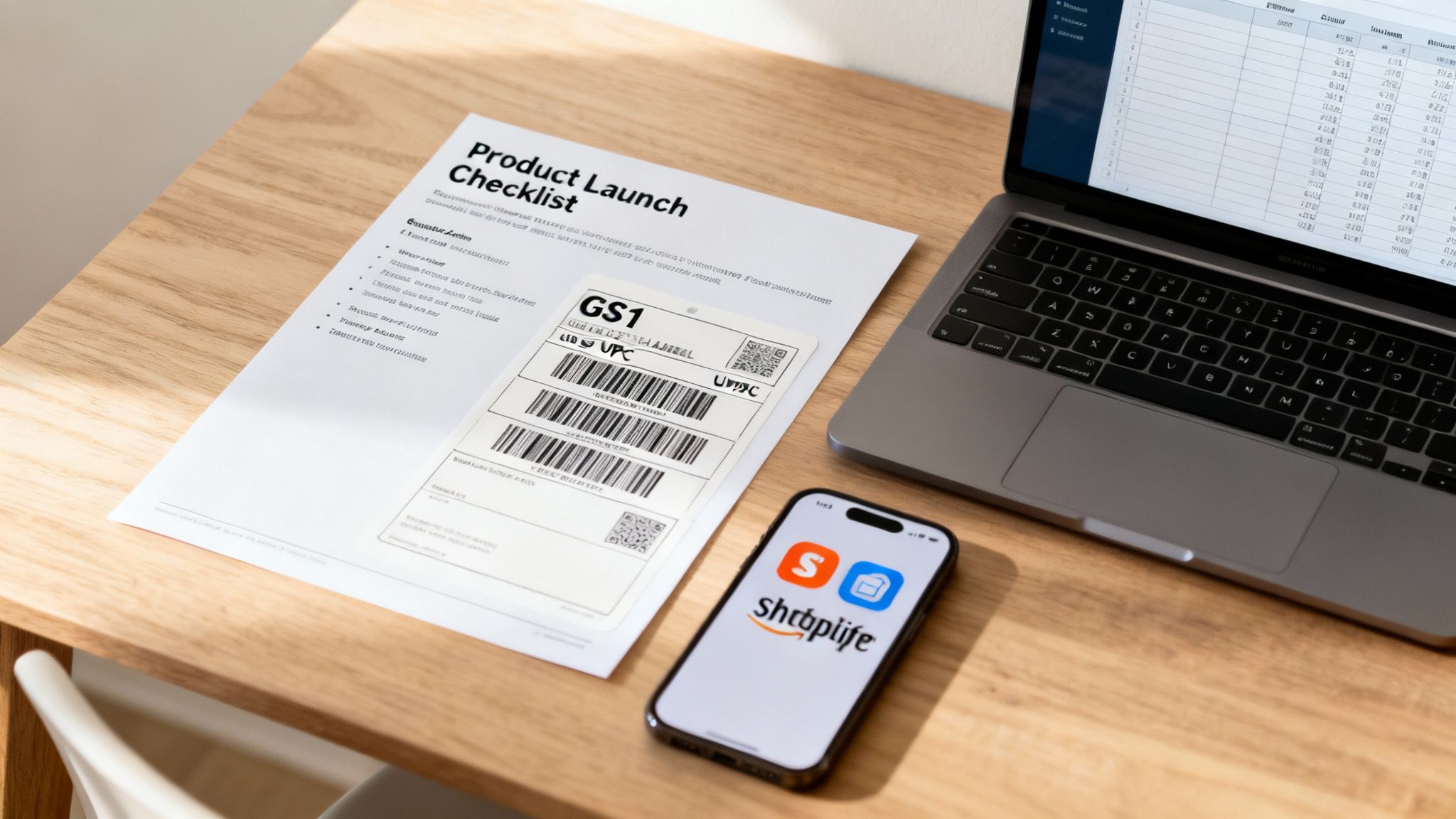
A common misstep is using the same creative assets across every channel. An effective omnichannel strategy isn't "one size fits all"; it's about tailoring your message and visuals to the shopper's mindset on each specific platform.
For example, a home goods product might use a technical graphic with dimensions as its hero image on Amazon, instantly answering a practical question for a high-intent buyer. On Shopify, however, that same shopper may be seeking inspiration. A beautifully styled lifestyle photo showing the product in a real home would be more effective at creating an emotional connection and driving the sale.
This is why a deep library of creative assets is non-negotiable.
You can have the most persuasive product page in the world, but it’s worthless if no one can find it. Keyword research is the engine of discoverability, ensuring your product appears the moment a customer starts searching.
This requires understanding search intent—distinguishing between high-volume "head" terms and the more specific, long-tail keywords that signal a customer is ready to buy.
We’ve seen brands double their day-one traffic simply by prioritizing a less competitive, long-tail keyword in their title. For a new kitchen gadget, instead of competing on the broad term "blender," they ranked for "quiet personal blender for smoothies," capturing highly qualified buyers and building early sales velocity.
A strong keyword strategy incorporates all three types:
Monitoring keyword performance is essential. Mastering your digital shelf analytics helps you see what's working and identify opportunities your competitors have missed.
Great photography and video do more than just make your product look good; they answer questions before they’re asked and build critical trust. Since shoppers can't physically touch your product, your visuals have to do all the heavy lifting.
Your visual asset library should be comprehensive. A great guide to product explainer video production can be a game-changer, helping you showcase your product in a way that truly connects. Go beyond standard white-background shots.
By investing in a well-rounded and channel-specific digital shelf, you stop just listing a product and start actively selling it. That's how you turn initial launch-day views into real, sustainable growth.
You can have a superior product and a perfectly optimized listing, but launching at the wrong time will undermine your efforts. The when of your launch is as critical as the what. This isn’t about guesswork; it's a calculated decision to align your market entry with peak consumer demand.
A strong debut requires orchestrating your timing across every channel—Amazon, Walmart, and your own Shopify site—to create a unified push. This coordinated effort drives the initial sales velocity that marketplace algorithms reward, giving you better organic visibility right from the start.
First, understand the rhythm of your industry. Launching a new grilling accessory in November is an uphill battle, just as launching tax software in May is a guaranteed miss. Look beyond major holidays to identify the micro-seasons relevant to your niche.
Consider the fitness industry. The January resolution rush is well-known, but there's also a "get ready for summer" spike in late spring. Launching into these natural waves of demand provides a tailwind, making your marketing dollars work harder.
Data reinforces this principle. Recent analysis of tech product launch statistics shows that launches in March see a 16% higher success rate than other months, often attributed to fresh Q1 budgets. October is a close second with a 14% higher success rate, driven by end-of-year purchasing momentum. While this data is tech-focused, the concept applies across categories.
A powerful launch doesn't just happen on day one. It begins weeks earlier with a carefully orchestrated hype cycle. The goal is to build an audience that is not just aware of your product but is genuinely excited and ready to buy the moment it goes live. This is about creating a slow burn of anticipation rather than a single big reveal.
Here’s how to prime the pump:
Key Insight: Don't just announce the launch date. Create a VIP list offering exclusive early access or a special launch-day discount for sign-ups. This simple tactic converts passive followers into committed buyers and provides a valuable forecast of initial demand.
For brands selling across multiple channels, a staggered launch is a significant missed opportunity. Launching on your Shopify site one week and on Amazon the next dilutes your marketing impact and confuses customers. A synchronized launch creates a powerful synergy that makes your brand presence feel cohesive and impactful.
This means all your assets—listings, ads, social posts, and emails—go live at the same time. This unified front creates a consistent customer journey and concentrates your marketing firepower. When a shopper sees your product in an Instagram ad, searches for it on Amazon, and finds the exact same branding and messaging, it builds immediate trust and drives conversion. That's how you turn a product release into a market-defining event.
With your listings optimized and foundation solid, it’s time to ignite the launch. This is the Amplification phase, where a strategic marketing blitz converts all that careful planning into measurable market momentum.
The goal isn't just to make noise. It's to kickstart a growth flywheel where paid media generates initial sales, which in turn fuels organic ranking and long-term brand growth.
Paid advertising is the catalyst for immediate traffic and sales. On marketplaces like Amazon and Walmart, this initial velocity is a powerful signal to their algorithms, helping you climb organic rankings far faster than you could on your own.
From day one, bid aggressively on your core, high-intent keywords. Concentrate your ad spend on the handful of highly relevant keywords identified in the planning phase to ensure you dominate the digital shelf for the shoppers most likely to convert.
While paid ads kickstart momentum, your organic strategy builds profitable, long-term growth. These efforts create trust and credibility in a way advertising cannot. The key is to get these initiatives moving before launch day so they land with maximum impact.
Your organic marketing should feel authentic. It’s about engaging with communities where your target audience already spends time, not just broadcasting messages into the void.
Our Takeaway: The best product launch strategies treat paid and organic marketing as two sides of the same coin. Paid ads generate the sales history needed to rank, while organic buzz and positive reviews sustain that rank long after you scale back ad spend. This creates a profitable, defensible market position.
A powerful marketing mix doesn't operate in silos. Each channel should support the others, creating a feedback loop that strengthens the entire launch. For example, high-performing user-generated content from your influencer campaign can be repurposed into your most effective social media ads.
To maximize reach, consider integrating tactics like AI-powered User Generated Content (UGC) ads. This approach blends the authenticity of customer content with the scale of paid advertising, creating campaigns that build trust and drive conversions.
A successful launch comes down to understanding how all the pieces fit together. For a deeper look at connecting these channels, check out our guide on omnichannel marketing integration for retail growth.
To make this more concrete, here's a look at how we typically approach a marketing budget allocation for a new product launch.
This table shows how a budget can be distributed across different marketing channels to create a powerful flywheel effect, ensuring every dollar works to drive both immediate sales and long-term brand equity.
| Marketing Channel/Activity | Budget Allocation % | Key Objective |
|---|---|---|
| Marketplace PPC | 40% | Drive initial sales velocity, boost organic rank, and gather early reviews. |
| Social Media Ads | 20% | Build brand awareness, drive DTC traffic, and capture email sign-ups. |
| Influencer/UGC | 15% | Generate authentic social proof and create content for ads. |
| PR & Affiliate Outreach | 15% | Secure third-party validation and open new commission-based sales channels. |
| Email Marketing | 10% | Nurture pre-launch leads and drive a concentrated sales spike on launch day. |
This balanced approach ensures you’re not just renting traffic but building a defensible brand. By combining aggressive paid campaigns with trust-building organic efforts, you create the momentum needed to turn a new product into a category leader.
Launch day isn't the finish line—it's the starting pistol. The real work begins the moment your first orders arrive and data starts telling a story. This is where your brand's agility is tested as you shift from a static launch plan to a dynamic growth strategy.
The first 30 days are a critical feedback loop. Your ability to monitor key metrics in real-time—and make smart, data-driven adjustments—will determine whether launch momentum builds into sustained success or fizzles out.
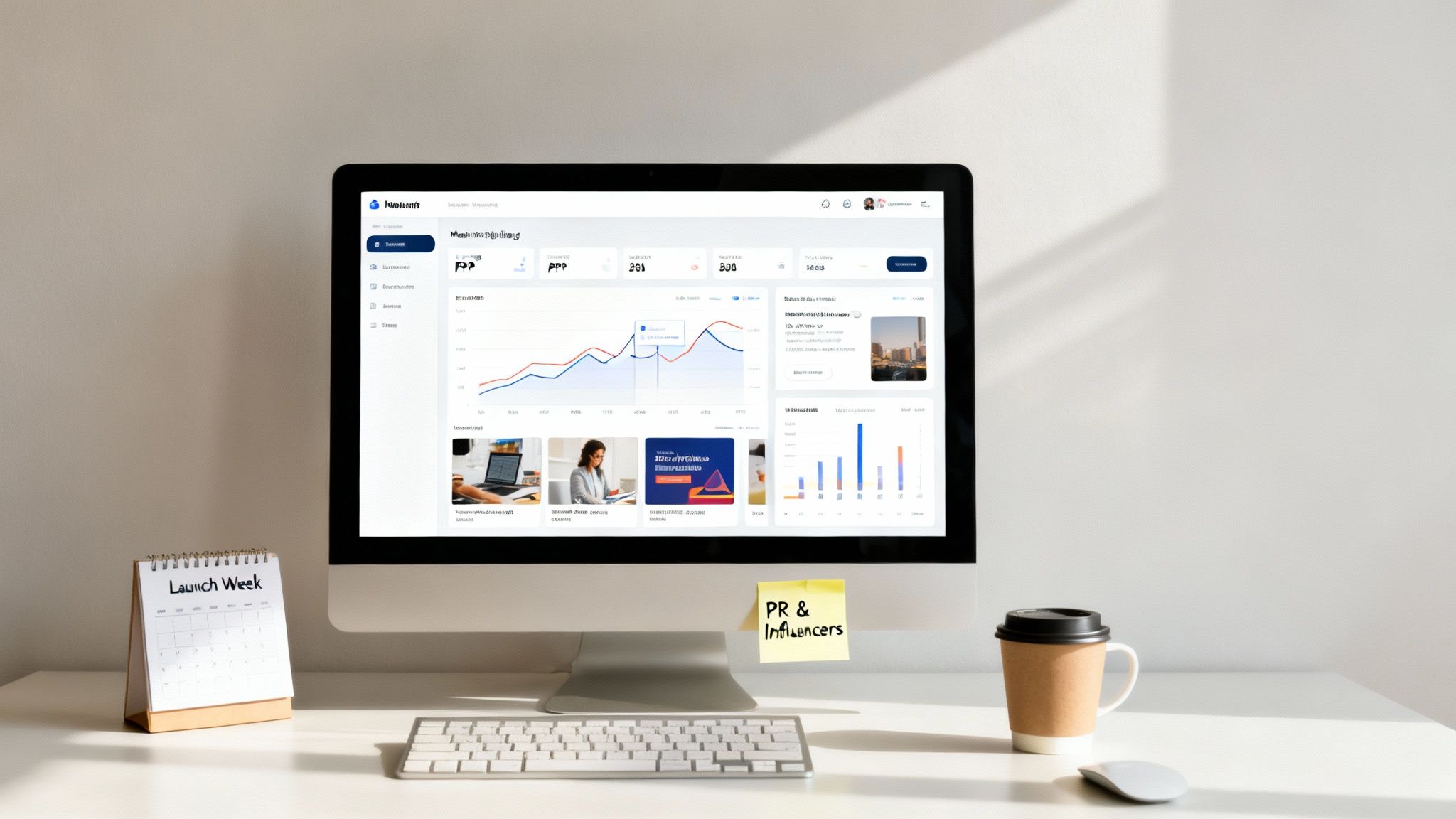
On launch day, your team needs a central dashboard pulling data from every channel for a clear, real-time view of performance. Forget vanity metrics like impressions; focus on the numbers that actually drive growth.
Here are the metrics to watch like a hawk:
This isn't about passively watching numbers. It's about diagnosing problems before they can derail your launch. A sudden drop in conversion rate, for example, could mean a competitor just undercut your price, and you need to respond now.
Here’s a hard truth: no product launch strategy survives first contact with the customer. You will have to make changes. The brands that win are the ones that adapt the fastest.
What happens when your top-researched keyword isn't getting clicks? Pivot. Shift that budget to secondary keywords that are performing, even if their search volume is lower. A sale from a long-tail keyword still counts toward your sales velocity and boosts your ranking.
Or perhaps you get an unexpected flood of customer service tickets. Don't panic—this is a goldmine of feedback. If five different people are asking the same question about your product's dimensions, that's a clear signal to update your main image with an infographic that provides the answer visually.
Our Takeaway: Treat your launch as a series of micro-battles, not one big war. Winning means having a dedicated team empowered to make quick decisions. If an ad isn't working, kill it. If a customer question reveals a gap in your content, fill it. Speed is your biggest advantage in the first 72 hours.
Even the best-laid plans can go sideways. Having a contingency plan for common hurdles is what separates professional execution from panicked scrambling. Anticipate these problems and have solutions ready to deploy.
Here’s a look at a few common scenarios and how to prepare for them:
| Potential Hurdle | Contingency Plan |
|---|---|
| Negative Initial Reviews | Have a customer service script ready to respond publicly and professionally. Offer a replacement or refund right away, and use that feedback to update your product listing or packaging. |
| Inventory Miscalculations | Selling out too fast? Immediately switch your ad campaigns to focus on pre-orders or building an email "notify me" list to capture that demand. Don't let valuable traffic go to waste. |
| Unexpected Shipping Delays | Communicate proactively with your customers. Send an email explaining the delay and maybe offer a small discount on a future purchase. Transparency builds way more trust than silence. |
Ultimately, the post-launch phase is about listening intently to the market and responding with speed and precision. Every customer review, every sales report, and every support ticket is a piece of the puzzle. By embracing this feedback loop, you turn your launch from a one-time event into the first step of a sustainable growth engine.
Even the most buttoned-up brands run into a few curveballs when planning a product launch. It’s a complex process with a ton of moving parts across operations, marketing, and sales. We get it. Here are the straight-up, actionable answers to the questions we hear most often.
For a smooth omnichannel launch, you need a bare minimum of 3-4 months for planning. This isn't just about picking a date; this is your runway to get the entire Foundation phase right without cutting corners. It gives you enough time to handle everything from locking down manufacturing and securing GS1 UPCs to sorting out freight and building a full suite of killer creative assets.
Rushing this part of the process is one of the most common—and expensive—mistakes brands make. It almost always leads to day-one stockouts, weak listings that don’t convert, and a fizzled-out market entry that’s incredibly hard to recover from. That solid 90-day window lets you build real anticipation, coordinate properly with retail partners, and make sure your ops can actually handle the sales you’re working so hard to drive.
That launch-day revenue number is exciting, but it doesn't tell the whole story. To get a real read on your launch performance, you need to be looking at a balanced set of KPIs that show both immediate sales and long-term growth potential.
Keep a close eye on these core metrics across your channels:
Tracking these numbers gives you a complete picture, helping you see what’s working and what needs to be fixed now to keep the momentum going.
Your marketing budget is obviously going to depend on your product’s price point and how crowded your category is. But a good rule of thumb is to set aside a marketing budget equal to 20-30% of your first three months' revenue forecast. This is the fuel you need for the Amplification phase of the launch.
For a typical consumer product, we see brands get the best results by splitting that budget up strategically:
The most important thing is to stay flexible. Be ready to shift your budget around based on what’s actually delivering the best return on investment (ROI) in those first few weeks. If one channel is crushing it, don’t hesitate to double down.
The single biggest—and most catastrophic—mistake we see is underestimating inventory and glossing over supply chain logistics. Brands get so caught up in the fun stuff like marketing and creative that they forget to actually plan for success.
Running out of stock during your launch is absolutely devastating. It completely torpedoes your sales velocity, tanks your rankings on marketplaces like Amazon and Walmart, and throws the door wide open for competitors to steal the momentum you spent months building. Our Foundation pillar is built around getting operations and inventory forecasting locked in before you spend a dime on ads. Always have a contingency plan and make sure your supply chain is ready for a best-case scenario, not just an average one.
At RedDog Group, we turn complex launch plans into measurable growth. We build the foundation, optimize the channels, and amplify the results to ensure your next product doesn’t just launch—it leads.
Ready to scale with a team that knows how to win? Let’s Talk Growth.
Leave a comment: