
Published: March 2020 | Last Updated:December 2025
© Copyright 2026, Reddog Consulting Group.

Over half of American retail brands struggle to unify sales data from their growing number of sales channels. With each new e-commerce platform, physical store, or marketplace, tracking performance quickly becomes complex and time-consuming. By focusing on simple strategies to measure and analyze sales metrics across all channels, American e-commerce managers can turn overwhelming data into practical actions that support profitable growth.
| Key Insight | Explanation |
|---|---|
| 1. Define sales metrics clearly | Identify key metrics such as conversion rates and sales volume to gauge business health effectively. |
| 2. Implement integrated tracking systems | Choose technology solutions that unify data collection from all sales channels for real-time insights. |
| 3. Establish robust data management | Create standardized protocols and centralized repositories to streamline data collection and organization. |
| 4. Analyze metrics for actionable trends | Use multi-layered analytical approaches to uncover significant patterns in sales data and customer behavior. |
| 5. Verify insights for accuracy | Regularly audit and validate data collection systems to ensure reliable insights and maintain data integrity. |
Tracking sales performance across multiple retail channels requires identifying the right metrics and gathering comprehensive data sources. By establishing clear measurement standards, you can gain actionable insights into your business performance and growth potential.
To effectively track sales performance, focus on key metrics that reveal your business health. These include conversion rates across different retail channels, total sales volume, average transaction value, and product performance by region. Critical data sources encompass transactional records from e-commerce platforms, point-of-sale systems, customer relationship management software, and inventory management tools. Integrating data from online marketplaces, physical stores, and direct sales channels provides a holistic view of your retail ecosystem.
Start by mapping out your current sales channels and identifying the unique metrics most relevant to each. Online platforms might prioritize web traffic and click-through rates, while physical stores focus more on sales per square foot and customer foot traffic. Collect data consistently across platforms to ensure accurate comparative analysis.
Pro Tip: Create a centralized dashboard that aggregates metrics from all sales channels to simplify tracking and enable real-time performance monitoring.
Here’s how popular retail sales metrics compare in terms of business insights and strategic impact:
| Metric | Reveals About Business | Strategic Use |
|---|---|---|
| Conversion Rate | Customer purchase efficiency | Channel optimization decisions |
| Sales Volume | Overall business scale | Revenue forecasting |
| Avg Transaction Value | Customer spending patterns | Pricing and bundling tweaks |
| Regional Product Sales | Local market preferences | Targeted marketing campaigns |
Successfully tracking sales performance across multiple retail channels requires implementing a comprehensive and integrated tracking system that captures data seamlessly from every sales platform. Your goal is to create a unified approach that provides real-time insights into your entire retail ecosystem.
Begin by selecting technology solutions that enable standardized tracking systems across different retail platforms. This involves investing in robust information systems that can collect and synchronize data from point-of-sale terminals, e-commerce platforms, mobile applications, and physical store environments. Look for software solutions that support universal product identification, utilize advanced barcode technologies, and offer flexible integration capabilities. Modern retail tracking systems leverage wireless technologies, RFID tags, and cloud-based platforms to ensure data accuracy and provide comprehensive visibility into sales performance.
Ensure your tracking system includes key components like centralized inventory management, real-time sales reporting, and cross-channel performance analytics. Configure your system to automatically aggregate data from different sources, allowing you to compare performance metrics, identify trends, and make informed strategic decisions. Regularly test and validate your tracking integrations to maintain data integrity and address any potential synchronization challenges.
Pro Tip: Select tracking systems with API compatibility that allow seamless data exchange between different platforms and enable future scalability of your retail operations.
Below is a summary of key technologies and their role in integrated sales tracking:
| Technology | Functionality Provided | Business Benefit |
|---|---|---|
| Cloud Platforms | Real-time data sync | Unified, accessible insights |
| RFID Tags | Automated item tracking | Accurate inventory analysis |
| API Integration | Seamless data exchange | Scalability and flexibility |
| Barcodes | Efficient product ID | Faster checkout, error reduction |
Efficiently collecting and organizing sales data is crucial for gaining actionable insights across your retail channels. Your objective is to develop a systematic approach that transforms raw sales information into a structured, easily analyzable format.
Start by implementing comprehensive data management strategies that streamline sales information collection. This involves establishing standardized data collection protocols across all sales platforms. Utilize robust database systems and data warehouses that can integrate information from point-of-sale systems, e-commerce platforms, mobile sales channels, and physical store transactions. Ensure your data collection methods capture key metrics such as transaction volume, product details, customer demographics, sales timestamps, and revenue figures.
Create a centralized data repository that allows for easy categorization and retrieval of sales information. Implement consistent data formatting and tagging protocols to ensure uniformity across different sales channels. Develop automated data cleaning processes that can identify and resolve inconsistencies, duplicate entries, and incomplete records. Regularly audit your data collection systems to maintain high-quality, reliable sales information that supports strategic decision making.

Pro Tip: Invest in cloud-based data management solutions that offer real-time synchronization and scalable storage capabilities for your growing sales data collection needs.
Unveiling meaningful insights from your sales data requires a strategic approach to metric analysis that goes beyond surface-level numbers. Your mission is to transform raw data into compelling business intelligence that drives informed decision making.
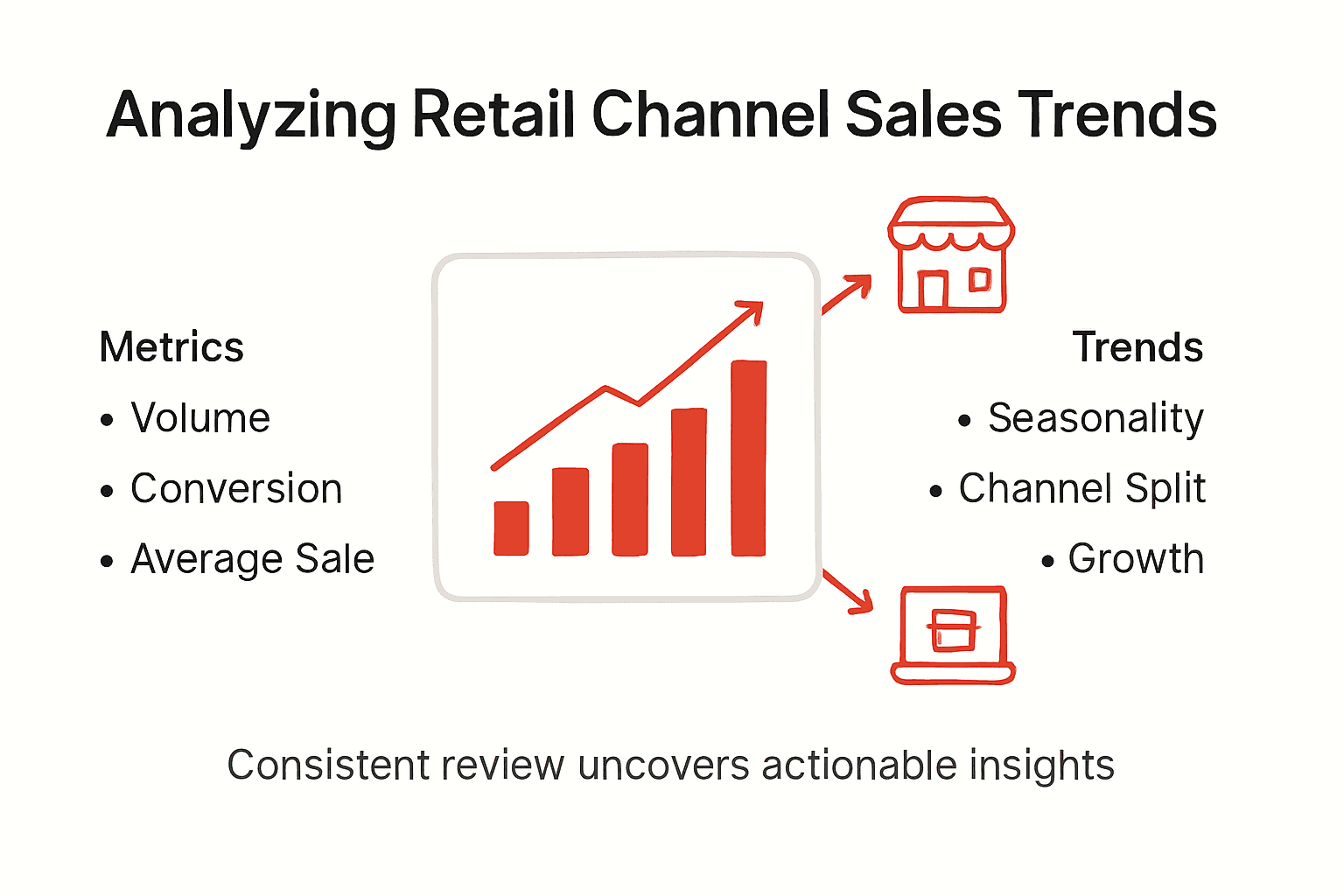
Comprehensive retail analytics techniques can help you systematically uncover trends across your multiple sales channels. Employ a multi-layered analytical approach that includes descriptive analytics to understand what happened, diagnostic analytics to determine why specific outcomes occurred, and predictive analytics to forecast potential future performance. Focus on comparing performance metrics across different channels, identifying patterns in product sales, customer purchasing behaviors, seasonal variations, and revenue fluctuations. Use data visualization tools to create intuitive dashboards that highlight key performance indicators and make complex data easily interpretable.
Develop a consistent analysis routine that examines your sales metrics from multiple perspectives. Compare year-over-year performance, analyze channel-specific trends, and look for correlations between different data points. Pay special attention to anomalies or unexpected shifts in sales patterns that might indicate emerging opportunities or potential challenges. Break down your analysis by product categories, customer segments, geographic regions, and sales channels to gain a nuanced understanding of your business performance.
Pro Tip: Schedule monthly deep-dive analysis sessions where you critically examine your sales metrics beyond standard reporting to uncover hidden insights and strategic opportunities.
Ensuring the reliability of your sales performance tracking requires a systematic approach to data validation and continuous improvement. Your goal is to develop a robust verification process that maintains the highest standards of data accuracy and insights quality.
Implement structured metric validation techniques that rigorously test the integrity of your sales tracking systems. This involves establishing clear data quality benchmarks, conducting regular audits of your tracking mechanisms, and creating cross-referencing protocols that can identify potential discrepancies. Develop a comprehensive verification workflow that compares data across different sources, checks for anomalies, and validates the consistency of your sales performance metrics. Pay close attention to potential data collection biases, technical integration issues, and measurement inconsistencies that could compromise your analytical insights.
Create a continuous improvement cycle for your tracking systems by establishing feedback loops and periodic performance reviews. Set up automated data integrity checks that flag unusual patterns or potential errors in real time. Regularly recalibrate your metrics to ensure they remain aligned with your evolving business objectives. Implement a systematic approach to tracking system refinement that includes quarterly reviews of your data collection methods, measurement criteria, and analytical tools.
Pro Tip: Develop a dedicated data quality dashboard that provides real-time visibility into the accuracy and reliability of your sales tracking metrics.
Tracking sales performance across multiple retail channels often feels overwhelming due to the complexity of integrating diverse data sources and managing accurate metrics like conversion rates and average transaction value. If you are facing challenges in setting up integrated tracking systems or analyzing sales data to uncover actionable trends, you are not alone. Many growing businesses struggle to maintain data integrity while striving for real-time performance monitoring and strategic growth.
Reddog Group specializes in helping businesses master omnichannel retailing by providing tailored digital and business consulting services that streamline your sales tracking efforts. With proven expertise in marketplace management, Amazon FBA, and both online and offline sales strategies, Reddog delivers measurable improvements in revenue growth and operational efficiency. Let us help you implement robust tracking solutions, optimize marketplace listings, and execute strategic marketing campaigns designed specifically for your unique retail ecosystem.
Don’t let fragmented sales data hold your brand back. Explore Digital & Business Consulting Services by Reddog Consulting to discover how we can empower your omnichannel strategy today. Visit our Home page for client success stories and detailed service descriptions. Take the next step to transform your retail performance now by connecting with us at Reddog Group. Your path to unified sales tracking and sustainable growth starts here.
To effectively track sales performance, focus on key metrics such as conversion rates, total sales volume, average transaction value, and regional product performance. Identify the most relevant metrics for each retail channel to tailor your analysis and insights.
Begin by selecting technology solutions that integrate data from all your sales platforms, such as point-of-sale systems and e-commerce platforms. Ensure these solutions support real-time data synchronization and can handle universal product identification.
Establish standardized data collection protocols across all sales platforms and utilize a centralized data repository for easy organization. Implement automated data cleaning processes to resolve inconsistencies and maintain a high quality of data.
Employ a multi-layered analytical approach, including descriptive, diagnostic, and predictive analytics, to systematically uncover trends. Regularly review performance metrics month-over-month to identify patterns and correlations in your sales data.
Implement structured metric validation techniques, such as conducting regular audits and establishing data quality benchmarks. Create a continuous improvement cycle that includes automated integrity checks to maintain high standards of reliability in your sales metrics.
Leave a comment: