
Published: March 2020 | Last Updated:December 2025
© Copyright 2026, Reddog Consulting Group.

When we talk about listing optimization on Amazon, we're referring to the process of turning your product page into a high-performance sales engine. It’s a systematic upgrade of every element—from the title to the last image—designed to rank higher in Amazon's search results, attract more clicks, and convert more shoppers into loyal customers.
This isn't just about satisfying Amazon's A10 algorithm; it's about making a clear, compelling case to real people, showing them why your product is the solution they've been looking for.
Think of your Amazon listing as more than just a product page. It's your digital storefront, your 24/7 salesperson, and your brand's first impression on the world's largest product search engine. A well-optimized listing is the foundational pillar for scaling your brand on the platform. It's the key differentiator that separates products that get lost in the noise from those that consistently command top search positions.
Imagine two brands selling a nearly identical stainless-steel water bottle. The first has a basic listing: a simple title, a few uninspired photos, and a generic description. The second brand has invested in optimization: a benefit-driven title, high-quality lifestyle images, bullet points that solve customer problems, and rich A+ Content that tells a compelling brand story.
Which one will generate more traffic, earn more clicks, and secure more sales, even at a slightly higher price point? The second one, every time. They didn't just list a product; they built an asset that communicates value and builds trust.
At RedDog Group, we implement a proven framework for omnichannel growth: Foundation → Optimization → Amplification. A fully optimized Amazon listing is the non-negotiable 'Foundation' of this entire strategy. Without it, every dollar spent on advertising and external marketing—from paid search to social media campaigns—will underperform.
This is our simple, three-step process for building a durable and profitable brand on Amazon.
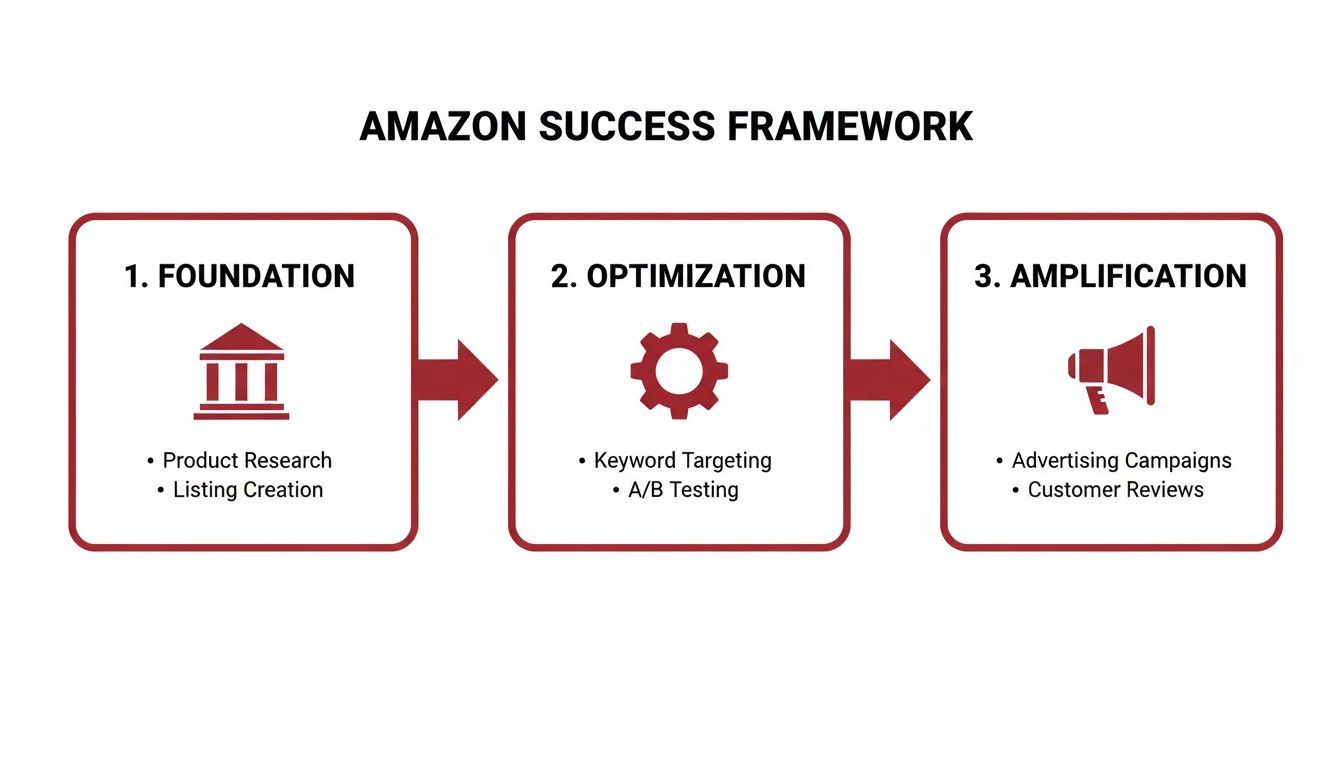
This framework highlights a critical point: a strong foundation makes every subsequent investment in growth more effective and sustainable.
Your listing is your primary conversion engine. When you drive traffic to it—whether from an offline event, a TikTok campaign, or an Amazon Sponsored Product ad—you need absolute confidence that shoppers are landing on a page meticulously designed to persuade and convert. To dig deeper into the mechanics, it's worth understanding all the moving parts involved in optimizing Amazon listings.
To understand how these elements create a measurable impact, let's break down the components of a high-converting listing. Each piece serves a specific function, targeting both the A10 algorithm and human shoppers to maximize visibility and sales velocity.
| Listing Component | Primary Goal | Impact on A10 Algorithm |
|---|---|---|
| Title | Capture attention & rank for top keywords | High (Keyword indexing, relevance) |
| Bullet Points | Highlight key benefits & features | High (Keyword indexing, conversion) |
| Images/Video | Showcase product & build desire | Medium (Click-through rate, conversion) |
| A+ Content | Tell a brand story & overcome objections | Medium (Conversion rate, time on page) |
| Backend Keywords | Index for hidden & long-tail terms | High (Keyword indexing, visibility) |
| Reviews & Ratings | Build social proof & trust | High (Conversion, click-through rate) |
Understanding this table is key to success. Neglecting any of these areas creates a weak link in your conversion chain, leaving measurable revenue on the table.
Your listing is the single most critical touchpoint in the Amazon customer journey. Getting it right leads to higher organic rank, better ad performance, and more profitable sales. It’s the cornerstone of your entire Amazon strategy.
Exceptional Amazon listings are not born from clever copywriting alone. They are built on a data-driven foundation of one critical insight: how your customers search for products.
Many brands make the mistake of targeting only broad, high-volume keywords, leading to wasted ad spend and stagnant conversion rates. The key to effective optimization is mapping your keyword strategy to the customer's intent at every stage of their buying journey.
This is the core of the 'Foundation' pillar in our growth framework. When executed correctly, your product appears not just in front of more shoppers, but in front of the right shoppers—at the exact moment they are ready to buy.
Think of your keyword strategy as a multi-layered net designed to capture shoppers at different points of consideration. You need to connect with those who are just browsing, those who know exactly what they need, and even those evaluating your direct competitors.
We segment search terms into three strategic buckets:
For a comprehensive approach, we recommend using a tool like Helium 10 for keyword discovery and validating findings with Amazon's Brand Analytics. Brand Analytics provides invaluable first-party data, showing the exact search terms that lead customers to your products and your competitors'—a direct line into the shopper's mind.
Let’s say you’re launching a premium garlic press. A novice seller might only target "garlic press." A data-driven brand, however, builds a more sophisticated keyword map.
Using our research methodology, we'd construct a keyword blueprint like this:
The difference is clear. Instead of competing for one term, you’re now visible to shoppers with a specific problem ("for arthritis"), a desired feature ("easy clean"), and even those loyal to another brand.
Once you have this blueprint, strategic placement is crucial. The A10 algorithm weighs keywords differently based on their location within your listing.
Key Takeaway: The goal isn't keyword stuffing; it's strategic allocation. Every keyword should have a designated home where it can have the most impact on ranking and conversion. This methodical approach is what separates amateurs from professional sellers.
Here is a simple, effective mapping strategy:
Starting with a robust keyword map makes every other aspect of your listing optimization easier and more impactful. You replace guesswork with a data-driven plan engineered for visibility and sales.
With your keyword blueprint in place, the next step is to weave those terms into copy that resonates with a human shopper before it ever satisfies an algorithm. Effective Amazon copy doesn’t just describe what a product is; it frames it as the solution to a customer's problem, creating a genuine desire to own it. This is where your keyword research transforms from a spreadsheet into persuasive content that drives measurable sales.
Think of your product page as a direct conversation. A potential customer has landed there with a specific need. Your title, bullets, and A+ Content are your opportunity to answer their questions clearly and compellingly, guiding them from browser to buyer.
Your product title is your most powerful SEO asset and your first opportunity to capture a shopper's attention on a crowded search results page. It must be informative, keyword-rich, and easily scannable. Stuffing it with keywords will only confuse customers and hurt your click-through rate.
A proven formula that balances readability with ranking power is:
Brand + Core Benefit + Main Keyword + Key Feature
For example, a generic title like "Sleeping Bag for Camping" is easily ignored. Applying our formula creates a much more compelling result:
Peak Gear | 4-Season Warmth | Mummy Sleeping Bag | for Adults, Lightweight & Waterproof
This structure immediately communicates the brand, the primary benefit ("4-Season Warmth"), the product type ("Mummy Sleeping Bag"), and other critical features. It’s a clean, effective format that works across most categories.
Shoppers don't buy features; they buy the outcomes those features deliver. This is the most common mistake brands make in their bullet points. They list a spec—"10,000mAh battery"—instead of explaining what that spec means for the customer.
Your bullet points are where you translate technical details into real-world value. A powerful technique is to lead each bullet with a clear benefit that solves a problem, then support it with the feature that makes it possible.
Consider the difference for a portable power bank:
The second example speaks directly to the customer’s fear of a dead phone and provides a tangible, reassuring outcome. You're not just selling a battery; you're selling peace of mind. For more in-depth strategies, explore our complete guide on how to write product descriptions that convert.
Many brands treat A+ Content as an afterthought—a place to add more text and images. This is a significant missed opportunity. A+ Content is a dedicated space to tell your brand story, build trust, and visually overcome purchase objections before they arise.
Think beyond simply restating your bullet points. Use your A+ Content to:
Ultimately, your copy and A+ Content must work together. The title grabs attention, the bullets deliver core benefits, and the A+ Content closes the sale by building an emotional connection and resolving any lingering doubts.

On Amazon, your product often appears alongside dozens of nearly identical competitors. In this sea of sameness, your images and video are your single greatest competitive advantage. While compelling copy seals the deal, it’s the visuals that capture a shopper’s attention and draw them into your listing.
Since shoppers can’t physically interact with your product, your visuals must do all the heavy lifting. They need to communicate quality, demonstrate the product in action, and help customers envision it in their own lives. A weak visual strategy is a surefire way to be overlooked.
Your main image—the "hero image"—is your most critical visual asset. It's what appears in search results and has one job: to earn the click. It must communicate precisely what your product is and why it's superior, all within a single glance.
Clarity is essential. Your hero image must be on a pure white background, be high-resolution, and fill at least 85% of the frame. But simply following Amazon's rules is the bare minimum. The best hero images showcase the product from a compelling angle and may include key accessories to signal value. Nailing this one image is a non-negotiable part of any serious listing optimization on Amazon.
Once you’ve earned the click, your secondary images and videos build the narrative. Each visual should serve a specific purpose, answering a customer's question before they have to ask.
A strong visual gallery tells a complete story with a mix of:
A complete visual strategy turns a static product page into an immersive experience. It preemptively answers questions, builds desire, and gives shoppers the confidence they need to hit ‘Add to Cart.’
The results of a visual overhaul can be dramatic. We worked with a yoga mat brand whose listing went from underperforming to a top seller after we helped them build out a full set of nine high-quality images, including lifestyle shots, infographics, and detailed close-ups. Their conversion rate increased by 156%, catapulting the product from page three to a prime position on page one in just 60 days.
To learn more about how powerful visuals align with a strong brand presence, check out Amazon's branding guidelines.
When you treat your visuals as a core component of your listing optimization on Amazon, you stop blending in and start standing out. You provide tangible proof of your product's value, forging a connection that words alone cannot achieve.
Top-performing Amazon listings are not just visually appealing; they are meticulously engineered behind the scenes. This is where the technical side of listing optimization on Amazon provides a significant competitive advantage by leveraging hidden ranking factors.
While many sellers focus exclusively on the title and bullet points, dominant brands understand that elements like backend search terms, dynamic pricing, and review velocity are powerful levers for sustained growth.

Let’s pull back the curtain on these crucial backend elements.
Think of your backend search term fields as your secret weapon for keyword indexing. These terms are invisible to shoppers but are fully indexed by Amazon's A10 algorithm. This is the ideal place to include valuable keywords that didn't fit naturally into your public-facing copy.
This space should be used for high-value search queries. Here’s how we advise clients to leverage them:
Fully optimizing these fields can dramatically amplify your product's visibility. Modern tools can accelerate this process significantly; some AI-driven platforms can execute these optimizations in as little as 15-30 minutes. You can dive deeper into how AI accelerates listing optimizations on christinaink.com.
On Amazon, price is a powerful signal to both shoppers and the algorithm. Your pricing strategy directly impacts your ability to win the Buy Box—and since over 80% of sales occur there, getting it right is critical. Price too high, and you lose to competitors.
However, it's not just about being the cheapest. Consider psychological pricing: ending your price in .99 or .97 is a classic retail tactic that makes a price feel substantially lower. It's essential to test different price points to find the optimal balance between conversion rate and profit margin.
Your price should be dynamic, not static. Monitor competitors, track your session-to-conversion rate, and be prepared to adjust to maintain a competitive edge and secure the Buy Box.
Reviews are the lifeblood of an Amazon listing. They are the ultimate form of social proof and a heavily weighted factor for both conversion and ranking. A consistent stream of positive reviews signals to Amazon that customers value your product, which in turn boosts your visibility.
Here is a practical system for generating more reviews:
Optimizing your Amazon listing is a significant achievement, but the work is never truly done. It's a continuous cycle of improvement, not a one-time task. You’ve built the foundation; now it's time to amplify your efforts—the final pillar in our growth framework. This stage involves using real-world data to make intelligent, incremental improvements that keep you ahead of the competition.
Success from this point forward is driven by data, not guesswork. It's about tracking the Key Performance Indicators (KPIs) that directly impact your bottom line.
To understand what’s working, you need a clear view of your performance funnel. We advise our clients to monitor these core metrics weekly:
Monitoring these numbers is fundamental to strong digital shelf analytics, as they reveal exactly where shoppers are dropping off. The overarching goal is to consistently improve ecommerce conversion rates and maximize the value of every visitor.
Amazon provides a powerful tool called 'Manage Your Experiments' that allows you to A/B test different elements of your listing. It's time to stop guessing and start making data-backed decisions.
Run controlled experiments on one element at a time—such as your main image or the first 80 characters of your title—to see what truly moves the needle on your CTR and conversion rate.
Your organic optimization and Pay-Per-Click (PPC) campaigns should not operate in isolation. They must inform each other, creating a powerful feedback loop that fuels growth. Your advertising data is a goldmine for uncovering high-converting search terms you may have missed during initial research.
If a keyword is driving profitable sales in your ad campaigns, it has proven its value. Promote that winning keyword to a more prominent position in your product title or bullet points. This strategy boosts your organic ranking for that term and ensures your listing is continuously optimized with the language your customers are actually using to buy.
Even with a clear playbook, questions are inevitable. Here are direct, practical answers to some of the most common queries we receive from brands.
Patience is key. While you may see initial movement in impressions and clicks within a few weeks, it typically takes 4 to 8 weeks for Amazon's A10 algorithm to fully index your changes and for performance data to stabilize.
The algorithm needs time to collect new data on your listing's performance—specifically, your click-through and conversion rates—before it rewards you with improved organic ranking.
We see a few common mistakes repeatedly. The biggest is keyword stuffing—jamming keywords into every available space, which hurts readability and can even lead to listing suppression. Other frequent errors include using low-quality images and neglecting the backend search term fields.
The backend is a missed opportunity for many sellers. It’s the perfect place to index for competitor brand names, common misspellings, and foreign language synonyms without cluttering your customer-facing copy.
But the most critical mistake is a ‘set it and forget it’ mindset. Amazon is a dynamic marketplace. True listing optimization requires a continuous cycle of monitoring, testing, and refining to stay ahead of competitors and adapt to evolving shopper behavior.
Yes, absolutely. Placing your brand name at the beginning of your title is non-negotiable. It is essential for building brand recognition, earning shopper trust, and protecting your listing from unauthorized sellers.
A high-performing title almost always follows this simple, effective formula:
[Brand Name] + [Main Keyword/Product Type] + [Key Feature or Benefit] + [Size/Color/Quantity]
This structure provides immediate clarity to both the customer and the algorithm, making a measurable difference in whether a shopper clicks your listing or a competitor's.
Optimizing your listings is the bedrock of sustainable growth on Amazon, but it's just one part of a bigger picture. At RedDog Group, we build complete omnichannel strategies that turn that hard-won visibility into profitable revenue.
Ready to see what a true growth partner can do for your brand?
Leave a comment: