
Published: March 2020 | Last Updated:December 2025
© Copyright 2026, Reddog Consulting Group.

When you hear "Amazon brand guidelines," it's easy to picture a long, restrictive rulebook. But that’s a limited view. Think of these guidelines as the official playbook for how your brand shows up on the world's largest marketplace, covering everything from your main image and product title to your A+ Content and packaging.
Following them isn't just about avoiding penalties like listing suppressions; it's about building a professional, trustworthy presence that wins customers and drives measurable growth.
Think of Amazon's guidelines as the blueprint for your brand's digital flagship. You wouldn't build a retail store on a shaky foundation, and the same logic applies here. Mastering these guidelines is the foundational first step—the bedrock of a scalable business. This isn't just about dodging trouble; it's a strategic competitive advantage.
When your branding is consistent—from your product packaging to your Amazon Store—it sends a powerful signal to millions of shoppers. It communicates that you're a serious, professional brand, not just another random seller. This alignment is the core of our Foundation → Optimization → Amplification growth framework.
A solid, compliant foundation helps you sidestep the common pitfalls that stall growth: suppressed listings, rejected ads, and dreaded account health warnings. Once your foundation is secure, you can confidently shift resources toward optimizing your listings and amplifying your reach.
The goal is to stop seeing compliance as a chore and start viewing it as a strategic asset. A well-presented, guideline-adherent brand is naturally more discoverable, trustworthy, and ultimately, more profitable.
This approach sets you up for real, measurable results. Brands built on a compliant foundation are best positioned to leverage powerful sales tools. A key part of this is Brand Registry, which is essential for protecting your brand and unlocking advanced features. Learn more in our guide on what Amazon Brand Registry is and how it fuels omnichannel growth.
The diagram below illustrates our three-pillar framework for achieving scalable success on Amazon.
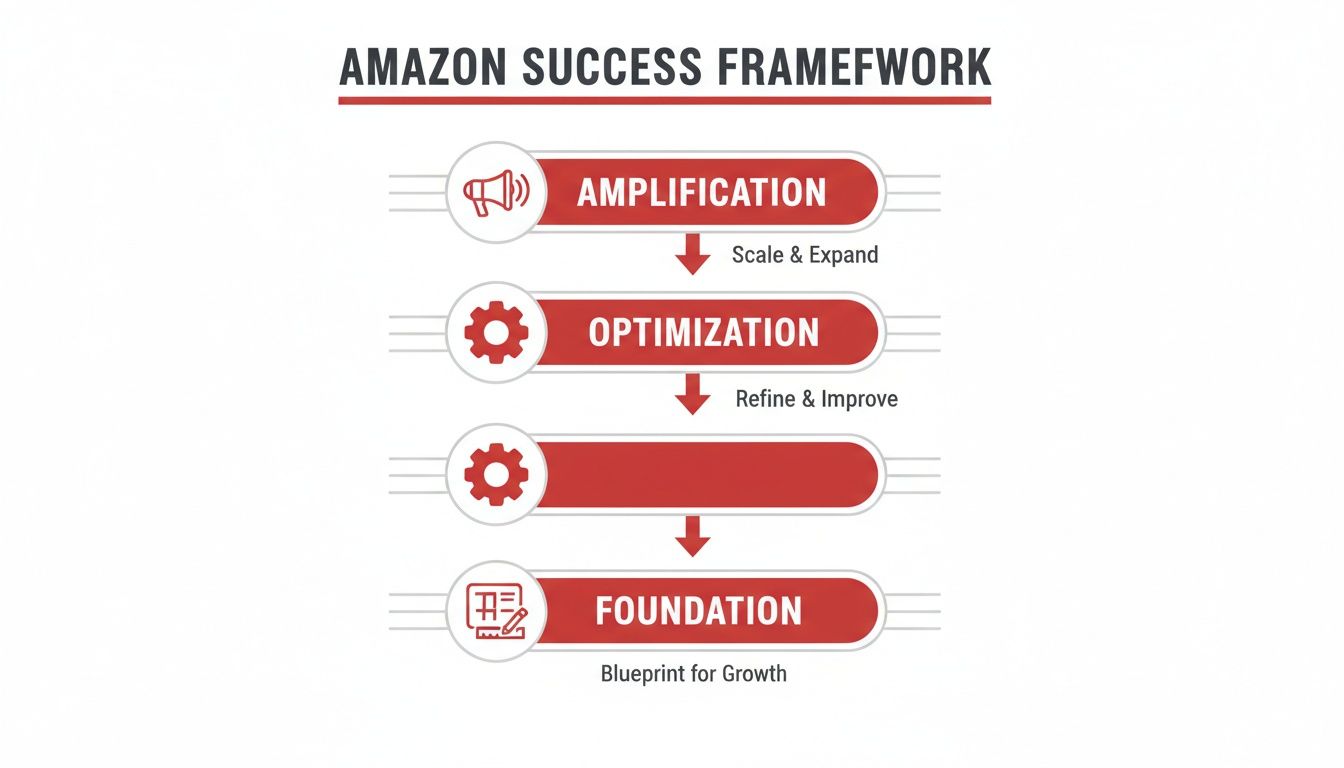
As you can see, everything starts with a strong 'Foundation' built on guideline compliance. It’s the mandatory first step before you can effectively 'Optimize' your listings and 'Amplify' your reach through advertising. Without that solid base, your ad spend is at risk. Get the foundation right, and you create a powerful launchpad for your entire omnichannel strategy.
To build a lasting brand on Amazon, you must first master the platform's core identity rules. These aren't just suggestions; they are non-negotiable standards designed to create a consistent, trustworthy, and seamless experience for every customer.
Think of these rules as the universal language of the marketplace. When you speak this language fluently, your brand communicates clearly and effectively. Getting them right directly impacts your search visibility, click-through rates, and sales. Getting them wrong can lead to suppressed listings and lost revenue, cutting off growth before it starts.

Your product listing is your digital shelf space, and Amazon has specific rules for how information is arranged. Every component—from the title to the bullet points—has a distinct job, both for the customer and for Amazon's A10 search algorithm.
Product Titles: Your title must be clear, concise, and descriptive. It should include your brand name, the product name, and key features like material or quantity. Amazon strictly forbids subjective promotional claims like "Best Seller" or "Highest Quality."
Bullet Points: This is your primary sales pitch. Use these five points to highlight the top features and benefits of your product. The key is to use clear, benefit-driven language that quickly answers a shopper's core questions.
Product Descriptions: This is your space for additional detail. While less critical for SEO than your title or bullets, it’s a valuable spot to explain use cases, technical specifications, and your brand's story.
Amazon's textual guidelines create a level playing field. By standardizing how information is presented, they help customers easily compare products and make informed decisions. This builds trust not just in your brand, but in the entire marketplace.
This intense focus on a uniform customer experience is woven into Amazon's DNA. The company's transformation from a bookstore to the "everything store" was marked by the introduction of its iconic A-to-Z smile logo in 2000. By 2019, Amazon was serving over 300 million active customers, demonstrating why it's so protective of its brand identity. You can explore Amazon's branding evolution and its impact to see how it shaped the platform.
Let's be clear: your visuals are arguably the most important part of your listing. Shoppers can't physically interact with your product, so your images and videos must do the heavy lifting. Consequently, Amazon’s visual standards are among its most rigid.
The most critical rule applies to your main image: it must feature only the product for sale against a pure white background (RGB 255, 255, 255). No logos, text, or lifestyle graphics are permitted. This single rule is what keeps the search results page clean and uniform for every shopper.
For your secondary images, you have much more creative freedom. This is your opportunity to show the product in use, highlight key features with text overlays (without overdoing it), and display different angles or packaging. These images tell a visual story and answer questions before a customer even has to ask.
One of the most common and costly mistakes is incorporating elements that mimic Amazon’s own branding. This is a strict violation that can get your listing suppressed almost instantly.
Here’s what to avoid at all costs:
Your brand must stand on its own. By sticking to these foundational rules, you build a professional presence that customers trust and keep your account in good standing—the perfect launchpad for optimization and growth.
Once you've nailed the basics, it's time to shift into the 'Optimization' phase. This is where you graduate from just listing products to creating an immersive brand experience. Your two most powerful tools for this are A+ Content and Amazon Brand Stores.
Think of your standard listing—title, bullets, basic images—as the regular shelf space in a retail store. It gets the job done. But A+ Content is your premium, end-of-aisle display. It replaces the plain-text product description with a dynamic, module-based layout, allowing you to use rich visuals and compelling copy to tell a deeper story and connect with shoppers on a new level.
A+ Content is your chance to move beyond a simple list of features. Here, you can showcase your brand’s origin story, highlight a unique manufacturing process, or use comparison charts to show why your product is the superior choice. When executed well, A+ Content can boost conversion rates by up to 10%.
However, this creative freedom comes with its own set of Amazon brand guidelines, all designed to maintain a high-quality customer experience.
Adhering to these rules isn’t just about avoiding rejection; it’s about building a seamless, trustworthy experience. Beyond Amazon’s rules, successful brands also apply universal strategies for improving ecommerce conversion rates to their product detail pages.
If A+ Content is your premium in-store display, your Amazon Storefront is your dedicated brand showroom. It’s a multi-page, custom-branded destination on Amazon where you can showcase your entire product catalog, share your brand’s mission, and create a curated shopping experience away from competitor ads and other distractions.
Think of your Brand Store as your brand’s home base on Amazon. It's the one place where you have complete control over the narrative, free from competitor ads and distractions.
This is a powerful tool for building brand loyalty and increasing average order value. When a customer lands in your Store, you can guide them through different product categories, highlight new arrivals, and feature best-sellers. Our data shows that listings driving traffic to a polished Brand Store see a significantly higher lifetime customer value.
Like A+ Content, your Brand Store must adhere to creative and structural rules to be approved and perform well.
Following these creative guidelines is about more than just getting approval; it directly impacts ad performance. For example, Sponsored Brands campaigns have specific requirements for logo usage and image sizes. Campaigns that adhere to these rules see higher approval rates and better performance, with fewer frustrating creative rejections.
By mastering A+ Content and Brand Stores, you move from merely selling products to building a true brand on Amazon. For more hands-on tactics, check out our complete guide to Amazon listing optimization. These tools are essential for the 'Optimization' phase, helping you create a rich experience that boosts conversions and builds lasting customer relationships.
Your brand experience doesn't end online; it extends into the physical world the moment a customer opens their package. This unboxing moment is a critical branding opportunity, but it's also where many sellers run afoul of Amazon's rules.
The guidelines covering packaging, inserts, and trademark usage are strictly enforced because they protect Amazon's core promise: keeping the customer journey on its platform. Violating these policies, even accidentally, can lead to serious account health issues. The goal isn't to stifle creativity—it's to channel it in a way that builds trust with both Amazon and your customers.
Packaging inserts are a fantastic tool for post-purchase engagement. However, Amazon draws a clear red line: you cannot use inserts to divert customers to any other website or sales channel. Any message encouraging a shopper to leave Amazon for a future purchase is a direct violation.
So, what’s allowed? Let’s clarify.
DON'T: Include a flyer with a discount code for your Shopify store.
DO: Provide a QR code that leads to a product instruction manual or video tutorial on a non-transactional webpage.
DON'T: Print your website URL (e.g., www.yourbrand.com) on the insert.
DO: Ask for an honest review on Amazon, but without offering any incentive in exchange.
The purpose is to add value to the product they just purchased, not to pull them into an off-Amazon marketing funnel. Product registration for a warranty is generally acceptable as a value-added service. But a link to "join our VIP club for exclusive deals" is a clear attempt to market off-platform and will quickly land you in trouble.
Your intellectual property (IP) is your brand's most valuable asset. On Amazon, Brand Registry is your primary defense. It gives you control over your listings and powerful tools to combat infringement.
Beyond protecting your own IP, understanding the Amazon Brand Registry benefits is crucial for building a solid brand presence. It helps you stop counterfeiters and ensures customers see accurate product information—a must for long-term growth.
A common mistake is thinking trademark rules only apply to protecting your own brand. They also dictate how you can reference other brands in your listings. This is especially important for sellers of accessories or compatible products.
You can’t simply use a well-known brand name in your title to capture traffic. For example, titling your product "iPhone Charging Cable" implies an official affiliation and is a fast track to a policy violation.
Instead, you must use specific, approved phrasing to show compatibility.
Incorrect: "Nike Shoe Laces"
Correct: "Replacement Laces Compatible with Nike Air Force 1 Shoes"
Incorrect: "Official PlayStation 5 Controller Skin"
Correct: "Protective Skin Designed for the PlayStation 5 Controller"
Using words like "for," "compatible with," or "fits" makes it clear that your product is an accessory, not an officially licensed item. This precision keeps your listings compliant and helps you build a trustworthy brand that respects IP laws, setting a professional tone with every customer.
Even the most careful sellers can stumble over Amazon's brand guidelines. The rules are detailed and constantly evolving, making it easy for a small mistake to cause a listing suppression or ad rejection. Understanding the most common missteps is the first step toward building a resilient and effective brand presence.
This is your practical guide to staying compliant. We’ll walk through the most frequent errors, explain why Amazon flags them, and provide a clear playbook to get things right. Mastering this shifts your focus from reactive problem-solving to proactive brand protection.
One of the most frequent—and easily fixable—violations is adding clutter to the main product image. This includes text like "Sale," "20% Off," your logo, or even a "Made in the USA" badge.
Amazon’s logic is simple: create a clean, consistent customer experience. The search results page is designed as a level playing field where shoppers can compare products at a glance. When sellers add promotional text, it creates visual noise that erodes trust.
How to Fix It:
Another common mistake is filling product titles with subjective marketing terms. Phrases like "Best," "Top-Rated," "Highest Quality," or "Most Popular" are strictly forbidden.
Why? These claims are unverifiable and create an unfair advantage. Amazon's A10 algorithm and its human reviewers are trained to spot them. The title is meant to be informative, not hyperbolic. Sticking to the facts ensures everyone plays by the same rules.
How to Fix It:
This insistence on a uniform look is deeply woven into Amazon's own brand DNA. Amazon’s visual identity solidified with the smile/arrow logo in 2000, a move that signaled its transformation from a niche bookseller to a global “everything store.” The logo was designed to explicitly show Amazon sells everything from “A to Z,” while the arrow doubles as a smile to communicate customer satisfaction. You can learn more about the strategy behind Amazon's iconic logo design on selectedfirms.co.
This is a much more serious violation that can jeopardize your account health. It occurs when sellers include inserts in their packaging asking customers to visit their website, follow them on social media, or join a mailing list—often by offering a discount on a future off-Amazon purchase.
This directly violates Amazon's anti-diversion policy. Amazon invests billions to attract shoppers and strictly prohibits any attempt to lure them to an external sales channel.
How to Fix It:
To help you troubleshoot, here’s a quick-reference table for identifying and fixing common brand guideline violations.
This table serves as a quick troubleshooting guide, breaking down the most frequent mistakes and providing a clear path to compliance.
| Common Violation | Why It's a Problem | How to Fix It |
|---|---|---|
| Promotional Text in Main Image | Creates a cluttered, inconsistent shopping experience and violates Amazon's clean background policy. | 1. Replace the main image with one showing only the product on a pure white background (RGB 255, 255, 255). 2. Move logos, badges, and text to secondary images. |
| Subjective Claims in Title | Uses unprovable, "hype" words like "Best" or "Top-Rated," which are forbidden. | 1. Remove all subjective adjectives. 2. Rewrite the title to focus on factual details: brand, product name, key features, and quantity. |
| Diverting Traffic with Inserts | Attempts to lure Amazon customers to an external website or sales channel, a serious policy violation. | 1. Remove all external URLs, social media handles, and QR codes that lead off-Amazon. 2. Redesign inserts to offer value (e.g., user guides, warranty info) or request an honest Amazon review. |
| Incorrect Capitalization | Using ALL CAPS for emphasis in titles or bullet points is seen as "shouting" and is not allowed. | 1. Review your titles, bullets, and descriptions. 2. Edit any text in all caps to use standard Title Case or sentence case as appropriate. |
| Mentioning Competitors | Referencing other brands or products, even for comparison (e.g., "better than Brand X"), is prohibited. | 1. Scan your listing copy for any mention of competitor brand names. 2. Remove these references and focus solely on your product's features and benefits. |
By keeping these common pitfalls in mind, you can build your listings and brand assets correctly from day one. A proactive approach not only keeps your account safe but also ensures your brand presentation is clean, professional, and perfectly aligned with customer expectations.
You’ve done the hard work. Your listings are clean, your branding is sharp, and you’re fully compliant with Amazon brand guidelines. Now it’s time to shift from defense to offense and scale your brand.
Think of your Amazon presence not as an isolated channel, but as the central hub of your entire growth strategy. Compliance was the price of admission. Now you can invest in growth without worrying about being shut down.
This is the ‘Amplification’ stage, where your perfectly tuned Amazon presence becomes a powerful asset in your broader omnichannel plan.
Your Amazon Storefront is the perfect destination for traffic from outside Amazon. You can confidently drive paid ads from Google, Meta, or TikTok directly to your curated brand experience, knowing it’s optimized to convert. This is the core of a truly effective omnichannel retail strategy.
Amazon also gives you powerful tools to tell your story on the platform itself.
The bottom line: these amplification tools deliver maximum ROI only when your foundation is rock-solid. A compliant, well-branded presence ensures your ad dollars are not wasted, driving both immediate sales and long-term brand loyalty.
With a solid foundation and optimized creative, you have the green light to scale aggressively. You can invest in traffic with confidence, knowing every click leads to a professional, compliant, and high-converting experience on Amazon.
Ready to shift from just playing by the rules to winning the game? Let's build a strategy that gets your brand in front of millions of new customers.
Let's Talk Growth
Navigating Amazon's rules can be tricky. Here are plain-language answers to some of the most common questions we hear from sellers.
The official guidelines are spread across several locations in Seller Central, which can be confusing. To get the full picture, you'll need to look in a few different places.
Start by searching the help pages for "Product image requirements," "Category style guides," and "A+ Content guidelines." For advertising rules, look for the "Creative acceptance policies" inside the Amazon Ads console. If you're enrolled in Brand Registry, be sure to review its specific policies on brand protection and IP usage.
No, this is a strict violation. Amazon has a zero-tolerance policy against any attempt to divert shoppers off its platform. Adding your website URL to your packaging or inserts is a fast way to get a listing suppressed or even an account suspension.
However, you can often use QR codes for value-added content, like warranty registration or a digital user manual. The key is that the destination page cannot contain marketing messages or links to purchase elsewhere.
The consequence depends on the severity of the violation. For a minor issue, like a main image with a non-white background, Amazon will likely just suppress the listing until you fix it. Once corrected, it's typically reinstated without further penalty.
For major offenses like trademark infringement or attempting to redirect customers off-Amazon, the penalties are much more severe. These can include permanent listing removal, a temporary hold on your selling privileges, or even complete account deactivation. Address any performance notification from Amazon immediately.
Yes, absolutely. Amazon is just as strict with its ad formats, including Sponsored Brands and Sponsored Display. There are specific creative acceptance policies that cover everything—your logo, headline copy, and any custom images.
If your ad creative doesn't meet these standards, it will be rejected, and your campaign will not run. Always review the advertising policies before building and submitting your campaigns to avoid delays.
Ready to move from simply following the rules to strategically amplifying your brand? The team at RedDog Group has the expertise to build a compliant, high-growth presence on Amazon and beyond.
Leave a comment: