
Published: March 2020 | Last Updated:December 2025
© Copyright 2026, Reddog Consulting Group.

Your brand name is the foundation of your entire business. It's not just a legal formality; it's a critical business asset that secures your identity across every channel, from your Shopify store to your Amazon listings. For any brand serious about omnichannel growth, understanding how to trademark a brand name is a non-negotiable step.
The process—conducting a thorough search, filing a precise application, and maintaining your registration—grants you legal ownership of your brand's identity. This guide will explain these complex steps in plain language, providing the practical takeaways you need to protect your brand and set the stage for measurable growth.
Without a registered trademark, you're building your brand on rented land. It’s a high-stakes risk for any growing business.
A competitor could launch a similar name, creating confusion among your customers and diluting your marketing ROI. Even worse, imagine investing years of capital into building brand recognition, only to be hit with a cease-and-desist letter. This forces a costly and damaging rebrand that can kill your momentum.

In today's integrated marketplace, brand consistency is paramount. A federal trademark grants you exclusive nationwide rights to your name, creating a powerful defensive shield against copycats and competitors across both online and offline channels.
This legal ownership becomes a tangible advantage on major platforms. For instance, a registered trademark is the key to unlocking Amazon Brand Registry, which provides enhanced tools to control your product listings, remove counterfeit sellers, and access premium features like A+ Content. It gives you the authority to combat hijackers trying to profit from your hard-earned reputation.
A trademark transforms your brand name from a simple identifier into a valuable, defensible piece of intellectual property. It’s a direct investment in your brand’s future equity and a prerequisite for long-term, scalable growth.
To understand the full context, it helps to grasp the basics of what is intellectual property protection. This foundational knowledge clarifies how different protections work together to safeguard your most important business assets.
At RedDog, we see brand protection as the first pillar of our omnichannel growth framework: Foundation → Optimization → Amplification. A secure trademark is the bedrock of that foundation. It enables you to confidently invest in marketing and expansion, knowing your core asset is protected.
Of course, a strong brand is more than a name; it’s a complete identity. You can explore our guide on developing a comprehensive branding strategy step-by-step for multichannel growth to see how a trademark fits into the bigger picture.
This guide will demystify the core process—search, file, and maintain—and frame it as an essential investment in your brand’s measurable success.
Before investing a single dollar in a USPTO application, you must be confident the brand name you’ve chosen is legally available. Rushing this step is like building a house without checking the foundation—it’s destined to crack. A thorough trademark search is your best defense against expensive rejections and future legal headaches.
This isn't just about finding an exact match. The primary goal is to avoid a “likelihood of confusion,” the number one reason the USPTO denies applications. If your name looks, sounds, or means something similar to an existing mark in a related industry, you face a significant hurdle.

Your clearance process should occur in two phases: a quick scan followed by a deep dive.
First is a preliminary "knockout" search, which you can and should do yourself. The objective is to quickly eliminate any names that are obvious non-starters by looking for direct conflicts.
Here’s your initial checklist:
This initial search is a critical part of your due diligence and often overlaps with early market research. You can learn more in our guide on why you should conduct market research.
A comprehensive search, however, is a much heavier lift best handled by a trademark attorney or a specialized firm. They go far beyond direct matches.
A professional search uncovers phonetically similar marks ("Kwik" vs. "Quick"), foreign word equivalents, and marks in related product or service classes that could still confuse consumers. This is where hidden risks are identified.
After the searches, you're not just looking at a list of names; you're evaluating risk. This is where strategy comes in. Consider the famous "Dove" brand—one sells chocolate (Class 30), and the other sells soap (Class 3). They coexist because their products are so different that consumers are unlikely to confuse them.
But if you tried to launch "Dovely" soap, you’d be in serious trouble because it’s too close to an established player in the same market. This is the kind of nuanced analysis that protects your investment.
Globally, over 15.2 million classes were included in trademark applications in a recent year. Rejection rates often hover near 40%, frequently due to conflicts or because a name is too descriptive. For an e-commerce brand, selecting the right class—like Class 25 for apparel or Class 9 for electronics—and understanding the competitive landscape is key to avoiding that rejection pile. You can dig into more global trademark filing trends on Clarivate.com.
Ultimately, a solid clearance search is foundational. It ensures the brand you're investing in is built on solid legal ground.
Once your name is cleared, it’s time to assemble a precise application for the U.S. Patent and Trademark Office (USPTO). A successful filing is all about the details. Getting it right the first time saves you from costly delays and potential rejections, moving you closer to securing your brand’s most important asset.
This isn’t just about filling out forms; it’s about making strategic decisions that define the scope of your trademark protection. Think of it as claiming your territory in the marketplace before a competitor does.
One of the first key decisions is your filing basis. This tells the USPTO whether you’re already using your brand name in the market or if you have a concrete plan to do so. This choice depends entirely on where your business is right now. Are you already generating sales, or are you still in the pre-launch phase?
| Filing Basis | What It Means | When to Use It | Key Requirement |
|---|---|---|---|
| Use in Commerce (1a) | You are currently selling goods or services with this trademark in the U.S. | Your brand is live, your store is open, and you are actively making sales. | You must submit a "specimen" (proof of use) with your initial application. |
| Intent to Use (1b) | You have a genuine, good-faith intention to use the trademark in commerce soon. | You're in the pre-launch phase, finalizing products, packaging, or a website. | You must eventually file a Statement of Use (and pay another fee) to prove you've started selling. |
Choosing an "Intent to Use" basis is an excellent strategy to reserve your name and secure your place in line, offering a significant competitive advantage. Just remember, you'll eventually have to prove you’re using the mark by filing a Statement of Use before the trademark can officially register.
Next, you must identify the correct "class" for your goods or services. The USPTO uses an international system (the Nice Classification) that organizes everything into 45 different classes. Getting this wrong can severely limit your protection, as your rights are tied directly to the classes you claim.
For example, a trademark for "Apex" in Class 12 (vehicles) won’t stop someone else from registering "Apex" in Class 28 (toys and sporting goods).
This is especially critical for e-commerce and retail brands selling products across different categories. For example:
Each class requires a separate filing fee, so you need to balance comprehensive protection with your budget. The practical approach is to start with your core offerings and expand protection as your brand grows into new product lines.
If you're filing under "Use in Commerce," you must submit a specimen of use. This is your real-world proof showing the USPTO exactly how you use your brand name to sell your products or services. This is a common stumbling block, so getting it right is vital.
The specimen must show your mark directly associated with the goods or services you're claiming. The USPTO has strict requirements.
For physical products, a good specimen could be:
For services, like an online retail store, you could use:
Items like invoices, packing slips, or press releases are not acceptable specimens. The golden rule is to show your brand name just as a customer would see it when making a purchase. A strong, compliant specimen is one of the best ways to avoid an Office Action and keep your application moving smoothly.
Submitting your trademark application is a huge milestone, but it’s the beginning of the journey, not the finish line. What follows is a structured waiting game managed by the USPTO, and understanding the road ahead is key to a successful outcome.
The entire process, from filing to registration, often takes between 9 to 18 months, and sometimes longer if complications arise. This timeline involves several critical stages of review and public notice designed to ensure your mark is legally sound.
This infographic outlines the key steps you complete before submission, which directly impacts how smoothly the process goes after you file.
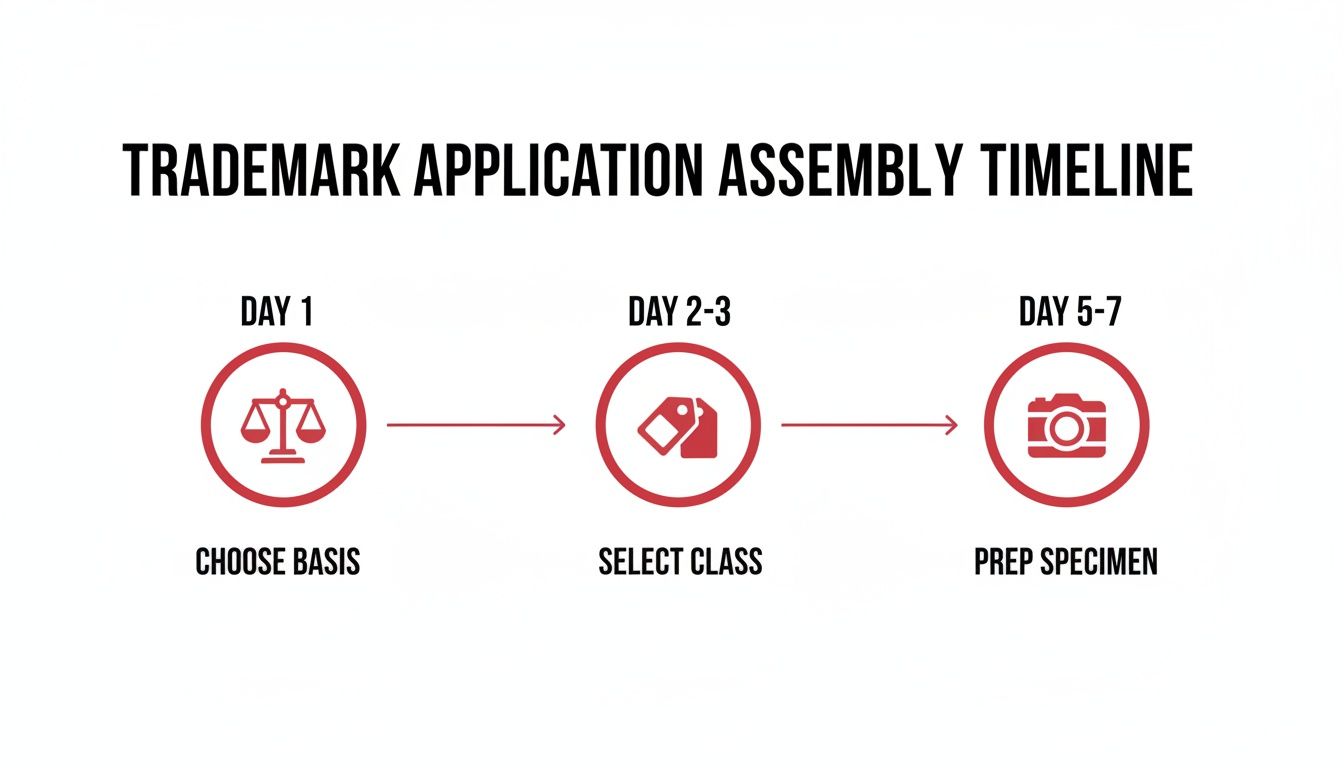
As you can see, getting it right when choosing your filing basis, selecting the correct class, and preparing a compliant specimen minimizes friction later on.
Once filed, your application is assigned a serial number and enters a queue. It typically takes several months before a USPTO examining attorney reviews it. This is a detailed examination to confirm your application complies with all federal laws and rules.
The attorney will conduct their own search for conflicting marks, verify that your goods or services are classified correctly, and scrutinize your specimen. This is where your upfront diligence in the search and application assembly phases pays off.
It’s common to receive an Office Action, an official letter from the examining attorney outlining issues with your application. Don't panic—this isn't a final rejection. It could be a simple request for clarification or a more substantive legal objection, like a "likelihood of confusion" claim.
You typically have six months to file a response. A successful response requires a clear, persuasive legal argument that directly addresses every point the attorney raised.
For example, if the examiner claims your mark is merely descriptive, you might argue that it has acquired distinctiveness through extensive use and marketing. Failing to respond or providing an insufficient answer can lead to your application being abandoned. This is a stage where professional guidance can be invaluable.
The most common reasons for an Office Action are procedural errors or substantive issues like a likelihood of confusion. A well-prepared application, built on a strong clearance search, is your best defense against lengthy delays.
Once the examining attorney approves your mark, it moves to the next stage: publication. Your trademark is published in the USPTO's Official Gazette, a weekly online publication.
This begins a 30-day window where any third party who believes your registration would harm them can file an opposition. An opposition is a formal proceeding within the USPTO that can significantly delay and increase the cost of registration.
If no one opposes your mark (which is typical), you're on the home stretch. For applications filed based on "Use in Commerce," the USPTO will issue your registration certificate. If you filed under "Intent to Use," you'll receive a Notice of Allowance, and you'll then have a set period to prove you've started using the mark before it’s officially registered.
Getting your trademark registered is a massive accomplishment, but the work doesn't stop. Think of your registration as a deed to a property, not a trophy on a shelf. Active management and enforcement are what give your trademark its real power and value.
This is where your registration certificate becomes a true business asset. If you don't maintain your registration and actively police your mark, your rights can weaken or be canceled altogether. The process isn't complex, but it demands attention.

The USPTO requires proof that you're still using your trademark for the registered goods or services. If you miss their deadlines, your registration will be canceled. No excuses, no extensions.
Add these dates to your calendar now:
These are hard deadlines. Letting your trademark expire due to a missed filing is one of the most painful and avoidable mistakes a brand owner can make.
Maintenance is playing defense. Enforcement is going on offense to protect your turf, revenue, and brand reputation. Once you've earned the right to use the registered trademark symbol (®), it’s time to put it to work.
Start using the ® symbol next to your brand name everywhere—on your website, packaging, social media, and marketing materials. It’s a clear signal that your mark is federally protected, which often deters casual copycats.
But a symbol isn't enough. You need to monitor the market for infringers trying to piggyback on your hard work. This means watching for:
For any brand selling online, a registered trademark is your golden ticket to the best protection tools available on e-commerce platforms. Amazon Brand Registry is the prime example.
Enrolling in Amazon Brand Registry transforms your trademark from a passive certificate into an active shield. It gives you the control to accurately represent your brand, remove counterfeit listings, and report violations, directly protecting your sales and customer trust.
Once enrolled in Brand Registry, you unlock a suite of tools that provide a significant competitive advantage. It’s one of the most direct ways your trademark investment delivers a measurable return. To learn what’s involved, check out our deep dive on what is Amazon Brand Registry and how it drives growth.
Understanding the Amazon Brand Registry benefits is non-negotiable for any serious brand. It’s the fastest path to cleaning up your listings and securing your brand’s presence on the world's largest marketplace.
With an estimated 11.7 million trademark applications filed globally in 2024, the digital marketplace is fiercely competitive. For sellers on platforms like Amazon and Walmart, Brand Registry is a must-have, but you need a registered mark to get in—a process that can take 6-12 months in the U.S. This is where strategic planning and expert guidance can help you navigate the complexities and scale securely.
At the end of the day, your trademark is a living asset. By staying on top of maintenance and actively enforcing your rights, you're not just protecting a name—you're building a stronger, more defensible, and more valuable brand.
As you begin the process of protecting your brand, questions are bound to arise. The trademark process involves specific legal concepts that aren't always intuitive. Getting clear, straightforward answers is the best way to move forward with confidence and build a solid foundation.
Here, we tackle some of the most frequent questions we hear from brand owners.
The total investment breaks down into two main categories: government filing fees and professional services. You will have to pay the USPTO filing fees, which typically range from $250 to $350 per class of goods or services.
For example, a clothing brand files under Class 25 (apparel). If that same brand also operates an online retail store, they might add Class 35 (retail services). That means paying the filing fee for two separate classes—a common scenario for integrated e-commerce brands.
Beyond government fees, there are optional—but highly recommended—costs:
While a DIY approach is tempting, investing in expert help often prevents costly mistakes and delays that can kill your brand's momentum.
The answer is a firm "it depends." Trademark rights in the United States are based on a "first to use" system, not "first to file." If another brand is already using a similar name for similar products, they may have "common law" rights that can block your registration, even if they never filed with the USPTO.
This is precisely why a thorough clearance search is non-negotiable.
The core issue is the "likelihood of confusion." If consumers are likely to be confused about the source of the products, your application will almost certainly be rejected.
However, coexistence is possible if the goods or services are unrelated. For instance, "Galaxy" for tires and "Galaxy" for chocolate can exist together because no reasonable person would think they come from the same company. The less overlap in products and customers, the stronger your case.
Patience is a key part of the trademark process. In the U.S., it typically takes 9 to 18 months from filing until your mark is officially registered. With USPTO backlogs or if issues arise, it can take even longer.
After filing, it can be several months before a USPTO examining attorney even reviews your application. If they issue an Office Action, your response and their subsequent review will extend the timeline. Once approved, your mark is published for a 30-day opposition period. Only after clearing all these hurdles is it registered.
These symbols all signal a claim to a brand, but they carry very different legal weights. Here’s the breakdown:
Using the ® on an unregistered mark is illegal and can jeopardize your ability to register it later. Once your registration is granted, displaying the ® symbol provides official notice of your federally protected status and dramatically strengthens your legal position against infringers.
Navigating the trademark process is a foundational step in securing your brand's future. At RedDog Group, we help brands build, protect, and amplify their presence across every channel, ensuring every aspect of your business—from trademarks to marketplace management—is optimized for growth. Let's Talk Growth.
Leave a comment: