
Published: March 2020 | Last Updated:December 2025
© Copyright 2026, Reddog Consulting Group.

Most American eCommerce owners underestimate the power of market research, yet businesses that prioritize it outperform competitors by over 30 percent in sales growth. The rapid pace of online retail means a single missed trend can leave your brand behind. Understanding what drives digital consumers gives you a real advantage, and this guide offers practical strategies to help American sellers uncover exactly what the market wants—before the competition does.
| Point | Details |
|---|---|
| Importance of Market Research | Market research is essential in eCommerce for understanding consumer behaviors and market dynamics, aiding in informed decision-making. |
| Diverse Research Methods | Utilizing a mix of primary and secondary research methods enhances insight depth, helping companies make strategic decisions. |
| Risk Mitigation | Systematic market research helps identify potential risks, validating product concepts and market demand before major investments. |
| Growth Catalyst | Continuous market research promotes agility and responsiveness in a rapidly evolving digital landscape, driving customer loyalty and sustainable growth. |
Market research in eCommerce represents a systematic approach to gathering, analyzing, and interpreting data about online consumer behaviors, preferences, and market dynamics. Unlike traditional market research, eCommerce market research focuses specifically on digital environments where consumer interactions, purchasing decisions, and brand perceptions unfold through online platforms.
At its core, market research for eCommerce involves collecting strategic intelligence about digital consumer segments, competitive landscapes, and emerging trends that impact online retail performance. This process encompasses multiple research methodologies, including quantitative approaches like web analytics and customer surveys, as well as qualitative techniques such as user experience testing and focused digital interviews. Brands leverage these insights to understand customer journey mapping, optimize product offerings, and develop targeted marketing strategies that resonate with specific online audience segments.
The fundamental objectives of eCommerce market research include identifying potential customer needs, evaluating market opportunities, understanding competitive positioning, and reducing business risks associated with digital product launches or expansion strategies. By systematically collecting data across various digital touchpoints, businesses can make informed decisions about inventory management, pricing strategies, user interface design, and customer experience optimization.
Pro Tip: Digital Research Efficiency: Utilize free and paid analytics tools like Google Analytics, SEMrush, and social media insights platforms to collect real-time market research data without significant upfront investment.
Ecommerce market research employs a diverse range of methodological approaches designed to extract actionable insights about online consumer behaviors and market dynamics. Primary research methods encompass direct data collection techniques that allow businesses to gather first-hand information directly from target audiences through targeted interactions and structured research protocols.
These primary research methods typically include several strategic approaches:
Companies can also leverage secondary research methods, which involve analyzing existing data sources like industry reports, competitor analyses, and publicly available market intelligence. These approaches provide broader contextual understanding and help validate findings from primary research techniques. Secondary research techniques enable eCommerce brands to benchmark performance, identify market trends, and make strategic decisions with minimal direct research investment.
Pro Tip: Research Efficiency: Combine multiple research methods to create a comprehensive understanding of your target market, ensuring you capture both quantitative metrics and qualitative insights that drive strategic decision-making.
Here’s how key eCommerce market research methods differ in approach and application:
| Research Method | Data Type | Business Impact |
|---|---|---|
| Surveys | Quantitative | Reveal trends and statistical insights |
| User Experience Tests | Qualitative | Improve site usability and engagement |
| Customer Interviews | Qualitative | Uncover motivations and barriers |
| Focus Groups | Mixed | Explore group perception and feedback |
| Industry Report Review | Quantitative | Validate market potential and benchmarks |
| Competitor Analysis | Mixed | Inform strategic positioning decisions |
Market research serves as a critical catalyst for eCommerce growth by providing strategic insights that transform raw data into actionable business intelligence. Systematic market research approaches directly correlate with enhanced sales performance, enabling businesses to make data-driven decisions that optimize product development, marketing strategies, and customer engagement.
The growth mechanisms driven by comprehensive market research are multifaceted and profound. By understanding consumer preferences, purchasing behaviors, and emerging market trends, eCommerce brands can:
Moreover, continuous market research enables adaptive business strategies that align with rapidly evolving digital consumer expectations. This dynamic approach allows eCommerce brands to remain agile, responding quickly to shifts in consumer behavior, technological advancements, and marketplace dynamics. By integrating data-driven insights across product development, marketing, and customer service domains, businesses can create more personalized, responsive experiences that drive customer loyalty and sustainable growth.

Pro Tip: Strategic Intelligence: Implement a quarterly market research review to ensure your eCommerce strategies remain aligned with the most current consumer trends and marketplace shifts.
Market research acts as a critical defensive strategy for eCommerce brands, providing a systematic approach to mitigating potential business risks before they transform into expensive mistakes. Comprehensive risk assessment techniques enable businesses to validate product concepts, understand market demand, and proactively identify potential challenges that could derail growth and profitability.
The primary risk reduction mechanisms in market research include:
Strategic market research fundamentally transforms speculative decision-making into data-driven strategic planning. By systematically gathering and analyzing market intelligence, eCommerce brands can construct robust risk management frameworks that anticipate potential pitfalls, evaluate market readiness, and develop contingency strategies. This proactive approach significantly reduces the likelihood of costly product launches, marketing missteps, and strategic miscalculations that could compromise business sustainability.
Pro Tip: Risk Management Protocol: Develop a standardized market research checklist that requires validation across multiple data points before greenlighting any significant business initiative or product launch.
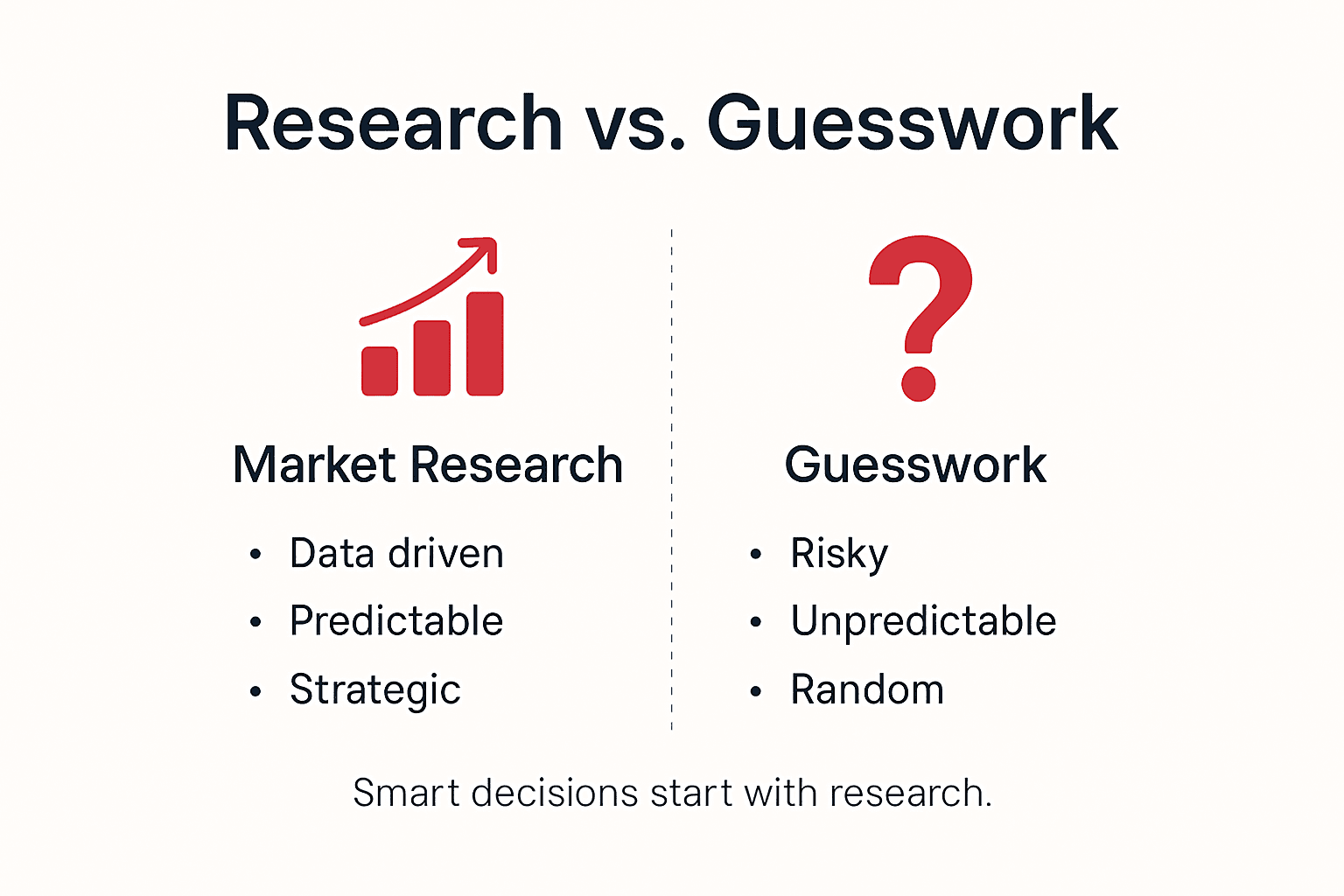
Intuition-based decision-making represents a high-risk strategy that can rapidly deplete an eCommerce brand’s resources and credibility. Structured market research systematically transforms speculative approaches by replacing gut feelings with empirical evidence, quantifiable insights, and strategic intelligence that significantly improve business outcomes.
The key distinctions between market research and guesswork are profound:
Market Research:
Guesswork:
Whereas guesswork represents a random walk through business challenges, market research provides a strategic roadmap illuminating potential opportunities and potential pitfalls. By collecting and analyzing comprehensive data across customer behaviors, market trends, competitive landscapes, and consumer preferences, eCommerce brands can develop nuanced strategies that minimize uncertainty and maximize the probability of sustainable growth. This methodical approach transforms market intelligence from a theoretical concept into a practical, actionable framework for strategic decision-making.
Pro Tip: Evidence-Based Strategy: Always allocate at least 3-5% of your marketing budget toward continuous market research to maintain a competitive edge and validate your business assumptions.
Here’s a comparison of market research versus guesswork in eCommerce decision-making:
| Aspect | Market Research | Guesswork |
|---|---|---|
| Decision Process | Fact-based, systematic analysis | Relies on instinct or feelings |
| Risk Level | Minimizes uncertainty and errors | Higher chance of mistakes |
| Strategic Outcomes | Enables scalable, repeatable growth | Results often unpredictable |
| Investment Efficiency | Supports informed budget allocation | May lead to wasted resources |
Market research is the foundation for eCommerce success. This article highlights the critical challenges of navigating consumer behavior, understanding market dynamics, and reducing costly risks without reliable data. If you want to stop guessing and start winning, you need strategic insights that translate research into measurable growth. Key pain points like optimizing product offerings, pricing strategies, and customer experience demand expert guidance tuned for digital marketplaces and omnichannel retail environments.
At Reddog Group, we specialize in turning market intelligence into actionable plans tailored for small and medium-sized eCommerce brands. With a proven track record managing over 50 brands and 30,000 SKUs, we offer expertise in marketplace management, Amazon FBA, DTC channels, and integrated online-offline strategies that drive sustainable revenue growth. Our services include product listing optimization, inventory management, and personalized marketing campaigns that align perfectly with the insights found in comprehensive market research.
Take control of your growth and reduce costly mistakes by partnering with a team that understands the power of data-driven decisions. Discover how our omnichannel mastery can expand your market reach and increase sales across all channels.
Start transforming your eCommerce challenges into opportunities today.
Explore Reddog Group’s proven approach to market research-powered growth.
Ready to elevate your results with expert consulting built on real market insights?
Contact us now to craft a custom growth strategy that leverages the full power of market research and turns your business vision into reality.
Market research is essential for eCommerce brands as it provides insights into consumer behaviors, market dynamics, and competitive positioning. It helps brands identify customer needs, evaluate market opportunities, and reduce risks associated with product launches and marketing strategies.
The primary methods of conducting market research in eCommerce include surveys, user experience testing, customer interviews, focus groups, and secondary research techniques like industry report analysis and competitor analysis.
Market research contributes to eCommerce growth by enabling brands to make data-driven decisions. It helps in identifying untapped market opportunities, optimizing product offerings and pricing strategies, enhancing customer experiences, and mitigating risks associated with innovation.
Effective market research helps eCommerce brands avoid risks like poor product-market fit, misjudging customer acceptance, underestimating competitive dynamics, setting incorrect pricing, and failing to comply with regulations or market demands.
Leave a comment: