
Published: March 2020 | Last Updated:January 2026
© Copyright 2026, Reddog Consulting Group.

For most brands with a smart omnichannel strategy, selling on Amazon isn't just worth it—it’s a non-negotiable part of modern growth. Yes, the concerns about high fees, fierce competition, and losing brand control are valid. But the key is to see them as manageable hurdles, not dead ends, on the path to unlocking a massive new customer base. The real question isn’t if you should sell on Amazon, but how to do it profitably and build a sustainable sales channel.
Deciding whether to launch on Amazon feels like a monumental choice, because it is. With over 60% of all product searches now starting on Amazon's homepage, staying off the platform means you’re invisible to a giant pool of ready-to-buy customers.
But diving in without a solid plan is a fast track to bleeding cash on fees, razor-thin margins, and watching your brand get diluted. Success here isn’t about just uploading a few product listings and hoping for the best. It’s about building a predictable, measurable sales engine. That requires a mental shift—stop seeing Amazon as just another retail channel and start treating it as a core pillar of your entire growth strategy. The challenges are real, but with the right framework, they are entirely solvable.
To get a quick sense of where your business might fit, this breakdown outlines the main opportunities and challenges for different types of sellers, helping you quickly gauge if Amazon aligns with your goals.
| Business Type | The Primary Opportunity | The Key Challenge to Manage |
|---|---|---|
| Direct-to-Consumer (DTC) Brands | Tapping into millions of new, high-intent buyers already shopping on Amazon. | Integrating Amazon with your DTC site without cannibalizing sales or diluting brand identity. |
| Established Retailers | Leveraging Amazon's massive fulfillment network (FBA) to expand reach and offer Prime shipping without building new infrastructure. | Navigating Amazon's complex fee structure while maintaining healthy profit margins across channels. |
| Startups & New Brands | Gaining instant credibility and visibility by launching on a trusted marketplace with a built-in audience. | Standing out in a crowded market and competing against established players with bigger ad budgets. |
| Wholesalers & Resellers | Moving large volumes of inventory quickly by tapping into Amazon's existing customer base and demand. | Winning the Buy Box, managing fierce price competition, and dealing with potential brand gating issues. |
This table is just a starting point. Your specific products, margins, and operational capabilities will ultimately determine your path. But it should give you a clearer picture of the strategic trade-offs involved.
So, how do you determine if Amazon is truly worth it for your business? It starts with building a solid foundation. We've launched hundreds of brands, and every single successful one was built on a simple but powerful framework that turns potential risks into measurable rewards.
By mastering these three areas, you can move past the common fears and build a framework for scalable, profitable growth on the world’s biggest marketplace.
To truly answer "is selling on Amazon worth it?" you have to know your numbers. Cold, hard, and down to the penny. Gross revenue looks great on a spreadsheet, but net profit is what actually funds growth. Too many brands get mesmerized by Amazon's massive sales potential and gloss over the fee structure that can quickly eat away at their margins.
Getting these costs right isn’t just about bookkeeping—it's the first and most critical step in building a profitable sales engine. Think of it as your Foundation.
It’s like running a restaurant. The menu price is your revenue, but what about the cost of ingredients, the chef's salary, and the rent? On Amazon, referral fees, fulfillment costs, and storage fees are your cost of goods sold and overhead. Ignore them, and you're setting yourself up to lose money on every sale.
This framework breaks down the path to Amazon success into three core pillars: mastering your economics, building your brand, and executing a smart growth strategy.
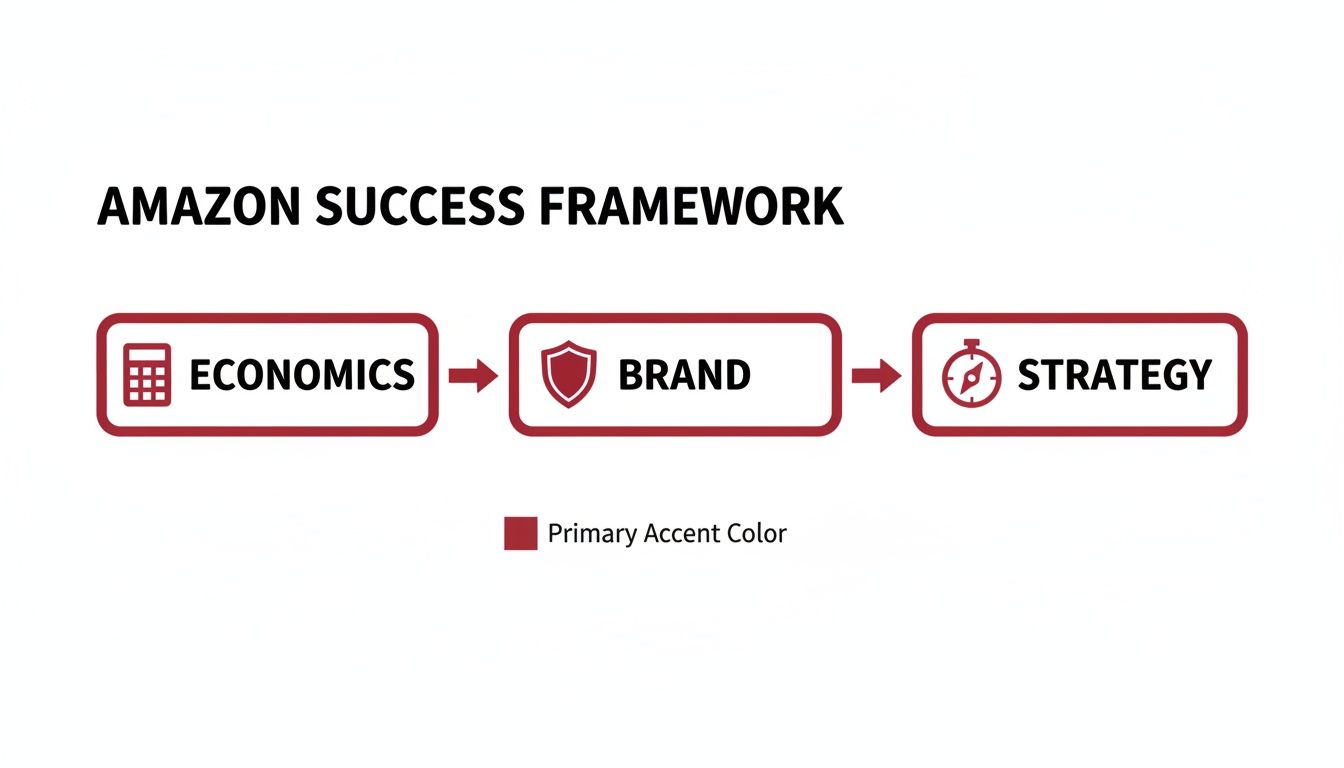
As you can see, it all starts with solid unit economics. If the math doesn't work on a per-unit basis, no amount of clever marketing can save a broken financial model.
At first glance, Amazon’s fees can feel overwhelming. But they really boil down to a few main categories. The key is to see them as payments for specific services—services that grant you access to the biggest pool of ready-to-buy customers on the planet.
You have two main paths for getting products into customers' hands: Fulfillment by Amazon (FBA) or Fulfillment by Merchant (FBM). Each comes with a different cost structure, operational demands, and growth potential.
Fulfillment by Amazon (FBA) is Amazon's all-in-one logistics service. You ship your inventory to their warehouses in bulk, and they handle everything else—storage, picking, packing, shipping, customer service, and returns. The biggest benefit? Your products instantly get the Prime badge, a massive conversion driver.
Practical Takeaway: With FBA, you’re paying for speed, convenience, and access to millions of loyal Prime members. The costs include fulfillment fees (based on your product’s size and weight) and monthly inventory storage fees. You can dig deeper into this in our detailed guide on what is FBA.
Fulfillment by Merchant (FBM) means you manage the entire fulfillment process yourself. You store the inventory, you pack the orders, and you ship everything directly to the customer. This route gives you more control and can sometimes be cheaper, especially for large, heavy, or slow-moving products. The trade-off? No automatic Prime badge, and you are responsible for all the operational heavy lifting.
Once you have a handle on these costs, you can calculate your net margin on every single sale. This isn't just a math exercise; it's the most important calculation you'll make. It determines whether Amazon is a goldmine or a money pit for your specific products.
The potential here is huge, especially when you realize that third-party sellers are the real engine driving the marketplace.
Data-Driven Insight: In Q3 2023, third-party sellers accounted for a staggering 60% of all paid units sold on Amazon. This demonstrates that independent brands aren't just surviving on Amazon; they are the driving force behind its growth. For DTC brands and retailers looking to expand, that trend is a massive green light.
In fact, nearly 60% of sellers become profitable within their first year, with many hitting that mark in under six months. Success almost always comes down to nailing pricing and unit economics from day one. The brands that neglect their margins are the ones that end up struggling to turn a profit.
Ultimately, the goal is to shift your focus from top-line revenue to bottom-line profit. By carefully calculating your per-unit costs, you build the strong financial foundation needed to scale a successful Amazon business.
The biggest roadblock for any established brand considering Amazon isn't the fees or the logistics—it's the fear of losing control. You’ve spent years building your brand’s story, fine-tuning the customer experience, and carving out your unique space in the market. Plugging that into a massive, one-size-fits-all marketplace can feel like handing over the keys to the kingdom.
That concern is completely valid. On Amazon, you’ll run into challenges like unauthorized resellers, sellers ignoring your MAP (Minimum Advertised Price) policies, and the reality that Amazon owns the customer relationship.
But the brands that win on Amazon don't see it as losing control. They see it as a strategic trade-off. In exchange for navigating these new hurdles, you get direct access to an incredible volume of high-intent buyers—customers who are searching for what you sell, ready to buy right now. This is the Optimization phase: taking control of your presence to build a compelling brand experience that converts.
The good news is, Amazon has rolled out a powerful suite of tools designed to help brand owners protect their turf and tell their story. This isn't about surrendering your brand; it’s about learning to speak its language within the Amazon ecosystem.
Your first move, and this is non-negotiable, is enrolling in Amazon Brand Registry. Think of it as your brand's official passport on the platform. It's a program that verifies you as the true brand owner and gives you the authority to police your listings.
Practical Takeaway: Brand Registry is your first line of defense. It gives you the power to find and report violations, from counterfeit products to sellers misusing your trademarks. It ensures that when a customer buys your product, they're getting the real deal.
Once you’re registered, you unlock the creative tools that let you turn a standard product page into a genuine brand experience.
These tools are your building blocks for creating a brand presence that feels solid, trustworthy, and drives people to click "Add to Cart." The goal is to ensure a customer’s experience with you on Amazon is as polished and professional as it is on your website. That consistency builds long-term brand equity, no matter where people find you.
To really nail this, mastering product photography with a white background is a foundational skill. Crisp, professional images are the cornerstone of any great A+ Content layout or Brand Store—they make your products look credible and desirable.
When you take these steps, you’re no longer just a passive participant. You’re actively shaping how shoppers see your brand. You stop being just another product in a sea of search results and become a distinct, trusted brand. This proactive approach flips the script—turning what felt like a loss of control into a massive opportunity for brand discovery and growth.
Once you’ve nailed your unit economics (Foundation) and built a compelling, protected brand presence (Optimization), it's time to pour fuel on the fire. This is the Amplification phase, and on Amazon, that means advertising.
Just listing your products isn't enough—you have to actively drive traffic to them. The key is to stop thinking of Amazon as just a store and start treating it like the massive product search engine it is.
This is where Amazon PPC (Pay-Per-Click) becomes your most valuable tool. Your product listing is your storefront, but PPC ads are the premium shelf space and promotional displays that get customers to walk through the door. The best part? You only pay when someone clicks your ad, making it a highly measurable way to acquire new customers.
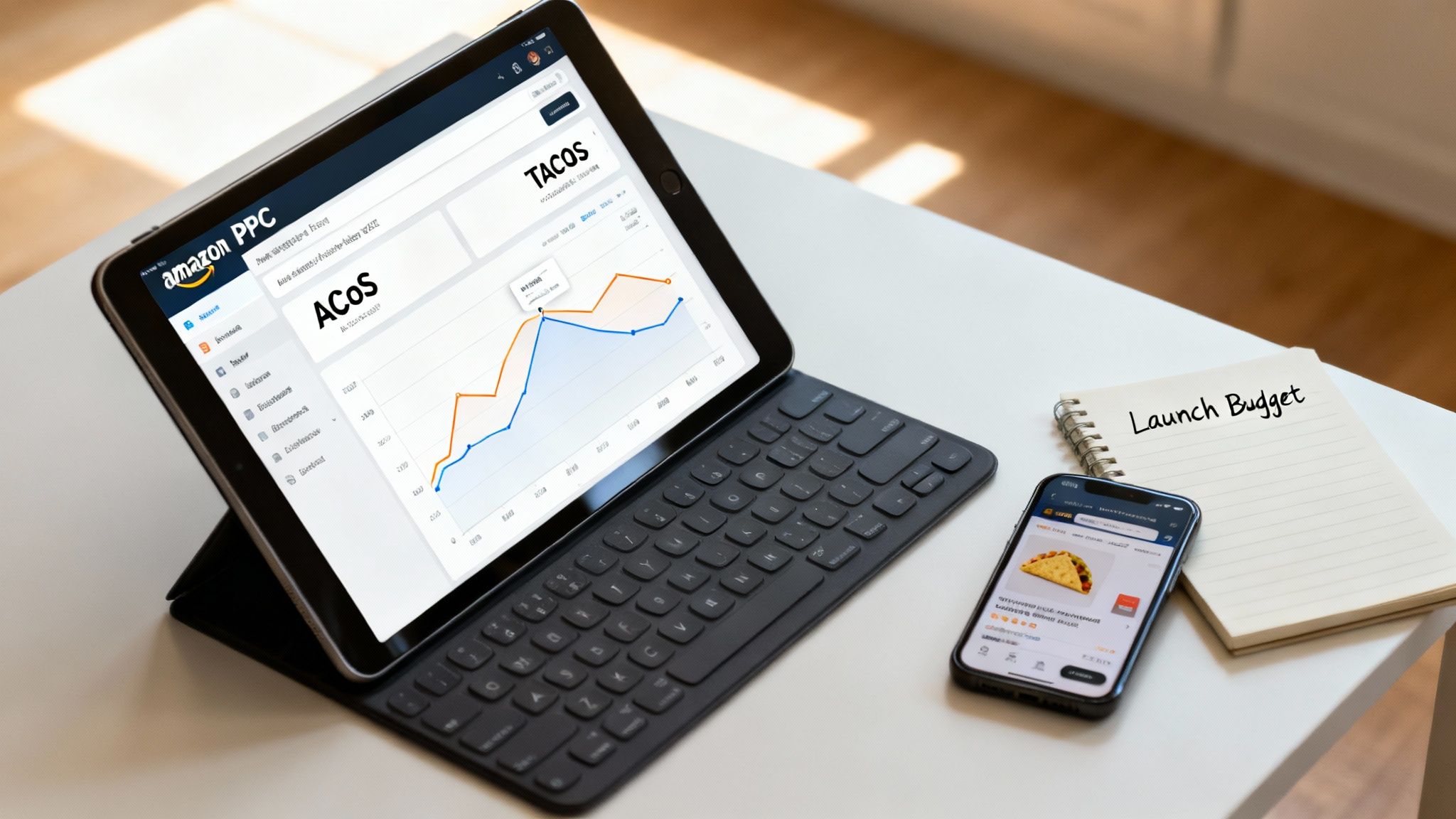
When you first dive into Amazon Ads, you’ll hear one metric constantly: ACoS (Advertising Cost of Sale). It tells you what percentage of sales came from your ad spend. For instance, if you spend $20 on ads and get $100 in ad-attributed sales, your ACoS is 20%.
But fixating on ACoS is a classic rookie mistake. It only tells part of the story. A much more powerful approach is to focus on TACOS (Total Advertising Cost of Sale).
TACOS = Total Ad Spend ÷ Total Revenue
This single metric reveals the true health of your entire Amazon business. Why? Because it measures your ad spend against all of your sales—both ad-driven and organic. A low and falling TACOS is a clear sign that your ads are successfully driving organic sales, creating a powerful growth flywheel.
For example, you might launch a new product with a high ACoS and a TACOS of 40%. While that seems high, it's a strategic investment. Over time, as those ads drive more sales and boost your organic ranking, your TACOS could drop to a much healthier 10%—even if your ACoS remains steady. That's what sustainable growth looks like.
A smart PPC strategy isn't just about making a sale today. It's an investment in your product's long-term visibility.
Every sale—whether from an ad or organic search—sends a positive signal to Amazon's A10 algorithm that your product is relevant and desirable. This, in turn, boosts your organic search ranking.
It creates a self-reinforcing cycle:
This dual approach is crucial. You use ads to kickstart the engine, which then fuels your organic ranking and leads to more profitable, long-term growth.
Your ad strategy must evolve with your product's lifecycle.
A smart, data-driven PPC strategy is non-negotiable for success. If you'd like to dive deeper, our experts share more details on Amazon ads management.
Thinking of Amazon as just another sales channel is a common—and costly—mistake. The real question isn't just "is Amazon worth it?" but rather, "how does Amazon integrate with my entire brand ecosystem?" It can't be a silo. To maximize its value, Amazon must work in sync with your DTC site (like Shopify), other marketplaces like Walmart, and even your brick-and-mortar partners.
This is where our Foundation → Optimization → Amplification framework comes full circle. Amazon is a powerful tool for the Amplification phase, but it only works if your brand and operational Foundation are rock solid. When you connect these channels, you create a seamless customer journey that drives sales today and builds profitable loyalty for tomorrow.
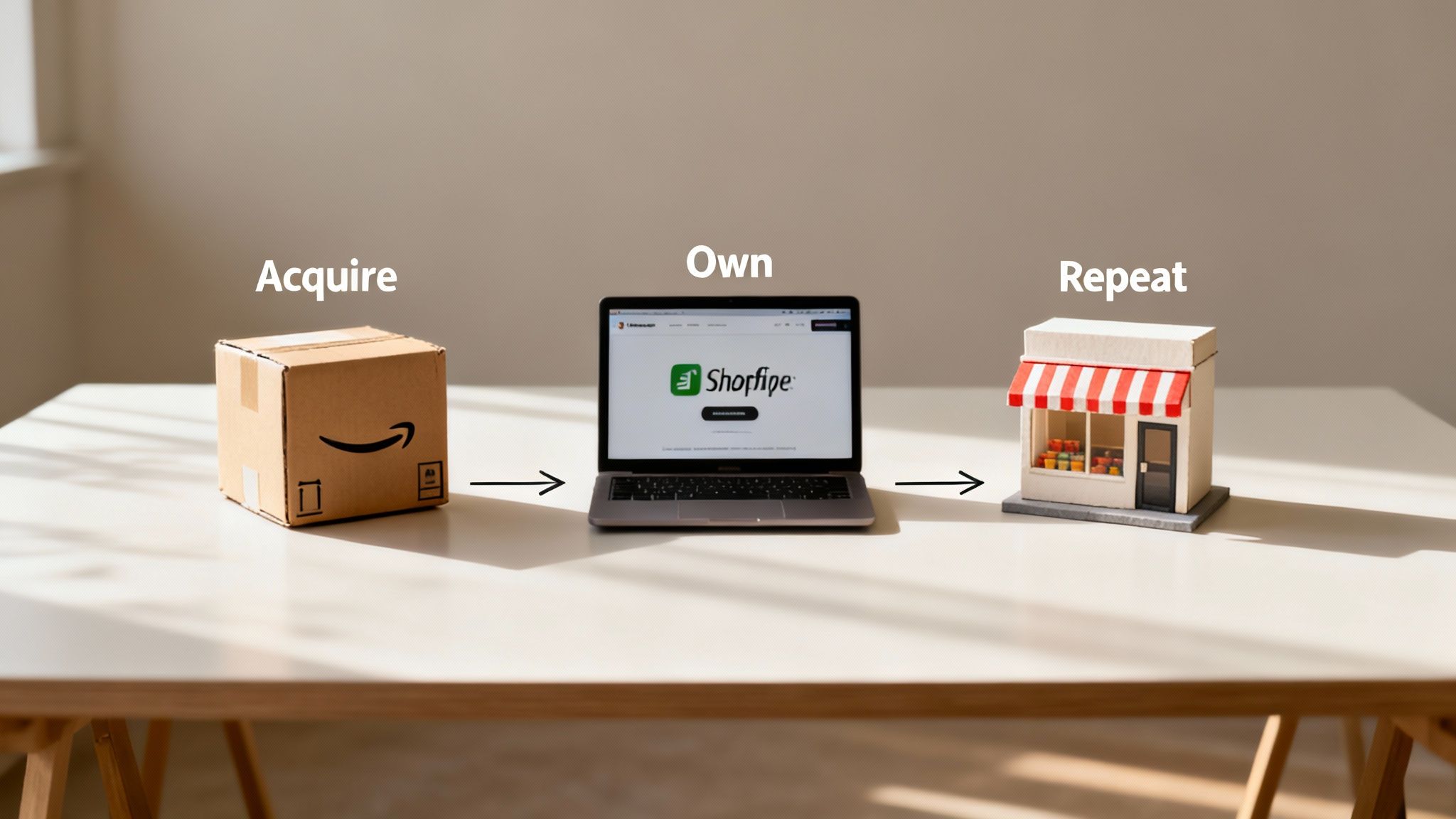
The smartest omnichannel strategies play to each channel's strengths. Amazon is the world's most powerful engine for product discovery and customer acquisition. Millions of shoppers start their search there with a high intent to buy, making it the perfect place to get your brand in front of new people.
The strategy is simple but incredibly effective:
This "flywheel" model effectively turns Amazon's fees into a customer acquisition cost. You then realize the long-term value of that customer on your own, higher-margin channels. We dive deeper into this approach in our guide on what is omnichannel commerce.
As you build this strategy, it's crucial to understand what's happening on the Amazon marketplace. Recent data shows a fascinating shift. While the number of new sellers has slowed, third-party sales are still soaring. This means traffic and revenue per existing seller have increased.
Data-Driven Insight: The game is shifting from quantity to quality. There are fewer new players on the field, but winning requires a much higher level of execution and strategy. Longevity and strategic thinking are winning out—over 60% of the top 10,000 sellers have been on the platform since before 2019.
This trend is a huge advantage for established brands with a smart, omnichannel approach. For brands that can nail the fundamentals and weave Amazon into a larger plan, the opportunity to capture market share is bigger than ever.
An integrated strategy isn't just about marketing—it's about operations. Amazon’s Multi-Channel Fulfillment (MCF) program is a game-changer here. It lets you use your FBA inventory to fulfill orders from your other channels, like your Shopify store.
This centralizes your inventory management, which simplifies logistics and reduces the risk of stockouts. Instead of juggling inventory between a 3PL and Amazon's warehouses, you can manage everything from one hub. That operational synergy is a key part of a strong foundation, letting you scale your entire business more efficiently and profitably.
We’ve covered the numbers, strategies, and brand implications. Now, let’s turn that theory into a practical game plan. Answering "is selling on Amazon worth it?" isn't a simple yes or no—it's about whether your business is genuinely ready to seize the opportunity.
This checklist boils down everything we've covered into a clear decision framework. Use it to take an honest look at your brand's readiness across our three core pillars: Foundation, Optimization, and Amplification.
First, the money. If your unit economics don't add up on paper, they won’t work in the real world of Amazon. A rock-solid financial foundation is non-negotiable.
Be brutally honest with your answers:
If the numbers work, the next step is to ensure your brand is prepared to compete. Your product listings are your digital storefront, and they must be optimized to convert traffic from day one.
Practical Takeaway: A great product with a weak Amazon listing is dead on arrival, no matter how much ad spend you throw at it.
Assess your brand's creative and strategic assets:
If you can confidently check off these boxes, you’re in a great position to move forward. From here, partnering with an expert can help you nail the launch and amplification phases, ensuring your solid foundation translates into real, scalable growth.
Even after digging into the numbers, a few key questions usually remain. Let's tackle the most common ones to provide the final clarity you need.
There's no single magic number, but a smart starting budget is typically between $5,000 and $10,000. This isn't just for inventory—it's your strategic launch fund.
You need enough capital to cover your first major product order, the initial FBA fees to ship and store it, and a solid budget for a 3-month PPC launch campaign. That last part is critical for generating the early sales velocity needed to start ranking organically. Underfunding is one of the most common reasons for failure; a healthy capital base gives you the runway to gather data and build momentum without panicking about immediate profit.
It’s possible, but you’re choosing to play on hard mode. Using Fulfillment by Merchant (FBM) can work in niche situations, like selling large, heavy, or highly customized items where FBA fees would be prohibitive.
For most sellers, however, FBA is the clearest path to scale. The Prime badge is a massive driver of consumer trust and conversions, and it's nearly impossible to compete with Amazon's logistics network on your own. If you go FBM, you are on the hook for meeting Amazon's strict shipping standards, which can quickly become an operational challenge.
The market is competitive, not saturated. The days of listing a generic product and watching the sales roll in are long gone, but the opportunity is far from over. It just means success requires a more strategic approach.
Today, winning on Amazon is about finding a well-defined niche, building a real brand with high-quality creative, and running a data-driven PPC strategy.
Practical Takeaway: Recent data shows that while the number of new sellers has slowed, the average revenue per seller has actually increased. The game is shifting from quantity to quality, rewarding well-prepared brands that bring real value to the marketplace.
You've decided to move forward. Your first moves are critical for building a strong foundation.
At RedDog Group, we guide brands through this exact process every day, turning a complex decision into a clear, actionable growth plan. If you’re ready to build your foundation for profitable scale, we’re here to help. Let's Talk Growth.
Leave a comment: