
Published: March 2020 | Last Updated:January 2026
© Copyright 2026, Reddog Consulting Group.

Omnichannel commerce isn't just a buzzword; it's a growth strategy that creates a single, continuous conversation with your customers across every touchpoint. It means a shopper can start their journey on one channel, like social media, and finish it on another, like your physical store, without ever feeling a disconnect.
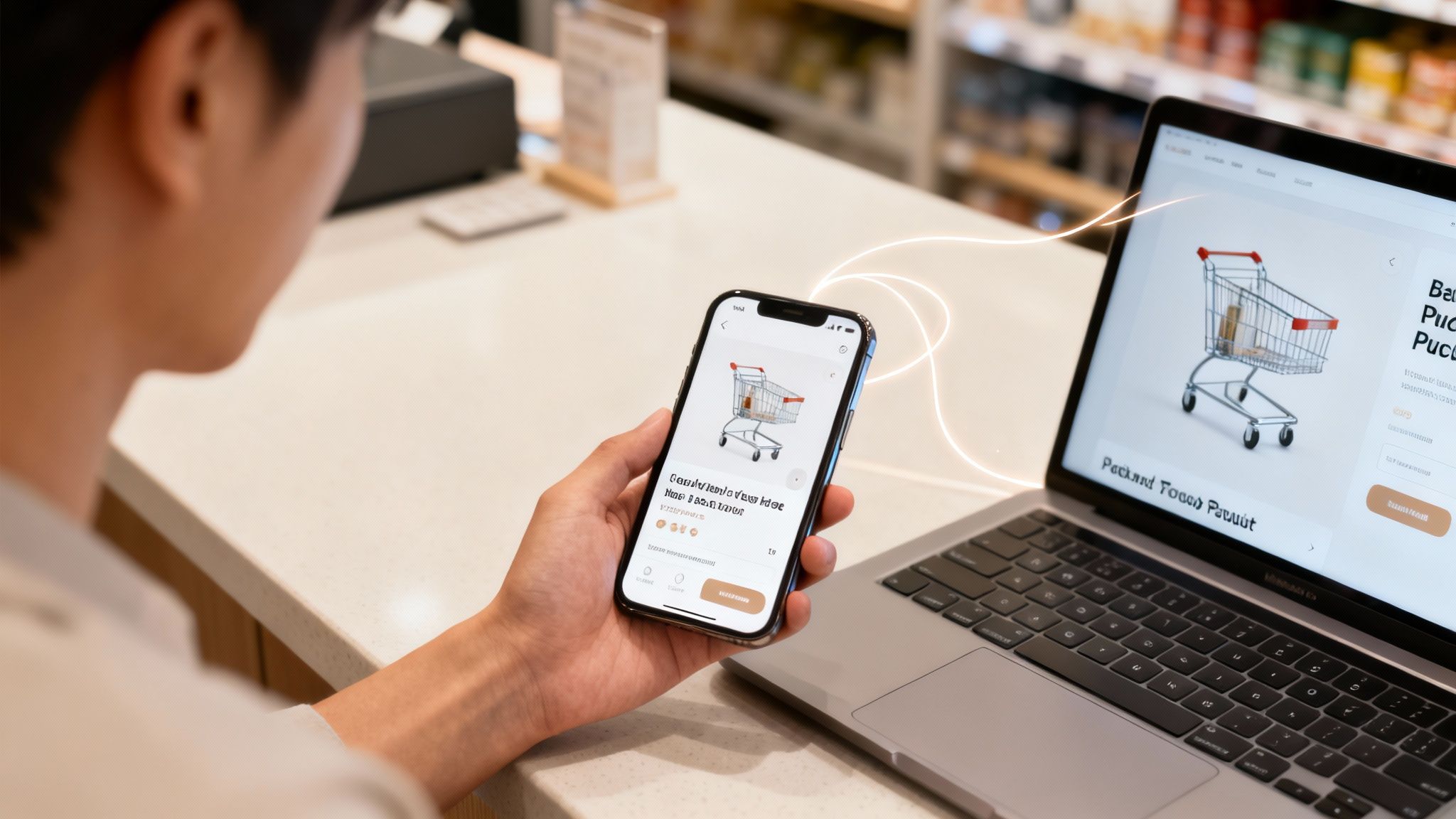
Let's cut through the jargon. Picture this: a customer sees a product on your Instagram Shop, adds it to their cart later on your website from a laptop, and then heads to your physical store to pick it up. That seamless, uninterrupted journey is the heart of omnichannel commerce.
It’s about more than just being present on multiple platforms; it's about making those platforms talk to each other. The goal is to put the customer at the center of your universe, letting them flow between your online store, mobile app, and brick-and-mortar locations as if it's all one cohesive brand experience. This is no longer a nice-to-have—it’s the new standard for modern retail.
Many brands confuse omnichannel and multichannel. While both use multiple channels to reach customers, their core philosophies are worlds apart.
A multichannel strategy is like having a great website, an active social media account, and a well-run store that all operate in separate silos. Inventory isn't shared, customer data is locked within each platform, and the experience on one channel has no impact on another. The channels exist, but they don't work together.
An omnichannel strategy, on the other hand, is an integrated system where every channel works in harmony, with the customer at the core. It connects all the dots to create a single, unified journey.
Here's how they stack up:
| Attribute | Multichannel Approach | Omnichannel Approach |
|---|---|---|
| Focus | Brand-centric (silos) | Customer-centric (unified) |
| Customer Experience | Inconsistent and fragmented | Seamless and consistent |
| Data | Separate data for each channel | Centralized, single customer view |
| Operations | Channels compete for attention | Channels work together |
| Goal | Be present on many channels | Create one unified journey |
The integrated omnichannel approach is what modern shoppers expect. Data shows that 73% of consumers use a mix of channels during their shopping journey. These omnichannel customers are your most valuable, shopping 1.7 times more often and spending more per visit than single-channel shoppers.
Adopting an omnichannel strategy is how you set the stage for sustainable growth. By creating a frictionless experience, you boost loyalty and increase customer lifetime value. It lets you build a deeper relationship with your audience, understanding their behavior across every touchpoint to deliver more personalized and meaningful interactions. For any brand serious about scaling in today's market, building an omnichannel presence is non-negotiable.
To dig into the core principles, we recommend exploring this a complete guide to omnichannel customer experience. Understanding these concepts is the first step in our proven framework for scaling your brand: building a solid Foundation before moving to Optimization and Amplification.
A powerful omnichannel experience doesn't just happen; it's built from core components working in perfect sync. A winning omnichannel strategy stands on four essential pillars. Getting these right is the Foundation stage of growth, setting you up for success. Without them, even the best products and marketing will fall flat.
The bedrock of any true omnichannel approach is unified customer data. This means creating a single, complete picture of every customer, no matter where or how they interact with your brand.
Imagine a customer browsing your website, abandoning their cart in your mobile app, and then walking into your physical store. Without a unified data system, your in-store team is flying blind. But with it, they can offer personalized help—perhaps even mentioning the product left in the cart—creating a "wow" moment that builds real loyalty.
Practical Takeaway: Stop thinking in terms of "online customers" and "in-store customers." They are all your customers. Centralizing data from every touchpoint is non-negotiable for delivering the personalized experiences that drive repeat business.
All that customer data is useless if your systems can't talk to each other. An integrated technology stack is the engine that makes your omnichannel strategy run, ensuring information flows freely between your operational tools.
This means your key platforms must communicate seamlessly:
When these systems are siloed, you get operational headaches. You might sell an out-of-stock item online or send a marketing email for a product a customer just bought in-store. To unify the customer journey, integrating CRM and marketing automation is essential.
Omnichannel isn't just a tech problem—it's a branding challenge. A consistent brand experience ensures that your company’s voice, visuals, values, and service feel the same everywhere a customer finds you.
A promotion advertised on Instagram should be honored in-store without confusion. The helpful tone in your support emails should match the attitude of your in-person staff. This consistency builds trust and makes your brand feel reliable, no matter the channel. For brands looking to scale, learning how to master the omnichannel strategy process for 2025 growth is critical for maintaining cohesion as you expand.
Finally, you need the operational muscle to deliver on your promises. Flexible fulfillment and logistics are what bring the omnichannel experience to life. This is the system that enables the convenient options modern shoppers expect, turning your entire operational network into a powerful asset.
Popular fulfillment models include:
These four pillars—data, tech, brand, and logistics—are the essential building blocks. Get this foundation right, and you'll have the structure you need to create a seamless customer journey and drive measurable growth.
Implementing an omnichannel foundation isn't just a customer-facing upgrade; it connects those seamless experiences directly to the metrics that matter to your bottom line. A solid strategy turns smooth interactions into measurable revenue and stronger brand equity. This is where omnichannel becomes a powerful engine for sustainable brand growth.
One of the biggest measurable results of an omnichannel approach is the boost to Customer Lifetime Value (CLV). When customers can move between your website, social media, and physical store without friction, their relationship with your brand deepens. Every positive, consistent interaction builds trust and encourages them to shop with you again.
A unified system makes every touchpoint feel personal and convenient. For example, a shopper who researches a product online and then picks it up in-store has a much better experience than someone who finds conflicting prices or inventory levels between channels. This friction-free journey encourages repeat purchases, turning one-time buyers into loyal advocates.
An integrated experience is the new currency of customer loyalty. Brands that deliver consistency don't just sell products; they build relationships that drive measurable value long after the first purchase.
Beyond customer benefits, omnichannel brings significant efficiencies to your back-end operations. When your systems are integrated, you get a single, real-time view of your inventory across every location—warehouses, retail stores, and even stock in transit.
This clarity is a game-changer for inventory management. It dramatically reduces the risk of costly stockouts on bestsellers while preventing overstocking on items that tie up cash. With accurate, centralized data, you can make smarter purchasing decisions, optimize stock allocation, and use physical stores as mini-distribution hubs for faster, more cost-effective shipping.
The image below breaks down the core pillars that support this integrated model.
This illustrates how unified data, technology, brand consistency, and logistics work together to create a powerful growth machine.
From a performance perspective, omnichannel commerce delivers a measurable impact. Research shows that strong omnichannel strategies can lift revenue by 10–15% and improve customer satisfaction by 20–30%. Furthermore, companies with effective omnichannel retailing retain over 89% of their customers and see annual revenue grow by 9.5%, far outpacing the 3.4% seen by their less-integrated competitors.
Every interaction on every channel generates valuable data. A unified system captures this information—browsing habits, purchase history, channel preferences—and funnels it into a single customer profile. These rich insights are gold for your marketing and product teams, enabling you to create highly targeted campaigns, personalize offers, and make data-driven decisions on future inventory. As you explore the 7 key benefits of omnichannel retail for business growth, it becomes clear this strategy is the foundation for scaling smarter, not just bigger.
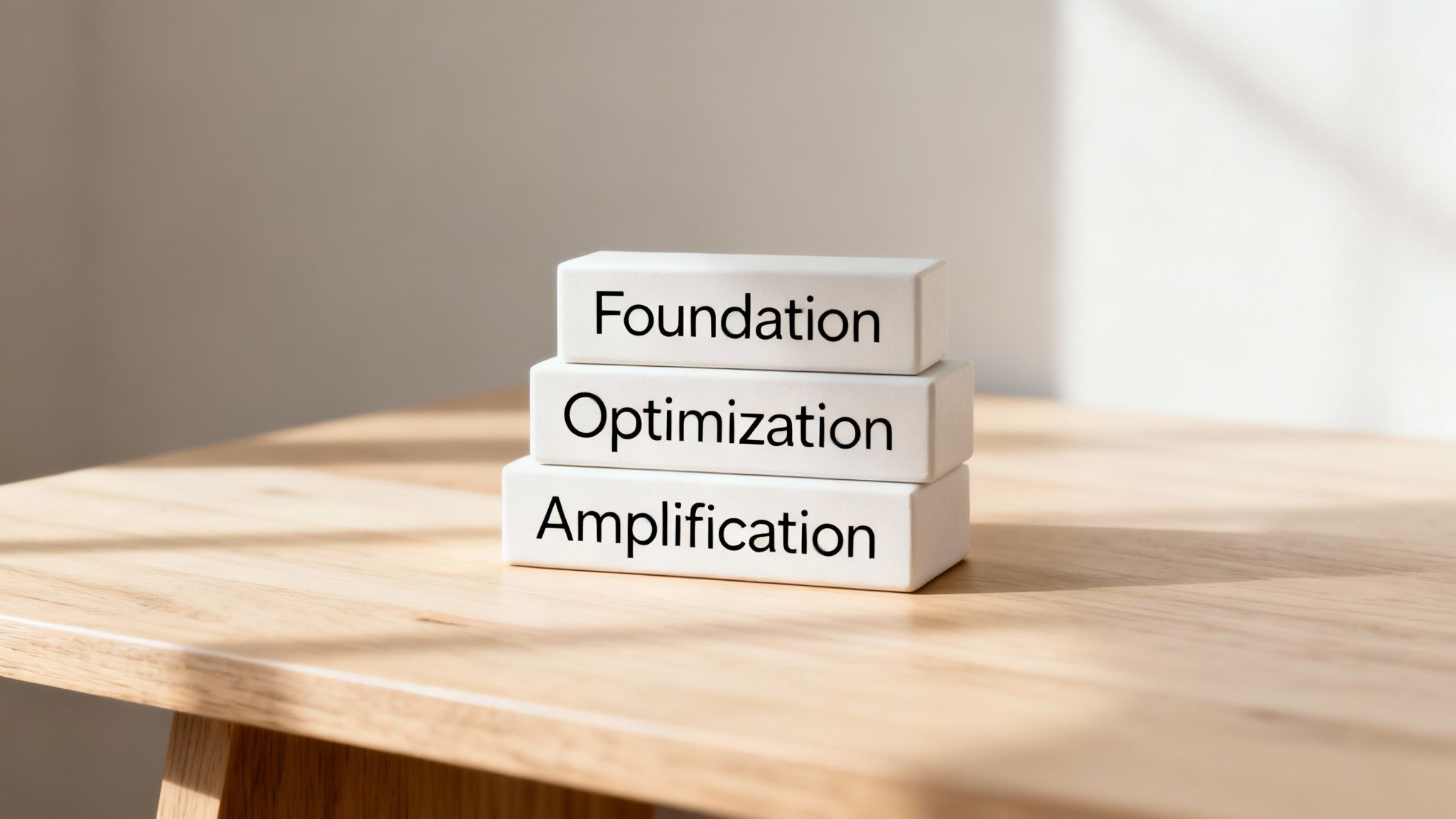
This is where the strategy becomes reality. Shifting to an omnichannel model can feel overwhelming, but it doesn't have to be. At RedDog Group, we guide brands through a proven, three-stage framework that breaks the process into manageable, results-focused steps.
This structured approach helps you build momentum the right way, avoiding common pitfalls and setting your brand up for scalable, long-term growth. The journey from disconnected channels to a unified customer experience follows a clear path: Foundation → Optimization → Amplification.
Before you can create a seamless customer experience, you need a rock-solid base. The Foundation stage is about getting your internal house in order, focusing on the data and technology that will support everything that follows. Rushing this part is the number one reason omnichannel strategies fail.
First, conduct a complete audit of your current channels. Get an honest picture of what’s working, what isn't, and where the biggest disconnects are for your customers. This isn't just about listing your website and social accounts; it’s about mapping the actual customer journey across them.
Next, centralize your customer data. This is the non-negotiable core of your foundation. You'll need to implement or upgrade a Customer Relationship Management (CRM) platform to act as your single source of truth, ensuring every customer interaction feeds into one unified profile.
Finally, integrate your inventory systems. Your website, marketplaces, and physical stores must all pull from the same real-time data pool. This single view of inventory eliminates "out of stock" frustrations and provides the technical backbone for modern fulfillment options.
The Goal of Foundation: To break down internal silos and create a single, unified view of both your customer and your inventory. This stage is about building the solid base required for scalable growth.
With a solid foundation in place, the Optimization stage shifts focus from internal systems to the external customer journey. This is where you start using your integrated data and technology to actively improve the shopping experience and make it truly seamless.
The first step is often rolling out flexible fulfillment options. With unified inventory data, you can confidently offer services like:
Next, personalize communications based on cross-channel behavior. Since all your data lives in one place, you can send an abandoned cart email that reflects items browsed on the mobile app. This relevant messaging shows customers you understand their entire journey.
Finally, this stage involves a relentless focus on creating a consistent user experience (UX) and brand message across every touchpoint. Pricing, promotions, customer service, and your brand voice must be identical everywhere. Consistency builds trust.
Once your experience is optimized, the Amplification stage is about scaling that success to accelerate growth. With a fully functional omnichannel engine, you can now press the accelerator with confidence, using your unified data to acquire new customers more efficiently and deepen relationships with existing ones.
This is where you launch highly targeted, profitable advertising campaigns. Your deep understanding of customer behavior allows you to create incredibly relevant ads, leading to higher conversion rates and a much better return on ad spend (ROAS). You can target in-store shoppers with specific online offers or vice-versa.
Amplification also means strategically expanding to new channels or marketplaces. With your integrated systems, launching on a new platform like Target+ or a social commerce channel becomes far less complex. You can maintain a cohesive brand presence and consistent operations from day one.
Lastly, this stage is about continuous refinement. You’ll use customer feedback and performance data from all channels to constantly improve your strategy, test new ideas, and stay ahead of what your customers will want next. This data-driven feedback loop ensures your omnichannel strategy delivers real, measurable results year after year.
Ready to build your growth plan? Let’s Talk Growth.

Theory is one thing, but seeing a true omnichannel strategy in action is where the real learning happens. Let’s look at how leading brands turned a seamless customer experience into a massive competitive advantage and a driver of measurable growth.
These companies don’t just exist on different channels; they’ve woven them together so tightly that the customer journey feels like one continuous conversation. By looking at their playbooks, you can see how the Foundation → Optimization → Amplification framework plays out in the real world.
Nike is a masterclass in building an entire world around the customer. Their strategy connects digital platforms and physical stores so effectively that they feel like two sides of the same coin, driving both immediate sales and unshakable brand loyalty.
At the center is the Nike App, which acts as a personal shopping assistant and a bridge between online and offline. A customer can browse products on their phone, check real-time inventory at a nearby store, and reserve an item for pickup.
Once in the store, the app unlocks even more value:
This deep integration of digital tools within a physical space turns a standard shopping trip into an interactive, personalized experience that drives repeat visits and higher spend.
In the beauty industry, Sephora sets the standard for omnichannel retail. They blend high-tech digital tools with a personal in-store touch, all built on a powerful foundation of unified customer data that delivers consistent, relevant interactions.
The Sephora mobile app extends the in-store experience into the customer's pocket. It features augmented reality (AR) virtual try-on tools, letting users test makeup looks before buying. That data, along with their purchase history, syncs directly to their Beauty Insider loyalty profile.
When a customer walks into a Sephora, an associate can pull up their profile on a tablet to see past purchases and preferences. This enables hyper-personalized service, like recommending a new concealer that complements a foundation they bought six months ago.
This unified view is what defines their success. The loyalty program tracks points and rewards seamlessly, whether a customer shops online, on the app, or in-store. By connecting every touchpoint, Sephora built a powerful engine for customer retention, proving that their omnichannel shoppers are their most valuable.
The lesson is clear: what is omnichannel commerce if not a strategy to make every customer feel known and valued, no matter how they choose to shop? It’s this consistent, data-driven personalization that turns casual buyers into lifelong fans.
Building a true omnichannel experience is a significant undertaking, and it’s easy for even the best plans to be derailed by common hurdles. The key to successfully moving from multichannel to omnichannel is knowing what not to do.
By understanding these challenges ahead of time, you can navigate the Foundation → Optimization → Amplification framework without wasting time and resources.
One of the quickest ways to kill an omnichannel initiative is letting departmental silos run the show. This happens when your marketing, sales, customer service, and operations teams all act independently.
The marketing team runs a flash sale, but the in-store staff has no idea. A customer calls support about an online order, but the agent can't see their purchase history. It’s a disconnected, frustrating experience for everyone. An omnichannel strategy is a team sport.
The Fix: Create a cross-functional team with representatives from every key department. Their sole mission should be to map the entire customer journey and identify every point where internal disconnects create friction for the customer.
Another major roadblock is a tangled mess of disconnected technology. Most brands accumulate a collection of software that doesn't communicate. You might have one system for your eCommerce site, another for your in-store POS, and a third for email, with none of them sharing data.
This technological fragmentation leads to inaccurate inventory, inconsistent customer profiles, and an inability to see what’s actually happening in your business. Investing in tools that don't integrate is like trying to build a puzzle with pieces from ten different boxes.
When your teams and technology are siloed, an inconsistent customer experience is the guaranteed result. This is the classic "price is different online" problem, or when your return policy is flexible for web orders but rigid in-store.
These inconsistencies destroy trust. Customers don't see your brand as separate channels; they see one brand. A promotion pushed on Instagram that isn’t honored at the register feels like a broken promise and can push customers away for good.
Finally, many brands invest heavily in new technology but forget about the people who have to use it. Rolling out a sophisticated new system without proper training and support for your team is a surefire way to fail.
Your employees—from the warehouse crew to the sales associates on the floor—are the face of your customer experience. If they don’t understand how the new tools work or why things are changing, they can't deliver the seamless service you're aiming for. An untrained team will always fall back on old habits, undermining your entire strategy from the inside out.
Even with a solid plan, practical questions will come up as you build your omnichannel experience. Here are a few of the most common ones we hear, with straightforward answers to keep you moving forward.
Before investing in new technology or adding more channels, your first step is to get all your customer data in one place. You need a single, unified view of your customer.
For most businesses, this means implementing a reliable CRM (Customer Relationship Management) system that connects your online store with any other sales points. The goal is simple: understand who your customers are and how they shop across the one or two channels you already use. This is the Foundation for everything that comes next.
Not at all. This is a common misconception. Omnichannel is about creating a connected, seamless experience across the channels you already have, whether they are digital, physical, or a mix of both.
If you are a purely online brand, your omnichannel strategy would focus on integrating your website, an Amazon storefront, social media shops on platforms like Instagram or TikTok, and your mobile app. The core principle is the same: a customer’s cart, history, and profile should follow them across every digital touchpoint, creating one unified journey.
Measuring the return on an omnichannel investment requires shifting your focus from isolated channel performance to blended metrics that tell the complete customer story.
Instead of tracking online sales and in-store sales separately, look at KPIs that show the bigger picture:
Ultimately, you’re not just measuring a single transaction; you’re measuring the total value of your relationship with a customer.
Ready to move from questions to a concrete growth plan? The team at RedDog Group builds the frameworks that turn disconnected channels into a powerful, revenue-driving machine. Let’s Talk Growth.
Leave a comment: