
Published: March 2020 | Last Updated:April 2026
© Copyright 2026, Reddog Consulting Group.

Over 60 percent of American retail brands report that unclear sales objectives lead to wasted analytics effort and missed revenue opportunities. For busy e-commerce managers, aligning sales goals with actual multichannel data is often the difference between growth and stagnation. This guide delivers practical strategies to help you set sharp objectives, gather the right sales data, and turn insights into real results across every channel.
| Key Insight | Explanation |
|---|---|
| 1. Define Clear Sales Objectives | Establish specific, measurable goals to guide your sales data analysis and improve performance. |
| 2. Collect Comprehensive Data | Utilize various sources like CRM, POS, and ecommerce platforms to gather detailed sales information. |
| 3. Clean and Validate Data | Implement systematic validation processes to ensure data accuracy, which is crucial for reliable insights. |
| 4. Analyze Performance Trends | Monitor key metrics across channels to identify strengths and weaknesses, informing strategic adjustments. |
| 5. Translate Insights into Actions | Convert data findings into targeted strategies that drive business growth and enhance sales performance. |
Successful sales data analysis starts with crystal clear objectives that transform raw numbers into strategic insights. Your mission is to establish specific, actionable goals that will guide your entire multichannel revenue tracking process.
Begin by identifying the precise questions you want your sales data to answer. Are you looking to understand sales performance across channels? Want to predict future revenue trends? Pinpoint which product lines generate the most profit? These targeted objectives will determine which metrics you track and how you interpret the data. Academic research confirms that well-chosen objectives break complex business goals into measurable tasks, directly improving overall performance.
Specifically, focus on defining objectives that are concrete and quantifiable. Instead of vague statements like “increase sales,” craft precise targets such as “increase online sales by 15% in Q3” or “reduce customer acquisition costs by 10% across Amazon and direct-to-consumer channels.” This approach allows you to create a structured framework for data analysis that aligns with your broader business strategy.
Pro tip: Create a one-page objective document that clearly outlines your sales analysis goals, ensuring every team member understands the specific metrics and targets you will be tracking.
Here’s a summary of key sales analysis objectives and their business impact:
| Objective Type | Description | Business Impact |
|---|---|---|
| Increase Channel Revenue | Grow sales in specified channels | Drives targeted revenue growth |
| Reduce Acquisition Costs | Lower costs to gain new customers | Boosts profitability |
| Identify Top Product Lines | Find most profitable product categories | Optimizes product strategies |
| Predict Revenue Trends | Forecast future sales patterns | Informs strategic planning |
Tracking sales data across multiple channels requires a systematic approach to gathering and managing information from diverse sources. Your goal is to create a comprehensive and reliable data collection strategy that captures the full picture of your sales performance.

Start by identifying all potential data collection channels and integration methods for your multichannel sales ecosystem. This typically includes customer relationship management (CRM) systems, point of sale (POS) platforms, ecommerce websites, marketplace sales data, social media insights, and customer feedback channels. Each source provides unique perspectives on your sales performance. Focus on collecting first-party data directly from your own platforms, which offers the most accurate and immediate insights into customer behavior and sales trends.
Implement a standardized process for documenting and organizing your sales data. This means establishing consistent naming conventions, creating clear metadata tags, and developing a centralized storage system that allows easy access and analysis. Consider using cloud-based tools that enable real-time data synchronization across different platforms, ensuring your sales information remains current and actionable. Proper documentation and version control will help your team track changes, maintain data integrity, and support future analytical efforts.
Pro tip: Develop a master spreadsheet or dashboard that automatically consolidates data from different sources, allowing you to quickly visualize and compare sales performance across all your marketing channels.
Compare popular sales data sources and their advantages:
| Data Source | Typical Insights Provided | Integration Ease |
|---|---|---|
| CRM System | Customer activity, sales funnel | Moderate |
| POS Platform | In-store transactions, inventory | High |
| Ecommerce Site | Online orders, user behavior | High |
| Marketplace | Third-party sales, sku trends | Variable |
| Social Media | Campaign engagement analytics | Moderate |
Accurate sales analysis depends on high-quality data that has been thoroughly scrubbed of errors, inconsistencies, and misleading information. Your objective in this crucial step is to transform raw data into a reliable foundation for strategic decision making.
Begin by implementing comprehensive data validation rules that systematically identify and correct potential issues. This process involves checking data types, verifying numeric ranges, standardizing formats, and ensuring consistency across different sales channels. Look for common problems like duplicate entries, incomplete records, incorrect data types (such as text in numeric fields), and outliers that could skew your analysis. Pay special attention to critical fields like sales amounts, customer information, product codes, and transaction dates.
Develop a structured approach to data cleaning that preserves the integrity of your original information while removing noise and inaccuracies. Use automated tools and manual review processes to handle missing values, correct coding errors, and standardize data representations. This might include normalizing customer names, converting currency values to a standard format, and ensuring consistent date formatting across all your data sources. By meticulously validating and cleansing your sales data, you create a trustworthy dataset that enables more accurate insights and more confident business decisions.
Pro tip: Create a data cleaning checklist with specific validation rules and run your cleaning process before each major analysis to maintain ongoing data quality and reliability.
Understanding how your sales perform across different channels is critical for developing targeted strategies that maximize revenue and efficiency. Your goal is to uncover meaningful insights that reveal which channels are driving growth and which might need strategic adjustment.
Start by analyzing key performance indicators that provide a comprehensive view of your multichannel sales landscape. Focus on metrics like total revenue per channel, conversion rates, average order value, customer acquisition costs, and product performance across different platforms. Compare these indicators side by side to identify strengths and weaknesses in each sales channel. Pay close attention to seasonal variations, growth rates, and how different channels complement or cannibalize each other. For instance, you might discover that your Amazon marketplace sales spike during holiday seasons while your direct to consumer website performs better during off peak periods.
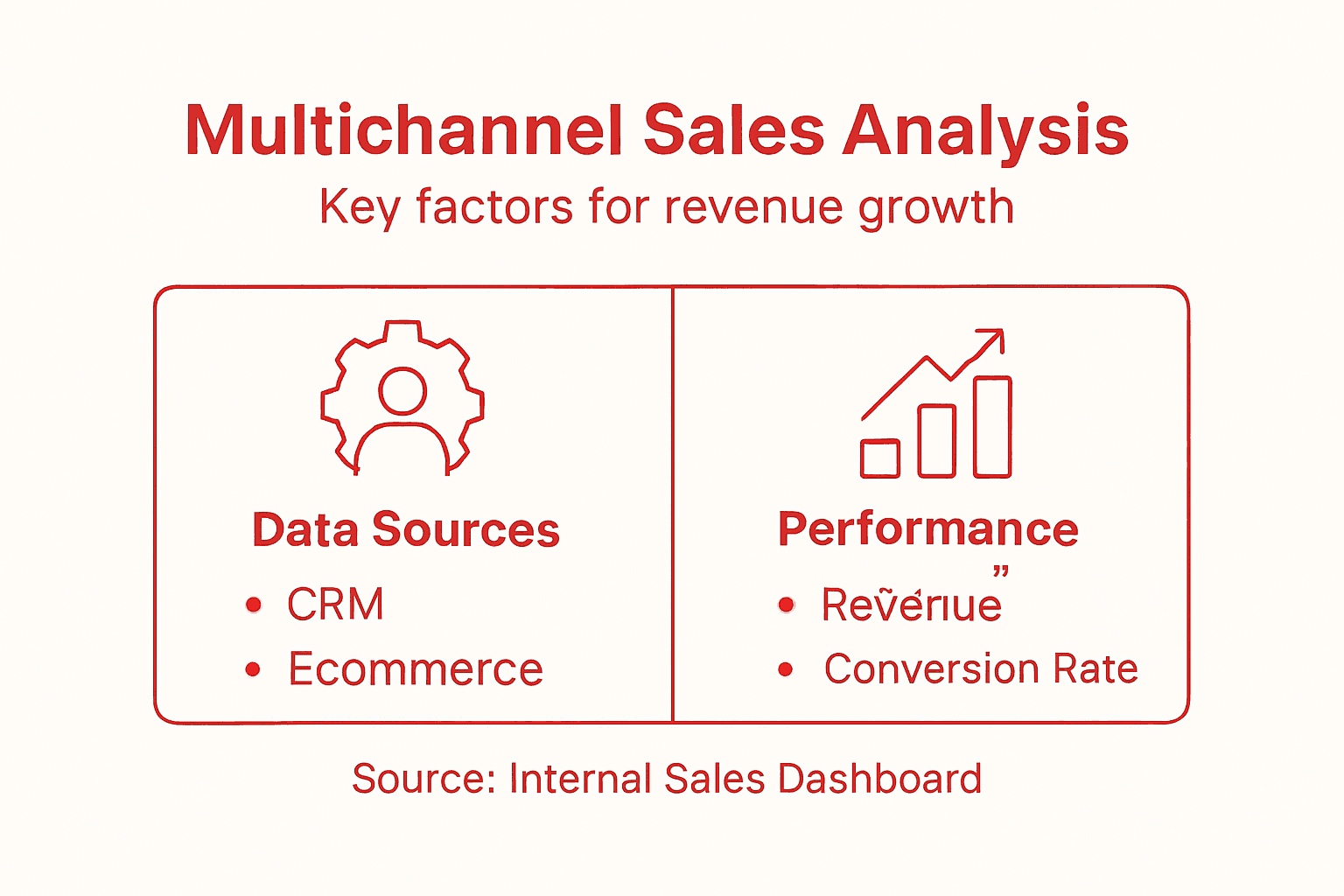
Create visual representations of your channel performance data using charts, graphs, and dashboards that make trends immediately apparent. Look beyond surface level numbers to understand the underlying patterns. Consider factors like customer demographics, marketing spend, and engagement levels for each channel. Are your social media campaigns driving traffic to your ecommerce platform? Are marketplace sales growing faster than direct sales? By developing a nuanced understanding of these performance trends, you can make informed decisions about resource allocation, marketing strategies, and channel optimization.
Pro tip: Develop a monthly performance dashboard that automatically compares key metrics across all sales channels, allowing you to quickly spot emerging trends and make data driven decisions.
Transforming complex sales data into meaningful strategic actions is the ultimate goal of your multichannel revenue analysis. Your mission is to convert raw insights into practical, executable strategies that drive tangible business growth.
Begin by translating data insights into strategic actions that directly address performance gaps and opportunities. This means moving beyond simply observing trends to creating targeted interventions for each sales channel. Identify specific recommendations such as reallocating marketing budgets, adjusting product positioning, optimizing pricing strategies, or developing channel specific promotional campaigns. For example, if your analysis reveals that your direct to consumer platform has lower conversion rates compared to marketplace sales, develop a comprehensive strategy to improve website user experience, streamline checkout processes, or enhance product descriptions.
Ensure that your strategic recommendations are communicated clearly across all relevant stakeholders. This involves creating detailed implementation plans that outline specific actions, responsible team members, expected outcomes, and measurable key performance indicators. Break down complex insights into actionable steps that can be easily understood and executed by different departments. By connecting data analysis directly to strategic planning, you create a dynamic feedback loop that continuously improves your multichannel sales approach and drives sustainable revenue growth.
Pro tip: Schedule quarterly strategy review meetings where data insights are directly discussed, ensuring that your team consistently translates analytical findings into concrete business actions.
If you are facing challenges in defining clear sales analysis objectives or organizing complex datasets from multiple channels the next step is to apply actionable insights that fuel real business growth. Understanding performance trends and cleansing your sales data are critical but can quickly become overwhelming without the right support. At Reddog Group we specialize in helping small and medium-sized businesses master omnichannel retailing and optimize their marketplace and direct-to-consumer strategies to drive measurable revenue increases.

Take control of your multichannel revenue growth today by partnering with a results-driven agency that brings deep expertise in Amazon FBA, integrated online-offline sales, and strategic marketing campaigns. With a proven track record managing over 30,000 SKUs across 50 brands, we provide tailored solutions from product listing optimization to inventory management. Visit Reddog Group now to discover how our data-driven strategies can transform your sales performance and set you on the path for sustainable growth.
Establish specific, actionable goals that your sales data should address. Focus on measurable targets, like increasing online sales by 15% in Q3, to guide your data analysis process.
Identify all data sources such as CRM systems, POS platforms, and ecommerce sites. Implement a standardized process for organizing this information, ensuring consistency in formatting and storage to facilitate easy analysis.
Apply comprehensive validation rules to identify and correct errors, such as duplicates or incorrect data types. Use a structured approach that includes automated tools to ensure your dataset remains accurate and reliable for analysis.
Focus on key performance indicators like total revenue per channel and conversion rates to assess sales performance. Compare these metrics to identify strengths and weaknesses, which will inform your business strategy moving forward.
Convert insights into practical actions by identifying specific recommendations like reallocating marketing budgets or optimizing pricing strategies. Develop detailed implementation plans that outline responsibilities and measurable outcomes for your team to follow.
Utilize graphs, charts, and dashboards to create visual representations of your sales data. This will help you quickly spot trends and patterns, allowing for data-driven decision-making across your sales channels.
Leave a comment: