
Published: March 2020 | Last Updated:January 2026
© Copyright 2026, Reddog Consulting Group.

A product launch checklist template is more than a to-do list; it’s your strategic playbook for turning a chaotic process into measurable growth. It outlines every critical task, from pre-launch supply chain logistics to post-launch data analysis, ensuring your marketing, sales, and operations teams execute as one.
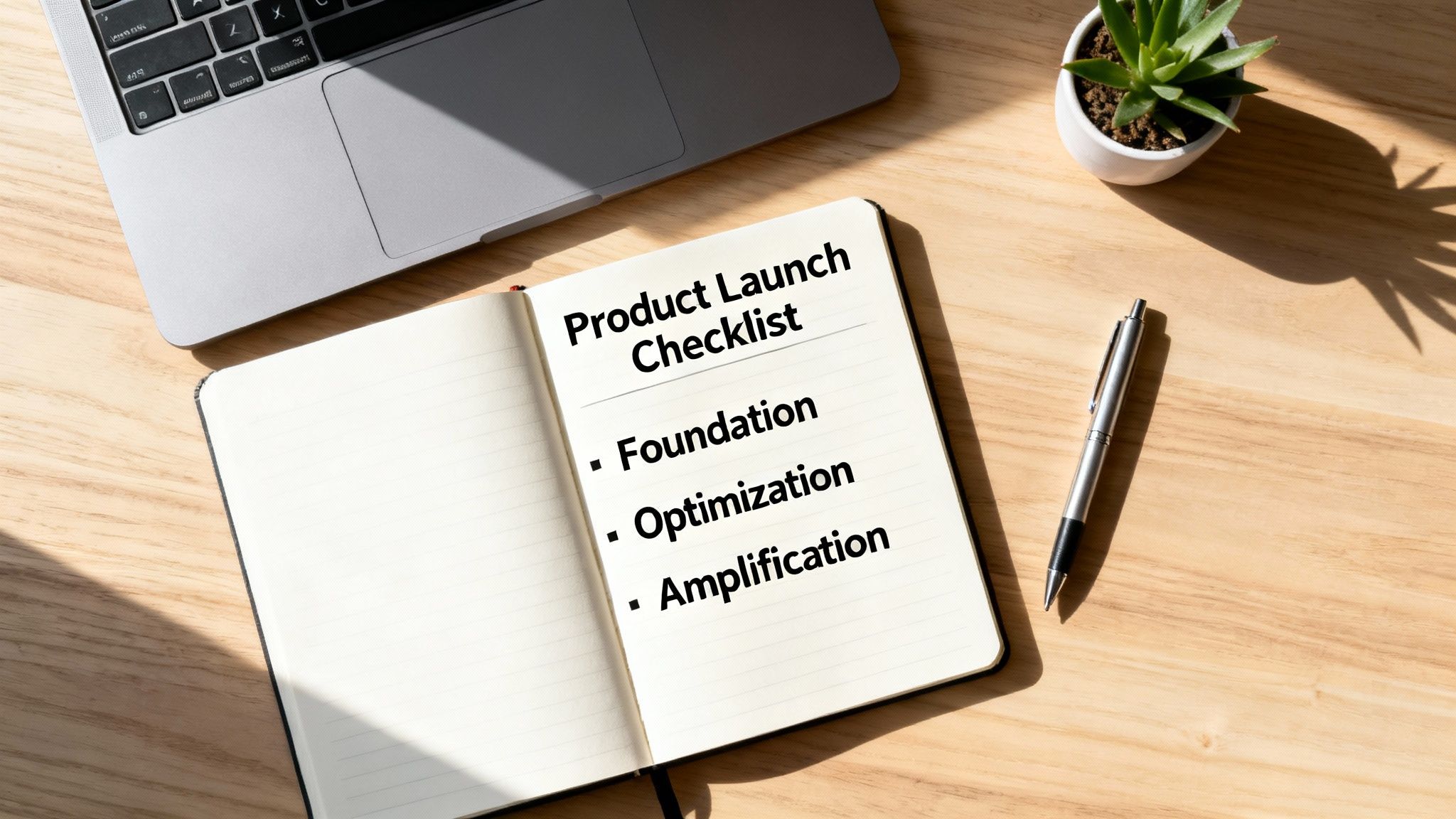
Today, launching a product means being present wherever your customers shop—a strategy we call omnichannel commerce. A weak launch can neutralize a great product before it gains traction, especially when juggling the unique demands of Amazon, your own DTC store, and physical retail simultaneously.
The difference between a breakout success and a quiet failure often comes down to one thing: a repeatable system.
This is where a product launch checklist becomes your most valuable asset. It’s not about ticking off boxes. It’s about creating a single source of truth that prevents costly errors, eliminates last-minute scrambles, and builds a predictable engine for brand growth.
At RedDog, every launch is executed through our proven Foundation → Optimization → Amplification framework. This methodical approach ensures nothing is missed, transforming a tangled web of dependencies into a clear, manageable workflow.
This checklist template serves as a detailed field guide, complementing broader strategies on how to launch new product in today’s e-commerce landscape. When you systemize your launch, every team member—from marketing to supply chain—knows exactly what to do and when.
A well-executed omnichannel launch isn’t just about being on multiple channels. It's about delivering a consistent, high-quality brand experience at every touchpoint, whether a customer is browsing on their phone or walking through a store.
This guide provides that system. We’ll break down each phase and share our downloadable template, which you can adapt for any platform. Understanding the core principles of what is omnichannel commerce is the first step toward a launch that doesn't just make a splash but drives long-term revenue.
Let's build your blueprint for a flawless launch.
A powerful launch is built on a solid foundation, not last-minute heroics. The most critical work happens months before your go-live date, typically in the 60 to 90-day window. This is the Foundation phase, where you meticulously prepare every asset, system, and logistical detail to ensure you launch with unstoppable momentum.
Think of it like building a house—you can't build the walls without a concrete foundation. Skipping these early steps is the most common reason launches fail to meet sales targets or fizzle out after a promising start.
This phase is less about flashy marketing and more about operational excellence. It’s where you handle the critical details that can derail a launch if not addressed early.
Before you can think about a marketing campaign, your operational house must be in order. This means ensuring your product can move through the supply chain smoothly, from the factory floor to the customer's doorstep.
Here are the non-negotiable first steps:
Locking down these elements early prevents frantic, last-minute scrambles and ensures your product is physically ready for the market.
With the operational pieces in place, the focus shifts to building your "digital shelf." This is your product’s home on every online channel, and it needs to be perfected before a single customer sees it. A poorly constructed digital shelf is like a physical store with messy aisles and no price tags—shoppers will simply leave.
The goal is to create a consistent, compelling, and persuasive experience everywhere your product appears online.
A strong digital shelf ensures that when customers discover your product, they have all the information they need to make a confident purchase. It's about combining persuasive copy, high-quality visuals, and strategic keywords to win the click and the conversion.
This process involves deep analysis and content creation tailored to each platform’s unique algorithm and user behavior.
What works on Amazon won’t necessarily drive results on Shopify. Your content must be adapted to the unique environment of each channel for maximum impact.
A critical part of building your foundation is understanding the competitive landscape on each channel. Analyze the top three to five competitors for your primary keywords.
Look at their:
This analysis reveals gaps in the market you can exploit and helps you position your product to win from day one. By investing heavily in this foundational work, you set the stage for a launch that not only happens on time but also has the assets and strategy in place to capture sales immediately. Organizations that use a structured product launch checklist template report that they can reduce missed activities by up to 40%, a significant factor in successful rollouts. You can discover more insights about launch readiness on productboard.com.
You’ve laid the groundwork. Now it’s time to move from planning to execution. Launch week is where your strategy meets the market, and a powerful rollout depends on hitting the right channels with the right tactics at the right time. This isn’t about flipping a single switch; it’s a coordinated push designed to capture attention and drive sales velocity from day one.
An omnichannel launch means recognizing that every platform is a unique ecosystem. The playbook for Amazon is different from the one for your Shopify store or a physical retail shelf. To win, you must treat each channel with the specific focus it demands while maintaining a consistent brand story across all of them.
Making the jump from pre-launch prep to a live, multi-channel rollout is a make-or-break moment.
This flow illustrates how the foundational elements—supply chain, digital shelf, and inventory—integrate to enable a powerful launch.
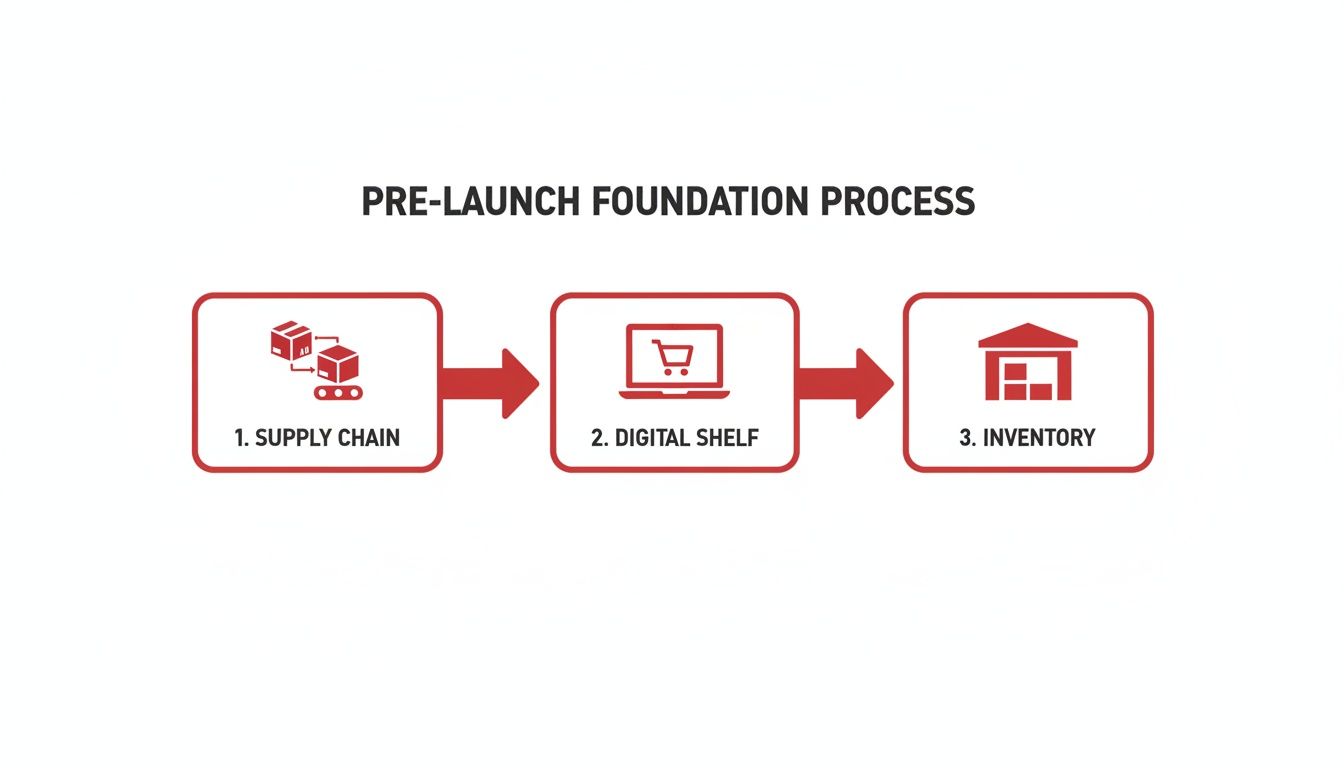
Nailing these steps provides the runway to execute smoothly across every sales channel.
On marketplaces like Amazon and Walmart, launch week is a sprint for visibility and sales momentum. These platforms' algorithms reward products that sell well right out of the gate, so your initial performance sets the tone for your long-term ranking.
A critical component of a strong marketplace launch is activating your ad campaigns.
Beyond ads, early reviews are the lifeblood of any marketplace launch. Generate them using programs like Amazon Vine and by ensuring your product and customer experience are flawless. A steady stream of positive reviews builds the social proof needed to earn badges like "Amazon's Choice" or "New Release," which can provide a massive visibility boost.
When you launch on your own Shopify site, you have total control over the customer journey—but you are also 100% responsible for generating traffic. Your execution plan here is about driving qualified visitors to your carefully crafted product pages.
This means you need to use an integrated approach, leveraging both your owned channels and paid media.
On DTC, success isn't just about sales. It's about building a direct relationship with your customers. Your launch should be designed to attract, convert, and retain an audience that you own.
Think of your DTC launch as a well-orchestrated event designed to create excitement and urgency.
While the channels differ, the core principle is the same: be ready to act fast. Below is a quick comparison of the critical action items for launch day across major channels.
A comparative look at critical launch day tasks for Amazon, Walmart Marketplace, Shopify (DTC), and Physical Retail to highlight the nuances of an omnichannel strategy.
| Action Item | Amazon | Walmart | Shopify (DTC) | Physical Retail |
|---|---|---|---|---|
| Paid Ads Activation | Go live with aggressive PPC bids on top keywords. | Activate Sponsored Products campaigns immediately. | Launch targeted social media & search ad campaigns. | N/A (Pre-launch trade marketing) |
| Listing/Page Status | Confirm listing is live, buyable, and indexed. | Verify product page is active and purchasable. | Ensure product pages are live with correct pricing. | Confirm product is on shelves and scannable. |
| Inventory Check | Monitor FBA inventory levels in real-time. | Check available inventory to avoid stockouts. | Monitor stock levels directly in the platform. | Check in with store managers on shelf stock. |
| Review Generation | Push enrollment in Amazon Vine or Early Reviewer Program. | Encourage early reviews through follow-up. | Send post-purchase review request emails. | N/A (Focus on in-store experience) |
| Customer Communication | Send launch announcement to external email list. | Announce launch to any off-platform audience. | Deploy launch day email & SMS campaigns. | Ensure staff are trained and ready to talk. |
| Promotions & Pricing | Verify launch pricing & coupons are active. | Double-check that promotional pricing is live. | Confirm discount codes are working correctly. | Verify in-store signage and promos are accurate. |
This table shows just how different the "go-live" moment is for each channel. Success means managing these distinct workflows simultaneously without dropping any balls.
Executing a launch in brick-and-mortar stores adds physical logistics and human coordination to the mix. Here, success hinges on clear communication and strong partnerships with the retail managers and staff who are your brand's ambassadors on the floor.
Your main goal is making it easy for shoppers to find, understand, and buy your new product in a busy store. That means ensuring your product is merchandised correctly and in-store promotions are running without a hitch.
No matter the channel, the first few days are all about gathering data. Watch everything—ad performance, customer feedback, sales velocity, social media chatter. Be ready to optimize on the fly. That might mean adjusting your Amazon PPC bids, tweaking your Facebook ad creative, or sending updated instructions to your retail partners. This agile approach is what lets you react to the market in real-time and truly maximize your launch's impact.
A strong launch is the starting point, not the finish line. Real, sustainable growth happens in the 30-60 days that follow. We call this the Amplification phase, and it’s where you convert initial buzz into a lasting market presence.
The moment you go live, data starts pouring in. Every click, sale, and customer comment is a signal telling you what’s working. Your job is to analyze those signals and act decisively—scaling what’s connecting with customers and refining what isn’t.
This is how a good launch becomes a great one. It’s a deliberate process of listening to the market and doubling down on your wins.
The first few weeks post-launch are a goldmine of information. You’ll see which ad creative gets the most clicks, which keywords drive sales on Amazon, and what product benefits people are mentioning in their reviews. Ignoring this feedback is one of the biggest mistakes a brand can make.
The goal is to shift from a launch mindset—focused on a single day—to a long-term growth strategy fueled by performance data. This means analyzing early results to make smart decisions about your ongoing marketing and inventory.
Your post-launch period isn't about celebrating; it's about analyzing. The initial sales data and customer feedback are your roadmap for the next six months of growth, telling you exactly where to invest your time and budget for maximum impact.
This shift from a one-off campaign to a continuous growth loop is what separates fleeting successes from brands that build lasting value.
After a week or two, clear patterns will emerge from your data. You might find that a specific video ad on Instagram has a cost-per-purchase that's 50% lower than other creative. Or perhaps a certain keyword phrase on Walmart is driving an unexpectedly high volume of sales.
This is your signal to get aggressive. Shift your budget toward the campaigns, channels, and creative that are proven winners.
Scaling isn’t just about spending more money; it’s about spending it smarter by using real-world data to make calculated decisions.
Your first happy customers are your most powerful marketing asset. Positive reviews, user-generated photos, and glowing testimonials are pure gold for building trust with new shoppers who are still undecided.
Make it a priority to gather and showcase this social proof everywhere. Feature a five-star review in a social media ad, add customer photos to your Shopify product page, and pull direct quotes into your email marketing. This gives your brand an authentic voice that polished ad copy can't replicate.
At the same time, bring back visitors who showed interest but didn’t buy. Setting up smart retargeting campaigns is a non-negotiable step in the amplification process.
Effective retargeting means:
This two-pronged attack—amplifying positive buzz while re-engaging interested shoppers—creates a powerful growth engine that builds on your launch-day success. Ultimately, this sustained effort drives measurable growth. Companies that implement a comprehensive product launch checklist template report an average of 25% year-over-year growth, a figure that aligns directly with RedDog's own client performance benchmarks. You can learn more about the impact of structured launches at productboard.com. This sustained momentum, powered by post-launch amplification, is the key to achieving such results.
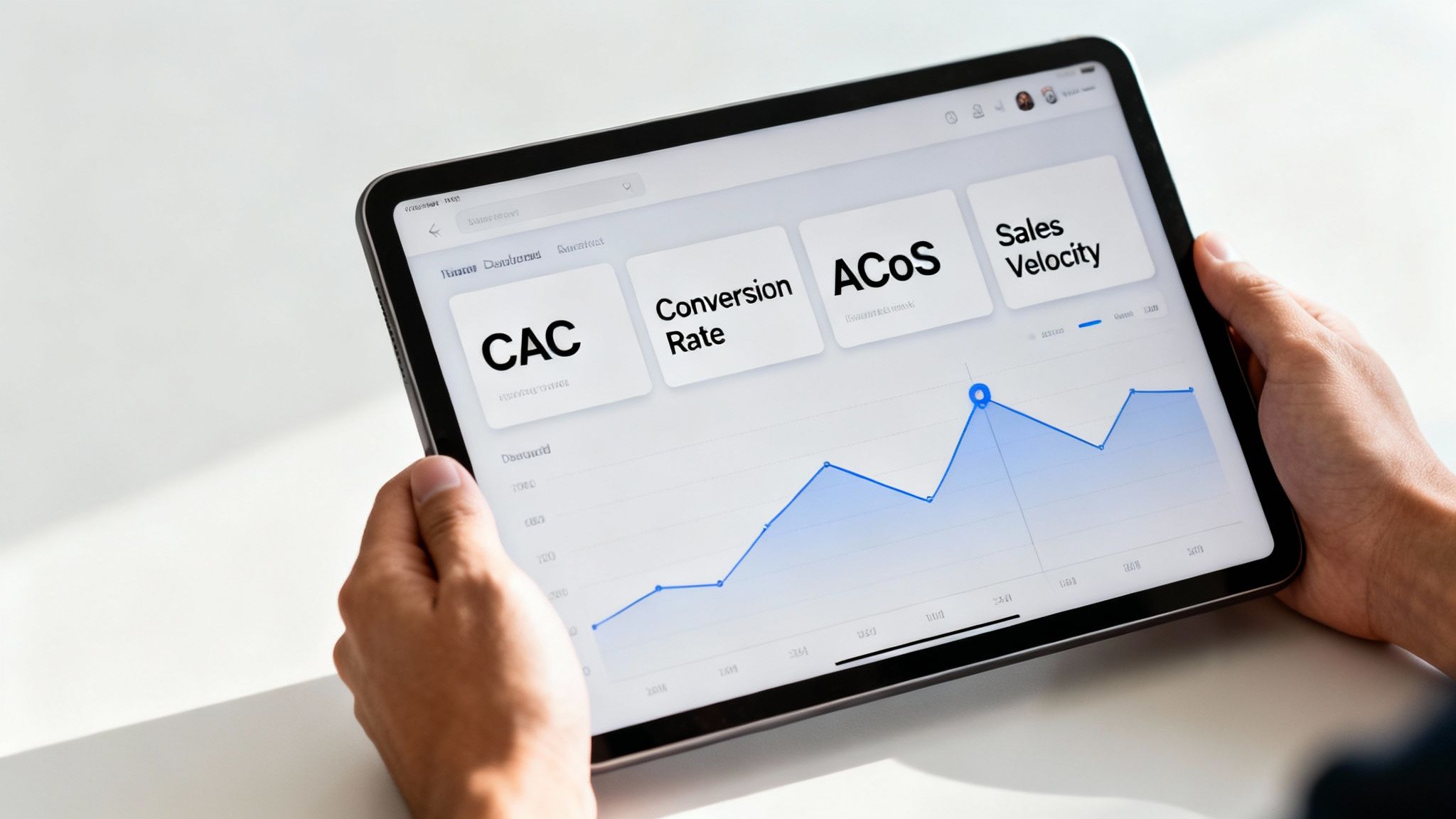
If you can't measure it, you can’t manage it. This has never been more true than during a product launch. A launch unleashes a flood of data, but drowning in numbers is useless. To determine if your launch was a true success, you must look past vanity metrics and focus on the key performance indicators (KPIs) that actually drive business growth.
This isn’t about chasing likes or impressions. It’s about building a data-driven dashboard that provides an honest, objective view of performance across every channel. Each platform has its own language of success, and your checklist must account for these different dialects of data.
The right KPIs don't just tell you how you did—they provide the blueprint for what to do next.
On marketplaces like Amazon and Walmart, the algorithm is king, and it loves momentum. Your performance in the first few weeks dictates your long-term visibility, so you must track the right metrics from day one.
These platforms are hyper-competitive, so your focus should be on KPIs that directly influence your search rank and sales velocity.
When you’re selling on your own direct-to-consumer (DTC) site, you control the entire customer journey. That means your KPIs shift from pleasing a marketplace algorithm to measuring how efficiently you acquire and convert your own customers.
On your DTC site, you’re not just selling a product; you’re building a customer base.
Metrics like Customer Acquisition Cost and Conversion Rate are the vital signs for your DTC channel. They show you exactly how effective you are at turning marketing spend into loyal, paying customers.
Here are the core DTC metrics you can't ignore:
To truly dial in your launch tracking, you also need to master the social media key performance indicators that tie back to your business goals. For a deeper look at connecting all these data points, our guide on understanding the role of omnichannel analytics is a great resource.
In the offline world of brick-and-mortar stores, the data looks different but is just as critical. Here, success is measured at the store level, focusing on how well your product moves from the shelf into a shopping cart.
Strong retail performance comes down to solid partnerships and great in-store execution. Here are the metrics to watch:
Here's a quick-glance table to help you track the most important KPIs for each channel during and after your product launch.
| Channel | Primary KPI | Secondary KPI | Why It Matters |
|---|---|---|---|
| Amazon/Walmart | Sales Velocity | Best Seller Rank (BSR) | Measures momentum and directly influences your search ranking on the platform. |
| Shopify (DTC) | Conversion Rate | Customer Acquisition Cost (CAC) | Tells you how effectively your website turns visitors into paying customers. |
| Social Media | Click-Through Rate (CTR) | Engagement Rate | Shows how well your creative and messaging are resonating with your target audience. |
| Email Marketing | Open Rate | Conversion Rate from Email | Indicates the strength of your subject lines and the effectiveness of your offers. |
| Physical Retail | Sell-Through Rate | Sales Per Store | Demonstrates demand at the shelf level and helps identify top-performing locations. |
By tracking these channel-specific KPIs, your launch checklist becomes more than a to-do list—it transforms into a powerful tool for learning, adapting, and building a repeatable process for growth.
We’ve covered the strategies, phases, and metrics that differentiate a forgettable launch from one that defines a category. Success isn't about luck; it's the direct result of a repeatable, well-executed system. The entire process comes down to the Foundation → Optimization → Amplification framework, ensuring no critical step is overlooked.
It begins with building a solid operational and digital bedrock. From there, you execute channel-specific plays to create crucial initial momentum. Finally, you amplify that success to drive sustained, measurable growth long after launch day.
You now have the blueprint for a powerful and profitable product launch. The next step is to put this knowledge into action. We’ve organized every task, timeline, and KPI from this guide into one comprehensive resource.
A great plan is the foundation of every successful launch. With the right checklist, you’re not just hoping for success—you’re engineering it.
Download our complete, customizable Product Launch Checklist Template to guide your next moves and turn your strategy into tangible results.
And for brands who aren't just looking to launch but to dominate their market, our team is ready to build your growth engine.
Still have questions about building a product launch plan that delivers results? Good. Here are the answers to the most common questions we get from brands navigating an omnichannel rollout.
For a serious omnichannel launch, begin planning at least 90-120 days out. This timeline provides a realistic buffer for critical moving parts you can't rush.
This gives you enough time to coordinate your supply chain, create high-quality content tailored to each channel, and navigate marketplace approvals like Amazon Brand Registry. The Foundation phase is the longest for a reason—getting it right prevents expensive, last-minute scrambles and sets the stage for success.
The single most damaging mistake is poor inventory planning. It’s a common but avoidable error. Brands either underestimate demand and stock out—killing sales velocity and search rankings—or they overestimate and get stuck with costly, slow-moving inventory.
A successful launch depends on a data-informed forecast that balances marketing excitement with operational reality. A product launch checklist forces you to address inventory from day one, connecting your sales forecast directly to your supply chain planning.
For example, a client in the CPG space used their checklist to align a 50,000-unit production run with a tiered marketing spend, ensuring they had enough stock for the launch spike without over-ordering. This simple act of integrated planning prevented a potential six-figure loss.
Think of a solid launch checklist as your master framework, not a rigid set of rules. The key to adapting it is knowing the difference between universal tasks and product-specific details.
First, lock down the universal items that apply to every launch:
Then, layer on the channel-specific sub-tasks unique to the product. For example, a new apparel line needs detailed sizing charts for your Shopify store and specific fabric composition details for Amazon. A new dietary supplement, on the other hand, requires extensive compliance documentation for every marketplace it touches. Always adjust the timelines and tasks based on product complexity and your channel strategy.
A detailed plan is the difference between a launch that fizzles out and one that drives sustainable growth. At RedDog Group, we build and execute data-driven launch strategies that deliver measurable results across every channel.
Let’s Talk Growth
Leave a comment: