
Published: March 2020 | Last Updated:January 2026
© Copyright 2026, Reddog Consulting Group.

Most American retailers miss out on up to 40 percent of potential sales simply because their analytics approach ends at single-channel reporting. As more American shoppers shift between online, mobile, and in-store experiences, understanding omnichannel analytics becomes the deciding factor for competitive growth. This article breaks down how actionable analytics strategies help marketing leaders unify data, drive smarter business decisions, and uncover real opportunities for sustainable market performance.
| Point | Details |
|---|---|
| Omnichannel Analytics Integration | Combining data from digital and physical channels provides a unified view of customer interactions, enhancing decision-making and personalization. |
| Types of Analytics | Retailers should master descriptive, predictive, and prescriptive analytics to optimize business performance and customer experiences effectively. |
| Data Governance Importance | Implementing robust data governance ensures compliance, mitigates risks like privacy breaches, and enhances the integrity of analytics outcomes. |
| Proactive Strategy Implementation | Start by integrating key customer interaction channels to build a solid foundation for omnichannel analytics, enabling immediate optimization opportunities. |
Omnichannel analytics represents a strategic approach to understanding and optimizing business performance across multiple interconnected sales and marketing channels. At its core, analytics transforms raw data into actionable insights that drive intelligent decision making. Advanced omnichannel analytics frameworks integrate information from digital and physical touchpoints to create a comprehensive view of customer behavior and organizational performance.
The fundamental purpose of omnichannel analytics is to break down traditional data silos and provide a unified perspective on customer interactions. By combining data from websites, mobile applications, physical stores, social media platforms, and call centers, businesses can develop a holistic understanding of customer journeys. This approach enables companies to track customer preferences, optimize marketing strategies, improve inventory management, and personalize customer experiences with unprecedented precision.
Modern omnichannel analytics leverages sophisticated technologies like artificial intelligence and machine learning to process complex datasets. Omnichannel supply chain research highlights how these advanced analytical tools can predict demand, manage inventory levels, and enhance fulfillment strategies across diverse retail environments. These capabilities allow businesses to anticipate customer needs, reduce operational inefficiencies, and create more responsive and adaptive sales ecosystems.
Pro tip: Start by integrating data from your top three customer interaction channels to build a foundational omnichannel analytics strategy and identify immediate optimization opportunities.
Retail environments leverage three primary types of analytics to drive strategic decision making and optimize business performance. Comprehensive retail analytics frameworks categorize these types into descriptive, predictive, and prescriptive analytical approaches, each serving a unique role in understanding and improving business operations.
Descriptive analytics provides a retrospective view of business performance by summarizing historical data and identifying past trends. Predictive analytics goes beyond historical analysis by forecasting future customer behaviors, sales patterns, and potential market shifts. These forward-looking insights enable retailers to anticipate customer needs, optimize inventory management, and develop proactive marketing strategies. Omnichannel analytics research further distinguishes these approaches into specialized categories such as customer analytics, inventory analytics, and campaign performance analytics.

Prescriptive analytics represents the most advanced analytical approach, providing actionable recommendations based on predictive insights. This sophisticated analytical method combines data from multiple channels to generate specific strategic recommendations. Retailers can use prescriptive analytics to optimize pricing strategies, personalize customer experiences, and make data-driven decisions that directly impact revenue growth and operational efficiency. By integrating these analytical approaches, businesses can create a comprehensive understanding of their retail ecosystem and develop targeted strategies for sustainable growth.
Pro tip: Implement a staged analytics strategy by first mastering descriptive analytics before progressively advancing to more complex predictive and prescriptive analytical techniques.
The following table compares the three main types of analytics used in retail environments, including their purpose and example business outcomes:
| Analytics Type | Key Purpose | Technology Used | Example Business Outcome |
|---|---|---|---|
| Descriptive | Summarize historical data | Reporting tools | Identify sales trends |
| Predictive | Forecast future actions | Machine learning models | Anticipate demand shifts |
| Prescriptive | Offer actionable recommendations | AI-driven simulations | Optimize pricing strategies |
Omnichannel data integration represents a critical strategy for modern retailers seeking to create seamless customer experiences across multiple sales platforms. Comprehensive omnichannel research reveals that successful integration requires breaking down traditional data silos and establishing a unified approach to collecting, analyzing, and interpreting customer interactions across digital and physical channels.
The technical process of integrating analytics involves creating a centralized data infrastructure that can capture and synthesize information from diverse sources such as e-commerce websites, mobile applications, physical store point-of-sale systems, call centers, and social media platforms. Procedural analytics integration enables businesses to develop consistent customer profiles, track complete customer journeys, and generate actionable insights that drive strategic decision making. This approach allows retailers to understand customer behaviors holistically, identifying patterns and preferences that might be missed when analyzing individual channels in isolation.
Successful analytics integration goes beyond technical implementation, requiring organizational alignment and a cultural commitment to data-driven decision making. Retailers must invest in robust technological infrastructure, advanced data management tools, and cross-functional teams capable of interpreting complex, multi-channel data sets. By creating a comprehensive view of customer interactions, businesses can optimize inventory management, personalize marketing strategies, and develop more responsive and adaptive operational approaches that directly impact revenue growth and customer satisfaction.
Pro tip: Implement a centralized data warehouse that standardizes data collection formats across all sales channels to ensure smooth and consistent analytics integration.
Here’s a summary of essential elements for integrating analytics across multiple sales channels:
| Element | Description | Benefit to Retailers |
|---|---|---|
| Centralized Data System | Unifies diverse channel data | Enables full customer visibility |
| Standardized Data Format | Consistent data collection rules | Reduces integration errors |
| Cross-Functional Teams | Blend analytical and business skills | Improves strategic decision making |
Data-driven strategies transform how retailers approach inventory management and marketing effectiveness. Advanced analytics in omnichannel retail enables businesses to predict consumer demand with unprecedented precision, optimize stock levels, and design targeted marketing campaigns that dramatically improve conversion rates.
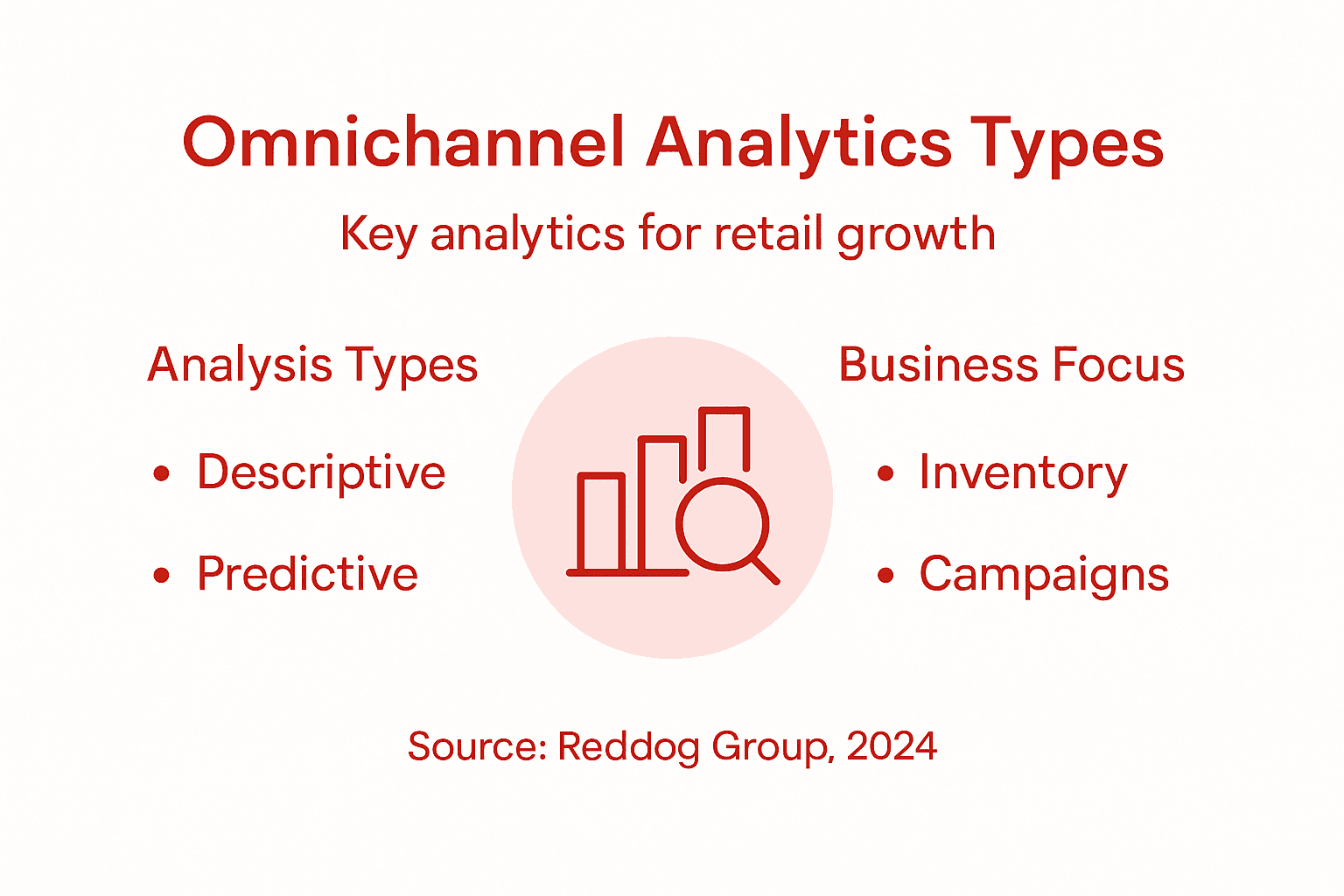
Inventory performance optimization relies on sophisticated predictive models that analyze historical sales data, seasonal trends, and real-time consumer behavior across multiple channels. By integrating data from e-commerce platforms, physical stores, and mobile applications, retailers can develop dynamic inventory allocation strategies that minimize stockouts and reduce excess carrying costs. AI-enhanced forecasting techniques allow businesses to anticipate customer preferences, adjust inventory in real-time, and create more responsive supply chain management approaches that directly impact bottom-line performance.
Marketing campaign performance sees similar transformative benefits from advanced analytics. Modern retailers can now segment customers with granular precision, developing personalized marketing messages that resonate with specific consumer groups. This approach enables businesses to design highly targeted campaigns, optimize marketing spend, and create more meaningful customer interactions across digital and physical touchpoints. The result is a more efficient, responsive marketing strategy that drives engagement, increases conversion rates, and ultimately supports sustainable business growth.
Pro tip: Implement a cross-channel analytics dashboard that integrates inventory and marketing data to provide real-time insights and enable rapid strategic adjustments.
Data governance is a critical component of successful omnichannel analytics strategies, requiring proactive risk management and comprehensive protective measures. Systematic risk assessment approaches reveal multiple potential vulnerabilities in data collection, integration, and interpretation that can compromise business intelligence and operational effectiveness.
One of the most significant risks in omnichannel analytics involves data privacy and security breaches. Retailers must implement robust protection mechanisms that comply with evolving regulatory standards, including comprehensive data anonymization techniques, secure storage protocols, and transparent data usage policies. Comprehensive analytics risk mitigation requires establishing cross-functional oversight teams that can identify potential data integrity issues, validate analytical models, and ensure ethical use of advanced technological tools.
Technical risks extend beyond privacy concerns to include challenges like data inconsistency, algorithmic bias, and overreliance on automated decision systems. Successful organizations develop multi-layered validation processes that incorporate human expertise alongside machine learning algorithms. This approach ensures that data-driven insights remain accurate, contextually relevant, and aligned with broader strategic objectives. By maintaining a balanced approach that combines technological sophistication with critical human judgment, businesses can leverage analytics while minimizing potential operational risks.
Pro tip: Establish a quarterly data governance audit process that reviews analytics methodologies, validates data sources, and checks for potential biases in predictive models.
Understanding the role of analytics in omnichannel growth means recognizing the importance of unified customer insights, integrated data, and predictive strategies to drive smarter decisions. If your challenge is managing separate sales channels, optimizing inventory, or personalizing customer experiences across platforms, you are not alone. Many businesses struggle with fragmented data and inconsistent analysis that limit their ability to maximize revenue and respond quickly to market demands.
At Reddog Group, we specialize in overcoming these exact pain points with tailored Digital & Business Consulting Services by Reddog Consulting. We help brands build cohesive omnichannel strategies that integrate complex data streams, optimize marketplace management, and enhance campaign performance for real growth. Our proven expertise with over 50 brands and a deep understanding of Amazon FBA, DTC channels, and retail integrations means your business will gain actionable insights and measurable results.
Don’t let disconnected data stall your success. Visit our Home page today to explore how we can transform your analytics challenges into a comprehensive growth engine. Take the first step toward smarter decisions and stronger sales by partnering with Reddog Group now.
Omnichannel analytics is a strategic approach that integrates data from multiple sales and marketing channels, providing a unified view of customer behavior and business performance to drive informed decision-making.
Predictive analytics forecasts future customer behaviors and sales patterns, while prescriptive analytics offers actionable recommendations based on predictive insights to optimize strategies such as pricing and inventory management.
Integrating analytics across sales channels enables retailers to create complete customer profiles, optimize inventory management, improve marketing effectiveness, and drive better strategic decision-making through a unified understanding of customer interactions.
Retailers can mitigate risks by implementing robust data governance, ensuring data privacy, and establishing multi-layered validation processes to address potential data inconsistencies and biases while leveraging advanced analytical tools.
Leave a comment: