
Published: March 2020 | Last Updated:December 2025
© Copyright 2026, Reddog Consulting Group.

Nobody starts a brand because they love packing boxes. At its core, Fulfillment by Amazon (FBA) is a strategic service that lets you outsource your logistics—warehousing, shipping, and customer service—to Amazon's massive, hyper-efficient machine.
This allows you to stop managing operational headaches and refocus on what drives measurable results: building your brand, developing great products, and accelerating your omnichannel growth.
Fulfillment by Amazon, or FBA, is more than just a shipping service—it’s a powerful engine for scaling your business on the world’s largest marketplace. By enrolling in FBA, you ship your inventory in bulk to Amazon’s fulfillment centers. From the moment it arrives, Amazon takes ownership of the entire post-purchase experience.
They manage the operational details so you can focus on strategy.
Here’s how this handoff works in practice:
This division of labor is what allows brands to break through growth plateaus. By offloading day-to-day operations, you free up resources to invest in marketing, product innovation, and expanding your brand’s reach.
To make it even clearer, here’s a simple breakdown of responsibilities when using FBA.
| Task | Your Brand's Responsibility | Amazon FBA's Responsibility |
|---|---|---|
| Product Sourcing & Manufacturing | ✅ | |
| Listing Creation & Optimization | ✅ | |
| Inventory Management & Forecasting | ✅ | |
| Prepping & Labeling Products | ✅ | |
| Shipping Inventory to Amazon | ✅ | |
| Warehousing & Storage | ✅ | |
| Order Picking & Packing | ✅ | |
| Shipping Orders to Customers | ✅ | |
| Handling Customer Service | ✅ | |
| Processing Returns & Refunds | ✅ |
As you can see, your job is to get great products to Amazon. Their job is to get those products to your customers. It's a partnership that frees you up to scale.
One of the most significant advantages of FBA is that your products instantly qualify for the Amazon Prime badge. That simple checkmark is a powerful symbol of trust for millions of shoppers, guaranteeing the fast, free shipping they expect.
Having the Prime badge does more than just meet customer expectations; it measurably boosts visibility and sales velocity. For a large segment of shoppers, products without Prime are effectively invisible.
FBA gives brands instant access to a world-class fulfillment network without the astronomical cost of building one yourself. It’s a strategic shortcut to scaling your operations and competing with the big players.
FBA isn't a niche service; it's the operational backbone of the Amazon marketplace. Data-driven insights confirm its dominance. Industry reports consistently show that around 82% of active Amazon sellers use FBA for some or all of their products.
With millions of sellers on the platform, that figure proves FBA’s role as a critical component for success on Amazon. You can see more on this in recent industry reports on FBA adoption. This isn’t just a trend; it's the standard. For modern brands, leveraging FBA is a foundational piece of their marketplace strategy.
So, what does FBA look like in practice? Think of it as a finely tuned relay race: you execute the critical first leg of preparing your products, then pass the baton to Amazon to sprint across the finish line to your customer.
The journey starts in your Amazon Seller Central account, the command center where you list products and enroll them in the FBA program.
The most hands-on part for any brand is preparing your inventory. Amazon's logistics network is built on standardization, so your products must meet their strict inbound requirements. This is not a step where you can cut corners—improper prep leads to receiving delays, unplanned fees, or even rejection of your entire shipment.
Here's what that looks like:
Once your products are prepped and labeled, you create a shipping plan in Seller Central—a digital manifest detailing the contents of your shipment. Based on this plan, Amazon directs you to the specific fulfillment centers where your inventory should be sent.
This diagram illustrates the entire FBA journey, from your facility to the customer's front door.
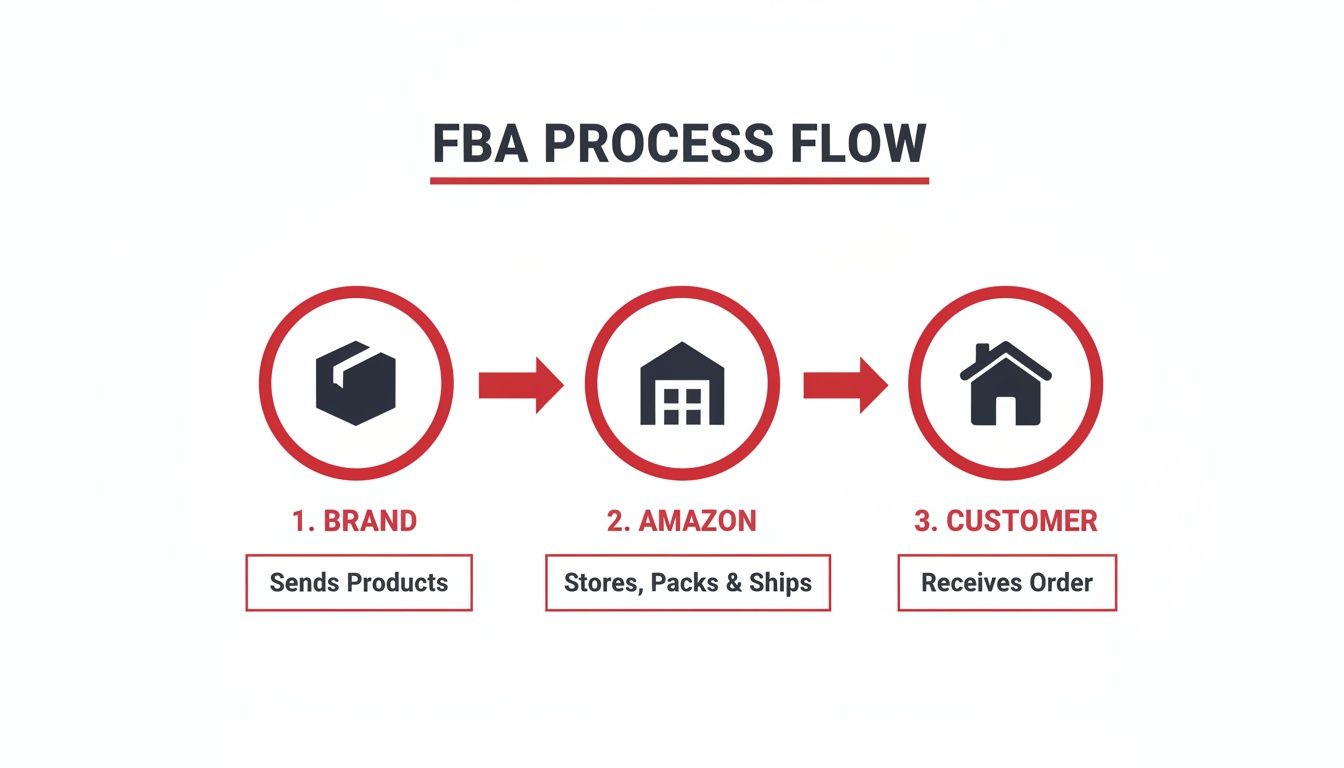
As you can see, your heavy lifting concludes once the inventory is correctly shipped. From there, Amazon's massive infrastructure takes over.
When your shipment arrives, Amazon’s team scans each FNSKU, officially checking your products into their inventory system. Your items are then stowed, and your product listing instantly updates to show it's in stock and available with the crucial Prime badge.
From this point on, the automated process takes over. A customer clicks "Buy Now," and Amazon's logistics engine activates.
At its core, the FBA process is about trading direct operational control for immense scale and efficiency. You manage the product and the plan; Amazon manages the physical fulfillment.
Amazon's system locates your product, an employee (or robot) picks it from the shelf, and it gets packed into an Amazon box and sent on its way.
The service extends beyond shipping. Amazon handles payment processing, provides the customer with tracking information, and manages all post-purchase customer service and returns. This end-to-end management is what frees your team to stop worrying about logistics and start focusing on growth. For a deeper look, check out our guide on the Fulfillment by Amazon explained benefits and process.
Success on Amazon hinges on one thing: knowing your numbers. While FBA’s convenience is a massive draw, it comes with a complex web of fees that can quietly erode your profitability if not managed carefully. Mastering FBA isn’t just about shipping products; it’s about building a profitable, sustainable business.
Let's break down the real costs you'll encounter.

Most FBA expenses fall into three main categories. These are the unavoidable costs of using Amazon’s powerful fulfillment network.
Fulfillment Fees (Pick & Pack): Amazon charges this fee per unit to pick your product from a shelf, pack it, and ship it. The cost is based entirely on size and weight—a small, light item costs significantly less to fulfill than a large, heavy one.
Monthly Inventory Storage Fees: You are essentially renting shelf space in Amazon’s warehouses. This fee is calculated based on the daily average volume (in cubic feet) your inventory occupies. Be aware that these rates increase during the Q4 peak holiday season (October–December).
Aged Inventory Surcharges (Long-Term Storage Fees): Amazon’s fulfillment centers are designed for high-velocity turnover, not long-term storage. If your inventory sits for too long (currently over 181 days), you will be charged these additional monthly fees. The longer an item sits, the higher the penalty.
These three fees form the foundation of your FBA costs, but they are just the starting point. To truly understand profitability, you must account for all potential Amazon FBA fees.
This table breaks down the most common fees and what they cover.
| Fee Type | What It Covers | How It Is Calculated |
|---|---|---|
| Fulfillment Fee | Picking, packing, and shipping the order to the customer. | Based on the product's size tier and shipping weight. |
| Monthly Storage Fee | The cost of storing your inventory in Amazon's warehouses. | Based on the daily average volume (in cubic feet) your inventory occupies. |
| Aged Inventory Surcharge | A penalty for inventory that remains unsold for too long. | A per-item monthly fee that increases the longer the item is stored. |
| Removal/Disposal Fee | The cost to have Amazon return or dispose of your inventory. | A flat fee charged per item. |
| Returns Processing Fee | The cost of processing a customer return. | A per-unit fee for returned items in categories with free return shipping. |
| Unplanned Services Fee | A penalty for not following Amazon's prep and labeling rules. | Charged per item for fixing non-compliant shipments (e.g., missing barcodes). |
Understanding these charges is the first step toward protecting your margins and making FBA work for you, not against you.
Beyond the core fees, several other charges can appear on your statement. Proactively managing these is key to avoiding margin-killing surprises.
Removal and Disposal Order Fees: If you need to pull inventory from a fulfillment center, whether to have it shipped back to you or disposed of, there's a per-item fee.
Returns Processing Fees: While FBA handles returns, it's not always free. For products in categories with free customer return shipping (like apparel), you pay a fee for every unit that comes back.
Unplanned Services Fees: These are effectively fines for not following Amazon's strict prep and labeling rules. If your shipment arrives non-compliant, Amazon will fix it and bill you for the service.
It's also critical to know that FBA fees are not static. Amazon frequently adjusts its fee structures. For example, FBA fulfillment fees for standard-size items have increased by roughly 30–96% in recent years, depending on the product’s size tier. These hikes, combined with new seasonal surcharges, make it essential to stay updated.
Mastering FBA isn't just about selling more; it's about selling smarter. Accurate cost forecasting turns FBA from a potential expense trap into a predictable and profitable growth engine.
Forecasting these costs is essential for profitability. When you can accurately model your expenses, you can set the right price, manage inventory intelligently, and protect your bottom line. To get a clearer picture of how these fees might impact your business, use our free marketplace profitability calculator. Building this solid financial foundation is how you turn FBA into a tool for real, measurable growth.
Fulfillment by Amazon can be a massive growth engine, but treating it as a one-size-fits-all solution is a strategic mistake. Choosing the right path requires an honest assessment of its undeniable benefits and its significant drawbacks. This decision impacts not just your operations but also your brand identity, profit model, and your ability to grow beyond a single channel.
Let's cut through the noise and analyze the realities of using FBA.
The primary benefit of FBA is gaining immediate access to Amazon's world-class logistics network. This partnership enables brands to scale rapidly without the millions in capital required to build a comparable infrastructure.
The core benefits are straightforward and powerful:
Together, these benefits create a powerful launchpad for growth. You're not just selling products; you're tapping into an ecosystem. With third-party sellers accounting for over 60% of units sold on a platform that generates hundreds of billions in sales, FBA is the primary gateway to that massive revenue stream. You can explore more data on Amazon's fulfillment ecosystem and its growth.
The convenience of FBA comes at a price beyond fees. When you outsource fulfillment to Amazon, you relinquish significant control over your inventory and customer experience.
Choosing FBA means trading direct control for immense scale. The key is ensuring that what you gain in efficiency doesn't come at the expense of your brand identity or profitability.
It's critical to understand these drawbacks before you commit:
Going all-in on FBA is like putting all your operational eggs in one basket. For brands focused on omnichannel growth, this dependency can limit reach, brand control, and profitability. Building a resilient fulfillment network isn’t about finding a single solution; it’s about exploring powerful alternatives that fuel growth across all sales channels.
Diversifying your strategy doesn't mean abandoning FBA. It's about strategically layering other fulfillment models to create a flexible, cost-effective, and brand-centric operation. That’s how you truly amplify your brand's presence.
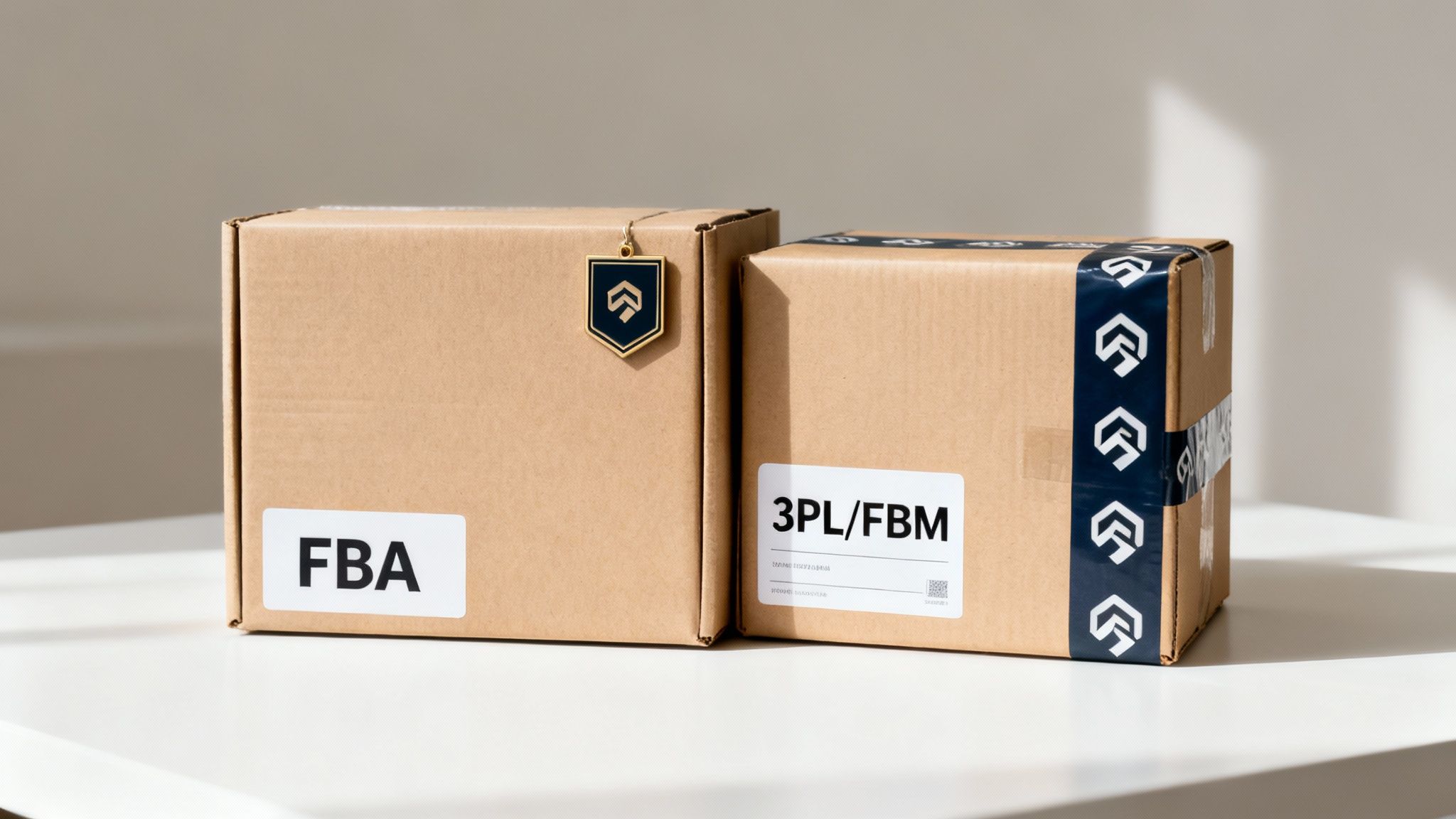
The most direct alternative is Fulfillment by Merchant (FBM), also known as the Merchant Fulfilled Network (MFN). With FBM, you are in complete control. You list products on Amazon, but once an order is placed, you handle everything else.
This means you are responsible for:
The primary advantage of FBM is total control. You can create a branded unboxing experience, manage a single pool of inventory for all sales channels, and avoid Amazon's storage fees. However, this control comes with significant operational responsibility and often higher shipping costs.
For brands that want control without the day-to-day operational burden of FBM, partnering with a Third-Party Logistics (3PL) provider is the optimal solution. A 3PL is a specialized company that manages your warehousing, order processing, and shipping.
The true power of a 3PL lies in its channel-agnostic nature. A great 3PL can fulfill orders from anywhere you sell—your Shopify store, other marketplaces like Walmart, wholesale accounts, and your Amazon FBM listings.
Partnering with a 3PL transforms your fulfillment from a channel-specific task into a unified, brand-wide operation. It’s the foundational step toward building a true omnichannel presence that isn't dependent on any single marketplace.
This model allows you to maintain your unique branding while leveraging professional logistics expertise. If FBA doesn't align with your business model, finding the right ecommerce outsourcing partners can be a game-changer.
For many growing brands, the smartest strategy isn't choosing FBA or an alternative—it’s using them together in a hybrid model. This approach leverages the strengths of each method to optimize for cost, speed, and customer experience.
A popular and effective hybrid strategy:
This strategy gives you the Prime advantage where it delivers the most ROI while avoiding FBA's punitive long-term storage fees on slower-moving items. It also centralizes fulfillment for all your off-Amazon channels, creating a scalable, resilient operation. To learn more about maximizing your presence across platforms, check out our complete guide to marketplaces for SMEs. An integrated strategy like this is how you amplify your brand and achieve sustainable, omnichannel growth.
Choosing a fulfillment strategy is a foundational decision that impacts your brand’s profitability, customer experience, and ability to scale. Now that you understand FBA's mechanics, costs, and alternatives, it’s time to move from learning to decision-making. Is FBA the right growth lever for your brand, or will it create more problems than it solves?
There is no universal answer. The right choice depends on your specific products, margins, and operational capabilities. What works for a high-volume seller of small, lightweight items could be a financial disaster for a brand selling large, slow-moving furniture.
Before committing inventory and capital, run through these critical questions. Your answers will clarify whether FBA is a strategic fit or a potential pitfall.
FBA should be a tool that serves your business strategy, not a strategy that dictates your business model. If you have to fundamentally change your products or pricing to make FBA work, it may not be the right path forward.
Finally, zoom out to the big picture. How does FBA fit into your brand’s long-term growth plan? If your goal is to build a powerful presence across multiple channels—your own website, other marketplaces, and retail—an all-in FBA strategy can be surprisingly limiting.
Ask yourself: Does using FBA make it easier or harder to manage a single, unified inventory pool for all channels? Will shipping orders in a generic Amazon box undermine the branded, direct-to-consumer experience you want to build? Answering these questions now ensures your fulfillment choice supports your long-term Foundation → Optimization → Amplification growth plan.
Making the right choice sets the stage for sustainable, profitable growth. If you’re ready to build a fulfillment strategy that truly aligns with your business goals, we’re here to help map out the best path forward.
Let’s Talk Growth
As brands explore FBA, several key questions consistently arise. Getting these details right is crucial for building a solid fulfillment strategy, so let's clarify the most common points.
Yes, through a service called Multi-Channel Fulfillment (MCF). MCF allows you to use Amazon’s warehouses to store inventory and ship orders from your own website or other sales channels.
However, there are trade-offs: MCF fees and shipping speeds often differ from standard FBA, and orders typically arrive in Amazon-branded packaging, which may not align with your D2C branding goals.
The most common mistake is underestimating fees and miscalculating profit margins. New sellers are often drawn in by the Prime badge and focus only on the core fulfillment fee, overlooking the full cost structure.
They forget to factor in monthly storage, long-term storage penalties, removal fees, and charges for non-compliant inbound shipments. These costs add up quickly and can turn a promising product into a loss leader.
The most successful brands on Amazon treat FBA as a financial tool, not just a logistics service. This means obsessively tracking every fee, forecasting costs accurately, and ensuring every SKU remains profitable after all expenses are accounted for.
A major benefit of FBA is that Amazon manages the entire returns process. When a customer initiates a return, Amazon provides a shipping label and handles the reverse logistics.
Once the item arrives back at the warehouse, Amazon's team inspects its condition:
While this process is convenient, it means relinquishing direct control over how your returned products are inspected and graded.
We've covered the most common questions brands have about FBA. Here are a few more quick answers to help you get a clearer picture.
| Question | Answer |
|---|---|
| Is FBA worth it for small businesses? | It can be, especially for high-volume products with healthy margins. However, if margins are thin or sales are slow, storage fees can quickly erode profitability. |
| How fast does FBA ship? | FBA orders are eligible for Amazon Prime shipping, which typically means 1-2 day delivery for customers—a significant competitive advantage. |
| Can I use both FBA and FBM? | Absolutely. Many successful sellers use a hybrid model, placing fast-moving products in FBA to secure the Prime badge while self-fulfilling slower-moving or oversized items to save on fees. |
| What happens if my inventory doesn't sell? | If inventory sits in an Amazon warehouse for too long (currently over 180 days), you'll incur aged inventory surcharges. Proactive inventory management is crucial to avoid these extra costs. |
These answers should provide a clearer understanding of how FBA operates. It’s a powerful system, but success depends on knowing the rules and managing your costs effectively.
Building a profitable, scalable fulfillment strategy is complex, but it's the foundation of true omnichannel growth. At RedDog Group, we help brands navigate these decisions to build operations that drive measurable results. If you're ready to move from planning to profitable execution, we're here to help. Let's Talk Growth.
Leave a comment: