
Published: March 2020 | Last Updated:January 2026
© Copyright 2026, Reddog Consulting Group.

Receiving the "Your Amazon selling privileges have been removed" email feels like a gut punch. For many brands, it brings revenue to a screeching halt and sparks an immediate sense of panic. The first instinct is often to fire back a quick, emotional appeal.
Don’t. That's the single biggest mistake you can make in these first crucial hours.

Resist the impulse to write an apologetic reply promising you'll "do better." Amazon’s reinstatement process isn't emotional; it's entirely procedural. They aren't looking for a heartfelt apology. What they demand is a data-driven business plan that proves you’ve identified the root cause and implemented measurable, permanent solutions.
Your first 24 hours are for investigation, not writing.
First, read the suspension notice. Then read it again. Every word matters. Amazon isn't trying to be cryptic—they are classifying your issue into a specific category. Correctly identifying this category is the foundational first step to a successful appeal.
Most suspensions fall into one of these three buckets:
A hasty appeal without a correct diagnosis is the #1 reason reinstatements fail. Sellers often send multiple appeals before realizing they’ve been trying to solve the wrong problem from the start.
Once you know the general category, it's time to gather the specific data from Seller Central. Your Account Health page, found under the 'Performance' tab, is your source of truth.
This is where you'll find the exact metrics, ASINs, or policy warnings that triggered the suspension. If the notice mentions "inauthentic," find the specific products and customer complaints. If it's a high ODR, drill down into every piece of negative feedback and every A-to-z claim from the relevant period.
This isn't about guesswork; it's about collecting the precise data Amazon is using against you. If you're feeling overwhelmed, this is often the point where sellers seek professional Amazon reinstatement services to ensure the diagnosis is accurate.
This initial diagnostic phase is the Foundation of your recovery. Before you even think about drafting a Plan of Action (POA), you must be 100% certain of the "why." That clarity will drive every other step, turning reactive panic into a proactive, strategic response that gets measurable results.

Let’s be clear: Amazon rarely suspends an account out of the blue. The notification is usually the result of a significant operational failure or a series of smaller issues that finally reached a tipping point. The suspension notice tells you what happened; your job is to uncover why.
This forensic audit is the Foundation of a successful Plan of Action (POA). Simply addressing the symptom mentioned in the email won’t work. Amazon needs to see that you’ve traced the problem back to a core weakness in your operations and have a measurable plan to fix it permanently.
Your Account Health dashboard provides the clues, but the real problems are hiding in your day-to-day processes. You must connect a poor metric to a specific operational breakdown. For example, a spike in your Order Defect Rate (ODR) isn't just a number; it’s a story. Perhaps it's a bad batch of inventory from a new supplier, a new warehouse employee skipping quality control steps, or a breakdown in your 3PL’s shipping process.
Consider these common real-world examples:
The goal is to move from a vague statement like "Our ODR is high" to a specific diagnosis: "Our ODR increased because a new supplier's packaging for ASIN B0XXXXXXX is failing in transit, causing a 40% increase in A-to-z claims for damaged goods in the last 30 days."
That level of detail proves to Amazon you are a professional operator who understands their business, not just someone trying to get back online.
While every situation is unique, most suspensions boil down to a handful of core issues. Your investigation should start with these usual suspects, as they’re exactly what Amazon’s performance teams are trained to identify.
As you investigate, document everything. This evidence will become the backbone of your POA, proving every claim you make. A successful appeal relies on facts, not guesswork.
Here’s a breakdown of common suspension triggers and the underlying issues to investigate.
| Suspension Trigger | Common Root Cause | Where to Look for Evidence |
|---|---|---|
| High Order Defect Rate (ODR) | A defective product batch, poor packaging leading to damages, or inaccurate product detail pages. | Customer feedback, A-to-z claims, return comments, and product reviews for specific ASINs. |
| Inauthentic Item Complaints | Flawed supplier vetting process or using retail arbitrage receipts instead of wholesale invoices. | Supplier invoices, letters of authorization from the brand, and your complete supply chain documentation. |
| Intellectual Property (IP) Complaint | Unauthorized use of trademarks in listings, selling products that violate patents, or sourcing from unverified distributors. | Listing content (titles, bullets, images), brand registry complaints, and communication from rights holders. |
| High Late Shipment Rate (LSR) | Inefficient warehouse workflow, unreliable shipping carrier, or poor inventory forecasting leading to backorders. | Shipping reports, carrier performance data, and internal order processing time logs. |
Once you’ve gathered this evidence, you have a clear, fact-based picture of what went wrong. This is the solid footing you need to draft a POA that Amazon will actually accept.
Once you’ve diagnosed why you were suspended, it’s time to build your Plan of Action (POA). This isn't an apology letter. A POA is a formal business document—your strategic plan to prove you’ve not only found the operational failure but have also implemented permanent, measurable solutions.
Think of it as a revised business plan for the part of your operation that broke down. The POA is the most important document you will submit. A vague or poorly written one will be rejected almost immediately, setting your brand back weeks. Conversely, a concise, evidence-backed plan demonstrates professionalism and dramatically increases your chances of a fast reinstatement.
Amazon's Seller Performance team reviews thousands of these documents. They are trained to scan for a specific format that answers three key questions. Deviating from this structure is a common reason for rejection.
Every successful POA is built on this foundation:
This isn’t just a list. You need to draw a clear line from the problem (why), to the immediate fix (now), to the permanent solution (future).
This is where your investigation pays off. Your goal is to show complete ownership. Never blame customers, competitors, or Amazon. State the facts and take full responsibility for the operational failure.
Instead of a weak statement like, "We got a few inauthentic complaints," be precise. A strong root cause sounds like this: "The root cause of the inauthentic complaints for ASIN B0XXXXXXX was our failure to properly vet a new supplier, [Supplier Name], whose sourcing documentation did not meet Amazon's requirements for supply chain verification."
This tells Amazon you’ve looked past the symptom (the complaints) and identified the real disease (a broken supplier vetting process). It's specific, factual, and doesn't make excuses.
Your root cause needs to be singular and sharp. If you list multiple weak root causes, Amazon will assume you don't really know what went wrong. Zero in on the single biggest point of failure.
This section is about damage control. Amazon needs to see that you've already handled the immediate fallout. This demonstrates proactive problem-solving. Get straight to the point and use past-tense verbs.
Your corrective actions should be concrete and verifiable:
Every point must be an action you have already completed.
This is the most critical section of your POA. It’s where you convince Amazon that you are a low-risk partner for the future. You must outline the new, improved processes that make a repeat violation impossible. Vague promises like "we will improve our quality control" are useless. Your actions must be tangible, measurable, and systemic.
Strong preventative measures look like this:
Suspensions are often sudden. A 2020 study of German sellers revealed that 23% had experienced account suspensions, but a shocking 66% received no prior warning. This data highlights how quickly Amazon acts, making a proactive, well-documented operational framework your best defense. You can read the full research on Amazon's enforcement trends.
Words alone aren't enough. Back up every claim in your POA with clear evidence. An organized file of supporting documents shows you’re taking this seriously and makes the investigator’s job easier.
Your evidence checklist should include:
When you combine a precisely structured POA with undeniable evidence, you shift from a defensive position to a proactive one. You're not just asking for your account back; you're presenting a compelling business case that proves you have fundamentally improved your operations. This is how you turn a crisis into a catalyst for brand growth.
You’ve submitted your Plan of Action (POA). While it feels like a finish line, it’s often just the start of a frustrating waiting game. What happens when your carefully crafted appeal is met with a generic, automated rejection?
This is the moment many sellers give up. It’s also where a persistent, strategic approach pays off.
The first rejection is rarely the final word. Amazon's first line of defense is often a combination of junior investigators and automated systems scanning for specific keywords and structures. A vague denial doesn't mean your case is hopeless—it means you need to refine your message and potentially get it in front of a new reviewer.
Amazon’s replies can be maddeningly unhelpful. Phrases like "we need more detail" or "your plan is not complete" provide little guidance. Instead of guessing, treat these responses as a signal to review your POA with a more critical eye.
Ask yourself: Did I truly identify the single root cause, or did I list several weak possibilities? Was my prevention plan filled with concrete, verifiable actions, or was it packed with vague promises like "we will monitor our account more closely"? That kind of language leads to rejection.
A classic mistake is failing to directly connect each preventative action back to the specific root cause. If your account was suspended for poor supplier vetting, outlining a plan to improve customer service response times is irrelevant. It shows a lack of understanding and will be rejected.
Pull up your original suspension notice and the rejection email and read them side-by-side. The gap between what Amazon flagged and what your POA addressed is where you need to focus. Each resubmission must be sharper and more focused than the last.
The decision tree below maps out the core logic your POA needs to follow. It all comes down to drawing a straight, undeniable line from the root cause to a permanent solution.
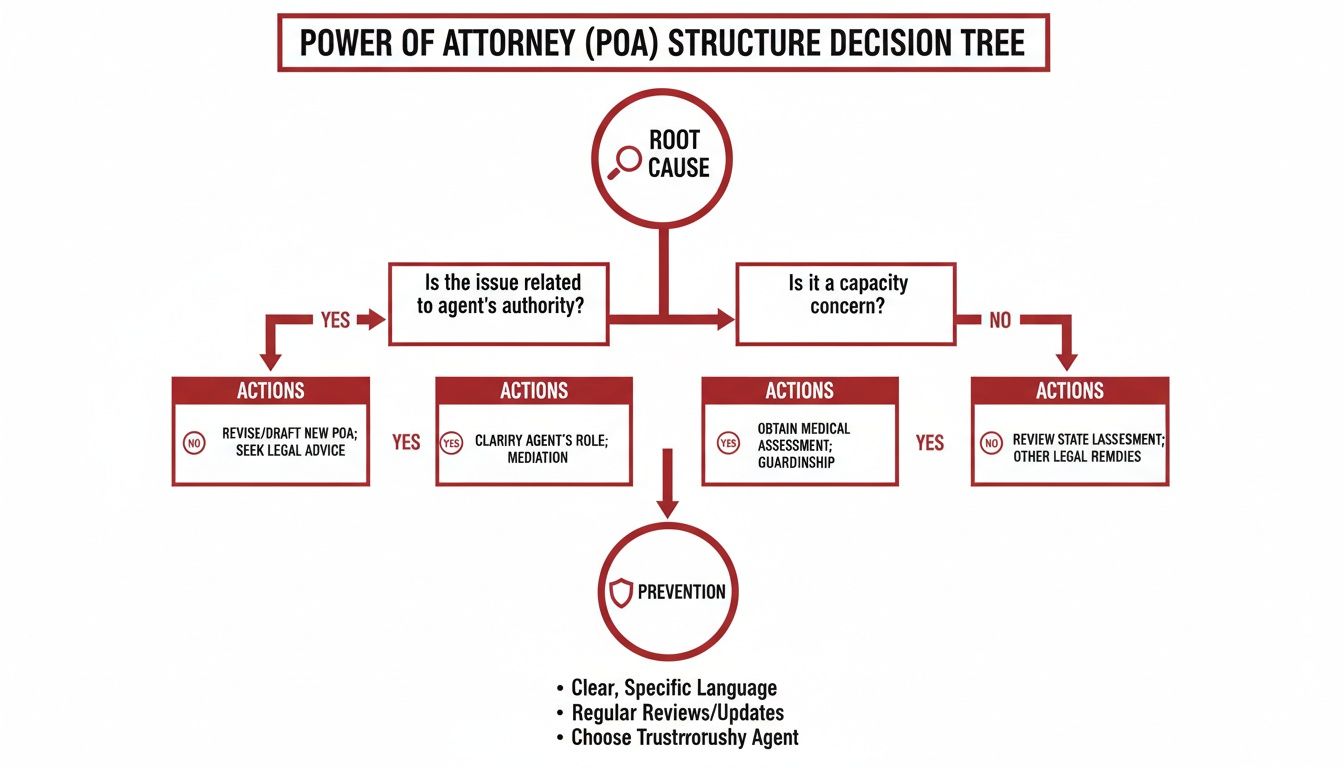
As this visual shows, every preventative step must directly solve the identified root cause. When you create this kind of closed-loop argument, it becomes much harder for an investigator to find fault.
If you’ve submitted two or three revised POAs—each a clear improvement on the last—and you're still getting the same copy-paste denial, you may be stuck in an automated loop. It’s time to escalate.
Repeatedly hitting the "Appeal" button with the same document is not a strategy. You have to get your case in front of a new person.
Your first escalation target is still the Seller Performance team, but a fresh approach is needed to reach a more senior investigator who can apply critical thinking.
Here are a few escalation paths that can be effective:
notice-dispute@amazon.com. Frame your email as a request for clarification, not a demand.jeff@amazon.com can sometimes trigger an internal review by a senior team.For more context on navigating the full process, you can read our other guides on what's involved in an Amazon account suspension.
Escalation is not about being aggressive; it's about being methodical. You’re building a case, and every step needs to be backed by clear evidence. The aim is to prove you've done everything in your power to fix the problem, forcing a human review that can finally break the automated deadlock and get your business back online.
Getting your account reinstated is the battle; staying active is the war. The real win is transforming your operations so you never have to go through this again. This is your opportunity to turn a painful experience into a catalyst for building a stronger, more profitable omnichannel brand.

This proactive approach is at the core of our Foundation → Optimization → Amplification growth framework. By solidifying your operational foundation, you create the stability needed to scale your brand without the constant fear of your Amazon presence vanishing overnight.
The key is to shift from a reactive mindset—fixing problems as they arise—to a proactive one. This means embedding compliance and performance monitoring into your daily, weekly, and monthly routines. It’s not about adding more work; it’s about making the right work a non-negotiable part of your workflow.
This has never been more critical. Amazon's enforcement is getting stricter, and they now look at seller performance holistically. An Order Defect Rate under 1%, a Late Shipment Rate below 4%, and perfect Policy Compliance are all viewed together. A borderline metric combined with a minor policy violation can trigger a surprise suspension.
Your goal is to build a "passively compliant" business. This means your standard operating procedures are so robust that your team follows Amazon's rules by default, not because they are constantly checking a policy manual.
To achieve this, focus on three core areas. These are the pillars that support a healthy Amazon account and will protect you from common suspension triggers.
A structured monitoring plan is essential. Here’s a checklist to help you build a proactive system that catches issues before they escalate.
This checklist is about building a routine that gives you a real-time pulse on your account's health. By integrating these checks, you can spot and fix small problems before Amazon’s algorithm flags them as major violations.
| Metric/Task | Frequency | Acceptable Threshold | Action if Threshold is Breached |
|---|---|---|---|
| Order Defect Rate (ODR) | Daily | < 1% | Immediately investigate root causes of negative feedback, A-to-z claims, and chargebacks. |
| Cancellation Rate | Daily | < 2.5% | Review inventory levels and sync processes to prevent overselling. |
| Late Shipment Rate (LSR) | Daily | < 4% | Audit shipping templates and carrier pickup schedules. |
| Valid Tracking Rate (VTR) | Weekly | > 95% | Confirm carrier info is entered correctly and supported by Amazon. |
| Account Health "At Risk" Banner | Daily | No banner visible | Address the specific policy violation highlighted immediately. |
| Voice of the Customer (VOC) | Weekly | "Good" or "Excellent" | For "Poor" or "Very Poor," analyze feedback and inspect inventory. |
| Stranded Inventory | Weekly | Zero units | Create removal orders or fix listing issues causing the strand. |
| Performance Notifications | Daily | No unread notifications | Read, analyze, and action every notification, no matter how minor. |
| Listing Policy Violations | Monthly | Zero violations | Proactively audit listings for compliance with Amazon's policies. |
Making this checklist a non-negotiable part of your operations turns compliance from a panicked reaction into a controlled, proactive process.
Ultimately, preventing the risk of Amazon suspending accounts comes down to culture. It means making account health a shared responsibility across your entire organization, from sourcing to fulfillment. When everyone understands how their role impacts your standing with Amazon, you create a powerful, self-correcting system.
For a broader look at maintaining overall account health, this complete guide to Amazon account management is a great resource.
This isn’t just about avoiding trouble. A resilient operation is more efficient, delivers a better customer experience, and builds a stronger brand on and off Amazon. When you turn the lessons of a suspension into foundational strengths, you’re not just protecting your revenue—you’re setting the stage for sustainable, long-term growth.
An Amazon account suspension is stressful, and it’s normal to have questions. Having guided countless brands through this process, we've found a few questions come up consistently. Here are clear answers to the most common ones.
There's no single answer. We've seen straightforward cases resolved in as little as 24-48 hours with a strong, well-written Plan of Action (POA). However, complex suspensions involving intellectual property (IP) claims or authenticity issues can easily take weeks, or even months, to resolve.
The single biggest factor is the quality of your first appeal. A clear diagnosis and a robust POA give you the best chance for a quick turnaround. If your initial appeal is rejected, the process becomes significantly longer.
Let me be direct: absolutely not. Attempting to open a new account to bypass a suspension is one of the fastest ways to get a permanent ban. Amazon’s systems are incredibly sophisticated at linking accounts using everything from bank information and tax IDs to addresses and IP addresses.
Trying this will get your new account shut down almost instantly. Worse, it signals deceptive intent to Amazon, making it nearly impossible to reinstate your original account. The only viable path forward is to resolve the issues on your existing account through the official appeal process.
Think of it this way: your business entity is suspended, not just the account login. Opening a new account is like trying to get a new driver's license after a DUI by using a different photo—the underlying identity is the same, and you will get caught.
Sellers often use these terms interchangeably, but they have very different meanings in Amazon's ecosystem.
It depends on the complexity. If you’re dealing with a simple performance issue—like a high late shipment rate—and you know exactly what went wrong, you may be able to handle it yourself with a clear POA.
However, for complex cases, engaging an expert is a strategic investment. This includes suspensions involving IP complaints, authenticity issues, related account flags, or if you’ve already had one or more POAs rejected.
An experienced consultant understands the specific language and structure Amazon’s investigators look for. They can provide an objective diagnosis of the root cause and draft an appeal that gets results. When your brand's revenue is on the line, that expertise can save you significant time, stress, and lost sales.
If you're facing a suspension notice or want to build a more resilient business, RedDog Group has been in the trenches and knows how to navigate these challenges. We turn operational crises into opportunities for growth. Let's Talk Growth.
Leave a comment: