
Published: March 2020 | Last Updated:January 2026
© Copyright 2026, Reddog Consulting Group.

Finding new ways to capture your customer’s attention on Amazon or Walmart can feel like a guessing game. As competition ramps up across American marketplaces, understanding retail media is marketing to consumers at their point of purchase or point of choice between competing brands becomes essential for driving online sales. This overview helps you cut through the confusion, clarify common misconceptions, and uncover practical strategies small to medium-sized eCommerce brands use to harness retail media for measurable growth.
| Point | Details |
|---|---|
| Understanding Retail Media | Retail media is a dynamic marketing approach targeting consumers at their point of purchase, extending beyond traditional in-store advertising to include digital channels and first-party data insights. |
| Measure Incrementally | Success in retail media should be assessed through incremental metrics like iROAS and iROI, ensuring true business impact is measured rather than surface-level activity metrics. |
| Strategic Channel Usage | Utilize both on-site and off-site retail media channels effectively, matching formats to marketing objectives for optimal customer engagement and conversion rates. |
| Collaboration is Key | Successful retail media campaigns require clear governance and collaboration across marketing, finance, and product teams to achieve targeted results and overcome operational complexities. |
Retail media sounds straightforward until you start digging into what it actually means for your business. At its core, retail media is marketing to consumers at their point of purchase or point of choice between competing brands. Think of it as the moment when a customer is standing in front of your product (or your competitor’s) ready to make a decision. That decision point happens everywhere now: in physical stores, on marketplace platforms, in loyalty programs, through email campaigns, and across digital channels you might not have even considered. The key difference from traditional advertising is that retail media leverages first-party data from retailers themselves, which means you’re reaching customers with behavioral intent already proven. They’re not just browsing the internet randomly; they’re actively shopping.
Here’s where most brand managers get confused. Many people think retail media is limited to in-store advertising only, like shelf talkers or endcap displays. That misconception has cost brands real opportunity. Retail media now encompasses both on-site and off-site digital channels, meaning it includes anything from sponsored product listings on Amazon to email campaigns retailers send to their loyalty members, to ads displayed on retailer websites, to digital marketing tactics that drive retail growth. When Walmart or Target collects shopper data through their apps, loyalty programs, and online behavior, they’re building audiences that brands can target. That’s retail media in action, and it operates completely differently than the in-store campaigns from five years ago. The retailer becomes your media partner, not just your distribution channel.
Another critical misconception involves how success is measured. Many brands assume retail media performance boils down to sales activity or basic attribution. They track clicks or conversions and call it a win. But here’s the reality: evaluating incremental business impact through metrics like Incremental Return on Ad Spend (iROAS) and Incremental Return on Investment (iROI) tells a vastly different story than counting transactions alone. You need to understand whether retail media actually drove incremental sales above what would have happened anyway, not just whether customers bought something after seeing your ad. A $10,000 investment might generate $50,000 in attributed sales on paper, but if those customers would have purchased your product without the ad anyway, your true return is essentially zero. The industry is shifting toward this incremental measurement approach because it actually separates real business impact from misleading activity metrics.
Retail media has transformed into the third-largest digital marketing channel behind paid search and social media advertising, and that growth reflects genuine business results for brands willing to approach it strategically. Your competitors are already running retail media campaigns on the major platforms. The brands winning market share understand that retail media isn’t just another advertising channel; it’s a direct conversation with customers exactly when they’re ready to buy. They also understand that success requires moving beyond surface-level metrics and digging into whether their investments are truly moving the needle.
Pro tip: Before launching any retail media campaign, establish your baseline sales data for the products you plan to promote so you can measure incremental lift accurately rather than just attributing all sales to your advertising.
Retail media isn’t a single thing you turn on and off. It’s an ecosystem of different channels and formats, each with distinct strengths and audience reach. Understanding what’s available helps you build a strategy that actually connects with your customers where they shop. The retail media world breaks down into two main buckets: on-site placements that happen directly on retailer platforms, and off-site placements that leverage retailer data to reach customers across the broader digital landscape. This distinction matters because your budget allocation, creative approach, and expected results shift dramatically depending on which channel you’re using.

On-site retail media includes sponsored product listings (those ads you see at the top of Amazon search results), display ads on retailer websites and mobile apps, email campaigns sent by retailers to their loyalty members, and in-store advertising like shelf displays and promotional signage. These channels work because customers are already in a buying mindset. They’ve navigated to the retailer’s property, searched for your category, and are ready to make a purchase decision. Sponsored search placements tend to deliver the highest conversion rates because intent is explicit. A customer searching for “organic dog treats” is much more likely to convert than someone seeing a random ad on a news website. Email campaigns from retailers can be surprisingly effective too, especially when retailers segment their audiences by purchase history or product affinity. In-store formats remain relevant even in our digital-first world because they catch customers at the exact moment of shelf selection. Retail media channels span both online shops and physical store displays, creating multiple touchpoints across the customer journey.
Off-site retail media operates differently. Here, retailers package their first-party data and sell it to ad networks that display your ads across the open web, social platforms, and other publisher websites. You’re still leveraging the retailer’s data (their customer insights, purchase behavior, loyalty program information), but you’re reaching those audiences beyond the retailer’s owned ecosystem. Display ads, video placements, and sponsored content formats dominate this space. The advantage is reach and frequency. You can build broader awareness campaigns to customers who have demonstrated retail loyalty but might not visit the retailer’s site regularly. The trade-off is that off-site audiences are slightly less purchase-ready than on-site audiences, so conversion rates typically run lower. However, off-site excels at driving store traffic and creating top-of-funnel awareness. The retail media ecosystem also includes Retail Media Networks (specialized companies managing ad inventory and data for multiple retailers), omnichannel retailers with both physical and digital presence, and independent marketers leveraging retailer data partnerships. Some of the largest retailers operate their own ad platforms (Walmart Connect, Amazon Advertising, Target Roundel), while others partner with third-party networks.
Format selection depends on your goals. Sponsored search and product ads work best for direct response and immediate sales lift. Display ads work better for awareness and reach. Email campaigns excel at conversion when retailers have strong segmentation. Video and interactive formats are growing but require more sophisticated creative execution. Most successful brands layer multiple formats within the same retailer’s ecosystem. You might run sponsored product ads to capture high-intent shoppers, display ads to reach awareness audiences, and email campaigns to convert newsletter subscribers. The key is matching your marketing objective to the format that delivers it most efficiently.
Here’s a comparison of on-site and off-site retail media channels to clarify their key differences:
| Aspect | On-Site Retail Media | Off-Site Retail Media |
|---|---|---|
| Placement Location | Retailer website or app | External websites and apps |
| Audience Intent | High, actively shopping | Moderate, browsing or researching |
| Typical Formats | Sponsored products, display, email, in-store signage | Display ads, video, sponsored content |
| Conversion Rate | Generally higher | Typically lower |
| Use Case | Immediate sales, point-of-purchase | Awareness, retargeting, driving store visits |
Pro tip: _Start with on-site sponsored product placements where intent is highest, measure your baseline conversion rates and profitability, then expand to off-site and email formats once you understand what actual customer acquisition costs you.
Retail media campaigns don’t operate like traditional digital advertising. There’s no Google search console or Facebook Ads Manager where you log in and build everything yourself. Instead, you’re working within each retailer’s ecosystem, following their specific processes, timelines, and measurement standards. Understanding how the mechanics actually work helps you set realistic expectations and allocate resources effectively. Campaigns typically begin with audience targeting, where you leverage the retailer’s first-party data to identify which customers to reach. That data might include purchase history, product browsing behavior, loyalty program membership, demographic information, or shopping frequency. A retailer like Walmart knows which households have bought baby formula in the past three months, which customers shop primarily in the produce section, and which ones visit multiple store locations. You can target based on these insights rather than guessing who might be interested.
Once you’ve defined your audience, you build your campaign creative and set it live within the retailer’s platform. The actual execution happens at or near the point of purchase or choice, using retailer data and targeting capabilities to influence consumer decisions. For sponsored product ads, your product listing gets promoted at the top of search results when a customer searches relevant keywords. For email campaigns, your message lands in the retailer’s weekly newsletter sent to segmented audiences. For display ads, your creative appears on the retailer’s website or app as customers browse categories related to your product. For in-store placements, your promotional signage or shelf talker appears at the shelf itself. The timing matters enormously because customers are actively shopping and comparing options. Media sales cycles vary significantly by retailer. Some platforms allow you to launch campaigns within 24 hours; others require 2 to 3 weeks of lead time. Amazon Advertising moves fast. Some regional retailers move slower. You need to understand each retailer’s specific timeline before planning your campaigns.
Measurement is where retail media campaigns diverge most dramatically from what many brand managers expect. Traditional digital advertising gives you real-time dashboards showing impressions, clicks, and conversions. Retail media measurement is messier. Some retailers provide detailed attribution data showing which customers purchased after seeing your ad. Others provide aggregate reporting showing sales lift in test versus control groups. Many retailers don’t disclose their exact measurement methodologies, making it difficult to compare performance across platforms. Here’s the critical part: activity metrics (clicks, impressions, attributed sales) don’t equal business impact. A retailer might report that your campaign generated 500 attributed sales worth $15,000 in revenue. But if half those customers would have bought your product anyway without the ad, your true incremental sales were only 250 units. Effective campaigns leverage data driven insights to optimize targeting and messaging, moving beyond activity tracking to demonstrate real business outcomes and ROI. This is why leading brands are pushing retailers to implement incremental testing, where they compare sales in markets where ads run versus matched markets where they don’t. That comparison reveals true lift.
The operational reality is that retail media requires ongoing management. You’re monitoring performance across multiple retailer platforms simultaneously, each with different dashboards and reporting structures. You’re adjusting bids on sponsored placements to maintain profitability. You’re testing different creative variations to improve click through rates. You’re negotiating placement timing for seasonal campaigns. You’re coordinating with your retail partners on email send dates to ensure your message doesn’t get buried. You’re building forecasts for holiday selling seasons months in advance. Most successful brands treat retail media campaigns like they’d treat their own website optimization. It’s not a set it and forget it channel. It’s active, ongoing management with constant testing and refinement.
Pro tip: Request that retailers provide both attributed sales metrics and incremental lift analysis for your campaigns so you can separate real business impact from inflated activity numbers.
Retail media isn’t just another advertising expense you add to your annual budget. It’s a fundamentally different way to reach customers at the moment they’re ready to buy, and the business impact for eCommerce brands can be substantial. Understanding the concrete benefits helps you justify the investment and prioritize it alongside your other marketing channels. The first and most obvious benefit is direct sales lift. When your product appears as a sponsored listing when a customer searches for your category on Amazon, or when your email promotion lands in a retailer’s newsletter to their most loyal shoppers, conversions happen immediately. Unlike brand awareness campaigns that take months to move the needle, retail media generates measurable sales within days or weeks. A small eCommerce brand selling specialty fitness equipment might invest $5,000 in Walmart sponsored product ads and generate $35,000 in incremental sales within the first month. That immediate return makes budgeting easier and ROI clearer than traditional marketing.
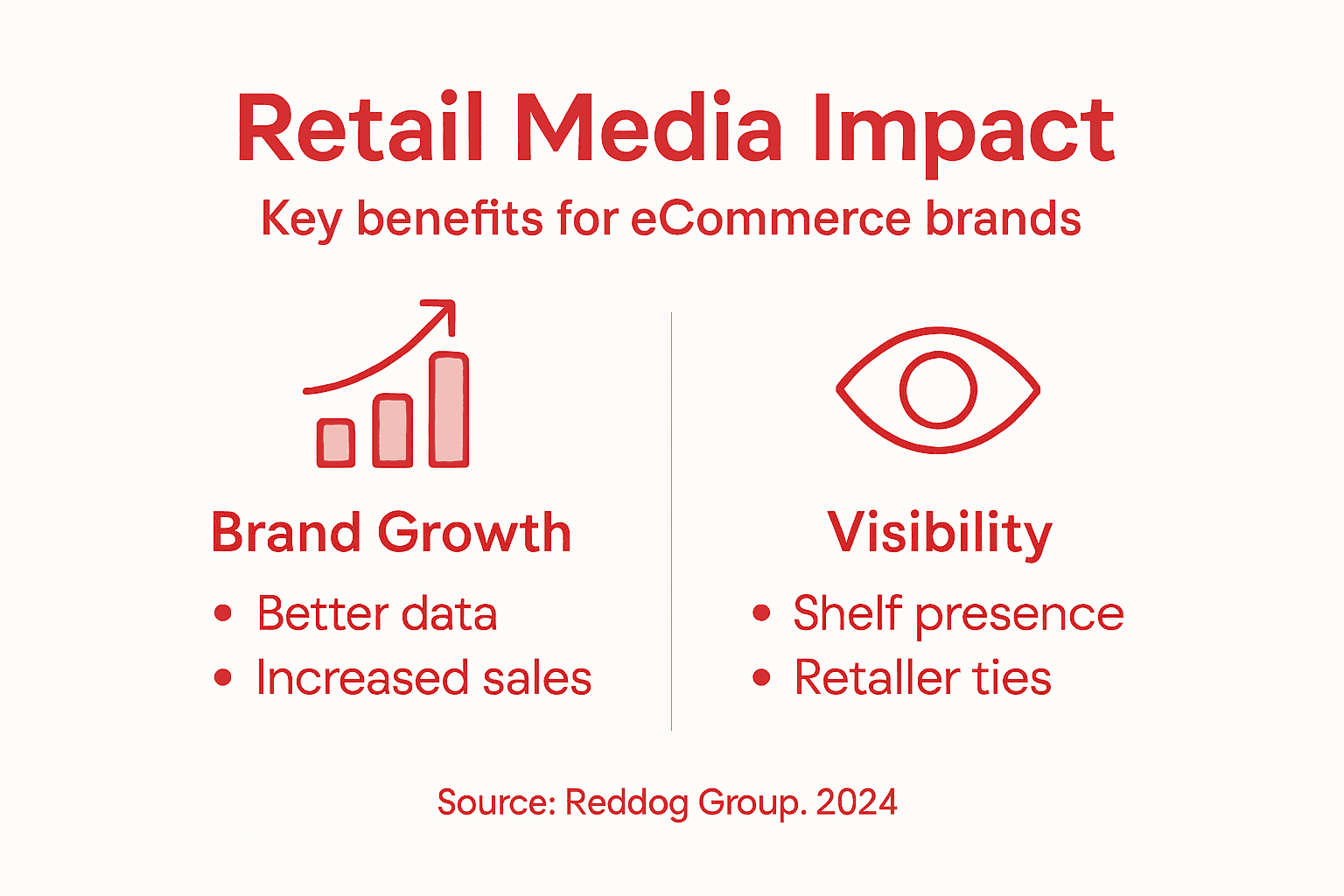
Beyond direct sales, retail media provides unprecedented access to first-party customer data and behavioral insights. When you run campaigns through retailer platforms, you gain visibility into which customer segments respond to your messaging, which products pair together in purchase baskets, and which promotional angles drive conversion versus which ones fail. Data-driven targeting and personalized marketing strategies leveraging retailer insights improve consumer behavior understanding and drive competitive advantage. A brand selling organic baby food learns that customers in suburban neighborhoods with household incomes above $100,000 are 3.2 times more likely to purchase than other segments. That insight informs product development, packaging decisions, and future marketing messages. You’re no longer guessing about your customer. You have behavioral proof. This data advantage compounds over time because each campaign teaches you something new about what actually drives purchase decisions versus what you assumed would work.
Retail media also solves a critical problem for eCommerce brands: shelf visibility and discoverability. Your product could be excellent, but if it’s buried on page 47 of Amazon search results or absent from a retailer’s email newsletter, customers never see it. Retail media puts your product in front of shoppers actively searching for solutions. This is particularly valuable for smaller brands competing against established national players. You don’t have to win the traditional marketing game against brands with 10 times your budget. You can win the retail media game by being smarter with targeting, creative, and optimization. Your $50,000 quarterly budget can outperform a competitor’s $500,000 brand awareness campaign if you’re using targeted advertising and shopper activation more strategically. The playing field tilts toward smart operators rather than deep pockets.
Another significant benefit is strengthened retailer partnerships. When you’re an active advertiser on a retailer’s media platform, you become a revenue generator for that retailer, not just a vendor seeking shelf space. That shift in relationship opens doors. Retailers invest in better data, faster implementation, and strategic support for brands running meaningful retail media campaigns. You get priority access to new placements, advanced targeting capabilities, and collaborative planning sessions. A regional eCommerce brand that invests $200,000 annually in retailer media gets treated differently than one that just ships products and hopes. The retailer’s team actively helps optimize performance because your success drives their revenue.
Finally, retail media provides competitive intelligence and market validation. You see which competitors are running campaigns, how often they’re bidding on keywords, and what their messaging looks like. You learn which product categories are growing on retailer platforms and which are declining. You understand pricing sensitivity because you can test different promotional strategies quickly. This intelligence helps you allocate resources toward opportunities with real market demand rather than pursuing ideas that look good in meetings but don’t actually resonate with customers.
Pro tip: Start by identifying which of your products have the highest profit margins and strongest customer demand signals, then concentrate your initial retail media budget on those winners rather than spreading thin across your entire catalog.
Retail media sounds straightforward until you actually start running campaigns. Then reality hits. Brands encounter real obstacles that derail performance if they’re not anticipated. The most immediate challenge is measurement confusion and misattribution. Most brand managers assume their retail media platform dashboards show true performance. Not necessarily. A retailer might report that your sponsored product campaign generated 1,000 sales worth $30,000. Sounds great until you realize those numbers include customers who would have purchased your product anyway, with or without the ad. Establishing clear standards to assess incremental value and avoiding misattribution of sales uplift requires developing reliable metrics like iROAS and iROI. This means you’re measuring true lift, not just attributing all sales to your advertising. Many brands spend months managing campaigns only to discover their actual return was half what the platform reported. The solution is demanding incremental testing from retailers. Ask them to compare sales in test markets where your ads run versus control markets where they don’t. That comparison reveals your true incremental lift. If a retailer can’t or won’t provide that analysis, you’re flying blind.
Another persistent challenge is budget inefficiency across fragmented platforms. Most eCommerce brands need to run retail media on multiple retailer platforms simultaneously. Amazon has different mechanics than Walmart, which operates differently than Target, which differs from regional chains your customers shop at. Each platform requires separate campaign management, different creative formats, and unique reporting dashboards. A $100,000 annual retail media budget spread across five platforms means you’re spending $20,000 on each. That’s often too small to optimize effectively. You don’t have enough volume to test variations, identify winning segments, or develop platform expertise. The solution is ruthless prioritization. Start with the one or two retailers where your customers spend the most money. Build profitability there. Then expand. Many brands attempt to be everywhere immediately and succeed nowhere. A focused $50,000 investment on Amazon will outperform a scattered $50,000 spread across eight platforms. You need scale within each platform to generate meaningful optimization insights.
The third major challenge involves operational complexity and cross-functional coordination. Running retail media effectively requires collaboration across marketing, finance, product, and supply chain teams. Marketing needs to manage creative and bidding strategy. Finance needs to track incremental ROI. Product teams need to respond quickly to demand signals. Supply chain needs inventory positioned correctly when campaigns drive sales spikes. When teams aren’t aligned on goals and metrics, campaigns underperform. A marketing team optimizes for clicks while finance demands profit per sale. Product doesn’t know a campaign is launching next week and can’t manage the resulting inventory surge. Addressing supply chain optimization, data-driven decision making, and seamless integration across online and offline channels prevents disjointed efforts and operational inefficiencies. The solution is establishing clear governance before launching campaigns. Define who owns what decision. Align everyone on what success looks like. Build communication rhythms where teams share updates weekly. Assign someone to own the entire retail media program rather than letting it scatter across departments.
A fourth challenge many brands underestimate is data-driven targeting without customer understanding. Retailer data is powerful but incomplete. A retailer might show you demographic segments and purchase history, but they don’t tell you why customers buy. They show what happened, not what customers actually want. Brands that rely solely on retailer data miss opportunities because they target the wrong audiences or use ineffective messaging. You need primary research. Survey customers. Run focus groups. Understand motivations beyond what transaction data reveals. A brand selling premium coffee discovers through retailer data that older customers buy more. So they target 55 plus demographics with discounts. But primary research reveals older customers actually want premium quality and sustainability, not lower prices. By shifting messaging to emphasize quality and sourcing instead of price, conversion rates jump 40 percent. The data told them who to target. Customer insights told them how to reach them.
Finally, many brands struggle with unrealistic expectations about timeline and ROI. Retail media isn’t a get rich quick channel. Initial campaigns often break even or generate modest returns. Success comes from iterative optimization over three to six months. Brands that expect immediate 300 percent ROI get discouraged and quit before campaigns mature. Set conservative expectations upfront. Plan for the first two months to be learning and optimization. Expect breakeven or 150 percent ROI minimum. As you optimize, returns improve. A campaign that generates 150 percent ROI in month two might hit 250 percent by month four as you refine targeting and creative. But that improvement requires patience and systematic testing.
This table provides a summary of major retail media campaign challenges and suggested solutions:
| Challenge | Impact on Brands | Recommended Solution |
|---|---|---|
| Measurement confusion | Overreports true ROI, inefficient spend | Demand incremental testing and lift analysis |
| Platform fragmentation | Dilutes impact, increases workload | Prioritize top retailer platforms first |
| Cross-team complexity | Misaligned efforts, missed goals | Set clear ownership and governance |
| Incomplete targeting data | Missed opportunities, low conversion | Combine retailer data with primary research |
| Unrealistic ROI timeline | Early disappointment, abandoned efforts | Set conservative goals and iterate over months |
Pro tip: Before scaling spending on any retail media platform, require your retailer to provide a formal incremental test results summary showing sales lift in test versus control markets, and only move forward if incremental ROI exceeds 200 percent.
Navigating the complex world of retail media requires more than just launching ads. The article highlights key challenges such as measurement confusion, fragmented platforms, and operational complexity that often hold eCommerce brands back from achieving true incremental sales lift and maximizing ROI. If you are struggling to pinpoint your real business impact, optimize campaigns across multiple retailer platforms, or align your teams to drive unified results, you are not alone.
At Reddog Group, we specialize in helping small and medium-sized brands overcome these exact hurdles through tailored omnichannel retail strategies and data-driven digital marketing expertise. With proven success managing over 50 brands and thousands of SKUs, we bring the experience needed to transform fragmented retail media efforts into cohesive growth engines. Our team focuses on strategic planning, marketplace management, and integrated online-offline campaigns that deliver measurable results and sustainable revenue increases.
Take control of your retail media campaigns now and move beyond surface-level metrics to real incremental lift. Discover how Reddog Group can help your brand optimize sponsored product placements, leverage powerful retailer data insights, and build stronger partnerships for greater shelf visibility and profitability. Visit our website to start a conversation and turn retail media complexity into your competitive advantage today.
Retail media is a marketing strategy that targets consumers at their point of purchase, leveraging first-party data from retailers. This approach impacts eCommerce brands by driving direct sales, improving shelf visibility, and providing insights into customer behavior, ultimately leading to increased revenue.
Brands can measure effectiveness by focusing on metrics like Incremental Return on Ad Spend (iROAS) and Incremental Return on Investment (iROI). These metrics help assess whether retail media campaigns are driving incremental sales beyond expected outcomes rather than just attributing all sales to the advertising efforts.
Retail media channels include on-site placements, such as sponsored product listings and in-store advertising, and off-site placements that utilize retailer data for ads displayed on other digital platforms. Each channel has distinct advantages for targeting customers at different stages of their buying journey.
Key challenges include measurement confusion due to misattributed sales, inefficiencies from operating across multiple retail platforms, and the need for cross-functional coordination. Brands must address these challenges to optimize their campaigns effectively.
Leave a comment: