
Published: March 2020 | Last Updated:December 2025
© Copyright 2026, Reddog Consulting Group.

That email hits your inbox like a punch to the gut: "Your Amazon selling privileges have been removed."
Instantly, sales grind to a halt. Your funds are frozen. Panic starts to creep in. Your first instinct is to fire back a desperate appeal, but that’s the single biggest mistake you can make.
The moments that follow are critical. You need to take a breath, push the panic aside, and approach this methodically. A rushed, emotional appeal will get you nowhere. A calm, calculated diagnosis of the real problem is what sets the stage for a successful reinstatement. This guide will walk you through the process, from initial triage to building a resilient business that prevents future issues.
How you handle this first hour can make or break your chances of getting back online. Your goal isn't to solve everything at once but to stop, gather intel, and understand exactly what went wrong. Firing off a half-baked Plan of Action (POA) without knowing the root cause is a surefire way to get a denial, making your situation much harder to fix.
You’re not alone in this. In 2024, Amazon suspended over 600,000 seller accounts. Their enforcement is swift and often automated, with AI flagging accounts for exceeding performance thresholds like an Order Defect Rate (ODR) over 1% or a Late Shipment Rate above 4%.
Forget about writing an appeal for now. Your first hour is all about a simple, three-step triage: Pause, Diagnose, and Check. This isn't the time for defense; it's time for investigation. This structured approach ensures you have all the facts before you make your next move.
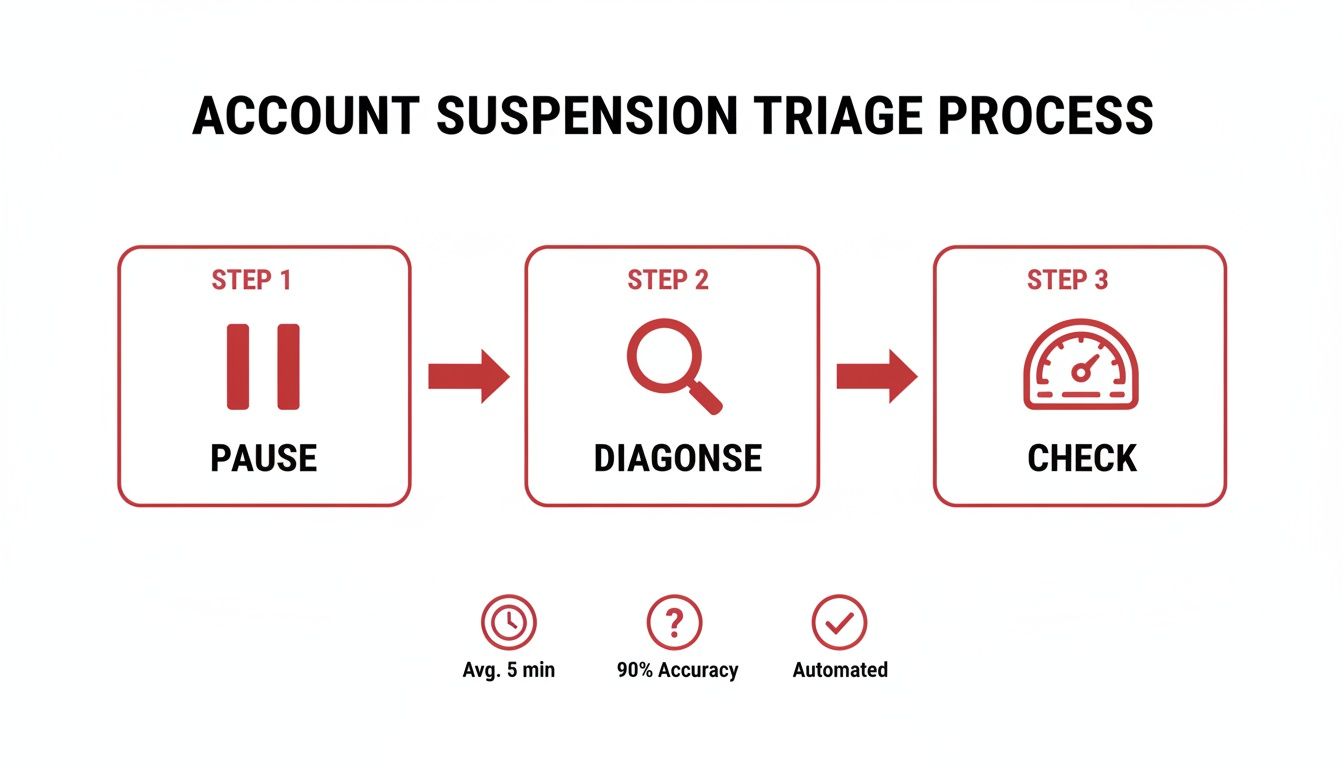
Here's a quick checklist to guide you through those first critical moments. Following these steps helps you stay calm and collect the information you'll need for a strong appeal.
| Action Item | Why It Matters | What To Look For |
|---|---|---|
| Do Not Appeal Immediately | A rushed appeal is a weak one. Amazon may only give you a few chances to get it right. | The "Appeal" button in Seller Central. Don't click it yet. |
| Read the Suspension Notice | This is your starting point. It contains vital clues, even if they seem vague. | The specific policy or performance metric mentioned (e.g., IP, ODR, inauthenticity). |
| Check Performance Notifications | This is where Amazon communicates official actions and may offer more details. | Any messages from seller-performance@amazon.com corresponding with the suspension date. |
| Review Account Health Dashboard | This dashboard provides the hard data behind the suspension. | Red or yellow flags next to metrics like ODR, VTR, Late Shipment Rate, or Policy Compliance. |
| Identify Specific ASINs | The suspension is almost always tied to specific products. Find them. | Any ASINs mentioned in the notice or flagged on your Account Health dashboard. |
| Check Customer Feedback & A-to-z Claims | Negative feedback and claims are often the source of performance-related suspensions. | Recent negative reviews, returns, or claims mentioning "not as described," "inauthentic," or "damaged." |
Once you’ve gone through this checklist, you’ll have a much clearer picture of the situation. The goal is to move from panic to a position of informed action.
Practical Takeaway: Treat this first hour like a detective, not a defendant. The evidence you gather now is the foundation of your entire reinstatement strategy.
Now, let's go back to that suspension email. Read it again, slowly. While Amazon’s notices can be frustratingly generic, they always point you in a general direction. You need to figure out which bucket your suspension falls into:
With the general reason identified, log into Seller Central. If you need a refresher on getting around the platform, our guide on what Seller Central is and its importance is a great resource.
Head straight to your Performance Notifications and the Account Health dashboard. This is where the vague email becomes concrete. You’ll find the specific ASINs, customer complaints, or metric failures that triggered the flag. This is the hard evidence you need to build your case.
Amazon's suspension notices are notoriously generic, often leaving you to connect the dots. You might get an email flagging "policy violations" without ever pointing to the specific policy or product. Your first job is to become a detective and figure out the real reason before you even think about writing an appeal.
Responding to the wrong issue is the fastest way to get your appeal rejected.

This diagnostic phase is the absolute foundation of your reinstatement strategy. A strong, successful appeal is always built on a clear and honest understanding of what went wrong. Most suspensions fall into one of three buckets, and your first step is to figure out which one is yours.
Performance violations are usually the most straightforward category. They're tied directly to your seller metrics, and the evidence is typically laid out for you right inside your Account Health dashboard.
These issues all come down to operational breakdowns that hurt the customer experience. Amazon is relentless about protecting its brand, so sellers who can't meet its standards get flagged. Fast.
Common culprits include:
When you're digging into a performance issue, cross-reference your Account Health dashboard with your Voice of the Customer (VoC) dashboard. The VoC gives you direct, unfiltered customer feedback on specific ASINs, which often reveals the "why" behind those bad metrics.
Policy violations are far more nuanced and require much deeper investigation. These suspensions happen when you’ve broken one of Amazon’s countless rules, often without even realizing it.
Weak sourcing documentation has become a leading cause of suspensions. For example, many sellers get hit with inauthenticity complaints even when they’re selling 100% genuine products. A common trigger? Sourcing from big-box retailers like Target. Amazon views those receipts as insufficient proof of a secure supply chain—they want to see proper invoices from authorized distributors.
Other common policy violations to watch for:
When you're looking into potential IP issues, it's crucial for understanding DMCA takedowns and how they can affect your account. An IP complaint is a serious red flag that demands an immediate, precise response.
This is often the toughest suspension to solve. It means Amazon's sophisticated systems have linked your account to another one that's already been suspended. The connection could be obvious, or it could be something completely obscure, making the root cause incredibly difficult to pin down.
Common ways accounts get linked:
We once worked with a brand that hired a freelance virtual assistant. Turns out, that VA had previously logged into another client's account that got suspended. Amazon's algorithm connected the two, putting the healthy account at immediate risk.
Data-Driven Insight: Amazon doesn't need definitive proof to link accounts. Their algorithm operates on a "guilt by association" model, connecting data points that a human might dismiss as a coincidence.
To diagnose this, you have to meticulously audit every single piece of data tied to your account—every user permission, every address, every financial detail, and every third-party service you’ve ever integrated. It's a tedious process, but it's absolutely essential for building a credible appeal. Your goal is to find that link, prove it was either a mistake or has been severed, and show you now have systems in place to keep it from ever happening again.
Once you’ve identified the true root cause, your entire focus needs to shift to the most important document in this whole ordeal: your Plan of Action (POA). This isn't an apology letter or a place to get emotional. Think of it as a formal business document meant to convince Amazon's investigators that you understand the problem, have already fixed it, and have implemented systems to ensure it never happens again.
A weak POA gets you ignored. A strong one gets your account back.
Your POA has to be clear, concise, and structured exactly how Amazon wants it. Every single statement you make must be factual, specific, and backed up with evidence. This is your chance to show Amazon that the suspension was a serious wake-up call that has forced you to fundamentally improve how you run your business.

Your POA must follow a strict three-part format. Getting creative here is a classic mistake that leads to rejection. Each section serves a specific purpose, and together, they tell a complete story of accountability and resolution.
Each section builds on the one before it, creating a logical argument that proves you’re a seller they can trust. Let's dig into how to nail each part.
This is where you prove you've done your homework. Amazon needs to see you’ve moved past the surface-level symptom (like a high ODR) and pinpointed the systemic failure that caused it. Vague admissions like "we made a mistake" are completely useless.
You have to take full ownership and get specific. For instance, if you were suspended for late shipments, the root cause isn't just "we shipped late." It's the why behind it.
The strong example identifies the specific software failure, the exact operational gap, and the resulting metric. It demonstrates a deep, data-driven understanding of the breakdown.
This section is all about proving you’ve already started making things right. It’s focused on the immediate fallout, especially how you’ve handled any negative customer experiences. This is not about what you will do; it’s about what you have already done.
Your goal here is to show Amazon you acted fast to contain the damage.
Don't just say it—prove it. Attach screenshots of your customer communications or your catalog management screen as evidence to back up these claims.
This is the most critical part of your POA. Amazon cares less about the past mistake and more about your ability to prevent future ones. This section needs to outline new, scalable systems—not just empty promises to "be more careful" or "try harder."
This is where our Foundation → Optimization → Amplification framework really shines. You're not just patching a hole; you're rebuilding a stronger operational foundation.
Practical Takeaway: Your preventive measures must be so robust that they make the original problem impossible to repeat. Think systems, not intentions.
It’s time to turn those weak promises into concrete, measurable actions. The table below shows just how different a vague statement looks compared to the kind of specific, actionable solution that gets an amazon account suspended notice reversed.
Vague, generic statements get POAs rejected. Specific, process-driven solutions get accounts reinstated. Here’s a side-by-side look at what works and what doesn't.
| POA Section | Weak Example (Ineffective) | Strong Example (Effective) |
|---|---|---|
| Root Cause | We made a mistake and listed a product we shouldn't have. | We failed to verify our new supplier's authorization to distribute Brand X products, leading to an IP complaint on ASIN B09ABCDE12. Our sourcing checklist lacked a mandatory brand authorization verification step. |
| Corrective Actions | We removed the listing and will be more careful. | We have permanently deleted the infringing ASIN and contacted the rights owner to retract the complaint. We have also audited our entire inventory and removed 5 other listings from the same unverified supplier. |
| Preventive Measures | We will check all products better before listing. | We have implemented a new 3-stage supplier verification process, documented in our company SOPs. This includes: 1) Requiring a letter of authorization from the brand. 2) Verifying the supplier with the brand directly. 3) Cross-referencing all new listings against the USPTO database using proprietary software. This process is now mandatory for all new supplier onboarding. |
The "Strong Examples" outline specific processes, name software, and create clear accountability. This approach shows Amazon you aren't just fixing one ASIN; you are fundamentally improving your entire business model to align with their policies.
Ultimately, your POA is a testament to your brand’s resilience and commitment to compliance. Make it count.
You’ve poured everything into crafting the perfect Plan of Action (POA). Now comes the hard part: sending it in and waiting. Hitting that "submit" button is more than just a click; it’s the start of a new phase where patience and strategy are everything.
Submitting the appeal itself is straightforward. You’ll head to the “Reactivate your account” page in Seller Central, where you can upload your POA and all the evidence you’ve gathered.
Make sure every file is named logically—think Supplier_Invoice_ASIN_B012345.pdf instead of scan123.jpg. Amazon accepts formats like PDF and JPEG. Once you’ve attached your documents and pasted the POA into the text field, take a final look and send it off.
Once you submit, the clock starts ticking. This is easily the most agonizing part of the process. Amazon's response times are all over the map, ranging from a few hours to several weeks.
While there’s no official timeline, you can generally expect an initial response within 24 to 72 hours. However, for complex cases like intellectual property complaints or related account issues, it’s not unusual to wait a week or even longer.
During this time, the single worst thing you can do is bombard Seller Performance with messages asking for an update.
Data-Driven Insight: Every time you send a new message, you risk resetting your place in line. Amazon's system often treats each new contact as a fresh submission, bumping your case to the back of the queue. Patience here isn't just a virtue—it's a critical part of your strategy.
Fight the urge to follow up. Give it at least a week before even considering a polite nudge.
When you finally hear back, the message will usually fall into one of three buckets. Knowing what each means is crucial for your next move.
If Amazon asks for more information, don't just tack on a few extra sentences and resubmit. Go back to your original POA and seriously beef up the sections they pointed out. Add more granular detail, provide more concrete evidence, and show them you’ve built even more robust systems.
For sellers stuck in this loop, professional Amazon reinstatement services can make all the difference by bringing in the expertise needed to pinpoint what Amazon wants and refine your appeal accordingly.
What if you've submitted a few revised appeals and you're just getting the same canned response? If you feel like you’re stuck in a loop with Seller Performance, it might be time to escalate. This should always be your last resort. Escalating too early will get you nowhere.
Your final option is to reach out to the executive team, often called the "jeff@amazon.com" team. This isn’t a magic shortcut. It’s a formal request for a higher-level investigation team to review cases that are complex or have stalled out in the standard process.
Your email needs to be incredibly concise and professional.
This is your last shot, so make it count. The message must be powerful, fact-based, and respectful. Your goal is to prove you've implemented bulletproof systems to protect Amazon's customers and that you are a seller worth having on the platform.
Getting your selling privileges back is the immediate goal, but the real win is making sure you never see an amazon account suspended notice again. This crisis is a powerful opportunity to rebuild your operations on a stronger, more resilient foundation. It’s time to shift from a reactive scramble to a proactive strategy.
This is where a structured growth framework makes all the difference. By focusing on your operational Foundation first, you create the stability needed to Optimize your listings and eventually Amplify your brand's reach. A strong foundation isn't just about avoiding suspensions; it's about building a business that can scale profitably and securely.

For many sellers, the single greatest point of failure is the supply chain. Amazon demands an unbreakable chain of custody, and any weakness can trigger an inauthenticity claim or policy violation, even if your products are 100% legitimate.
Building a fortified supply chain means going beyond just finding a product that sells. It requires rigorous, documented diligence at every single step.
This foundational work is non-negotiable. Think of it as the operational bedrock that protects your account from the most common and damaging types of suspensions.
With a solid supply chain, the next move is continuous optimization. This means treating your Account Health dashboard not as a place you visit when there's a problem, but as your daily operational scorecard. Proactive management is the only way to stay ahead of Amazon’s ever-changing policies and algorithms.
A major risk area is the related account suspension. With over 9.7 million sellers globally, Amazon's automated systems can link accounts for something as simple as using a shared Wi-Fi network, and appeals often fail without meticulous documentation and a clear explanation of the link.
To get a better handle on strengthening your operations, Learn more about general risk management strategies and account unblocking in business.
Practical Takeaway: Proactive account management means dedicating time each week to audit your metrics, read performance notifications, and stay informed on Amazon policy updates. Don't wait for the warning email to take action.
Now, let's turn this defensive posture into a growth engine by embedding these practices into your daily workflow. This is how you move from merely surviving to actually thriving.
Ultimately, preventing a future suspension is about building a business that’s as disciplined as it is ambitious. It requires systems that enforce compliance, from how you source products to how you talk to customers. By turning the hard lessons from a suspension into a resilient operational strategy, you build a brand that’s ready for sustainable, long-term growth.
Getting hit with a suspension notice from Amazon opens up a floodgate of questions and anxiety. Even after you've submitted a solid Plan of Action, the uncertainty can be overwhelming. Here are some straight answers to the most pressing concerns we hear from sellers.
Honestly, it varies wildly. For a straightforward suspension—say, a performance metric dip that you’ve clearly addressed in your POA—you might get reinstated in as little as 24-48 hours.
However, for complex issues like intellectual property complaints or related account issues, you need to be patient. These cases require a much deeper investigation from Amazon's teams and can easily stretch into several weeks, or even months, of back-and-forth communication. The speed of your reinstatement boils down to three things: the quality of your appeal, the severity of the violation, and how backed up Amazon’s review teams are.
In short: absolutely not. Trying to open a new seller account to get around a suspension is one of the fastest ways to get permanently banned from the platform.
Amazon's systems are incredibly sophisticated at connecting data points—IP addresses, bank accounts, business information, and more. A new account will almost certainly get flagged and shut down as a "related account." This action destroys your credibility and makes reinstating your original account exponentially harder. Your only path forward is to solve the problem on the account you already have.
The moment your account is suspended, Amazon automatically freezes your funds. This hold typically lasts for a minimum of 90 days while they investigate and ensure any outstanding customer issues are resolved.
Meanwhile, your FBA inventory is safe in Amazon's fulfillment centers. What happens next depends entirely on your appeal.
Practical Takeaway: A strong Plan of Action isn't just about getting your selling privileges back. It's about protecting your inventory and unlocking your cash flow. The entire fate of your assets rides on the success of your appeal.
While you can handle some suspensions on your own, there are times when calling in a professional is the smartest move you can make. You should seriously consider hiring a consultant if you're in a high-stakes situation.
Expert help is most valuable when:
Professionals who deal with this day in and day out know how to craft a POA that speaks Amazon's language. For simple metric-based issues, it might be overkill. But for anything complicated, an expert can be the difference between getting reinstated and getting shut down for good.
Navigating an Amazon suspension feels like a high-wire act, but you don’t have to walk it alone. The team at RedDog Group has spent years in the trenches, diagnosing tangled issues, writing winning Plans of Action, and getting sellers back online. If you're staring down a suspension and need a clear path forward, let's talk about a strategy that gets measurable results.
Leave a comment: