
Published: March 2020 | Last Updated:January 2026
© Copyright 2026, Reddog Consulting Group.

A successful Amazon marketing strategy is more than a list of tactics—it’s a structured plan built to drive visibility, conversions, and profitable growth. We break it down into three pillars: build the Foundation (market research, brand positioning), move to Optimization (listing quality, SEO), and finally, Amplify your reach (PPC, promotions).
This framework ensures every action, from keyword selection to ad spend, is deliberate and contributes to measurable results.
Before spending a dollar on ads, your strategy needs a rock-solid foundation. Many brands jump straight into PPC without auditing their market position or ensuring their operations can handle success. This is like hitting the accelerator before building the engine—a waste of fuel that rarely leads to sustainable scale.
Getting these core elements right separates brands that stall from those that achieve profitable, long-term growth. It begins with a deep dive into your market, competitors, and capabilities to ensure every piece is in place.
Your first move isn't keyword research; it's understanding the competitive landscape. Who are your direct competitors, and how are they positioning themselves? Analyze their pricing, review sentiment, and the core benefits they highlight. This isn’t about copying them—it’s about finding the strategic gaps they’ve left open.
This analysis helps define your unique selling proposition (USP) on Amazon. Are you the premium option with superior materials? The budget-friendly choice offering the best value? Or the innovative solution to an unmet need?
Your brand's position on Amazon dictates every subsequent decision—from the keywords you target to the audiences you build. A clear position prevents you from being dragged into a price war, which is a race to the bottom.
This strategic groundwork is essential. Amazon’s own growth illustrates this principle: its net sales revenue skyrocketed from $61.09 billion in 2012 to $513.98 billion in 2022. This eight-fold increase wasn't accidental; it was built on a deliberate foundation of customer-centric strategies, starting with unbeatable prices and selection.
A brilliant marketing plan will collapse if your operations can't keep up. An operational audit isn't optional; it's a non-negotiable step in building your foundation. It ensures the backend of your business can support the growth you’re about to generate.
Here are the key areas to audit first:
Getting these foundational pieces right requires a specific skill set. For brands wanting to ensure their operations are primed for growth, expert Amazon account management can provide the necessary structure and oversight. With solid operations, your marketing efforts build upon a stable base, ready to handle new demand.
Your product detail page is your digital storefront. Its one job? Turn shoppers into customers. You’ve built a foundation to compete; this optimization phase is where you win the sale. Here, we shift from high-level strategy to the tactical execution that turns clicks into cash.
A winning Amazon marketing strategy treats every element on your listing as a conversion tool. This isn’t just about stuffing in keywords; it's about blending the art of storytelling with the science of Amazon’s A9 algorithm. Every word and image must work together to answer questions, build trust, and give shoppers a compelling reason to click "Add to Cart."
Let's be clear: Amazon is a product search engine. To get found, you have to speak its language. That starts with keyword research that goes beyond obvious, high-volume terms. The goal is to uncover the specific, long-tail phrases that high-intent shoppers use right before they buy.
Tools like Helium 10 are great for mining data, but the real value is in how you apply it. Place keywords where they’ll make the biggest impact:
The aim is to create a complete keyword footprint that tells Amazon exactly what your product is and who it's for. This broadens your reach, making you visible for a much wider range of relevant searches. For brands that want a competitive advantage, mastering digital shelf analytics can provide a serious edge.
Keywords get you found, but visuals get you sold. In a crowded marketplace, high-quality images and video are what stop the scroll. Your main image must be crystal clear on a pure white background, but your secondary images are where you tell your story.
Show your product in action. Use text overlays to highlight key features. Include a size comparison chart. Show different angles. This visual merchandising builds confidence and helps shoppers picture the product in their lives. To create compelling product demos and lifestyle videos, you can use general video maker tools to get the job done.
A+ Content is your chance to create a rich, branded experience right on the product page. It's not an optional extra; it’s a conversion-driving machine.
Use A+ Content to tackle common objections, compare products in your lineup, and drive home your brand's story. A well-designed A+ module can boost conversion rates by up to 10% by giving shoppers the detailed information they need to buy with confidence.
Think of your Amazon Storefront as your brand’s dedicated home on the platform. It's an immersive, multi-page hub where you can showcase your entire catalog, tell your brand story, and curate collections—all without a single competitor ad in sight. A polished Storefront is a powerful tool for driving cross-sells and increasing your average order value.
When you combine meticulous keyword optimization with compelling visuals, A+ Content, and a sharp Brand Store, you transform a simple product page into a high-performance conversion engine. That’s the core of the optimization pillar: making every visitor count.
Your listings are optimized and ready to convert. Now, it's time to add fuel to the fire with paid advertising. An effective Amazon marketing strategy integrates organic visibility and paid ads to put your products directly in front of shoppers ready to buy. This is the amplification phase—where you strategically invest to scale growth.
Amazon PPC (Pay-Per-Click) is about control. You're not just buying clicks; you're buying valuable data and market share. A well-structured campaign will help you find new customers, defend your digital shelf space, and drive profitable, measurable growth.
This process map outlines the entire flow, from initial research to launch, setting the stage for a powerful amplification campaign.
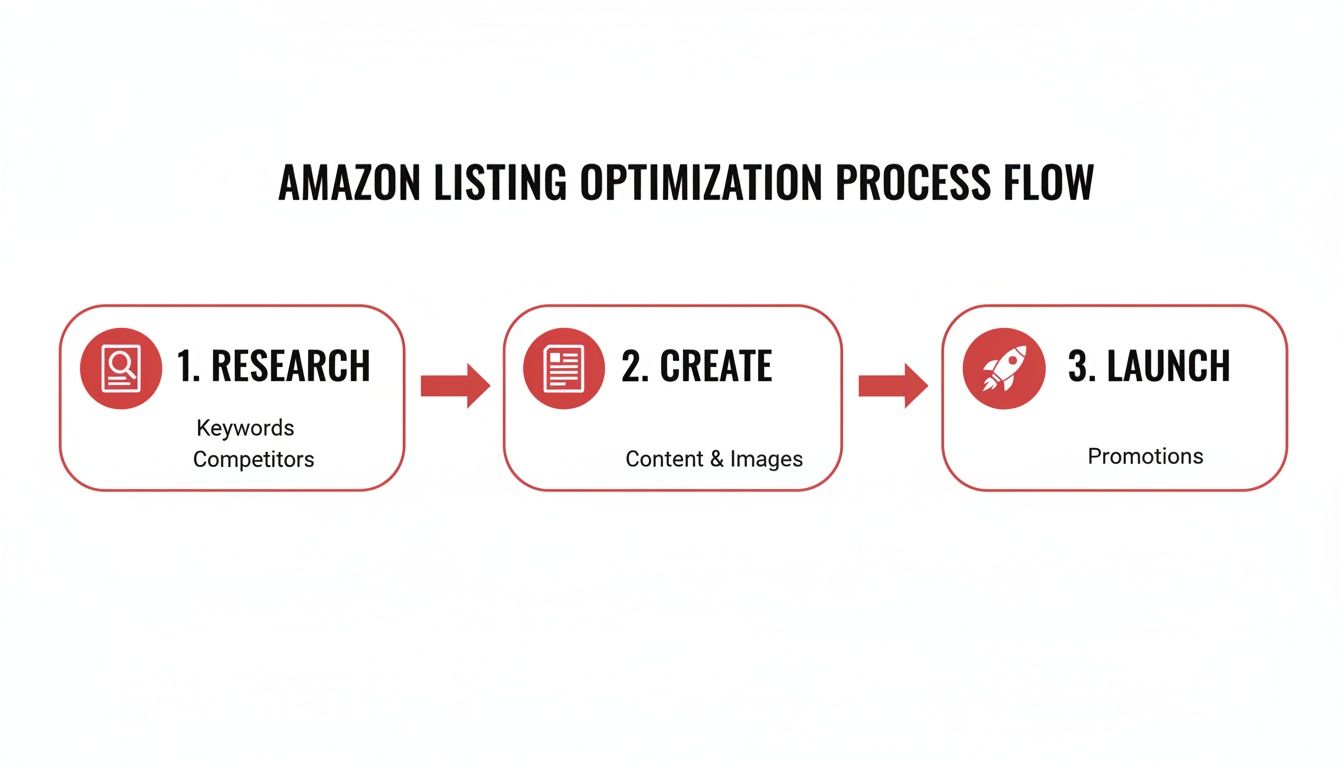
As you can see, successful amplification builds on a solid foundation of research and creative development before moving into a strategic launch.
A common mistake is throwing an entire budget at a single campaign type. A better approach is a full-funnel structure that meets shoppers at every stage of their journey, using different ad types for specific jobs.
Here’s a practical look at how these ad types work together:
To maximize your campaigns, it helps to understand the fundamentals of effective e-commerce ad strategies, even those outside the Amazon ecosystem.
Amazon's PPC ad formats each play a distinct role. The key is knowing which to deploy for a specific goal, whether aiming for broad awareness or closing a sale with a high-intent shopper.
| Ad Type | Primary Use Case | Key Metrics to Watch |
|---|---|---|
| Sponsored Products | Driving direct sales & conversions from high-intent keywords. | ACoS, Conversion Rate, Clicks |
| Sponsored Brands | Building brand awareness & driving traffic to Storefronts. | Impressions, New-to-Brand Metrics, Click-Through Rate (CTR) |
| Sponsored Display | Retargeting past viewers & targeting competitor product pages. | ROAS, Viewable Impressions, Detail Page Views (DPV) |
A mix of all three ad types creates a powerful synergy, guiding customers smoothly from discovery to purchase.
How do you build a scalable campaign structure without guessing which keywords will work? You let Amazon do the initial heavy lifting. The best approach is to use automatic and manual campaigns in a feedback loop.
Here's how it works: launch a new product with an automatic campaign. Amazon will test your ad against a wide array of search terms and related products. Think of this as your automated research tool.
After a week or two, dive into the search term report. You'll find a goldmine of data showing which actual customer queries led to clicks and—more importantly—sales. Harvest these proven, high-converting search terms and move them into a manual campaign. There, you gain granular control over bids, allowing you to invest aggressively in keywords you know work. This methodical process turns guesswork into a data-driven strategy. For a deeper dive, our team explains how expert Amazon ads management can elevate this process.
For years, Advertising Cost of Sale (ACoS) was the go-to metric. While it measures campaign efficiency, it doesn't show the full picture. A low ACoS is meaningless if total sales are flat.
The metric that truly matters for growth is Total Advertising Cost of Sale (TACOS). Calculated by dividing total ad spend by total revenue (paid and organic), TACOS shows the true impact of advertising on your overall business.
A healthy, declining TACOS signals a winning strategy. It means your ad spend is creating a "halo effect"—driving more organic sales and boosting organic rank over time. It proves your PPC budget is an investment in your brand's long-term health, not just a line-item expense.
With over 61,000 average daily impressions per user on the platform, a smart strategy is non-negotiable. Well-run campaigns can achieve conversion rates of 10-15% with an ACoS between 25-36%, but getting there requires data-driven decisions. This data-first approach turns advertising from an expense into a reliable growth engine.
Optimized listings and smart PPC get you in the game, but sustained sales velocity is how you win. This phase is about creating strategic spikes in demand that signal to Amazon's algorithm that your product is popular. This is where promotions and customer engagement come into play.
A well-timed deal can do more than clear inventory. It can jumpstart a new product, revive a slow-moving item, or create a massive sales surge during holidays. This part of your Amazon marketing strategy uses Amazon’s promotional tools to build momentum that lasts long after the discount ends.
Sales velocity—the speed and volume of your sales—is a massive ranking factor. Promotions are one of the most direct levers you can pull to influence it. But this isn't about a race to the bottom on price; it's about using the right tool for the right job.
Here are a few effective tools in your promotional arsenal:
The power of targeting Prime members can't be overstated. These core customers spend around $1,400 annually compared to just $600 for non-members. That 2.3x multiplier shows why promotions aimed at this group are so effective for driving sales volume. For more insights on leveraging Prime, check out our friends at Blankboard Studio.
Amazon's major shopping holidays—Prime Day, Black Friday, Cyber Monday—are massive traffic events your brand must be ready for. A successful strategy for these tentpole events is planned months in advance, aligning inventory, advertising, and promotions for maximum impact.
For example, leading up to Prime Day, you should increase ad spend to build awareness. On the day itself, your promotions go live to capture the wave of high-intent shoppers. This coordinated push creates a powerful spike in sales velocity that can lift your organic rank for weeks.
Think of tentpole events as a slingshot. The work you do beforehand—building inventory, priming campaigns, setting up deals—pulls the slingshot back. The event itself is the release, launching your product's rank and visibility forward.
The sale isn't the end of the customer journey; it's the beginning of a relationship. The final piece of the puzzle is building a community around your brand, turning one-time buyers into loyal, repeat customers who leave the positive reviews that fuel your growth flywheel.
Actively engaging with customers is key. For Brand Registered sellers, Amazon’s "Manage Your Customer Engagement" tool allows you to send targeted email campaigns to followers, announcing new products or promotions.
More importantly, have a system for monitoring and responding to customer questions and reviews. A negative review isn't a disaster; it's a public opportunity to demonstrate excellent customer service and gather valuable product feedback. This feedback loop builds the trust and loyalty that define top-tier brands.
A winning Amazon marketing strategy is never "set it and forget it." It’s a living system that needs constant attention—a cycle of measuring, learning, and refining your approach. This is where you connect every action, from a keyword bid to an A+ Content refresh, directly to your bottom line.
Forget vanity metrics that look impressive but don't move the needle. Real growth comes from focusing on the key performance indicators (KPIs) that signal the health of your Amazon business. This data-first mindset is how you build a resilient, long-term brand.
To make smart decisions, you must track the right data. It’s easy to get lost in numbers, but a few core metrics tell you almost everything you need to know about your performance on the digital shelf.
These are the KPIs that matter most:
Tracking these three metrics provides a high-level snapshot of your performance. They quickly tell you if you have a traffic problem (low sessions), a conversion problem (low Unit Session Percentage), or an efficiency problem (high TACOS).
Data is only useful when you act on it. A structured monthly performance review turns insights into action. This isn’t about generating a massive report; it's about asking the right questions to guide your strategy for the next 30 days.
Your monthly check-in should be a straightforward process. Carve out a couple of hours to dig into the data and walk away with a clear action plan.
A consistent review process transforms your strategy from reactive to proactive. Instead of putting out fires, you start preventing them by spotting trends early and making small, iterative adjustments that compound over time.
This disciplined approach ensures you’re always steering the ship in the right direction.
To keep your review focused, break it down into four critical pillars of your Amazon business.
By consistently analyzing these areas, your Amazon marketing strategy becomes a powerful growth loop. You measure, learn, adapt, and repeat—turning raw data into smarter decisions and sustainable, profitable growth. Ready to put this framework into action for your brand? Let’s Talk Growth.
Jumping into a full-blown Amazon marketing strategy always kicks up a lot of questions. We get it. To help clear the air, here are some straight answers to the most common things we hear from brands trying to navigate the platform.
There’s no one-size-fits-all answer here. Your budget really depends on how competitive your category is, what your growth goals look like, and your product's price. A good starting point for most is to earmark 10-15% of your target Amazon revenue for marketing, with the bulk of that going straight to PPC.
But if you’re launching a new product, you’ll need to be more aggressive out of the gate. Plan on investing a lot more in the first 90 days—think up to 25% or even higher—to get that critical early traction and sales velocity. The metric you really want to watch is your Total ACoS (TACOS). It’s the best way to see if your ad spend is actually lifting all your sales, not just the ones directly tied to ads. Our advice? Start with a test budget, see what sticks, and then pour gas on what’s working.
Amazon SEO is a marathon, not a sprint. While PPC gets you traffic right away, SEO is your long-term play for organic visibility. After you’ve fully dialed in a listing, you might see some small ranking bumps in two to four weeks as Amazon's A9 algorithm re-crawls your page.
But getting to the top of page one and staying there? That’s a three to six-month game. Why so long? Because your rank is heavily influenced by sustained sales velocity, consistent conversion rates, and a steady stream of good reviews. The algorithm loves seeing consistent sales, which is why a smart blend of paid and organic traffic is so powerful.
Think of it this way: Your SEO work builds a strong foundation for profitable, long-term traffic. PPC is the spark that gets the fire going, but a solid organic rank is what keeps it burning strong, so you aren't completely dependent on ad spend forever.
For nearly any brand serious about scaling on Amazon, Fulfillment by Amazon (FBA) is the way to go. It's a no-brainer. Using FBA instantly makes your products Prime-eligible, which is a massive driver for conversions and a non-negotiable for participating in big sales events like Prime Day.
Plus, with FBA, Amazon takes care of all the warehousing, packing, shipping, and customer service. That frees you up to focus on what you do best—growing your brand. Fulfillment by Merchant (FBM) can be a good tactical move for certain situations, like for oversized items, highly custom products, or as a backup plan to avoid going out of stock if your FBA inventory is running low. A hybrid model can work wonders, but always lead with FBA for your main product line.
So many sellers get tunnel vision on ACoS, but the single most important metric for the health of your Amazon business is your Unit Session Percentage—in other words, your conversion rate. This number tells you point-blank how good your product page is at turning browsers into buyers.
A high conversion rate makes everything else better. Seriously.
If you focus on one thing, it should be constantly improving your conversion rate. Better images, sharper copy, more reviews—this is where your optimization efforts will pay the biggest dividends.
A winning Amazon strategy isn't about guesswork. It requires a clear framework and relentless execution. At RedDog Group, we help brands build that framework from the ground up, linking operations, merchandising, and marketing to drive real, measurable growth.
Leave a comment: