
Published: March 2020 | Last Updated:December 2025
© Copyright 2026, Reddog Consulting Group.

Think of Amazon account management as the command center for your brand's presence on the marketplace. It's not just about listing products; it’s the day-to-day work of steering your brand through Amazon’s complex ecosystem to drive measurable growth and sustainable profitability.

Forget a simple checklist. The best way to think about Amazon account management is like captaining a massive cargo ship. You're not just a passenger—you're at the helm, navigating your brand toward success on the world's most competitive eCommerce platform.
This is a world away from uploading a few product photos and hoping for the best. It’s about building a profitable, scalable sales channel that integrates with and fuels your entire brand, both online and off.
True account management means you're actively steering through Amazon's constant algorithm changes, strategically managing your inventory and supply chain, and charting a course for new growth opportunities with data-driven precision.
Too many brands treat Amazon as a "set-it-and-forget-it" platform. That's a direct path to stagnant sales and leaving significant revenue on the table.
Real Amazon account management is a dynamic, hands-on process that pulls together multiple disciplines to achieve specific business goals. While the day-to-day tasks can vary, the core job is to transform a simple seller profile into a powerful engine for your brand.
This demands a structured approach that touches every single part of your Amazon presence:
At its core, proactive management is the critical difference between merely existing on Amazon and truly thriving. It’s about taking control of your brand's destiny on the platform, rather than letting the platform control you.
To achieve that level of control, you need a clear, repeatable system. At RedDog Group, we build our entire process around three core pillars: Foundation → Optimization → Amplification.
This framework ensures every action we take is deliberate and builds on past wins, creating compounding momentum for your brand. This guide will unpack what goes into each stage, giving you a practical roadmap for sustainable growth. The principles are universal, forming the basis for strong eCommerce account management across all major platforms, not just Amazon.

Effective Amazon account management isn’t a single job—it's a collection of specialized disciplines that must work in harmony. Think of your Amazon presence like a building. For it to stand strong and support real growth, it needs several solid pillars.
Each pillar represents a critical area of focus, and if one is weak, it can compromise the entire operation. These are the day-to-day responsibilities that power a successful Amazon channel, turning a simple product listing into a dynamic sales and brand-building machine.
Your product listings are your digital storefront. If they're messy, incorrect, or broken, customers won't stick around—they’ll just keep scrolling. That's why maintaining listing and catalog health is the absolute foundation of managing an Amazon account.
This means ensuring every product detail page is live, accurate, and error-free. The practical takeaway is to proactively fix suppressed listings, resolve ASIN conflicts, and ensure your brand name and product details are consistent across your entire catalog. A clean catalog doesn’t just look professional; it directly impacts your search visibility and sales.
Once your catalog is clean, it's time to make it compelling. This is where you transform your product pages into high-converting assets through strategic content and SEO. Knowing how to optimize Amazon listings for maximum sales is where measurable results begin.
This pillar is a mix of art and science. It includes:
Great SEO ensures you show up when customers search. Powerful content convinces them to click "Add to Cart."
Organic visibility is essential, but a smart PPC advertising strategy is what truly accelerates growth and helps you capture market share. This pillar is all about turning ad spend into profitable sales by getting in front of customers with high purchase intent.
Managing PPC campaigns is far more than setting a budget and letting it run. It's a constant cycle of launching campaigns, analyzing performance data, and refining your strategy. The ultimate goal is a profitable Total Advertising Cost of Sale (TACoS), where your ad spend not only drives direct sales but also elevates your organic ranking over time. For any brand serious about scaling, mastering PPC is non-negotiable.
You can have the best listings and ads in the world, but they're useless if you don't have products to sell. Inventory and demand forecasting is the operational backbone of your Amazon business, directly impacting your sales, profits, and overall account health.
A stockout is more than just a missed sale. It erases your sales velocity, drops your search ranking, and gives competitors a golden opportunity to steal your customers. Effective forecasting prevents this.
This pillar involves analyzing sales data, monitoring seasonal trends, and planning for promotions to maintain optimal stock levels. A solid handle on your inventory means you can meet customer demand without tying up excessive capital in slow-moving products.
Finally, you must protect your brand's reputation at all costs. This pillar covers two key areas: proactive brand protection and responsive customer service.
Brand protection involves using tools like Amazon Brand Registry to monitor for counterfeit sellers, combat listing hijackers, and ensure only authorized retailers are selling your products. It’s how you maintain control over your brand's image and pricing on the platform.
Excellent customer service backs this up by quickly answering buyer questions, managing feedback, and resolving problems to keep your seller rating high. As a real-world example, data shows 58% of sellers achieve profitability in their first year, and many who grow beyond $10,000 in monthly revenue do so through disciplined management—including outstanding service—from day one.
Building that trust is a core part of our deep dive on mastering Amazon Seller Central. When managed correctly, these pillars form a rock-solid foundation for scalable and sustainable brand growth.
Here’s a quick summary of how these core responsibilities and their metrics fit together.
| Responsibility Area | Primary Goal | Key Metric to Track |
|---|---|---|
| Listing & Catalog Health | Ensure all product pages are accurate, live, and error-free. | Account Health Rating, Suppressed Listing Rate |
| Content & SEO | Improve organic search ranking and convert shoppers into buyers. | Keyword Rank, Conversion Rate (Unit Session Percentage) |
| PPC Advertising | Drive profitable sales and increase market share through paid ads. | Total Advertising Cost of Sale (TACoS), ACoS, Ad Sales |
| Inventory & Demand Forecasting | Maintain optimal stock levels to meet demand without overstocking. | In-Stock Rate, Inventory Performance Index (IPI) Score |
| Brand Protection & Service | Protect brand integrity and maintain a positive customer experience. | Seller Feedback Rating, Order Defect Rate (ODR) |
Each of these areas requires constant attention, but mastering them is what separates the brands that merely exist on Amazon from those that truly thrive.
Growth on Amazon doesn't just happen. It’s the result of a structured, repeatable process that builds momentum over time. Random efforts—like running a few ads here or tweaking a listing there—rarely lead to lasting success. To turn your Amazon account into a true growth engine for your brand, you need a clear roadmap.
At RedDog Group, we've built our entire Amazon account management approach around a proven three-pillar framework. This isn't just theory; it's a progressive system that ensures every action we take is intentional, building on previous wins to create a compounding effect. It provides a clear path from stabilizing your account to actively scaling your brand.
The framework moves through three distinct phases: Foundation → Optimization → Amplification.
Before you can think about scaling, you have to build on solid ground. The Foundation phase is all about nailing the fundamentals and eliminating any underlying issues that could sabotage your growth later. It's the critical, often-overlooked work that ensures your account is healthy, stable, and ready for more advanced strategies.
Think of it like building a house: you wouldn't put up walls on a shaky foundation. On Amazon, this means:
This foundational work isn't glamorous, but it’s completely non-negotiable. It stops you from pouring money into advertising products that aren't retail-ready.
With a strong foundation in place, the focus shifts to continuous improvement. The Optimization phase is a dynamic, data-driven cycle of testing, learning, and refining. This is where we start turning your stable account into an efficient, high-performance sales channel.
This phase is less about one-time setup and more about active, ongoing management. We let Amazon’s own data guide our decisions, constantly seeking ways to improve key performance metrics.
Optimization is the engine of growth. It's where you move from a passive presence to an active strategy, using data to find and exploit opportunities your competitors are missing.
Key activities in this phase include:
Once your account is stable and highly optimized, it's time to hit the accelerator. Amplification is the true growth phase where we take what's working and expand its reach, both on and off Amazon. This is where you leverage that strong foundation and those optimized systems to aggressively capture market share and drive significant revenue growth.
This final pillar is all about strategic expansion. We identify high-impact opportunities to introduce your brand to new audiences and markets, turning your Amazon presence into a powerful omnichannel asset. This includes expanding into new ad formats like Sponsored Display and DSP, launching new products with a data-backed strategy, and exploring promising international marketplaces.
To win on Amazon, you have to measure what matters. In a marketplace overflowing with data, it's easy to get lost in vanity metrics that look good on a chart but do nothing for your bottom line. Real success comes down to a handful of Key Performance Indicators (KPIs) that directly impact your account's health and, most importantly, your profitability.
Think of it like a pilot's dashboard. While dozens of gauges are running, survival depends on three core instruments: altitude, airspeed, and heading. For an Amazon seller, the metrics below serve the same purpose—they keep your business airborne and headed in the right direction.
Before you can focus on growth, you must protect your right to sell. Amazon’s performance metrics are non-negotiable; letting them slip risks everything from suppressed listings to a full account suspension.
Your account health is the foundation of your Amazon business. With over 2.5 million active sellers competing for the Buy Box, a poor ODR is a fast track to an "account under review" notification, which can halt your sales overnight. You can learn more about the scale of the competition from these seller statistics and see why mastering these numbers is critical.
Once your account is secure, the focus shifts to ensuring your business is a well-oiled machine. These metrics reveal how efficiently your operations and advertising are running, confirming you’re not just making sales, but actually making money.
Total Advertising Cost of Sale (TACoS) is the ultimate measure of your marketing's flywheel effect. It shows how your ad spend is influencing not just direct ad sales, but your total organic revenue as well. A decreasing TACoS over time is a clear, measurable sign that your ads are successfully boosting brand awareness and organic rank.
Here are the key efficiency metrics to watch:
By keeping a close eye on these KPIs, you stop being a passive participant and start acting as a strategic director. This is how you turn raw data into a clear roadmap for building a sustainable brand on Amazon.
As your brand grows on Amazon, you’ll hit a fork in the road that will define your future on the platform: do you build an in-house team or partner with a specialized agency?
This isn't just about cost—it's a strategic choice based on expertise, scalability, and focus. Both paths have advantages, and the right answer depends entirely on your brand's needs, budget, and long-term growth goals.
An in-house team offers a singular focus on your products and perfect alignment with your company culture. They live and breathe your brand daily. The downside? This route comes with significant overhead—salaries, benefits, training—and a steep learning curve in an ever-changing marketplace.
An agency, on the other hand, provides immediate access to a team of seasoned professionals who manage diverse accounts and have seen it all. They bring advanced tools, cross-category insights, and proven best practices from day one. This model simply requires clear communication to ensure their goals are always aligned with yours.
Hiring an in-house Amazon manager or team gives you a dedicated resource completely embedded in your brand. This person becomes the ultimate product expert, understanding your catalog in a way an external partner might struggle to match.
They can walk down the hall to chat with the product development team or sync instantly with marketing for a new launch. This cultural integration is a huge asset. Your in-house expert can ensure every piece of A+ Content and every customer message perfectly reflects your brand’s voice.
The trade-off is the major investment in both time and money. Finding, hiring, and training a top-tier Amazon expert is challenging, and the full cost of a salaried employee often exceeds an agency retainer.
Partnering with an agency is like plugging an entire Amazon department into your business overnight. Instead of hiring one person, you get a full roster of specialists—a PPC strategist, a content expert, an inventory analyst, and a brand protection manager—all for a single fee. This model is incredibly efficient and delivers immediate expertise.
Agencies also bring a breadth of experience that’s nearly impossible to build in-house. Because they work across multiple brands and categories, they spot new trends and platform changes much faster. They also invest in enterprise-level software that may be too costly for a single brand. When evaluating potential partners, ask about their operational stack, including tools like specialized project management software for creative agencies, to get a feel for their efficiency.
The core benefit of an agency is leverage. You leverage their team, their tools, and their collective knowledge to accelerate your growth without the high fixed costs and lengthy ramp-up time of building a team from scratch.
To help you determine the best fit for your business, we've broken down the key factors in this decision matrix. Use it to weigh the pros and cons based on where your brand is today and where you're headed.
| Factor | Best for In-House Team | Best for Agency Partner |
|---|---|---|
| Budget | High, consistent budget for salaries, benefits, and tools. | Flexible budget; want to avoid high fixed overhead costs. |
| Speed to Scale | Slower ramp-up; time needed for hiring and training. | Immediate impact; instant access to a full team of experts. |
| Expertise | Deep knowledge of a single brand and product line. | Broad expertise across multiple categories and the latest trends. |
| Brand Control | Maximum control; team is fully integrated into company culture. | High control with a true partnership; requires strong communication. |
| Tools & Tech | Responsible for purchasing and managing your own software stack. | Access to enterprise-level tools included in the retainer. |
| Scalability | Scaling requires hiring more people, which takes time. | Can scale efforts up or down quickly based on business needs. |
Ultimately, there’s no single right answer. The best choice depends on a clear-eyed assessment of your internal resources, growth goals, and how quickly you need to move.
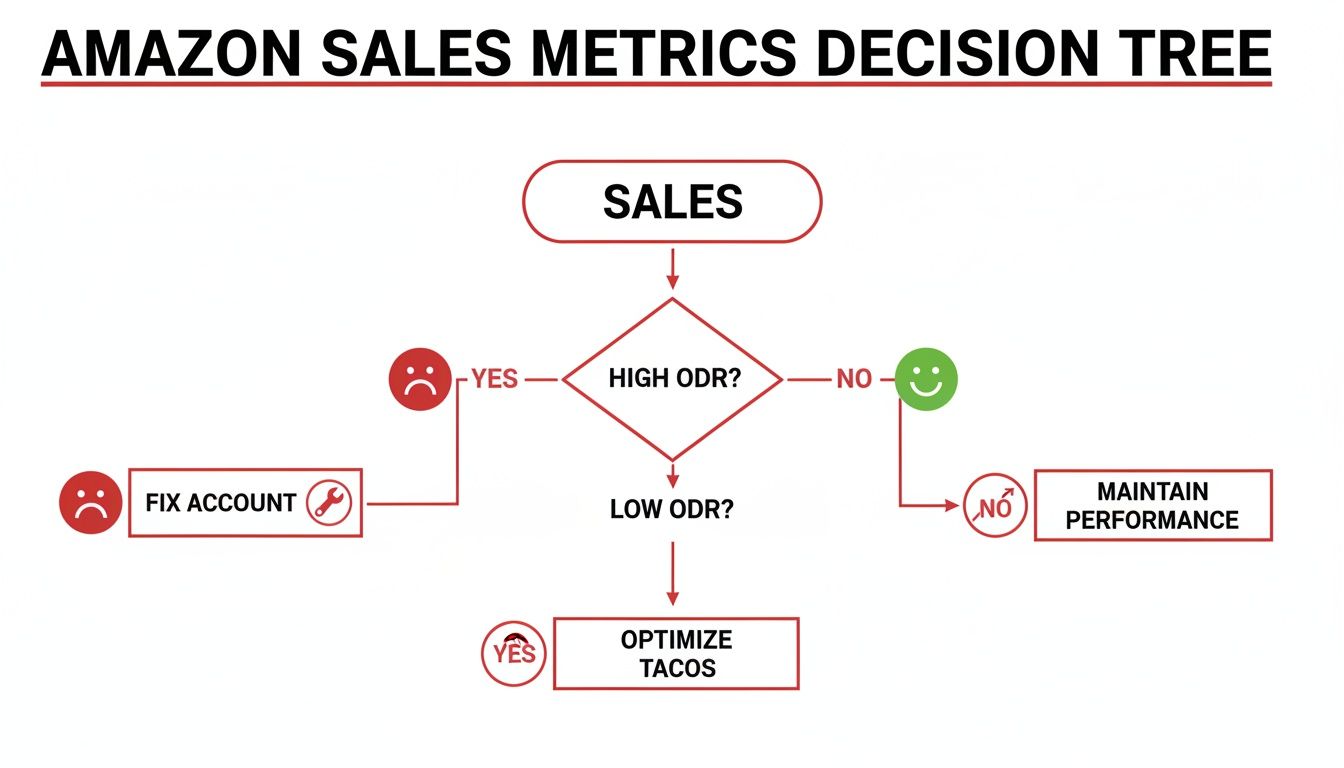
This flowchart illustrates how critical account health metrics like your Order Defect Rate (ODR) are the foundation for everything else. You can't focus on growth or optimization if your account health isn't in a good place.
For a deeper look into what a specialized partner can bring to the table, check out our guide on what to look for in an Amazon marketplace consultant. It’ll help you weigh your options and make the best decision for your brand's future.

Sometimes the fastest way to get ahead on Amazon is to stop making the same mistakes everyone else does. Real Amazon account management isn't always about finding a revolutionary new tactic; it's about consistently sidestepping the common, costly errors that can quietly sink an otherwise great brand.
These aren't just minor bumps in the road. These are blunders that can kill your sales momentum, tarnish your brand's reputation, and even put your entire account at risk of suspension. The first step to building a resilient business is knowing what these traps look like.
By far the most dangerous pitfall is treating Amazon like a passive sales channel. You can't just upload your products and hope for the best. Success on this platform demands active, daily attention. The algorithm is always changing, new competitors emerge overnight, and customer expectations constantly evolve.
Without someone actively managing the account, you won't notice critical issues until they've spiraled into emergencies. This reactive approach almost always ends in lost sales, wasted ad spend, and significant stress.
Too many sellers only check their Account Health Dashboard when they get a warning from Amazon. That’s like ignoring your car’s check-engine light until smoke starts billowing from the hood. Metrics like your Inventory Performance Index (IPI) and Order Defect Rate (ODR) are your early warning system, providing clear data on your operational health.
Letting your IPI score drop can lead to crippling FBA storage limits right before Q4, leaving you unable to stock up for your biggest sales season. And letting your ODR creep toward the 1% limit isn't just a warning—it's gambling with your entire business.
This kind of vigilance is what separates top sellers from the rest. As a data-driven insight, independent sellers now drive the majority of sales on the platform, accounting for 62% of Amazon's total sales recently. Their success is built on meticulous management and steering clear of these exact pitfalls. You can discover more about how independent sellers thrive on Amazon by maintaining disciplined oversight.
Beyond the big-picture mindset, a few specific operational traps can completely derail your growth. Here are the ones we see trip up sellers most often:
Running PPC Without a Profitability Strategy: Simply throwing money at ads to increase sales is a rookie move. If you're not tracking your Total Advertising Cost of Sale (TACoS), you have no idea if your campaigns are actually profitable. A smart ad strategy connects every dollar spent to overall business growth, not just vanity metrics.
Underestimating Inventory Needs: The classic "Prime Day Stockout" is a perfect real-world example of this. Running out of stock during a major sales event doesn't just cost you sales that day—it tanks your sales velocity and search ranking for weeks after. Solid forecasting isn't optional; it's essential.
Failing to Monitor for Listing Hijackers: If you're not actively watching your listings, it's only a matter of time before an unauthorized seller jumps on, starts selling counterfeits, and destroys your customer reviews. Proactive brand protection is the only way to maintain control and preserve customer trust.
By understanding and actively avoiding these common mistakes, you can protect your brand, maintain your momentum, and build a far more stable and profitable business on Amazon.
Jumping into the world of Amazon always sparks a few questions. Below are the ones we hear most often from brands trying to get their footing, along with straightforward answers to help you prioritize and make smarter decisions.
Always start with your data and catalog health. Forget about ads and fancy content for a moment. The real foundation is ensuring your product titles, bullet points, and backend keywords are packed with relevant search terms.
A clean, accurate catalog is a practical first step that does two critical things: it boosts your organic search visibility and stops you from wasting ad spend driving traffic to listings that aren't optimized to convert. Everything else you do builds on this.
There’s no magic number here. The smartest approach is to tie your budget directly to your goals and profit margins. A practical rule of thumb is to aim for an Advertising Cost of Sale (ACoS) that’s at or below your product's breakeven point.
Think of it this way: when you're launching a new product, you might accept a higher ACoS (and lower profit) to gather data and build sales velocity. But for a mature, best-selling product, you’ll want a much lower ACoS to maximize profit. The real goal is to shift from a rigid budget to one that flexes based on measurable performance metrics like TACoS.
Your Amazon account management needs consistent attention, but you don't need to be glued to your screen 24/7. The key is knowing what to check and when. Here’s a practical schedule that works:
Effective amazon account management isn't just about selling on a platform; it's about turning a sales channel into a powerful engine for brand growth. At RedDog Group, we build the strategies that connect your brand to customers and drive measurable results across every channel. Let's Talk Growth.
Leave a comment: