
Published: March 2020 | Last Updated:December 2025
© Copyright 2026, Reddog Consulting Group.

So, what exactly is ecommerce account management?
Think of it as the strategic command center for a brand's digital sales channels. It’s far more than a simple checklist; it's the comprehensive oversight of the health, growth, and profitability of your online presence—from marketing and inventory to customer experience and platform compliance. The ultimate goal is to build a unified and profitable omnichannel engine that drives measurable results.

Many brands get this wrong. They view account management as a simple to-do list: list new products, answer customer questions, and glance at sales reports. While those tasks are involved, that operational mindset misses the bigger picture. True account management is strategic.
An ecommerce account manager is effectively the digital general manager for your brand’s online stores. Just as a GM is responsible for a physical store’s success, a digital manager is accountable for the health, growth, and bottom-line profitability of every online channel—from Amazon and Walmart to your own direct-to-consumer (DTC) website.
This role acts as the central hub connecting all your digital sales efforts, ensuring every moving part works together to drive real, measurable growth. It's the critical difference between simply being online and actually building a profitable ecommerce machine.
Great ecommerce account management isn't about performing siloed tasks; it's about integrating multiple disciplines into one powerful sales strategy. It’s not just about keeping the lights on—it’s about architecting growth from the ground up.
This strategic oversight connects all the dots, including:
This integrated approach guarantees that every decision is tied directly to the core goal: sustainable brand growth.
The core function of ecommerce account management is to transform disjointed digital efforts into a cohesive, data-driven growth strategy. It connects the dots between marketing spend, operational efficiency, and bottom-line revenue.
Without a strategic leader, a brand's online presence quickly fragments. The marketing team runs ads without knowing inventory levels, while the operations team gets blindsided by promotional sales spikes. This disconnect leads to wasted ad spend, frustrated customers, and stalled growth.
A skilled account manager closes those gaps. They dive into data from every channel to make smart, informed decisions. They ensure promotional calendars align with inventory forecasts and that real customer feedback is used to optimize product listings.
For example, by analyzing sales data from both Amazon and a brand's Shopify store, a manager might discover a product sells best in multi-packs on Amazon but as single units on the DTC site. That insight allows them to tailor inventory, marketing, and listings for each channel, maximizing profit across their entire digital footprint.
Ultimately, strategic ecommerce account management builds the foundation for scalable, predictable growth. It transforms your digital channels from a collection of disconnected tasks into reliable revenue drivers, empowering you to move from simply existing online to truly dominating your market.
So, what does a great ecommerce account manager actually do? It’s a role that’s part strategist, part operator, and part growth expert, touching every component of your brand’s presence on the digital shelf. The goal isn't just to keep things running; it's to actively identify and execute opportunities that drive sales and boost profitability.
To give you a clear picture, let’s break down the role into tangible, daily work. Think of this as the playbook for results-driven ecommerce account management. It all comes down to building a rock-solid foundation, optimizing every detail, and then amplifying what works to truly scale your brand.
Here’s a practical overview of the key areas an account manager owns:
| Responsibility Area | Primary Goal | Example Activities |
|---|---|---|
| Storefront Operations | Ensure a smooth, compliant, and professional customer experience. | Managing brand registry, handling customer service inquiries, monitoring reviews. |
| Catalog & Listings | Turn product pages into high-converting digital salespeople. | Keyword research, copywriting, A+ Content creation, image optimization. |
| PPC & Promotions | Drive profitable growth and visibility through paid advertising. | Building ad campaigns, managing budgets, tracking ROAS & ACoS, running deals. |
| Inventory & Repricing | Prevent stockouts and maintain competitive pricing to maximize sales. | Sales forecasting, coordinating with logistics, managing automated repricing tools. |
| Compliance & Reinstatements | Protect the account from policy violations and resolve issues quickly. | Monitoring platform policy changes, auditing listings, writing Plans of Action. |
Now, let's dive deeper into what each of these responsibilities means for your brand’s growth.
At its core, ecommerce account management is about keeping the digital store open and running smoothly. This is the operational bedrock on which all growth strategies are built. Without solid operations, even the most brilliant marketing campaign will fall flat.
This covers everything from setting up new marketplace accounts and navigating brand registry to managing the technical backend of your listings. It’s about making sure your storefront is functional, professional, and compliant with each platform’s specific rules—whether you're on Amazon, Walmart, or your own Shopify site.
A huge piece of this puzzle is managing customer interactions and feedback. A good manager constantly monitors reviews, answers questions, and resolves issues before they escalate. This not only protects your brand's reputation but also provides priceless feedback you can use to improve your products and listings. To take this a step further, understanding the role of CRM in ecommerce is key to turning great service into lasting loyalty.
Think of your product listing as your best salesperson—one that works 24/7. An account manager’s job is to ensure that salesperson is exceptional at closing deals. This goes far beyond simply uploading a product title and a few pictures.
Strategic catalog and listing optimization is a craft that involves:
For instance, an account manager using a tool like Helium 10 might discover that while a primary keyword is highly competitive, a long-tail phrase like “easy-clean non-stick garlic press” has significant search volume with less competition. They would then optimize the entire listing to dominate that specific, high-intent phrase, capturing customers who are ready to buy.
A well-optimized listing doesn’t just describe a product; it solves a problem for the customer. It's the difference between a product that sits on the digital shelf and one that consistently flies off it.
Paid ads and promotions are the fuel for expanding your reach and accelerating sales. But without a sharp strategy, it’s incredibly easy to burn through your budget with little to show for it. An effective account manager turns your ad spend from a cost into a predictable, profitable growth engine.
This isn’t just about “running ads.” It’s a continuous cycle of planning, launching, measuring, and refining. A skilled manager is responsible for:
If a manager sees ACoS start to rise, they investigate. They might find a specific keyword is consuming budget without converting and reallocate its spend, or they might identify a new competitor and adjust bidding strategy accordingly. This data-driven approach ensures advertising dollars directly contribute to brand growth.
You can’t sell what you don’t have. It’s a simple concept, yet one of the most critical—and often overlooked—responsibilities of an account manager is maintaining healthy inventory levels. Going out of stock doesn’t just mean lost sales today; it can damage your product’s search ranking on platforms like Amazon for weeks, creating a long-term revenue problem.
Proper inventory management is a constant balancing act that includes:
A proactive manager has low-stock alerts and a clear replenishment plan, ensuring an uninterrupted flow of products from your warehouse to your customer’s doorstep.
Finally, a crucial part of the job is navigating the complex rules each ecommerce platform enforces. Violating a policy—even accidentally—can get your listings suppressed or, in a worst-case scenario, your entire account suspended. This brings your business to a grinding halt.
A great account manager is your brand’s first line of defense. They stay on top of policy updates to ensure your listings and business practices are compliant. If something goes wrong, they are the ones who diagnose the problem, write a compelling Plan of Action, and work with platform support to get you back in business fast. This protective oversight keeps your revenue flowing and your business safe.
Sustainable ecommerce growth isn’t about chasing trends or getting lucky. It’s the result of a deliberate, repeatable process that builds momentum over time. Think of it like building a house: you wouldn't install countertops before pouring the foundation. The same logic applies to scaling a brand online.
At RedDog, we guide every client through our three-pillar framework: Foundation → Optimization → Amplification. This methodical approach ensures we fix critical issues first, make data-driven improvements, and only then, scale what’s already working. It’s a roadmap designed for measurable, long-term brand growth.
This visual shows how the core tasks of account management—listings, ads, and inventory—are not separate jobs but parts of a continuous cycle.
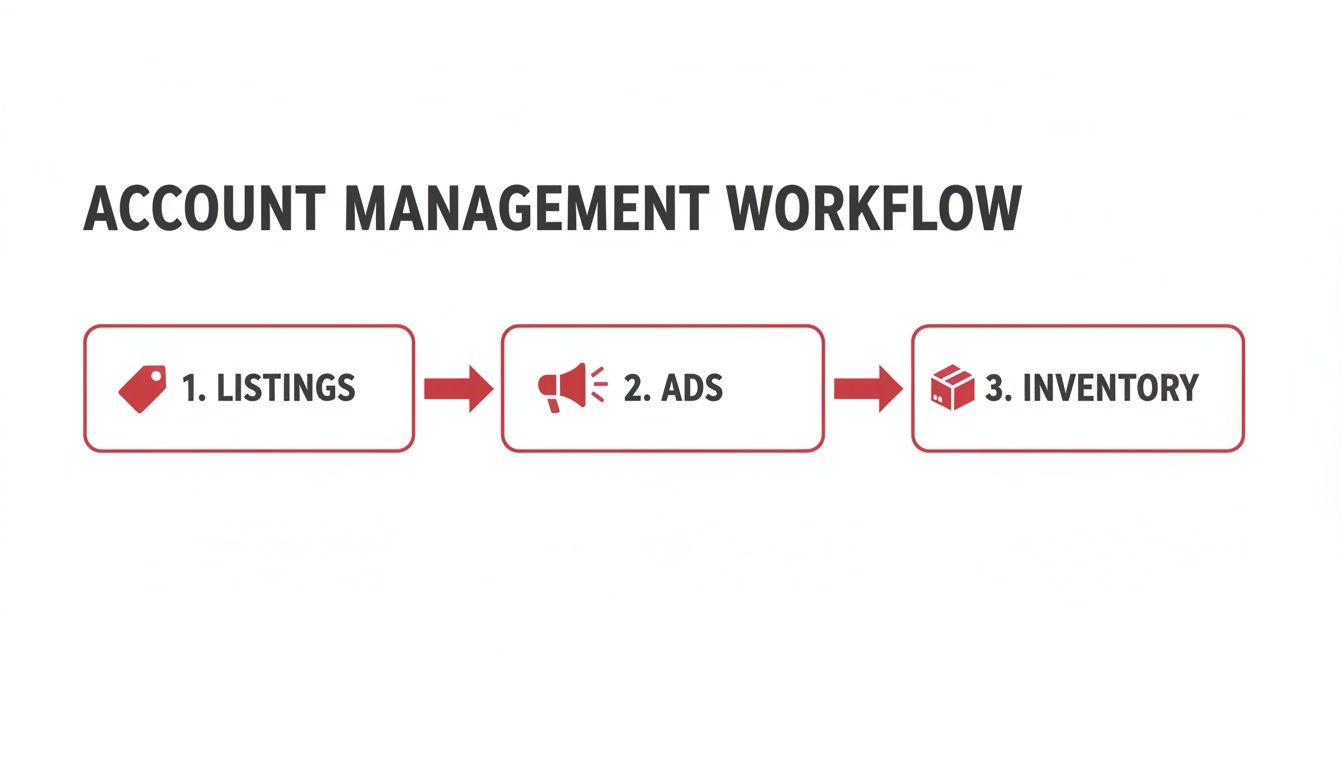
They feed into each other, creating a growth engine that gets stronger with every turn.
Every new partnership begins with the Foundation. This first phase is about auditing, cleaning up, and strengthening the fundamentals of your digital storefront. Before we drive a single click, we ensure the house is in order. A weak foundation will crumble under the pressure of increased ad spend or traffic.
Key activities in this stage include:
Building a strong foundation isn’t the flashy part of ecommerce, but it’s the most important. This is the work that prevents costly account suspensions, ensures a smooth customer experience, and sets the stage for scalable growth.
Once the foundation is solid, we move to Optimization. This is where we let data lead the way, systematically improving performance across the board. The goal is simple: make every part of your ecommerce engine more efficient. We aim to convert more clicks into customers and maximize the value of every dollar spent.
This phase is a continuous loop of testing, learning, and refining. We don’t guess; we measure. A core part of this is implementing proven strategies to increase ecommerce sales based on what the data tells us.
Here’s what that looks like in practice:
Amplification is the final and most exciting phase. With a solid foundation and a finely tuned conversion engine, it’s time to accelerate. Here, we take what we’ve proven to work and expand its reach to capture more market share and drive rapid growth.
This isn’t about just throwing more money at ads; it's about smart, controlled scaling backed by solid data. Amplification connects your efforts across platforms, a crucial step you can learn more about as you master the omnichannel strategy process for 2025 growth.
Scaling activities often involve:
This structured framework transforms ecommerce management from a reactive firefight into a proactive, predictable system for building a powerful and sustainable brand.
Good ecommerce account management isn't about feeling busy—it's about delivering real, measurable results that impact your bottom line. To distinguish between genuine progress and "vanity metrics" like clicks or impressions, you need to focus on a handful of Key Performance Indicators (KPIs).
These are the numbers that paint a true picture of your brand’s health and growth. Tracking these KPIs isn't optional; it's essential for making smart, data-driven decisions. To get a handle on your performance, you need to analyze your financials, including understanding metrics like how to see how much a Shopify store makes. This knowledge lets you manage your business based on what the numbers are actually telling you.
Let's dive into the five most critical KPIs every brand needs to monitor. These metrics provide a 360-degree view of your business, from customer acquisition efficiency to long-term profitability.
Your Conversion Rate is the percentage of visitors who complete a purchase after landing on your product page or website. Calculate it by dividing the total number of sales by the total number of visitors, then multiplying by 100.
This is arguably the most important metric for efficiency. A strong conversion rate means your product listings, pricing, and overall customer experience are compelling enough to turn browsers into buyers. It's a direct reflection of how well your digital shelf is performing.
Customer Acquisition Cost (CAC) tells you the total sales and marketing cost required to acquire one new customer. To find it, divide your total marketing spend by the number of new customers you gained in that period.
CAC answers a critical question: how much are you paying for each new buyer? A low CAC indicates efficient, well-targeted marketing. If this number climbs, it’s a warning sign that your ad campaigns or targeting strategies need adjustment.
Your Average Order Value (AOV) is the average amount a customer spends per order. It's calculated by dividing your total revenue by the number of orders.
AOV is a powerful lever for growth because it focuses on increasing value from the customers you already have. A rising AOV is a strong signal that your cross-selling, upselling, and bundling strategies are effective.
Tracking KPIs isn't just for building reports; it's about finding actionable insights. Each metric points you to where you need to focus your energy—whether that’s fixing a leaky conversion funnel, optimizing ad spend, or improving customer loyalty.
Customer Lifetime Value (CLV) is a projection of the total revenue your business can expect from a single customer over their entire relationship with your brand. While more complex to calculate, it's vital for understanding long-term profitability.
CLV shifts your focus from a single transaction to building lasting relationships. Great account management is built on retaining customers, as repeat buyers are the engine of most successful ecommerce businesses. Data shows that repeat customers can drive 40% of online revenue while only making up 8% of shoppers.
Finally, Return on Ad Spend (ROAS) measures the gross revenue generated for every dollar spent on advertising. Calculate it by dividing the revenue from your ad campaigns by their cost.
ROAS is the ultimate report card for your advertising profitability. It answers the critical question: "Is my ad spend actually making me money?" A healthy ROAS confirms your campaigns are reaching the right audience with the right message. The data from these KPIs is invaluable, and you can dive deeper by understanding the role of omnichannel analytics in our detailed guide.
Knowing what not to do is just as important as having a growth playbook. I’ve seen even the most ambitious brands get derailed by common, preventable errors. These aren't just minor hiccups; they're costly mistakes that burn cash, damage your reputation, and bring your growth to a dead halt.
Good ecommerce account management is about proactive prevention. It’s about spotting these pitfalls from a mile away and building systems to sidestep them entirely. Let's break down the most common mistakes we see and the simple, actionable steps you can take to avoid them.

One of the fastest ways to erode customer trust is to show up differently on every channel. When your messaging, pricing, and visuals on Amazon don’t match what’s on your DTC site or social media, it creates confusion and makes your brand feel amateurish.
Nothing kills momentum like a stockout. When your best-seller goes dark, you don't just lose immediate sales—you also damage your search ranking on marketplaces like Amazon, which can take weeks or even months to recover. It's a self-inflicted wound that is almost always avoidable.
In ecommerce, your customer reviews and checkout process are integral parts of your brand. Ignoring negative feedback or having a clunky, frustrating checkout is like leaving money on the table. Cart abandonment hovers around a staggering 70% average across ecommerce sites. For every 10 shoppers who add an item to their cart, 7 of them walk away, often due to friction like unexpected costs or a complex process. You can find more details in this breakdown of key ecommerce stats.
Ignoring the small friction points in the customer journey is a massive mistake. A single negative review or a confusing checkout step can undo thousands of dollars in marketing spend.
To combat this, actively monitor and respond to customer reviews—both good and bad—and use the feedback to improve your products and listings. Simultaneously, audit your checkout process. Remove unnecessary steps, display shipping costs upfront, and offer multiple trusted payment options. Simple abandoned cart email flows can often recover 10-20% of these otherwise lost sales, directly boosting your bottom line.
Jumping into the world of ecommerce account management brings up a lot of questions, especially when you're getting ready to scale. Getting the right partner on board is a big decision, so let's clear up some of the most common questions we hear from brands.
The real difference comes down to strategy versus tasks. A Virtual Assistant (VA) is great for executing specific, pre-defined tasks. You give them a clear set of instructions—like handling basic data entry, answering customer emails with a script, or scheduling social media posts—and they get it done.
An Ecommerce Account Manager, on the other hand, is a strategic partner focused on growing your business. They aren't just checking off a to-do list; they're building and running the entire growth playbook. This means digging into sales data to make smart decisions, managing your ad budgets to squeeze out more ROI, and being held accountable for hitting your sales targets. A VA follows instructions, while a manager drives the plan.
There's no single price tag for professional account management. The cost really depends on how complex your business is, what services you need, and the agency's pricing model. It's definitely not a one-size-fits-all kind of service.
Generally, you'll see a few common ways agencies structure their fees:
Costs can start at a few thousand dollars a month for a smaller brand on a single channel and go up from there for larger, multi-channel businesses. The trick is to look at the value and potential Return on Investment (ROI), not just the monthly fee. The right partner will pay for themselves many times over.
The goal isn't just to manage an account; it's to build a profitable growth engine. The right partnership generates returns that far exceed the monthly fee, making it a strategic investment rather than an expense.
There are a few clear signs that it’s time to call in the experts. If any of these sound familiar, it’s a good signal that you need a professional partner to help you break through to the next level of growth.
You should think about hiring an agency when:
If your ecommerce operations feel more reactive and chaotic than proactive and strategic, that’s the perfect time to start looking for a partner.
You can't manage what you can't measure. Effective account management runs on a solid tech stack that helps automate tasks, pull in clean data, and deliver insights you can actually use. The exact tools will change depending on your channels and needs, but a good setup usually has a few core pieces.
Some of the must-have platforms include:
The point of all this tech is to build a streamlined, data-driven machine that lets your team make smarter decisions, faster.
Ready to move from reactive management to proactive, profitable growth? At RedDog Group, we build the foundation, optimize the performance, and amplify the results for brands ready to scale. Let’s Talk Growth.
Leave a comment: