
Published: March 2020 | Last Updated:January 2026
© Copyright 2026, Reddog Consulting Group.

More than 80 percent of American eCommerce brands struggle to set prices that increase both sales and profit. With intense competition online, the difference between thriving and barely surviving often comes down to mastering smart pricing strategies. This practical guide breaks down the core techniques that help American store owners refine their pricing, stand out in crowded markets, and secure long-term revenue growth.
| Point | Details |
|---|---|
| Pricing Strategies are Multifaceted | Effective pricing strategies encompass market analysis, consumer psychology, and business objectives to maximize profitability and capture market share. |
| Diverse Pricing Models are Essential | Implementing various pricing models like cost-plus, value-based, and dynamic pricing helps brands address specific market needs and consumer behaviors. |
| Brand Perception is Influenced by Pricing | Pricing serves as a communication tool, shaping consumer perceptions of quality, value, and brand integrity. |
| Common Mistakes Can Undermine Success | Avoid uniform pricing across different products and over-reliance on algorithms to maintain customer trust and long-term profitability. |
Pricing strategies represent sophisticated decision making frameworks that online brands utilize to determine product pricing in competitive digital marketplaces. At their core, these strategies transcend simple mathematical calculations - they are complex approaches that integrate market analysis, consumer psychology, and strategic business objectives. Pricing strategies create competitive advantage by capturing potential sales and maximizing profit potential across target market segments.
Successful eCommerce pricing strategies consider multiple interconnected factors: production costs, target consumer demographics, competitive landscape, perceived product value, and overall business positioning. Brands must develop nuanced approaches that balance profitability with market attractiveness. This means understanding not just how much customers will pay, but why they perceive certain price points as fair and compelling. Strategic pricing methodologies involve comprehensive analysis of consumer behaviors, market trends, and product positioning.
The most effective pricing approaches typically include several key models: cost-plus pricing, competitive pricing, value-based pricing, and dynamic pricing. Cost-plus pricing calculates prices by adding a standard markup to production expenses. Competitive pricing involves setting prices relative to market competitors. Value-based pricing focuses on the perceived economic value delivered to customers. Dynamic pricing allows real-time price adjustments based on demand, competition, and market conditions.
Pro tip: Regularly analyze your pricing strategy performance by tracking key metrics like conversion rates, average order value, and profit margins to continuously refine your approach.
Online brands leverage multiple pricing strategies to navigate complex digital marketplaces and maximize revenue potential. Pricing strategies adopt different methods based on specific business objectives such as increasing market share, defending existing markets, or penetrating new market segments. Understanding these diverse approaches enables brands to develop targeted pricing frameworks that align with their unique business goals.
Seven primary pricing strategies dominate eCommerce landscapes. Cost-plus pricing involves calculating prices by adding a standard markup to production expenses, ensuring basic profitability. Competitive pricing requires setting prices relative to market competitors, maintaining market relevance. Penetration pricing strategically introduces products at lower price points to quickly gain market share and attract initial customers. Value-based pricing focuses on the perceived economic value delivered to customers, allowing brands to charge premium rates for exceptional products or services.
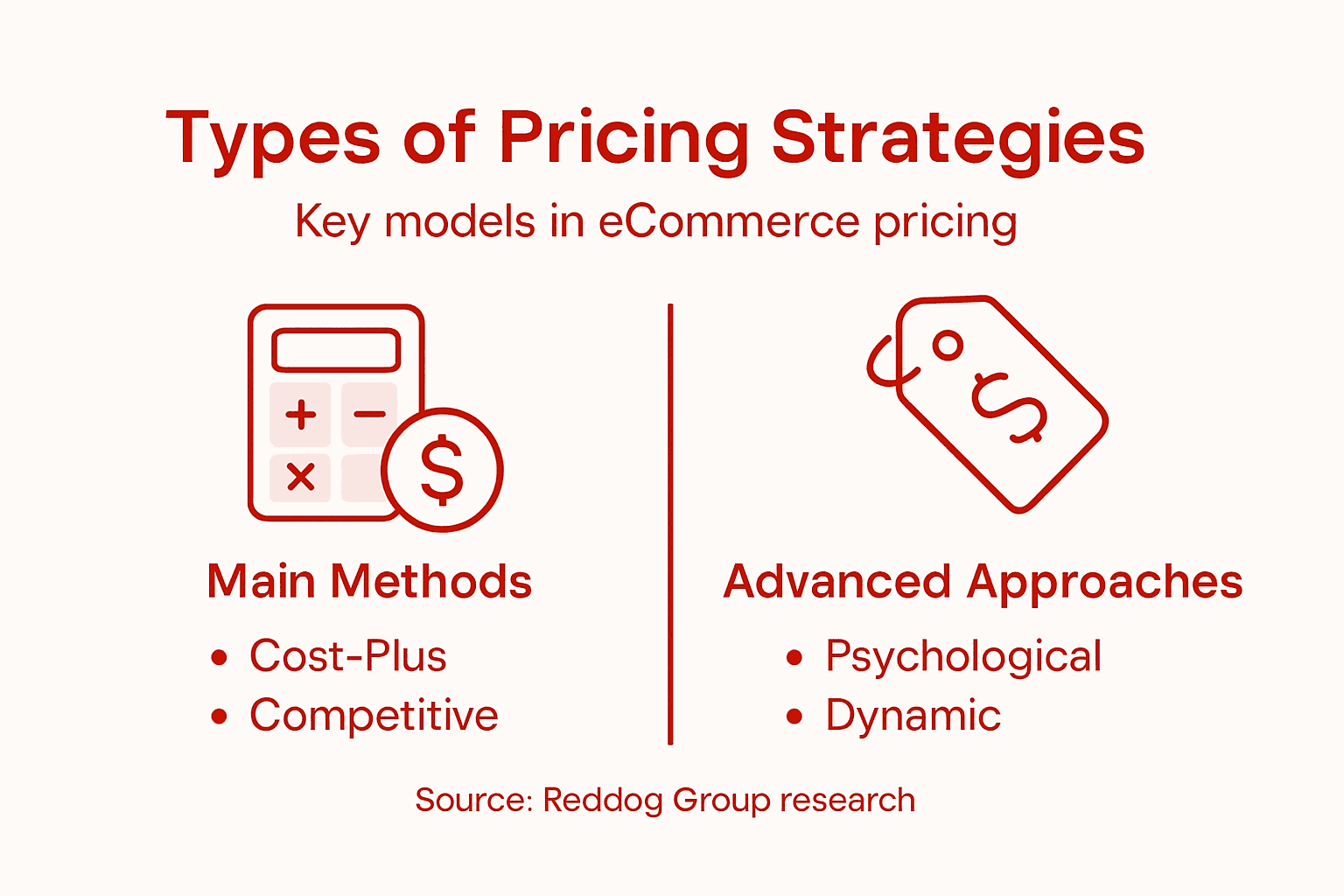
Additional sophisticated pricing models include psychological pricing, which leverages consumer perception by using pricing techniques like charm pricing (ending prices in .99), and dynamic pricing, which enables real-time price adjustments based on demand, competition, and market conditions. Pricing approaches help businesses convey value while attracting and retaining customers through strategic financial positioning. Premium pricing represents another nuanced strategy where brands deliberately set higher prices to communicate superior quality and exclusivity.
Here’s a comparison of key eCommerce pricing strategies and their business impact:
| Strategy Type | Core Mechanism | Typical Use Case | Impact on Brand Perception |
|---|---|---|---|
| Cost-Plus Pricing | Adds markup to production cost | Basic products, cost control | Neutral; signals practicality |
| Competitive Pricing | Sets prices relative to competitors | Saturated markets, price wars | Accessible; emphasizes fairness |
| Value-Based Pricing | Prices based on perceived value | Premium brands, unique offers | High-quality; boosts trust |
| Dynamic Pricing | Real-time adjustment from data | Seasonal, fast-moving goods | Innovative; can risk fairness |
| Psychological | Uses charm rates, price signaling | Broad appeal, impulse buys | Friendly; influences perception |
| Penetration | Enters market with low prices | Market entry, new launches | Affordable; can boost acquisition |
| Premium | Sets highest price for exclusivity | Luxury, niche products | Prestige; highlights exclusivity |
Pro tip: Conduct monthly pricing strategy audits by comparing your current pricing against market benchmarks and analyzing customer acquisition costs to ensure ongoing optimization.
Pricing serves as a powerful communication tool that extends far beyond simple monetary transactions. Consumer price perception profoundly shapes brand attitudes by creating intricate psychological associations between price, quality, and brand value. Customers unconsciously interpret pricing as a signal of product worth, brand positioning, and overall market credibility.
Brands can strategically leverage pricing to communicate multiple messages about their market positioning. Premium pricing signals exceptional quality and exclusivity, attracting consumers seeking high-end experiences. Competitive pricing demonstrates market accessibility and customer-centric approaches. Value-based pricing communicates transparency and confidence in product benefits. Each pricing strategy sends nuanced signals about brand personality, target audience, and competitive stance.

Psychological factors play a critical role in how consumers interpret pricing signals. Price perceptions directly influence purchasing decisions by creating complex emotional and rational associations with brand value. Lower prices might suggest affordability but could simultaneously imply lower quality. Conversely, higher prices can communicate sophistication, reliability, and superior product characteristics. Understanding these subtle psychological mechanisms enables brands to craft pricing strategies that align with their desired market image.
Pro tip: Conduct periodic consumer surveys to understand how your current pricing strategy impacts brand perception and align pricing with your desired market positioning.
E-commerce sales channels significantly drive revenue generation for online brands, transforming traditional business models and creating unprecedented growth opportunities. Sophisticated pricing strategies serve as critical mechanisms for capturing market share, optimizing profitability, and establishing competitive positioning in digital marketplaces. Understanding the intricate relationship between pricing decisions and financial performance becomes essential for sustainable business expansion.
Pricing directly influences three fundamental business metrics: revenue growth, profit margins, and market penetration. Competitive pricing enables brands to attract price-sensitive customers and expand market share rapidly. Premium pricing allows companies to maintain higher profit margins by targeting consumers who prioritize quality over cost. Value-based pricing creates a balanced approach that communicates product worth while maintaining attractive price points that drive consistent sales volume.
Quarterly retail e-commerce sales demonstrate consistent growth trends that underscore the importance of strategic pricing. Successful online brands recognize that pricing is not merely about setting a number, but about crafting a comprehensive strategy that communicates brand value, attracts target consumers, and generates sustainable revenue streams. Dynamic pricing models, which adjust prices based on market demand, competition, and consumer behavior, provide additional sophistication in revenue optimization.
Pro tip: Implement a quarterly pricing audit that analyzes your current strategies against market benchmarks, customer feedback, and competitive landscape to ensure ongoing revenue growth and market relevance.
Common pricing mistakes can significantly undermine business performance by creating long-term challenges that extend beyond immediate revenue impacts. Online brands frequently fall into predictable traps that erode profitability and customer trust. Recognizing these potential pitfalls becomes crucial for developing robust and sustainable pricing strategies that support consistent business growth.
One of the most prevalent errors involves implementing uniform pricing across diverse product lines without considering individual market dynamics. Brands often default to simplistic pricing models that fail to account for product complexity, customer segments, and unique value propositions. Competitive analysis requires nuanced approaches that differentiate pricing strategies based on product characteristics, target demographics, and competitive positioning. Equally problematic is the tendency to focus exclusively on short-term revenue targets while neglecting long-term brand positioning and customer perception.
Pricing algorithms can create unexpected brand reputation risks when implemented without careful consideration of consumer psychology and ethical implications. Dynamic pricing technologies, while powerful, can inadvertently communicate perceived unfairness or trigger negative customer reactions. Successful brands must balance technological capabilities with transparent, customer-centric pricing approaches that prioritize trust and perceived value over purely mathematical optimization.
Here are common pricing mistakes and their potential long-term impacts on online brands:
| Common Mistake | Description | Potential Long-Term Impact |
|---|---|---|
| Uniform Pricing Across Products | Fails to tailor pricing per product segment | Lower profits, brand disconnect |
| Overuse of Algorithms | Relies too much on automated pricing technology | Loss of trust, reputation risk |
| Ignoring Market Dynamics | Neglects competitor or consumer shifts | Reduced competitiveness, stagnation |
| Overfocus on Short-Term Revenue | Prioritizes immediate profit over positioning | Weak brand loyalty, lost growth |
Pro tip: Develop a comprehensive pricing review process that includes regular market analysis, customer feedback collection, and cross-functional team assessments to identify and mitigate potential pricing strategy vulnerabilities.
Omnichannel retail strategies create complex pricing ecosystems that require sophisticated approaches to channel-specific pricing and consumer expectations. Successful integration demands a holistic view that considers digital and physical sales channels as interconnected revenue streams rather than competing platforms. Brands must develop flexible pricing frameworks that adapt to diverse consumer purchasing behaviors and preferences across multiple touchpoints.
Strategic pricing in omnichannel environments involves creating seamless experiences that balance consumer convenience with business profitability. Digital pricing must account for fulfillment costs, return policies, and channel-specific consumer expectations. In-store pricing requires complementary strategies that encourage cross-channel engagement, such as price-matching guarantees and unified loyalty program incentives. This approach transforms pricing from a transactional mechanism into a strategic tool for building comprehensive customer relationships.
Dynamic pricing technologies enable sophisticated omnichannel strategies by allowing real-time adjustments across sales channels. Retailers can implement nuanced pricing models that consider factors like stock availability, delivery costs, and consumer channel preferences. Successful implementations might include differentiated pricing for online and physical store purchases, promoting pick-up options, and creating incentives that encourage multi-channel interactions.
Pro tip: Develop a centralized pricing management system that provides real-time visibility across all sales channels, enabling rapid adjustments and maintaining consistent pricing strategies.
Navigating the complex world of eCommerce pricing strategies can feel overwhelming. The challenge lies in balancing profitability, market competitiveness, and brand perception while continuously adapting to shifting consumer behaviors and omnichannel demands. This article highlights the importance of tailored pricing approaches like value-based pricing, dynamic pricing, and psychological pricing to convey brand value authentically and drive revenue growth.
At Reddog Group, we understand these pain points and offer expert solutions designed specifically for small and medium-sized online brands striving to elevate their pricing frameworks. With deep expertise in omnichannel retailing, Amazon FBA, and digital marketing, we excel at integrating pricing strategies that enhance market share and strengthen brand positioning. Our hands-on experience managing over 50 brands and 30,000 SKUs means we know how to translate complex pricing insights into measurable sales growth.
Ready to stop guessing and start optimizing your pricing for maximum impact?

Discover how Reddog Group’s strategic guidance can transform your pricing challenges into powerful business opportunities. Visit our website to explore tailored consulting services and proven omnichannel growth strategies. Take control of your pricing approach today with Reddog Group and watch your brand thrive in competitive marketplaces.
The main types of pricing strategies include cost-plus pricing, competitive pricing, value-based pricing, dynamic pricing, penetration pricing, psychological pricing, and premium pricing. Each strategy serves distinct purposes based on business goals and market conditions.
Pricing strategies communicate messages about product quality and brand value. For example, premium pricing can signal exclusivity and high quality, while competitive pricing may suggest accessibility and fairness to consumers.
Regular pricing audits help brands analyze their pricing strategies against market benchmarks and customer behavior. This ensures ongoing optimization, improved profit margins, and alignment with market trends, ultimately supporting revenue growth.
Common pricing mistakes include using uniform pricing across diverse products, over-relying on pricing algorithms, ignoring market dynamics, and focusing excessively on short-term revenue. Avoiding these pitfalls helps maintain profitability and customer trust.
Leave a comment: