
Published: March 2020 | Last Updated:January 2026
© Copyright 2026, Reddog Consulting Group.

Scaling an ecommerce business is about much more than a temporary sales spike. It's about building a repeatable, predictable system for profitable growth. Too many ambitious brands get caught in the chaos of operational breakdowns and cash flow nightmares because they skipped the foundational work.
The proven path follows three clear stages: first, you build a solid Foundation. Then, you drive relentless Optimization. Only then are you ready for strategic Amplification.
It’s tempting to jump straight to running ads, thinking more traffic is the magic bullet. But this is a classic mistake. We've seen brands burn through cash with disappointing returns, all because the business couldn't handle the volume they were paying for.
Scaling isn't a single tactic—it's a disciplined process that ensures you grow profitably and sustainably. Think of it as building a cohesive engine for expansion, not just running isolated marketing campaigns. To get this right, you need a clear roadmap, and exploring some of the top e-commerce growth strategies can provide a great starting point.
This isn't about just getting bigger; it's about getting stronger.
True, sustainable scale comes from mastering three distinct phases in the right order. Each builds on the last, creating momentum while keeping risk in check. Trying to skip a step is like building a skyscraper on a weak foundation—it’s only a matter of time before it all crumbles. For a deeper dive into the core principles, our complete overview of what business scalability is is a great resource.
Here’s a visual breakdown of our proven, three-stage process for scaling an ecommerce business from the ground up.
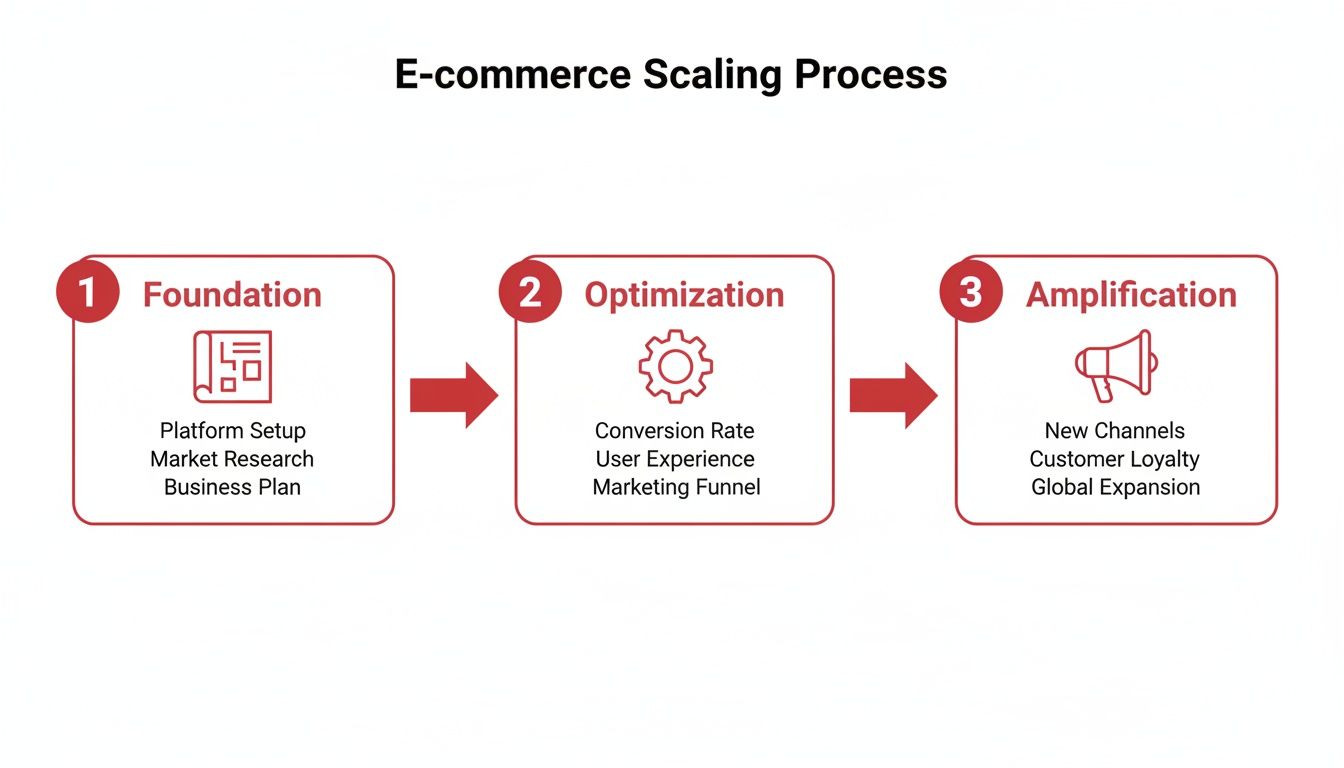
This logical flow—from Foundation to Amplification—is the exact progression successful brands follow. It ensures every dollar you spend on growth is backed by a stable and efficient operation.
To give you a clearer picture, here's a table that summarizes the three core growth pillars and what each one is designed to achieve.
| Growth Pillar | Primary Objective | Key Focus Areas |
|---|---|---|
| Foundation | Build a stable, scalable base. | Product-market fit, unit economics, tech stack, data infrastructure. |
| Optimization | Maximize profitability and efficiency. | Conversion rate optimization, catalog management, fulfillment, margin improvement. |
| Amplification | Accelerate profitable growth. | Paid media, marketplace expansion, customer retention, strategic partnerships. |
By breaking down the process this way, you can focus your energy and resources exactly where they'll have the most impact at each stage of your journey.
Here's how those stages work in practice:
This isn't just theory. It's the practical playbook our clients use to achieve an average of 25%+ year-over-year growth. It transforms scaling from a high-stakes gamble into a calculated, repeatable process.
Trying to scale an ecommerce business without getting the fundamentals right is like building a house on sand. You might get the walls up, but the first storm will expose every weakness. This first stage is all about auditing, reinforcing, and validating the core of your operation to make sure it’s ready to support rapid, profitable growth.
Many brands skip this part. They get impatient and jump straight into chasing revenue with aggressive marketing. We’ve seen it happen time and again: a brand pours money into ads, sales spike, and then the entire operation implodes.
Orders get shipped late, inventory runs out, customer service is overwhelmed. It’s a costly lesson: profitable scaling starts with a stable launchpad, not a bigger marketing budget.
Product-market fit isn't a gut feeling. It’s a measurable reality you can see in your sales data. Before pouring money into scaling, you need cold, hard proof that a specific group of customers not only wants your product but is willing to pay for it repeatedly.
Intuition might get you off the ground, but data is what lets you scale with confidence.
Take a hard look at your numbers:
For example, a client of ours noticed one of their flagship products had a 20% higher return rate than anything else in their catalog. Instead of scaling ads for it, they paused. After digging into customer feedback, they discovered the product images were setting the wrong expectations. A quick reshoot dropped the return rate to 4%, allowing them to amplify its sales profitably.
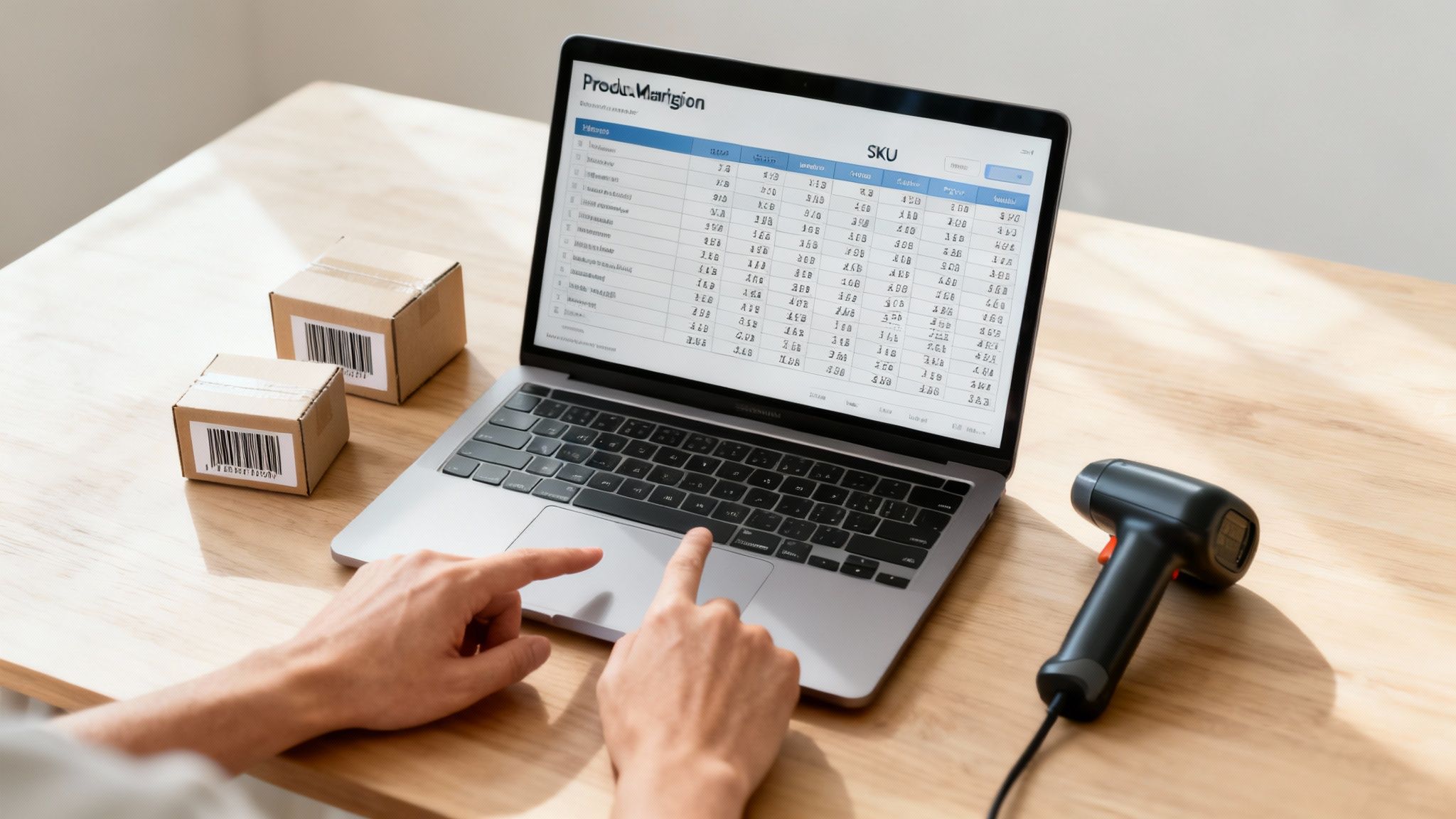
Profitability at scale is decided long before you sell a single unit. It’s baked into your unit economics. You must know the precise profit margin for every SKU in your catalog after all costs are accounted for.
And this means more than just the cost of goods sold (COGS). This is about total clarity.
One of the most common mistakes is overlooking the "hidden" costs that quietly eat away at margins. Things like payment processing fees, marketplace commissions, packaging, and even the labor cost to pick and pack an item can turn a seemingly profitable product into a loser at scale.
To get this right, run a detailed margin analysis for every product, including:
Once you have this data, you'll see which products are your true profit drivers and which are draining resources. This clarity lets you make smart, strategic decisions—like discontinuing low-margin items or renegotiating with suppliers—to build a truly profitable foundation.
Your technology stack—all the software and platforms you use—is either a growth accelerator or a bottleneck. There's no in-between. A clunky, disconnected system creates manual work, data silos, and operational chaos that only gets worse as you grow. The goal is a setup that enables growth, not one that gets in the way.
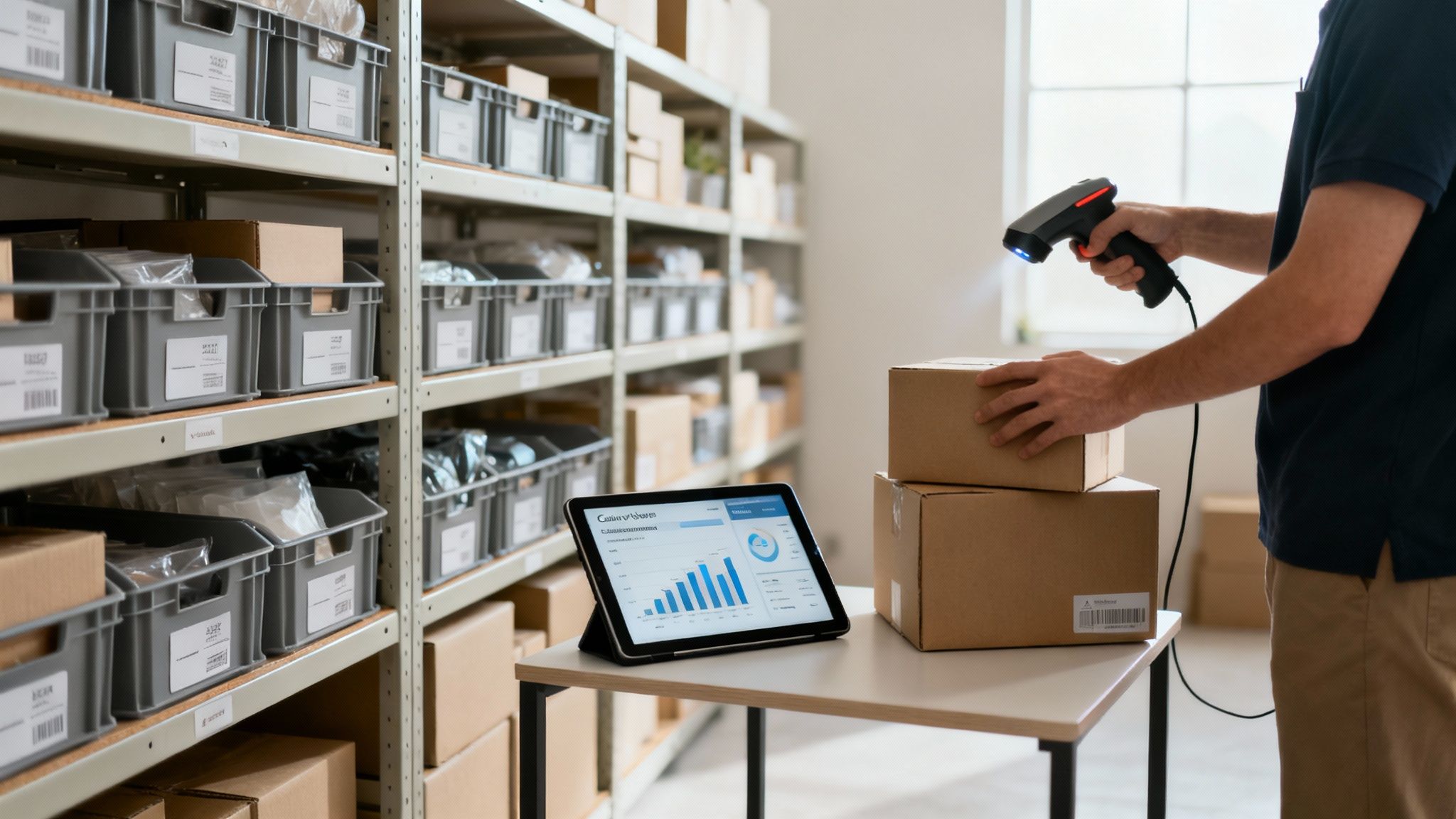
A scalable tech stack should provide a single source of truth for your most critical data. Your inventory management system needs to talk seamlessly to your sales channels (Shopify, Amazon, Walmart) and your accounting software. This integration prevents overselling, streamlines order processing, and gives you an accurate, real-time view of your business’s health.
We worked with a CPG brand that was manually updating inventory levels across three different sales channels. As orders grew, they were constantly overselling popular items, leading to angry customers and canceled orders. By implementing an integrated inventory management system, they automated the process, eliminated stockouts, and freed up 15 hours of manual work every week.
Your foundation also includes operational readiness. This means having proper GS1 UPCs for your products, securing Brand Registry on platforms like Amazon to protect your listings, and ensuring your fulfillment partner can handle a 3x or 5x surge in daily orders without breaking a sweat. Skipping these steps is a recipe for disaster when growth finally arrives.
Once these foundational pillars are secure—validated product-market fit, profitable unit economics, and a scalable tech stack—you have a business that’s ready for the next stage.
You've built a solid foundation. Now it's time to shift gears from building to refining. This is the Optimization stage—a crucial pivot where the focus moves from simply having the right pieces in place to making every single one of them work harder for you.
Forget chasing every new customer for a minute. This phase is about converting the traffic you already have more effectively and tightening every process to boost your bottom line. This is where scaling becomes profitable, and these practical steps create serious, measurable gains.
Your product detail pages are your digital sales floor. Whether on Amazon, Walmart, or your own Shopify store, this is where customers make the final call. A weak listing is like a messy, unhelpful retail shelf—it kills sales on the spot.
Start with the basics: high-quality imagery is non-negotiable. Customers can’t touch or feel your product, so your photos have to do all the heavy lifting. You need a solid mix of studio shots on a clean white background, lifestyle images showing the product in action, and infographics that spell out key features and benefits.
Next up is your copy. It needs to pull double duty, satisfying both search algorithms and human shoppers.
We worked with a brand whose top-selling product had a conversion rate of just 8% on Amazon. By rewriting their bullets to focus on benefits and adding two lifestyle images, their conversion rate jumped to 14% within 30 days—without any additional ad spend. That’s the power of optimization.
As you grow, small operational hiccups turn into massive, expensive headaches. What was a minor annoyance at 10 orders a day becomes a nightmare at 100. The two areas you absolutely have to master are fulfillment and inventory management.
Fulfillment isn't just about putting things in boxes; it's a huge part of your customer experience. Slow, inaccurate, or pricey shipping will cost you customers. You need a system that can handle sudden sales spikes without breaking, ensuring orders are picked, packed, and shipped correctly every single time.
Inventory management is a constant balancing act. You need enough stock to meet demand, but you can't tie up all your cash in products sitting on a shelf.
Smart inventory planning means using sales data to forecast demand, setting up automated reorder points, and knowing your supplier lead times inside and out. This isn't just about avoiding problems—it's a strategic advantage. For a deeper dive, our guide on ecommerce supply chain management breaks it all down.
Profit is the fuel for your growth engine. During this optimization phase, you have to be relentless in hunting down opportunities to improve your margins. Even tiny, incremental gains add up to serious capital you can pour right back into scaling the business.
Look past the initial cost of the product. Real margin improvement comes from looking at the entire picture of your expenses.
| Margin Improvement Tactic | Practical Application | Expected Outcome |
|---|---|---|
| COGS Reduction | Negotiate better pricing with suppliers based on increased volume, or source alternative manufacturers. | Increases gross margin on every unit sold. |
| Strategic Pricing | Analyze competitor pricing and perceived value to test slight price increases on high-demand products. | Boosts revenue per sale without impacting conversion rates. |
| Fulfillment Optimization | Audit shipping carrier rates, renegotiate contracts with your 3PL, and optimize packaging to reduce dimensional weight costs. | Lowers your cost-per-order, directly improving net profit. |
| Operational Waste | Identify and reduce costs associated with returns, damaged goods, and inefficient processes. | Frees up cash flow and stops preventable profit leaks. |
We helped a DTC client analyze their fulfillment costs and found they were losing $1.50 per order just by using oversized boxes. Switching to right-sized packaging saved them over $45,000 in the first year alone. These are the kinds of wins that create the financial runway for the aggressive growth we'll tackle next.
You've built a solid foundation and fine-tuned your operations. Now you have a powerful growth engine waiting for you to hit the accelerator. This is the Amplification stage, where you strategically expand your market presence to drive serious, exponential growth.
This isn’t about just throwing money at ads. It’s about smart, calculated expansion into the channels where your ideal customers are already active. You'll build a true omnichannel presence, reaching new audiences while getting more value from every customer. It’s time to pour fuel on the fire.
Expanding to new marketplaces is one of the fastest ways to get your products in front of millions of fresh eyes. Platforms like Target+, Walmart, and niche marketplaces give you instant access to built-in audiences ready to buy. The key is to be strategic, not exhaustive.
Start by figuring out which platforms align with your target demographic. A brand selling high-end kitchen gadgets is a natural fit for Target+, while a B2B parts supplier should look at industry-specific marketplaces.
Here’s how to approach it without getting overwhelmed:
International expansion follows the same logic. Start small to validate the market. Launching in a single new country, like Canada or the UK, is much smarter than trying to go global all at once.
With your conversion rates dialed in, you can finally invest in paid media with confidence. The goal is a scalable, predictable system for acquiring new customers profitably. This means mastering both marketplace advertising and the social/search ads that drive traffic to your DTC site.
For anyone serious about growth, mastering ecommerce PPC marketing is a must. On platforms like Amazon, this means getting more sophisticated than just running a few automatic campaigns.
The secret to a high-ROI paid media engine is creating a feedback loop. Use data from your ad campaigns—which keywords convert, which creative gets clicks—to improve your organic listing optimization. This creates a powerful cycle where your paid and organic efforts constantly make each other stronger.
The first sale is just the beginning. The most profitable ecommerce brands are masters at turning a first-time buyer into a loyal fan. In this stage, your focus shifts from just worrying about CAC (Customer Acquisition Cost) to maximizing LTV (Customer Lifetime Value).
A solid retention strategy is built on personalized communication and genuine engagement.
Your growth strategy will look different depending on whether you're primarily a DTC brand or a marketplace seller. Here’s a quick playbook comparing how each can tackle the amplification stage.
| Growth Tactic | DTC Brand Application | Marketplace Seller Application |
|---|---|---|
| Paid Media | Focus on Google/Meta ads driving to landing pages. Build lookalike audiences from customer lists. Heavy retargeting. | Dominate on-platform PPC (e.g., Amazon Ads, Walmart Connect). Use Sponsored Products for visibility and Sponsored Brands for awareness. |
| Content Marketing | Create a blog, YouTube channel, or podcast to build a community and authority. Use SEO to attract organic traffic. | Optimize A+ Content and Brand Storefronts. Create high-quality video content for product detail pages. |
| Retention | Implement email/SMS marketing, a tiered loyalty program, and subscription options to increase LTV. | Use Amazon's "Manage Your Customer Engagement" tool. Focus on getting repeat buys through Subscribe & Save. |
| Partnerships | Collaborate with influencers and complementary brands for affiliate marketing and co-branded campaigns. | Not a primary focus, but can partner with platform-specific influencers (e.g., Amazon Live creators). |
By systematically amplifying your reach through these interconnected strategies—channel expansion, paid media, and customer retention—you create a multifaceted growth machine that is not only powerful but also resilient.
Trying to scale an ecommerce business without a clear way to measure success is like flying blind. You can't improve what you don't measure, and gut feelings won't tell you if your investments are actually moving the needle. A data-driven approach removes the guesswork, ensuring every decision is backed by cold, hard numbers.
This means assigning specific Key Performance Indicators (KPIs) to each stage of your growth framework. The metrics that matter when you're building your foundation are different from those that define success when you're amplifying growth. This keeps you focused on what's most important right now.

During the Foundation stage, your world revolves around profitability and viability. Before you think about rapid expansion, you have to know if your core business model is sound. The goal here is simple: track the metrics that confirm you have a profitable product that people want.
Your dashboard at this stage should be brutally honest. Here's what to watch:
These numbers give you a clear, unfiltered picture of your business's financial health. They ensure you're building on solid ground. Understanding the role of analytics in business growth is fundamental to making sense of this data.
Once your foundation is secure, the game shifts to efficiency. In the Optimization stage, you’re looking to squeeze more value out of the assets and traffic you already have. Your KPIs should reflect how well you’re turning clicks into cash and plugging operational leaks.
Mobile commerce, in particular, isn't just a trend—it's a critical battleground for optimization. By 2025, mCommerce sales are expected to hit $2.51 trillion globally. That's a huge 21.25% jump from $2.07 trillion in 2024, driven by the smartphone in everyone's pocket. It's a stark reminder of why a seamless mobile experience is essential for scaling.
Key metrics to obsess over during this phase include:
Now you're in the Amplification stage, and it's time to pour fuel on the fire. Your KPIs need to measure the effectiveness and profitability of your growth moves. The focus shifts to expanding your reach while ensuring customer relationships stay strong and profitable for the long haul.
At this point, your dashboard becomes a high-level command center for growth. You’re not just tracking sales; you’re measuring the ROI of every channel and the long-term value of every customer.
Here are the essential metrics for this final stage:
When you start talking about how to scale an ecommerce business, the same tough—but critical—questions always come up. After managing over 30,000 SKUs, we’ve heard them all. Here are the straight answers to the biggest hurdles brands face when they’re ready to shift from stable to full-throttle growth.
One of the first questions founders ask is, "When is the right time to start scaling?" The answer isn’t a date on the calendar. You’re ready when your Foundation is rock-solid. That means your unit economics are profitable on your core products, and your operations can handle a 3x surge in orders without breaking a sweat.
If you hesitate on either of those, you’re not ready. Pouring cash into ads at that point just makes your existing problems bigger and more expensive.
Another big one is funding. Do you need to raise a round to scale? While outside capital can certainly hit the gas, it's not always a must—especially if you’ve nailed the Optimization stage.
When you methodically improve your conversion rates, Average Order Value (AOV), and operating margins, you start generating the cash flow needed to fund your own growth. We’ve watched clients fuel major expansions entirely off their own profits, just by optimizing what they already had before spending another dime on amplification.
Scaling is less about how much cash you have in the bank and more about how efficiently you use it. A killer Return on Ad Spend (ROAS) and a high Customer Lifetime Value (LTV) are far better signs of readiness than a fat check from a VC.
"Should we jump on Walmart, try for Target+, or go international?" This is a classic Amplification question. The data consistently points online. In Q3 2025, for example, U.S. retail e-commerce hit $310.3 billion, growing 5.1% year-over-year while total retail only grew 4.1%. You can dig into more of these U.S. ecommerce trends on census.gov.
The smartest way to pick your next channel comes down to two things: audience alignment and operational lift.
Scaling isn’t just about getting bigger; it's about getting smarter. By tackling these key questions with a clear, data-backed strategy, you build a business that grows profitably and is ready for whatever comes next.
At RedDog Group, we build scalable growth frameworks that connect your operations, merchandising, and marketing. If you’re ready to move the numbers, let’s talk. Let’s Talk Growth.
Leave a comment: