
Published: March 2020 | Last Updated:February 2026
© Copyright 2026, Reddog Consulting Group.

Effective Amazon listing optimisation is about building a profitable operational asset, not just chasing vanity keywords. It's the disciplined process of refining every element of your product detail page—from title to backend data—to directly improve conversion rates, ad spend efficiency, and ultimately, your contribution margin. This isn't just a marketing task; it's a core driver of your channel's economics.
Too many CPG brands treat their Amazon listings like static digital brochures. They upload them once, then pivot their entire focus to PPC. This is a critical mistake that compresses margins and bleeds cash through inefficient ad spend and lost sales.
Your listing is a dynamic sales tool that directly influences everything from inventory velocity to your customer acquisition cost (CAC). This is the foundational stage of our structured growth framework. Before you start amplifying with advertising, you must build a solid base. A fully optimized listing ensures that every dollar you spend on traffic has the highest possible chance of converting into a profitable sale.
This simple flow shows how a well-structured listing feeds your bottom line.
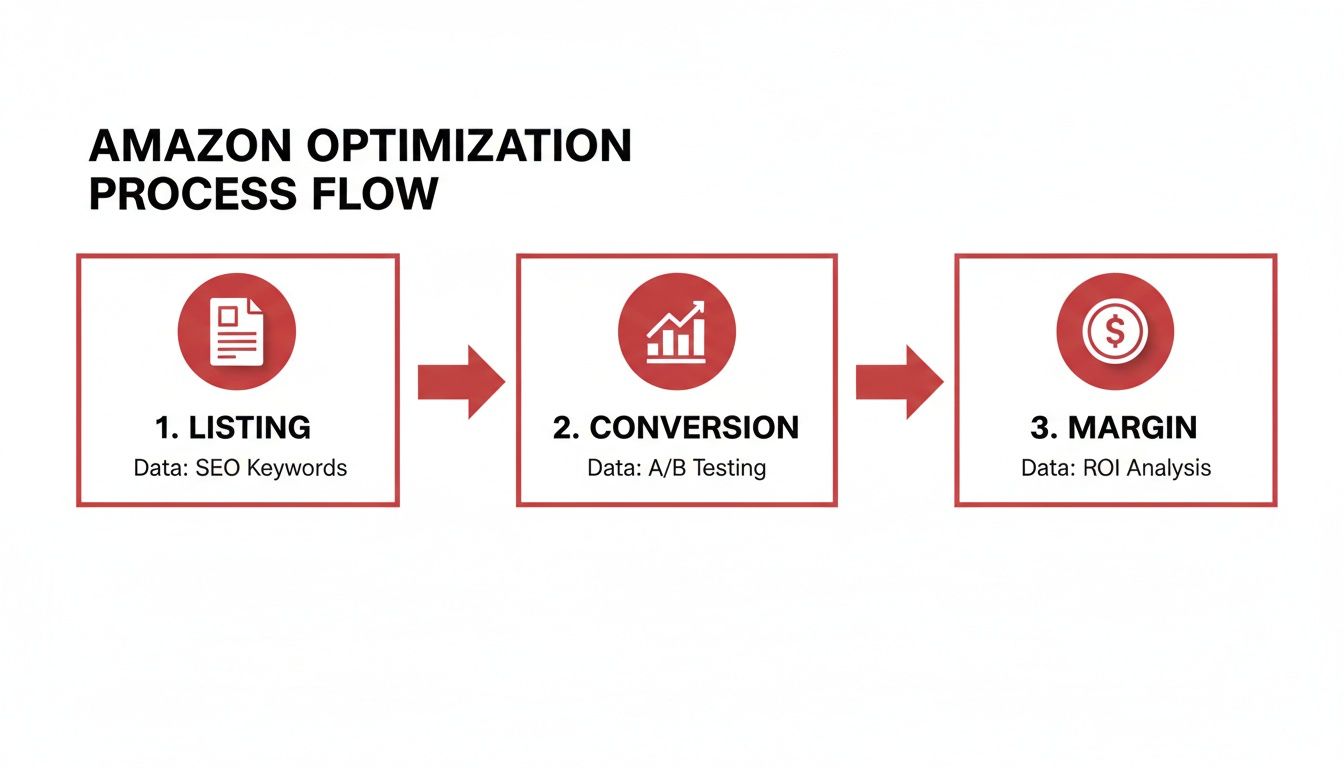
It’s a clear path: a better listing drives higher conversion, which in turn protects and grows your margin on every unit sold.
Every component of your listing has a job, and that job is always tied to a financial outcome. Your title must secure the click. Your images need to answer questions visually. Your bullet points have to overcome purchase objections.
When these elements work together, they drive up your Unit Session Percentage Rate (your conversion rate), which is the single most important metric for organic ranking on Amazon.
A higher conversion rate tells Amazon's A10 algorithm that your product satisfies customer intent. This signal is far more powerful than raw traffic, leading to better organic placement and a lower reliance on paid advertising, which directly improves your break-even ACOS.
For instance, listings with A+ Content see conversion rates improve by 3-10%. For a brand doing $1M in annual sales with a 15% contribution margin, a 5% conversion lift doesn't just mean more top-line revenue; it means an additional $7,500 in pure contribution margin falls to the bottom line, assuming the traffic was already paid for.
| Listing Element | Primary KPI Impact | Secondary Margin Impact |
|---|---|---|
| Title | Click-Through Rate (CTR) | Lowers Customer Acquisition Cost (CAC) through higher organic visibility. |
| Main Image | Session Conversion Rate | Reduces return rates by setting accurate visual expectations for customers. |
| Bullet Points | Unit Session Percentage | Increases Average Order Value (AOV) by effectively cross-selling features. |
| A+ Content | Conversion Rate & Traffic | Decreases ad dependency and Ad Cost of Sale (ACoS) by improving organic rank. |
| Backend Keywords | Organic Impressions | Improves inventory velocity by capturing long-tail, high-intent search traffic. |
Optimizing these elements isn't just about making the page look good; it’s about making strategic improvements that strengthen your financial health on the platform. This process starts inside your primary dashboard. For a complete walkthrough of the platform where this work happens, check out our guide on what Amazon Seller Central is and how to use it. Mastering this foundation is non-negotiable for building a profitable brand on the marketplace.
Let's move from theory to where the rubber meets the road: your title and bullet points. Think of these not as just keyword fields, but as high-speed sales copy. They have to work in seconds, especially on a cramped mobile screen. Get this wrong, and you're bleeding sales before a customer even scrolls.
The challenge is balancing what the algorithm needs and what a human wants to read. Your title is your #1 tool for getting indexed and earning the click. Your bullets are there to crush objections and seal the deal. Both have a direct line to your conversion rate—the engine that drives organic rank and gets you off the paid ads treadmill.
Forget stuffing every keyword you can think of into your title. Amazon's algorithm, now smarter with systems like Rufus AI, cares more about relevance and customer experience than keyword density. A title that reads like a machine-generated mess will tank your click-through rate.
You need a structured, front-loaded formula built for shoppers on phones. Most will only see the first 60-80 characters before the rest gets cut off. That's your prime real estate.
Here’s a battle-tested title structure that works in CPG: [Brand Name] [Product Name], [Key Benefit/Use Case] - [Key Feature/Ingredient], [Pack Size/Count]
Let's see this in action:
Protein Bars High Protein Snacks Gluten Free Healthy Snacks Chocolate Peanut Butter 12 Count
Kodiak Peak Protein Bars, 20g Protein Keto Snack for Post-Workout Recovery - Gluten-Free Chocolate Peanut Butter, 12 Count (Pack of 1)
The second one is stronger because it leads with the brand and product type, immediately calls out the main benefit (20g Protein Keto Snack), and ties it to a real-world use (Post-Workout Recovery). It serves the algorithm and speaks directly to a person.
Get your highest-intent keywords into those first 80 characters. Ask yourself: what does a customer need to know to click? It’s almost always the brand, what it is, its main purpose, and how many they get. Everything else is secondary.
Your bullet points are your chance to have a conversation with the customer's inner voice. They're asking, "Is this for me? Will it actually solve my problem? Is it worth the money?" Each bullet needs to be a mini sales pitch, not a dry list of specs.
The secret is to lead with the benefit, then back it up with the feature.
See the difference? We've reframed a simple fact into a solution for a real problem. Here’s a framework to build out your five bullet points:
This is a core part of the Optimization phase of our growth framework. You’re taking your foundational assets and sharpening the message to squeeze every last drop of performance out of them, turning clicks into profitable sales.
On Amazon, your visuals are your packaging, your in-store display, and your best salesperson. Customers can't touch or feel your product, so your images and A+ Content have to do all the heavy lifting. Get this wrong, and you'll see it in your return rates and conversion metrics almost immediately.
Your title and bullets earned the click, but your visuals close the sale. They need to answer questions, build trust, and create a connection in seconds. For CPG brands, this is where you show the texture of your protein bar or the quality of ingredients in your sauce.
This is a fundamental step in the Optimization phase. You're refining the core assets that have the biggest impact on a customer's decision to add your product to their cart, which directly drives your unit velocity and, ultimately, your profitability.
Most brands upload a few basic product shots and call it a day. This is a massive missed opportunity. A complete image stack is designed to preemptively answer customer questions and overcome objections, which boosts conversion and cuts down on costly returns.
Your first seven image slots should be treated like a strategic narrative. Here’s a checklist of the visual assets that are non-negotiable for a high-converting listing.
| Image Type (Slot) | Purpose | Key Elements |
|---|---|---|
| Slot 1: The Hero Image | To grab attention in search results and represent the product clearly. | Pure white background, high-resolution, product-only. No text, no badges. Instantly recognizable. |
| Slot 2-3: The Infographics | To communicate key benefits and features quickly. | Bold text overlays calling out USPs like "20g Plant-Based Protein" or "USDA Organic Certified". Must be mobile-friendly. |
| Slot 4: The Lifestyle Shot | To help customers visualize the product in their own lives. | Show your product in a real-world context, like someone enjoying your snack on a hike or using your cleaning spray in a kitchen. |
| Slot 5: The Comparison Chart | To show your product's superiority over competitors. | A clear, side-by-side comparison with 1-2 key competitors or other items in your line. Highlight your advantages. |
| Slot 6: The Trust-Builder | To build brand trust and justify a premium price. | A "How It's Made" or sourcing story image. Highlight quality ingredients or a unique manufacturing process. |
| Slot 7: The Scale Shot | To manage expectations and reduce returns. | Show the product next to a common object for scale, or lay out exactly "what's in the box." This prevents "smaller than expected" complaints. |
The impact of getting visuals right is measurable. High-resolution, multi-angle shots can improve click-through rates by 12-15% and conversions by 8%, simply because shoppers can inspect what they're buying.
A+ Content is your chance to tell a compelling brand story, but many brands waste it on beautiful but useless marketing fluff. Effective A+ Content isn't a brochure; it's a conversion tool designed to handle a customer's final objections.
The primary goal of A+ Content isn't to look pretty—it's to reduce friction in the buying process. Use modules to handle objections, clarify use cases, and reinforce the value proposition you established in your bullet points and images.
Think of it as an extension of your customer service team. What are the top three questions you get about this product? Build a module that answers them head-on. Use comparison charts to clearly differentiate products in your line and encourage trade-ups or bundle purchases.
Don't just talk about when your company was founded in the Brand Story module. Connect your mission to the product. If you're an all-natural snack brand, show your commitment to sourcing with pictures from the farm. If you want to create engaging visual content without a massive budget, you can use an AI product video generator to produce compelling videos.
For a deeper operational dive, explore our guide on product photography for Amazon. It breaks down the technical and strategic requirements for building an image stack that drives sales.
Most of the heavy lifting in Amazon listing optimization happens where customers never see it: the backend. Your title and images might close the sale, but it's your backend keywords and product attributes that get you found in the first place. Neglecting this is like building a perfect retail store with no roads leading to it.
This is a fundamental part of the Foundation stage. Before you can optimize customer-facing elements, you have to ensure Amazon's A10 algorithm knows exactly what your product is, who it’s for, and when to show it. Clean, complete backend data is the bedrock of discoverability.

Too many sellers think "backend keywords" just means the "Search Terms" field. That's an incomplete view. The algorithm pulls from every single data field you populate—from Subject Matter to Intended Use—to figure out relevance. Leaving these fields blank is willingly giving up organic visibility.
The goal isn't keyword stuffing; it's feeding structured data to the algorithm. A big part of this involves finding the best keywords for SEO to ensure your products show up where they should. Your strategy needs to cover:
Remember, you have under 250 bytes in the search terms field. Don’t waste space with commas, repeating words, or anything already in your title or bullets. Use other attribute fields for everything else.
Amazon’s algorithm is getting smarter. With the move toward advanced systems and the Rufus AI assistant, old-school keyword stuffing is dead. The system now prioritizes understanding the meaning and intent behind a search, not just matching keywords.
The algorithm is no longer just matching words; it's understanding concepts. Your job is to feed it clean, structured data so it can accurately connect your product to a customer's underlying problem.
This isn't just about showing up in main search results. It’s about qualifying for filtered navigation on the left-hand sidebar. When a customer filters by "Diet Type: Vegan," your product will only appear if you’ve filled out that backend field. Every blank field is a lost sale.
"Data governance" sounds intimidating, but for an operator, it's just a disciplined process. Make this a non-negotiable step in your new item setup (NIS) workflow.
This disciplined approach ensures your products are indexed correctly. For operators managing hundreds of SKUs, this is a huge competitive edge. To dive deeper, our guide on Amazon's most searched keywords provides a structured approach to research.
Aggressive Amazon listing optimisation is a double-edged sword. While core to building a profitable channel, the relentless pursuit of perfection comes with operational trade-offs that many brands underestimate. The pressure to rank higher, faster, can easily lead to reactive decisions that quietly bleed your bottom line.
The most common mistake is chasing high-volume, broad keywords without regard for conversion. Jamming "healthy snacks" into the title of your niche, keto-friendly protein bar will drive traffic, but most of those shoppers won't convert because their intent doesn't match your product.
This tanks your unit session percentage, signaling to Amazon that your product isn't relevant for that search. The result? Your organic rank drops, and you waste ad spend, compressing your contribution margin on every sale. A better strategy is to focus on long-tail, high-intent keywords like "keto protein bar for hiking" where traffic is lower but conversion rates are significantly higher, protecting your margin.
Another huge risk is making constant, knee-jerk changes. Brands get fixated on daily rank fluctuations, tweaking titles or images every few days. This frantic activity prevents the A10 algorithm from gathering any stable, long-term performance data, effectively resetting your progress.
Amazon’s algorithm needs time to index changes and measure customer response. Constant adjustments create noise. Implement changes, let them run for at least 30-45 days, and then measure the impact on metrics like conversion rate, organic impressions, and ACOS.
One of the toughest trade-offs is balancing branded messaging and direct-response, conversion-focused copy. Your marketing team wants to weave a beautiful brand story, but the marketplace demands clear, scannable information that solves a problem in three seconds.
Too much brand fluff in your title pushes critical information below the fold on mobile, killing conversion. A purely functional, keyword-stuffed listing feels generic and gives no reason to pay a premium.
The solution is to give each piece of content a specific job:
In the rush to optimise, brands often make unsubstantiated claims. Using words like "cures," "prevents," or making unverified health claims is a fast track to a listing suppression or account suspension. For example, a supplement brand claiming its product "improves sleep by 50%" without clinical data is a major compliance violation. It's much safer to stick to compliant, benefit-oriented language like "Promotes Restful Sleep."
The risk of losing your entire sales channel over an exaggerated claim is not worth the perceived conversion lift. Effective Amazon listing optimisation always operates within the guardrails of compliance.
Getting your Amazon listing optimized is a huge win, but it’s not the finish line. Think of it as a dynamic asset, not a static one you set and forget. The marketplace is always shifting—competitors tweak strategies, customer habits change, and Amazon’s algorithm is a moving target. If you treat optimization as a one-and-done project, you’re guaranteed to watch your gains fade away.
This is where the real work begins, shifting from a project mindset to a process mindset.
On Amazon, reviews are the ultimate social proof, with a direct impact on your conversion rate. A consistent flow of positive, recent reviews tells shoppers and the algorithm your product is a trustworthy choice. Getting them requires a disciplined and compliant process.
Your go-to tool is Amazon's "Request a Review" button, available for any order between 5 and 30 days after delivery. It’s the safest, most effective way to nudge customers for feedback.
For CPG brands, especially consumables, review velocity is everything.
Managing reviews is just as crucial. Check them daily, respond professionally to negative feedback, and mine the insights to improve your products and listing.
Pricing is one of the most powerful levers you can pull, but you must manage it with a laser focus on your contribution margin. Knee-jerk price cuts to chase the Buy Box or juice short-term sales can wreck your profitability.
Instead, think of promotions as strategic tools:
Your pricing strategy should never be reactive. It needs to be a deliberate tool tied to your inventory levels, marketing calendar, and margin targets. Don't launch a promotion without first calculating its exact impact on your per-unit profitability.
Finally, you have to validate every major change. In a scalable Amazon business, there’s no room for guesswork. Amazon’s "Manage Your Experiments" tool lets you A/B test your titles, main images, and A+ Content so you know for sure what works.
Use it to set up controlled tests that answer specific questions. For instance, does a lifestyle main image convert better than a product-focused infographic? Let the data decide.
Run experiments for at least four to six weeks for statistically significant data. And remember the golden rule: only change one variable at a time. This disciplined approach is the only way to confidently attribute performance boosts to the right change.
Optimizing an Amazon listing isn't a marketing task—it's a critical operational process that directly shapes your profitability. It demands a structured, data-driven playbook that goes far beyond creative copy and into the realm of disciplined execution.
By getting the fundamentals right—clear titles, compelling images, clean backend data, and constant measurement—you build the foundation for sustainable growth. This isn't about chasing short-term algorithm hacks or stuffing your listing with vanity keywords.
It’s about engineering a superior customer experience on the digital shelf—one that drives conversions, improves sales velocity, and strengthens your contribution margin. Every element, from your main image to the smallest backend attribute, is a lever that can either protect or erode your bottom line.
Our entire approach is built on a structured growth framework: first, establish a solid Foundation with clean data. Then, move into disciplined Optimization of your customer-facing assets. Only then have you earned the right to Amplify your reach. This methodical process ensures every dollar you invest into the channel delivers the highest possible return.
True scale on Amazon isn't bought with aggressive ad spend. It's built on a perfectly optimized listing that converts traffic with ruthless efficiency. This operational excellence is what separates top-tier CPG brands from everyone else.
If you're a CPG operator ready to move past generic advice and build a genuinely optimized presence on Amazon, the next step is a hard look at your channel economics and operational readiness.
At RedDog, we build growth strategies that put contribution margin first. If you’re a CPG founder or operator ready for a practical discussion about your marketplace performance, book a complimentary 30-minute strategy call. We’ll dive into your current listing performance, pinpoint key opportunities to improve your margins, and map out an actionable plan. This is a working session, not a sales pitch.
Leave a comment: