
Published: March 2020 | Last Updated:January 2026
© Copyright 2026, Reddog Consulting Group.

Before you can find the most searched keywords on Amazon, you have to understand its search engine. Amazon’s A10 algorithm is fundamentally different from Google—its sole purpose is to drive a sale, not just provide information. Grasping this core distinction is the first step to building a keyword strategy that delivers measurable results.
At RedDog Group, every omnichannel strategy begins with a solid Foundation. For Amazon, that foundation is a deep understanding of customer search intent. Someone typing "best running shoes" into Google is likely in research mode, looking for reviews and comparisons. On Amazon, that same search is a strong buying signal. The A10 algorithm is engineered to reward listings that perfectly match this transactional intent.
This is why a specific phrase like "hypoallergenic dog treats for small breeds" consistently outperforms a broad term like "dog food." That longer, more detailed search tells Amazon you have a shopper with a specific need who is ready to buy. The algorithm recognizes that specificity, matches it to listings with a proven sales history for similar terms, and boosts them to the top.
Think of the A10 algorithm as an efficient matchmaker connecting customers who are ready to buy now with the products most likely to convert them. It constantly analyzes a keyword's historical performance—click-through rates and, most importantly, conversion rates—to determine its commercial value. While high-volume, informational keywords might generate impressions, they won't drive the sales velocity that Amazon’s algorithm values most.
The data backs this up. A look at the most searched items on Amazon reveals a clear pattern: categories are dominated by shoppers with high purchase intent. For instance, electronics account for 24% of top searches, with "Kindle" leading at 2,313,297 searches in a single 30-day period. Close behind are "iPhone" with 2,154,928 searches and "Amazon Gift Card" with 1,578,436 searches—all products with an immediate transactional purpose.
The most successful brands on Amazon don't just rank for one or two keywords; they build a competitive advantage by owning entire keyword ecosystems. They understand that a customer's path to purchase involves multiple related searches, and they ensure their listings appear at every step.
To truly grasp how Amazon's algorithm prioritizes commercial queries, it's useful to compare it with Google's approach.
This table breaks down the fundamental differences in user behavior and algorithmic priorities between these two dominant platforms.
| Factor | Amazon (A10 Algorithm) | Google (Search Algorithm) |
|---|---|---|
| Primary Goal | Facilitate an immediate transaction | Provide the most relevant information |
| User Intent | Transactional & Commercial ("I want to buy") | Informational, Navigational, Commercial |
| Key Ranking Signals | Sales velocity, conversion rate, reviews, CTR | Relevance, authority, backlinks, user experience |
| Keyword Focus | Product-specific, long-tail, purchase-driven | Broad topics, questions, problem-solving |
| Content Priority | Optimized product listings (title, bullets, images) | High-quality articles, videos, web pages |
While Google aims to answer a world of questions, Amazon is laser-focused on converting a search into a sale. This is why your keyword strategy must be built around purchase-ready terms.
Winning at Amazon search means moving beyond a one-keyword-per-product mindset. The real goal is to map out a cluster of related terms a customer might use throughout their buying journey.
Let's return to our dog treat example. The keyword ecosystem could look like this:
hypoallergenic dog treats
grain free puppy training treats, sensitive stomach dog treats for yorkies
dog treats for skin allergies, low calorie treats for overweight dogs
When you integrate this entire ecosystem into your product listing—from the title and bullets to your backend search terms—you send a powerful signal to the A10 algorithm. You're demonstrating that your product is the most relevant, comprehensive solution for a wide range of transactional searches. This is a crucial step in building a resilient brand presence and a key part of how to effectively track Amazon rankings for omnichannel growth. This foundational work ensures your products don't just get seen—they get sold.
Finding keywords that drive revenue requires more than just typing ideas into Amazon's search bar. An effective strategy is a multi-layered process that blends different tools and perspectives to uncover the exact phrases your ideal customers use when they're ready to make a purchase.
Think like a detective. Start with the obvious clues—your own product—and then expand your search. Follow leads from competitors, analyze broader market trends, and listen for specific customer pain points. This approach helps you find not only the high-volume head terms but also the high-conversion long-tail keywords that your rivals are likely overlooking. This is the Optimization phase, where data informs action.
No single tool provides the full story. The most successful sellers build a "keyword toolkit," leveraging the unique strengths of different platforms to create a comprehensive list of opportunities.
A powerful combination typically includes:
Let's say you sell blenders. You could start by reverse-engineering the top five competing listings. This would likely yield obvious terms like "blender," "smoothie maker," and "kitchen blender." But digging deeper with search volume and trend analysis could uncover more specific, high-intent phrases like "personal blender for smoothies" or "quiet blender for apartments"—keywords that speak directly to a customer's specific needs.
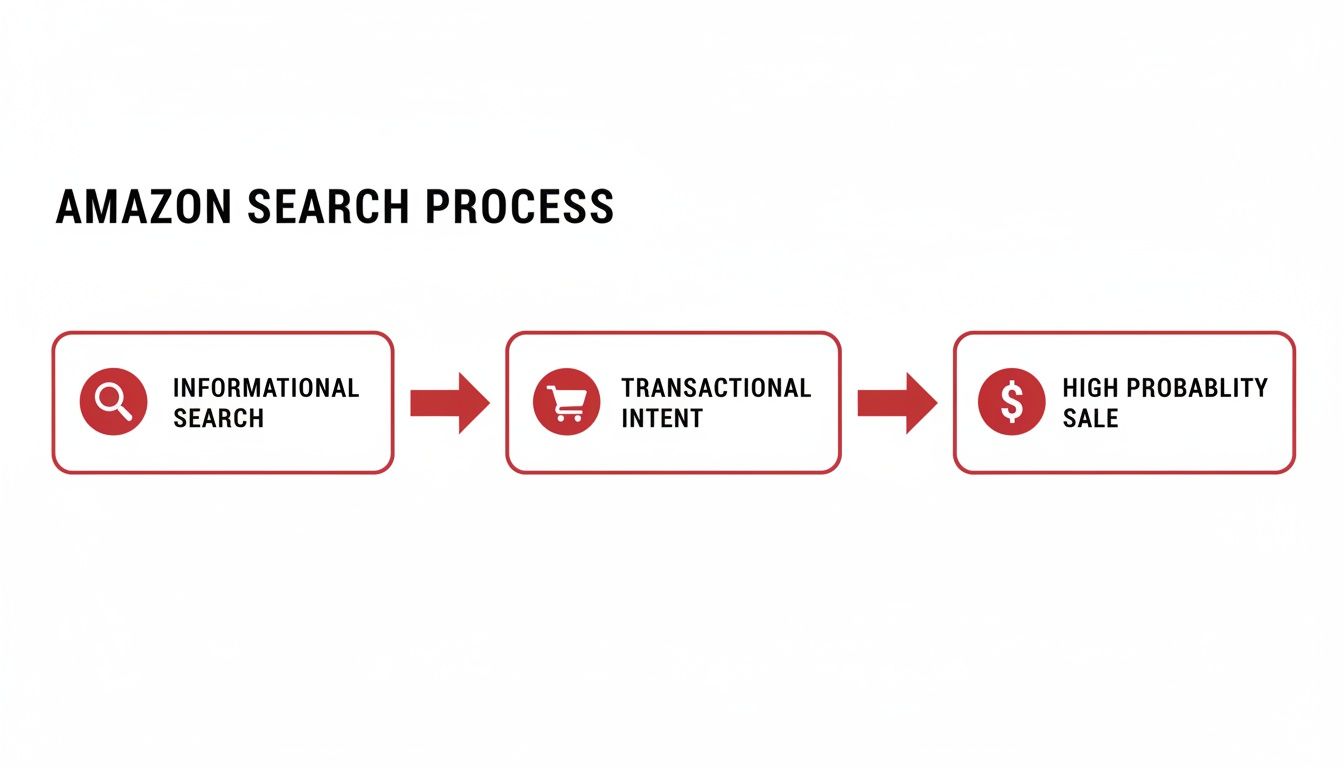
This process illustrates how a customer's search term becomes more specific as their intent to buy increases—a clear signal for you to convert them.
It's also clear that certain categories on Amazon have a massive, built-in audience with high purchase intent. While consumer electronics are always dominant, when it comes to raw search volume, "coffee" is the undisputed champion.
Recent data shows "coffee" generates over 16.6 million monthly searches on Amazon alone, leading to an average of 4,500 units sold per month. This staggering volume reflects its universal appeal and consistent, year-round demand.
Building your keyword list isn't a one-time task; it's an ongoing process. Your goal is to create a dynamic library of terms that reflects how real people shop, adapting as trends and seasons change.
Once you have a solid list of potential keywords, the real work of Optimization begins. You need to analyze and prioritize them based on three core factors: relevance, search volume, and competition. A keyword might have massive search volume, but if it isn't highly relevant to your product, the traffic it generates will never convert.
Understanding your competitive landscape is a crucial part of this. To get a deeper look into this process, you can learn more about how to find competitors of a website. This big-picture view ensures you are strategically positioning your product where it has the highest probability of winning the sale.
You've put in the work and found a goldmine of high-intent keywords. Now comes the part that drives revenue: integrating those terms into your listing.
This is where you turn raw data into a compelling sales pitch that satisfies both the A10 algorithm and the real shopper you're trying to win over. It's a careful blend of technical SEO and persuasive copywriting.
Simply stuffing keywords everywhere won't work and can even harm your ranking. Each element of your listing has a specific purpose. You're not just trying to get seen; you're trying to convince a customer that your product is exactly what they were searching for.

Think of your product listing as a direct conversation with your customer. The title is your introduction, the bullet points are your sales pitch, and the backend terms cover all the niche searches. Every element must contribute.
Let's break down where to place your keywords for maximum impact.
Your most important keyword must be in your title. This is non-negotiable.
The A10 algorithm gives immense weight to the terms used here, and it’s the first thing a customer reads to determine relevance. Place your top keyword—the one with the highest search volume and clearest intent—right at the beginning.
For instance, a title starting with "Grain-Free Salmon Dog Treats" instantly connects with a high-value search. A vague title like "Premium Paws Natural Snacks" forces the algorithm and the shopper to guess, and neither has time for that.
Your five bullet points are where you bring your long-tail keywords to life. This is your opportunity to directly answer the questions embedded in those more specific search queries.
If your research identified "hypoallergenic dog treats for small breeds," one of your bullets should speak directly to that customer.
PERFECT FOR SENSITIVE STOMACHS – Our grain-free formula is specifically designed as **hypoallergenic dog treats for small breeds**, using limited ingredients to prevent allergic reactions and support digestive health.
This not only helps you rank for that specific term but also shows a shopper with a specific problem that you have the solution.
The best listings use bullet points to translate product features into customer benefits, embedding keywords naturally within persuasive copy. You’re not just listing specs; you’re solving problems.
For a deeper dive into crafting every part of your product detail page, it's helpful to explore expert advice on how to optimize Amazon listings for maximum impact.
While your title and bullets do the heavy lifting, A+ Content and backend search terms are your secret weapons. They allow you to expand your keyword reach without making your main copy sound robotic.
Amazon may state that A+ Content isn't directly indexed for ranking, but its text and image alt-text absolutely contribute to contextual relevance.
Use this space to visually demonstrate your product’s benefits and include related, semantic keywords. If you sell a blender, your A+ modules can discuss "making green smoothies" or "crushing ice for cocktails," capturing shoppers who aren't searching for your primary keyword. This gives Amazon a richer understanding of your product's use cases.
The backend search term field is a 250-byte space for all the keywords you couldn't fit naturally into your title and bullets. This is the place for:
thermos, flask, insulated bottle
thermis, thermoses
botella de agua
gym water bottle, hiking flask
The strategy here is efficiency. Do not repeat keywords from your title or bullets. Don't use commas or punctuation—just single spaces. The goal is to cast the widest net possible without sacrificing the readability of your customer-facing content.
Putting this all together requires a clear plan. The table below breaks down where to place your keywords for maximum impact, a core concept in our guide on how to optimize Amazon product listings.
Here's a simple framework to guide where different types of keywords should live within your listing. This structure ensures you're optimizing for both the algorithm and your customers.
| Listing Section | Keyword Type | Strategic Purpose | Example (for a blender) |
|---|---|---|---|
| Title | Primary Keyword | Maximum SEO weight; immediate relevance | "High-Speed Personal Blender for Smoothies" |
| Bullet Points | Long-Tail & Feature Keywords | Answer specific questions; detail benefits | "Powerful ice crushing blender for frozen drinks" |
| A+ Content | Thematic & LSI Keywords | Build contextual relevance; tell a story | Text about "healthy breakfast shakes" and "protein shake mixer" |
| Backend Terms | Synonyms, Misspellings | Capture all search variations without stuffing | blendor smothie maker nutribullet juicer |
By systematically placing your keywords across every available field, you build a powerful, fully optimized listing. This is how you go from just having a list of the most searched keywords on Amazon to converting that traffic into consistent, measurable revenue.
An effective keyword strategy is the engine that powers both your organic Optimization and your paid advertising. This is the Amplification stage, where your meticulous keyword research becomes the blueprint for your Pay-Per-Click (PPC) campaigns.
The goal is to create a flywheel effect: your ads drive initial traffic and sales, which in turn signals to Amazon's algorithm to boost your organic ranking for those same keywords, creating an integrated growth loop.
This isn't just about spending on ads; it's about investing strategically to turn every dollar of ad spend into a predictable driver of brand growth. When campaigns are built on solid keyword data, you can operate with a precision that maximizes your budget and accelerates your presence on the digital shelf.
A common mistake is cramming all keywords into one large, disorganized campaign. A smarter approach is to build tightly themed ad groups that mirror specific customer intent, separating high-volume head terms from long-tail phrases that are ready to convert.
Consider a brand selling camping gear. Instead of a single "tents" campaign, a more strategic structure would be:
2 person tent. This casts a wide net to drive brand awareness and general traffic. Your ACoS (Advertising Cost of Sale) might be higher, but the objective is visibility.waterproof tent for heavy rain. This captures shoppers who know their problem and are actively comparing options. These keywords typically have lower search volume but a much higher conversion rate.Coleman Sundome 2 person tent (assuming that's your product) with an exact match campaign. This ad speaks directly to a customer who has already done their research and is ready to buy.This targeted structure allows you to set different bids and budgets based on traffic value. You can bid aggressively on high-intent, long-tail keywords while keeping a tighter rein on broader, exploratory terms. That’s how you lower your overall ACoS and maximize the performance of your ad spend.
A disciplined PPC structure turns advertising from an expense into an investment. By aligning ad groups with customer intent, you create a system that not only sells products but also generates valuable data to fuel your entire omnichannel strategy.
While manual campaigns offer precision, Automatic campaigns are your secret weapon for continuous keyword discovery. Think of them as an automated research assistant.
When you launch an Auto campaign, Amazon’s algorithm scans your listing and shows your ad to shoppers using search terms it deems relevant. The resulting Search Term Report is a goldmine, revealing the exact, real-world phrases customers are using to find and buy your product—terms you might have never discovered on your own.
This creates a powerful feedback loop:
lightweight backpacking tent for solo hiker is driving sales.This cycle of discovery and optimization ensures your keyword strategy remains dynamic. You're constantly feeding both your organic and paid efforts with fresh, customer-validated data, which is critical for building a resilient brand on Amazon.
For a deeper dive, explore our complete guide to Amazon advertising strategies to boost sales and visibility. By combining a smart PPC structure with an always-on discovery process, you’ll amplify your reach and create a sustainable flywheel for growth.
To truly dominate your category on Amazon, you must move beyond individual keywords and start thinking in clusters. This is where professionals gain an edge. Keyword cluster analysis involves grouping related search terms to uncover what customers actually want and how they think. It’s the difference between merely showing up in search and building a brand that is impossible to ignore.
When you map the entire ecosystem of terms a shopper uses, you can anticipate their needs and stay ahead of the curve. This insight transforms a good keyword strategy into a great one, providing a playbook for everything from product bundles to A+ Content.

This approach delivers a deeper level of market intelligence. You’re not just finding keywords; you're mapping the customer’s entire buying journey and identifying the related products and accessories they'll need along the way.
Let's make this practical. Imagine a brand selling a drip coffee maker. They might focus all their resources on ranking for "drip coffee maker." While a decent starting point, a cluster analysis reveals a much larger, more profitable picture.
Shoppers searching for a coffee maker are also looking for:
reusable coffee filter: A necessary accessory for daily use.coffee bean grinder: An essential tool for a fresh coffee experience.airtight coffee canister: A product that solves the related problem of keeping beans fresh.descaling solution for coffee makers: A maintenance item required for long-term ownership.This group of keywords tells a complete story. It reveals the entire "coffee corner" ecosystem that customers are trying to build. This knowledge is a strategic asset.
Once you've mapped out a keyword cluster, the opportunities for brand growth multiply. This is where research becomes real-world tactics that drive sales and improve the integration between your online and offline channels.
Here’s how to turn that insight into action:
This is how you transition from being just another product on a digital shelf to becoming a brand that truly understands its customers.
Keyword clusters reveal the "what's next" in a customer's mind. By understanding these relationships, you stop reacting to search trends and start anticipating them, building a brand that feels indispensable.
Recent Amazon search data highlights the power of these patterns. Among two-word phrases, "gift card" is a common component, appearing in 616 different keyword variations and accounting for 6.30% of all tracked two-word clusters. Similarly, terms like "3d printer" and "picture frame" each anchor 359 unique combinations, proving how one core product can become the center of an entire universe of related searches. You can discover more insights about these keyword patterns to identify other trends.
Navigating Amazon keywords can seem complex, but a few core principles can guide your strategy. Here are concise, practical answers to the questions we hear most often from brands aiming to turn search data into measurable growth.
Keyword optimization is a continuous process, not a one-time task. We recommend conducting a full audit of your listing's keywords at least once per quarter.
However, you should be analyzing your PPC Search Term Reports weekly. This is where you'll uncover new, high-converting phrases that actual customers are using to find products like yours.
Seasonal shifts are another critical trigger for a refresh. If you sell outdoor gear, you need to pivot from "winter camping essentials" to "summer hiking gear" well before the seasons change. Staying ahead of these trends is how you capture early search traffic.
Treat your keyword strategy as a living document. Regular updates ensure your listings are aligned with how customers are searching right now, not six months ago. This is the key to maintaining relevance and driving consistent sales.
Targeting a competitor's brand name in your backend keywords or PPC campaigns can be an effective—though aggressive—tactic. It provides a direct line to shoppers already considering a purchase, giving you an opportunity to win the sale.
However, this approach requires a clear competitive advantage. Are you more affordable? Do you offer superior features? Are your reviews better? Without a compelling reason for a shopper to switch, you risk a low conversion rate and a high ACoS, ultimately wasting your budget.
Understanding match types is essential for managing your PPC budget and is a cornerstone of the Amplification phase. Each type tells Amazon how broadly to apply your keyword.
By strategically using all three match types in your campaigns, you can control costs while continuing to discover new, profitable Amazon most searched keywords.
Ready to turn keyword research into a powerful growth engine for your brand? The team at RedDog Group builds data-driven strategies that connect every channel and deliver measurable results. Let's Talk Growth.
Leave a comment: