
Published: March 2020 | Last Updated:October 2026
© Copyright 2026, Reddog Consulting Group.

Ranking and conversion gains don't automatically create profitable growth. A listing can attract more shoppers, win more orders, and still damage the business if fulfillment costs, advertising spend, returns, pricing, or inventory pressure consume the contribution margin.
Strong Amazon listing best practices start with Foundation. That means accurate catalog data, compliant claims, clear product positioning, dependable images, and a price that works with the actual unit economics. Optimization comes next, with better customer-facing copy, search coverage, review feedback, and structured testing. Amplification comes last, using advertising, promotional planning, pricing adjustments, and demand generation only when the product can support the added volume.
Amazon measures listing performance at the ASIN level through Unit Session Percentage, found in Business Reports under Detail Page Sales and Traffic by ASIN. Amazon's own guidance emphasizes readable titles, clear images, concise bullets, and relevant keywords, because the product page is where traffic becomes a purchase decision. Amazon listing guidance and tools such as a Trendlytic listing creator can help with execution, but neither replaces margin review, compliance control, or inventory planning.
The practical framework below connects every listing decision to conversion, contribution margin, inventory velocity, and operational risk. It also shows where brands should slow down rather than automatically add more ads or more content.
Backend keywords should expand search coverage without making the visible listing harder to read. These manufacturer search terms and related fields aren't visible to customers, so they're useful for relevant variants, regional language, use-case descriptors, and common misspellings that would make front-end copy feel forced.
A functional beverage, for example, might map terms around natural energy, clean energy drinks, no-crash use cases, and regional wording. A premium snack bar could distinguish dietary intent from general snack intent, while a face wash may need separate coverage for sensitive skin, oil control, and cleanser-related searches. The important distinction is relevance. A larger keyword field filled with generic words such as “product,” “item,” or “best” creates noise rather than qualified demand.
Start with the search terms customers use in Advertising Console reports, reviews, customer questions, and category research. Group terms by intent, such as product type, problem solved, audience, ingredient, format, and use occasion. Then place the strongest terms in the title and bullets where they support comprehension, and use backend fields for useful variants that don't deserve visible repetition.
Keep the field concise and review it regularly. Seasonal language, new use cases, and emerging category vocabulary can change the search mix, but irrelevant additions can dilute the catalog signal.
Practical rule: Backend keywords should fill genuine relevance gaps, not compensate for a weak title or unclear product promise.
Review search-term performance alongside Unit Session Percentage and contribution margin. A keyword that produces sessions but attracts shoppers who won't accept the price or format may increase traffic without improving the business. The Amazon keyword research process should therefore connect search coverage to conversion quality, not rankings alone.
Images do more than decorate a product page. They answer the questions that copy often can't answer quickly: What does the package look like in hand? How large is the product? What does the texture look like? How is it used? What exactly arrives in the box?
For a beverage, a useful sequence might begin with a clean hero image, then show the can from another angle, a close-up of an important claim, the nutrition panel, and a real consumption occasion. A protein snack can use detail photography to communicate texture and portion expectations. Skincare buyers may need to see the texture, packaging, application context, and realistic use rather than a polished brand image alone.
The first images carry the most responsibility because shoppers may decide whether to continue before reading the full listing. Make the opening images independently useful on mobile. One should establish the product, another should explain the principal benefit, and another should reduce a common objection such as size, ingredients, preparation, or application.
Use overlays sparingly and keep claims accurate. A crowded graphic can hide the product and create compliance exposure. Supporting images should also match the actual product, packaging, quantity, and variant. Misleading scale or overly polished lifestyle photography can increase returns when the delivered item doesn't match the shopper's expectation.
A useful image set doesn't need the most expensive production. It needs clear information in the right order. The Amazon product photography guidance is most valuable when it's applied to a specific conversion problem, not used as a generic creative brief.

Bullets are compressed sales and merchandising space. They work best when each one helps a shopper answer a specific question, rather than when they repeat ingredients or list disconnected features.
A functional beverage shouldn't lead only with its caffeine content. It should explain the customer outcome first, then support that outcome with the formulation and serving context. A snack bar can connect its nutritional profile to a use occasion such as commuting or post-workout eating. A cleanser can lead with the skin concern it addresses, then clarify texture, ingredients, testing, and who should use it.
Amazon guidance emphasizes readable titles, concise bullets, clear images, and relevant keywords as part of a product page built for both discoverability and conversion. Amazon's product-page recommendations support an integrated approach, where search terms and shopper comprehension reinforce each other.
A practical hierarchy is benefit, supporting feature, specificity, use case, then reassurance. This prevents the common failure mode where every bullet starts with a technical attribute and leaves the shopper to interpret why it matters.
Keep the visible copy scannable. Longer education belongs in the description or A+ Content. Quantified claims can improve clarity, but only when they're accurate, substantiated, and permitted for the category. A compelling bullet that creates regulatory or review risk is not an optimization win.

Price is both a conversion lever and a financial control. Lowering it may increase order velocity, but it can also reduce contribution dollars, create reference-price problems, and put pressure on replenishment. Raising it can protect margin while reducing sessions or slowing rank. Neither direction is automatically correct.
Model three scenarios before changing a core ASIN: volume capture, margin protection, and balanced pricing. For each scenario, include product cost, fulfillment, referral fees, advertising, promotions, returns, and expected inventory velocity. The right price is the one that produces an acceptable contribution margin at a realistic rate of sale, not the one that generates the most units in isolation.
Amazon changed FBA inbound placement service fees effective January 15, 2026, increasing standard-size product fees by an average of $0.05 per unit and adding shipping-weight bands for small standard and large standard items. The fee is assessed 45 days after shipment receipt and varies by size tier, shipping weight, and inbound locations, according to Amazon's FBA fee guidance.
That change may look small at unit level, but it matters when a CPG brand has thin contribution margin or high inbound volume. Recalculate the floor price using actual Seller Central fees, then coordinate price tests with promotions and inventory. A discount that clears aging stock may be sensible. A permanent price cut that trains customers to wait for promotions usually needs stronger justification.
Reviews are a product and operations feedback system, not just a social-proof layer. A sudden increase in complaints about leakage, taste, texture, sizing, packaging, or irritation often points to a supplier, formulation, packaging, or expectation problem. Editing the listing without fixing the cause may improve conversion briefly and worsen the customer experience later.
Monitor new review flow and sentiment by SKU, variation, and time period. Look for repeated language in lower-rated reviews, then compare it with return reasons, customer service contacts, and fulfillment notes. A snack brand that sees repeated complaints about bar texture may need to investigate storage conditions or formulation. A skincare brand may discover that shoppers misunderstand product strength or application frequency.
Post-purchase review requests should follow Amazon's rules and must not include incentives or pressure for positive sentiment. Seller replies should be empathetic and solution-focused, but a public response isn't a substitute for root-cause work. If a supplier change creates a quality issue, the operational response matters more than a new headline.
Review trends also influence the content roadmap. Repeated questions belong in bullets, images, or A+ Content. Repeated complaints belong in product development, packaging, quality control, or inventory handling. Listing optimization thus becomes a cross-functional operating process rather than a copywriting task.
Customer sentiment is useful only when someone owns the corrective action.
A disciplined team reviews sentiment alongside conversion, return rate, and contribution margin. More orders from a product with unresolved quality issues can increase costs faster than it increases profit.
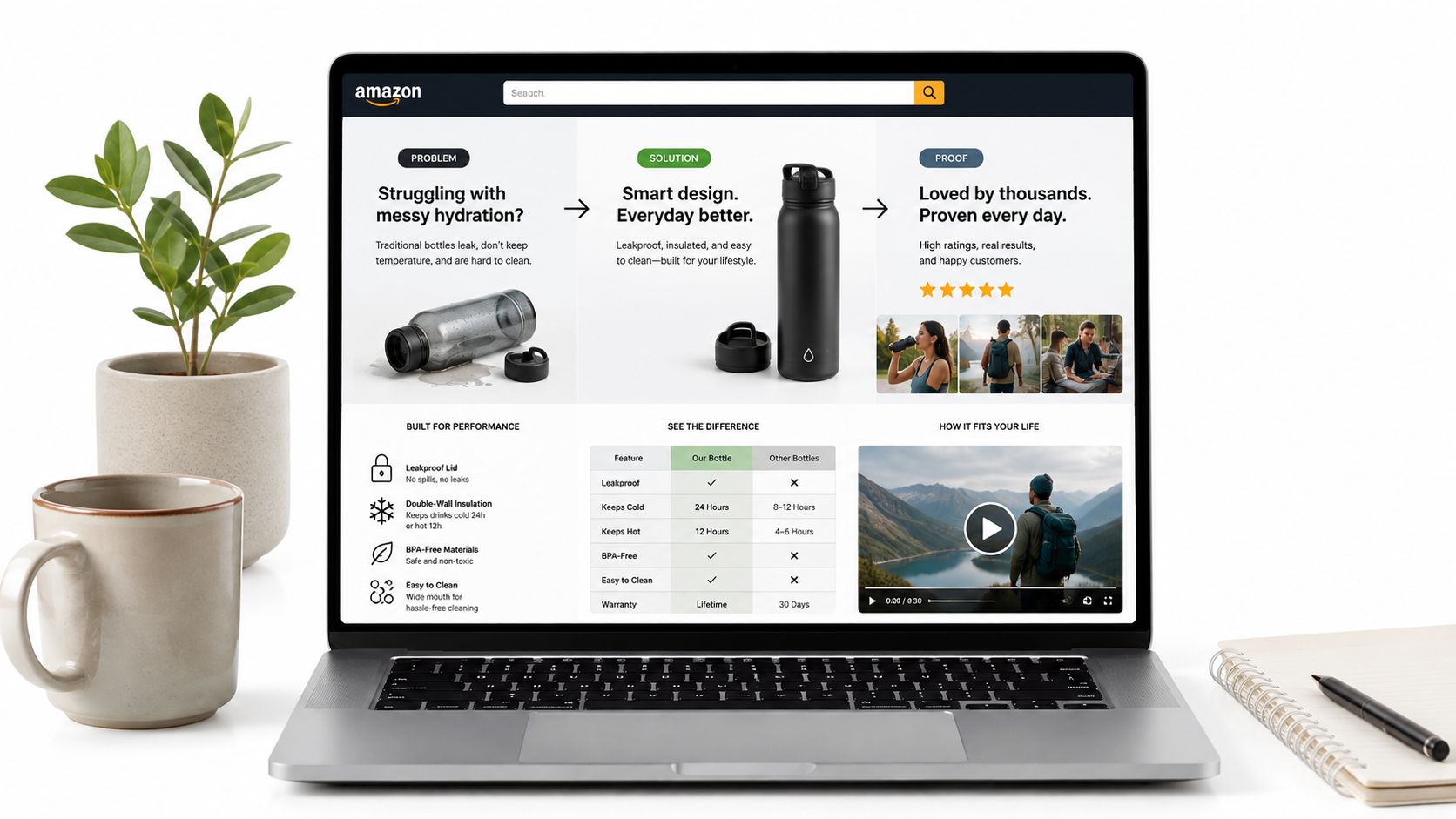
A+ Content gives Brand Registered sellers additional space for images, text, comparisons, and structured product education. The strongest modules act like a short buying guide. They explain the customer problem, show the product in use, provide credible proof, clarify differentiation, and help the shopper choose the right format or variation.
A functional beverage can use A+ Content to explain when the product fits into a daily routine. A snack brand can compare flavors, formats, or nutritional attributes without forcing every detail into the bullets. A skincare brand can explain application order, expected product feel, and the difference between related products.
Amazon states that adding A+ Content can increase sales by an average of 5.6%, and industry coverage cites an Amazon statement reporting a 3% to 10% conversion-rate lift from A+ Content. Amazon's listing guidance also notes that more than 60% of Amazon product searches now happen on mobile, which makes concise modules and front-loaded visual communication especially important.
Start with four- and five-star reviews to identify the benefits customers already understand, then use lower-rated reviews to identify objections. Keep the module sequence focused on decisions rather than company history. A comparison chart should help customers select the right SKU, not make unsupported competitor claims.
A+ Content can't rescue an uncompetitive price, poor availability, or a product that generates returns. It should enter the roadmap after the listing foundation is accurate and the main conversion blockers are known. That keeps creative investment tied to a measurable commercial problem.
A low ACOS target can damage a listing if it restricts profitable demand or leaves inventory idle. Set advertising targets from contribution margin first, then adjust them for category conditions, SKU role, and growth objectives.
Amazon defines ACOS as ad spend divided by ad revenue, multiplied by 100, and states that ACOS must remain below profit margin to maintain profit. Amazon's ACOS explanation supports the basic rule, but the target still has to reflect the product's actual economics.
A product selling for $10 with $3 in contribution margin before advertising has a break-even ACOS of 30%. An ad cost of $3 consumes the full contribution margin. The complete calculation appears in our guide to how to calculate ACOS. At 40% ACOS, the product loses $1 per attributed sale, unless repeat purchases or a defined launch objective justify that investment.
Set targets by SKU, campaign type, and business objective. A branded campaign that protects existing demand should not use the same efficiency standard as a discovery campaign for a new product. Sponsored Products, Sponsored Brands, and retargeting may also serve different stages of the customer journey.
Reserve a defined share of contribution margin for sustainable advertising. Increase that share only when inventory, repeat purchase, cash flow, and replenishment capacity support it. A higher-converting listing may justify more spend, but first confirm that stock can support the added velocity, the current landed margin remains accurate, and incremental demand will not trigger costly replenishment or competitive price pressure.
The strongest account may appear less aggressive. It funds profitable demand, while treating rank-building spend as a documented investment with a clear limit, review point, and commercial rationale.
Repricing can protect Buy Box participation, but aggressive automation can also destabilize a CPG brand's price architecture. A product that changes price sharply in response to every competitor move may win a short-term placement while weakening customer trust, retailer relationships, and internal forecasting.
CPG pricing also has an offline context. Amazon customers may compare the same brand with a grocery, specialty, wholesale, or direct-to-consumer offer. A repricer that ignores those channels can create visible inconsistencies. It may also respond to a temporary competitor stockout by pushing price higher, only to reverse direction when that seller returns.
Every automated rule should include a contribution-margin floor, a stock position, and a clear competitive boundary. Core SKUs that establish the brand's price perception often deserve manual or conservative management. Peripheral or highly competitive SKUs may justify more automation, provided the rules don't permit disruptive swings.
Inventory planning must sit inside the repricing conversation. If supply is tight, a higher price may slow velocity and protect availability. If excess inventory is approaching its practical selling window, a controlled promotion may be better than leaving an automated system to make isolated decisions.
External market monitoring can help teams understand competitor movement, but ecommerce scraping tools don't replace judgment. Use competitive data as context, then decide based on margin, channel agreements, inventory, and the role of the ASIN in the portfolio.
A Buy Box win isn't useful if it trains the customer to distrust the price or leaves the order unprofitable.
Amazon listing changes should be treated as operating experiments. Change one major variable at a time, record the launch date, document promotions and stock conditions, and define the decision rule before the test begins. Otherwise, teams tend to credit the newest change for every movement in sales.
For an image test, keep the title, bullets, price, advertising structure, and availability stable where possible. For a bullet test, identify the customer objection the new wording is intended to resolve. For pricing or A+ Content, allow enough time for the marketplace to settle before drawing a conclusion. The exact window depends on traffic, category, seasonality, and the size of the change.
Track sessions, Unit Session Percentage, ordered revenue, contribution dollars, ACOS, return signals, review sentiment, and inventory velocity together. A conversion improvement that comes from a deep discount may not be a sustainable win. A lower ACOS that results from cutting profitable discovery campaigns may also be a false improvement.
Use similar unchanged SKUs as directional controls when possible. They won't create a perfect experiment, but they can reveal whether a category-wide promotion or seasonal shift affected the result. Keep a change log that records who approved the change, what customer problem it addresses, and whether the listing remains compliant.
A sensible launch cadence follows the Foundation, Optimization, Amplification sequence. Fix data and compliance first, test customer-facing content next, then scale paid demand after the numbers support it.
Listing work compounds when the parts reinforce one another. Accurate attributes help shoppers find the item. Clear images and bullets improve understanding. A credible price supports conversion. Reviews reveal product problems. A+ Content handles objections. Advertising creates more qualified traffic. But every improvement carries a trade-off that operators need to price into the plan.
The most common mistake is scaling demand before the product is operationally ready. More advertising can accelerate a stockout. A stronger claim can increase attention while increasing compliance exposure. A lower price can improve conversion while reducing the cash available for replenishment. A more polished image can create returns if it overstates size, texture, or product experience.
Use a practical sequence:
Amazon guidance also emphasizes catalog completeness, accurate product information, and category-specific formatting. The Amazon Product Detail Page guide is useful for checking the structured data that visible copy can't replace.
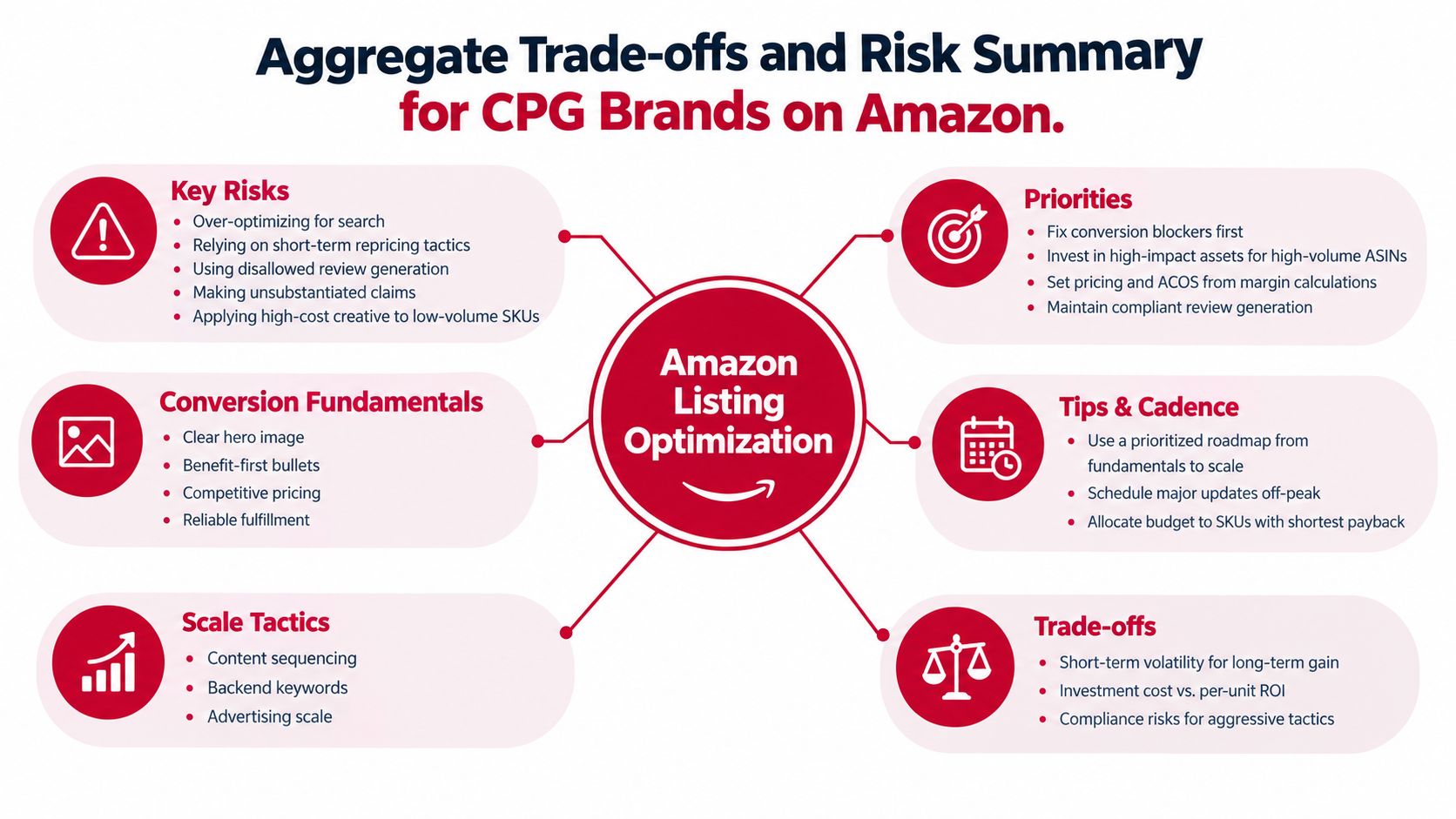
Allocate creative and operational resources to SKUs where the expected payback is clear. Schedule major updates away from critical peaks when possible, change one major element at a time, and keep compliance review involved before publication.
| Strategy / Practice | 🔄 Implementation Complexity | ⚡ Resource Requirements | ⭐📊 Expected Outcomes | 💡 Ideal Use Cases | ⭐ Key Advantages |
|---|---|---|---|---|---|
| Backend Keyword Strategy and Density Optimization | Medium 🔄, ongoing research & monitoring | Low–Medium ⚡, keyword tools + analyst time | ⭐⭐⭐ 📊 Increases long-tail organic reach; gradual rank improvements | 💡 New ASINs, niche/long-tail targets, brand defense | ⭐ Captures intent without front-end clutter; low penalty risk |
| High-Resolution Image Sequencing and Angle Coverage | High 🔄, professional shoots + sequencing | High ⚡, photography, retouch, lifestyle production | ⭐⭐⭐⭐ 📊 Significant conversion lift; reduced returns | 💡 Premium CPG, tactile/visual products, mobile-first categories | ⭐ Improves CTR & conversion; reusable across channels |
| Bullet Point Copy Hierarchy and Benefit-First Messaging | Low–Medium 🔄, copywriting + iterative tests | Low ⚡, copywriter + analytics | ⭐⭐⭐ 📊 8–12% conversion uplift typical; fewer customer queries | 💡 Listings needing clarity; mobile scannability priorities | ⭐ Fast, low-cost edits that improve conversion and reduce CS volume |
| Pricing Strategy Alignment with Category Penetration & Margin Targets | High 🔄, modeling, coordination, testing | Medium ⚡, finance modeling, reporting tools | ⭐⭐⭐⭐ 📊 Direct impact on margin & sales velocity; rapid signals | 💡 Launch pricing, margin-sensitive SKUs, competitive categories | ⭐ Optimizes contribution margin and ACOS alignment |
| Review Velocity and Sentiment Monitoring | Medium 🔄, compliant outreach & analysis | Medium ⚡, CX ops, monitoring tools | ⭐⭐⭐ 📊 Rank & conversion gains over weeks; actionable product insight | 💡 New products, quality remediation, competitive monitoring | ⭐ Builds trust and surfaces product improvement opportunities |
| A+ Content Development and Enhanced Brand Content | High 🔄, design + brand registry coordination | High ⚡, designers, copywriters, possible agency costs | ⭐⭐⭐⭐ 📊 15–25% conversion uplift when well-executed | 💡 High-volume ASINs needing storytelling/differentiation | ⭐ Long-form persuasion; reduces returns and supports premium positioning |
| Advertising ACOS Target Setting Based on Margin & Category Dynamics | Medium 🔄, financial calc + campaign management | Low–Medium ⚡, analytics + campaign managers | ⭐⭐⭐ 📊 Better ad profitability and allocation; informed growth decisions | 💡 Active ad programs; margin-aware growth phases | ⭐ Aligns ad spend to margin, prevents unprofitable scaling |
| Repricing and Dynamic Pricing Risks and Best Practices | Medium 🔄, ruleset design & monitoring | Low–Medium ⚡, repricer tools + policy controls | ⚡📊 Quick buy-box responses but risk rank volatility and customer distrust | 💡 Peripheral SKUs, short-term competitive defense; avoid for core SKUs | ⭐ Automates price reactions; preserves margin floors if conservative |
| Testing, Measurement and Launch Cadence Best Practices | Medium 🔄, disciplined single-variable tests | Low ⚡, analytics, coordination | ⭐⭐⭐ 📊 Faster, more reliable learnings; reduced attribution noise | 💡 Any listing optimization; high-traffic SKUs for signal strength | ⭐ Improves decision quality and reduces harmful regressions |
| Aggregate Trade-offs and Risk Summary for CPG Brands on Amazon | Medium 🔄, strategic prioritization & governance | Low–Medium ⚡, roadmap planning, cross-functional alignment | ⭐⭐⭐ 📊 Holistic prioritization; balances short-term volatility vs long-term ROI | 💡 Portfolio-level planning; resource allocation across SKUs | ⭐ Provides a prioritized roadmap: fix fundamentals first, scale wisely |
Amazon listing best practices work when they're managed as a commercial system rather than a sequence of isolated content tasks. Foundation work establishes the conditions for profitable selling. It includes accurate titles, bullets, images, attributes, backend terms, compliant claims, reliable fulfillment assumptions, and a price that reflects current costs. If these inputs are wrong, advertising and enhanced content only send more shoppers into a leaky funnel.
Optimization should then focus on the customer decision. Use search terms and reviews to understand what shoppers want to know. Reorder images around the questions that block purchase. Rewrite bullets around benefits and objections. Use A+ Content to explain the product's use, differentiation, and fit without making unsupported claims. Test changes with documented windows and compare conversion against contribution dollars, returns, and inventory velocity.
Amplification belongs after those fundamentals. Advertising can increase demand, but ACOS must be evaluated against contribution margin. Promotions can accelerate sell-through, but they should have a defined commercial purpose. Repricing can protect competitiveness, but it needs margin floors and channel awareness. Review requests can support trust, but they must remain compliant and connected to product-quality work.
Fulfillment costs also need to stay in the model. Amazon's FBA inbound placement changes show why historical assumptions can become unreliable. For brands selling across marketplaces, Walmart introduces a different cost structure. Walmart Fulfillment Services charges storage at $0.75 per cubic foot per month from January through September, then charges $0.75 per cubic foot per month for the first 30 days from October through December, with an additional $1.50 per cubic foot per month for items stored longer than 30 days. Walmart's WFS fee schedule makes the inventory-aging risk visible.
Walmart's fulfillment pricing also uses unit weight for items up to 150 pounds, with rates starting at $3.45 for units at or below 1 pound and formulas such as $5.75 plus $0.40 per pound over 4 pounds for products in the 4 to 20 pound band. Walmart Marketplace pricing shows why packaging, bundle size, and product weight can materially change contribution margin across channels.
That is the operating discipline behind Foundation, Optimization, and Amplification. Resolve content, pricing, fulfillment, inventory, and compliance blockers first. Test improvements with defined measurement windows. Scale demand only when the product can absorb it profitably.
Qualified CPG founders and operators can book a free 30-minute strategy call with RedDog Group for a working session focused on marketplace margin, listing performance, or growth planning. The session is intended to review the operating problem, not deliver a sales pitch.
Reddog Consulting Group helps CPG brands connect Amazon listing decisions with pricing, marketplace performance, inventory velocity, and contribution margin. Visit Reddog Consulting Group to discuss a focused working session for your listing and channel-growth priorities.
Leave a comment: