
Published: March 2020 | Last Updated:November 2025
© Copyright 2026, Reddog Consulting Group.

Pricing on Amazon isn't about being the cheapest; it's about being the smartest. Slashing prices might get you a quick sale, but it's a race to the bottom that erodes brand value and profit margins. The real goal is to build an intelligent pricing strategy that drives both sales velocity and healthy profits—the essential foundation for any brand serious about long-term growth on the platform.
On Amazon, your price is far more than just a number. It’s a powerful signal that communicates your brand’s quality, directly influences your search ranking, and is a critical factor in winning the all-important Buy Box. A well-designed pricing strategy is the cornerstone of our Foundation → Optimization → Amplification framework, ensuring every decision supports measurable, sustainable growth.
The marketplace is intensely competitive. Amazon itself, which captured a staggering 37.6% of the US e-commerce market in 2023, is proof that a data-obsessed approach to pricing leads to dominance. They didn't get there by guessing; they achieved it with sophisticated algorithms and vast historical data. To compete effectively, sellers must be just as strategic.
Too many sellers view pricing defensively, as a reaction to competitors. This is a missed opportunity. Instead, you should see it as a flexible, proactive tool to achieve specific business goals.
At the core of any effective pricing strategy is solid data. This means implementing robust pricing intelligence strategies to monitor competitors, market trends, and your own performance metrics. You can't make smart decisions in the dark.
The goal is not just to win the sale today but to build a profitable and scalable business for tomorrow. Smart pricing protects your margins, funds your marketing efforts, and fuels your growth across all channels.
To help you get started, we've outlined the core pricing strategies in a quick-reference table. Use it to identify which approach aligns best with your business needs. Afterward, we’ll explore each one in detail.
Here's a concise overview of the primary pricing models on Amazon. Think of this as your cheat sheet for matching the right strategy to your products and business objectives.
| Strategy Type | Primary Goal | Best For |
|---|---|---|
| Cost-Plus | Ensure a consistent profit margin on every sale. | Sellers with predictable costs and unique products. |
| Competitive | Win the Buy Box and position against key competitors. | Resellers in highly saturated, price-sensitive categories. |
| Value-Based | Maximize price based on perceived customer value. | Private label brands with strong differentiation and brand equity. |
| Dynamic/Repricing | Automate price adjustments to react to the market 24/7. | Sellers with large catalogs in fast-moving, competitive markets. |
| MAP/Retailer Rules | Maintain brand value and retail partner relationships. | Brands selling through multiple online and offline channels. |
| Psychological | Influence customer perception and purchase behavior. | Almost any seller looking to boost conversion rates. |
Each of these strategies serves a distinct purpose. The most successful brands often blend elements from several to create a flexible and profitable pricing framework.
Before you can build a winning plan, you need to understand the tools at your disposal. Pricing on Amazon is not a one-size-fits-all game. The right model depends entirely on your product, brand positioning, and strategic goals. Selecting the right approach is the first practical step toward building a pricing foundation that supports sustainable growth.
Let's break down the six most critical pricing models. Think of these not as dry definitions, but as different plays in your brand's growth playbook. Each one is designed for a specific scenario, and mastering them gives you the flexibility to adapt to nearly any market condition.
This concept map illustrates how connected profitable pricing is to your brand, inventory, and even sales channels outside of Amazon.
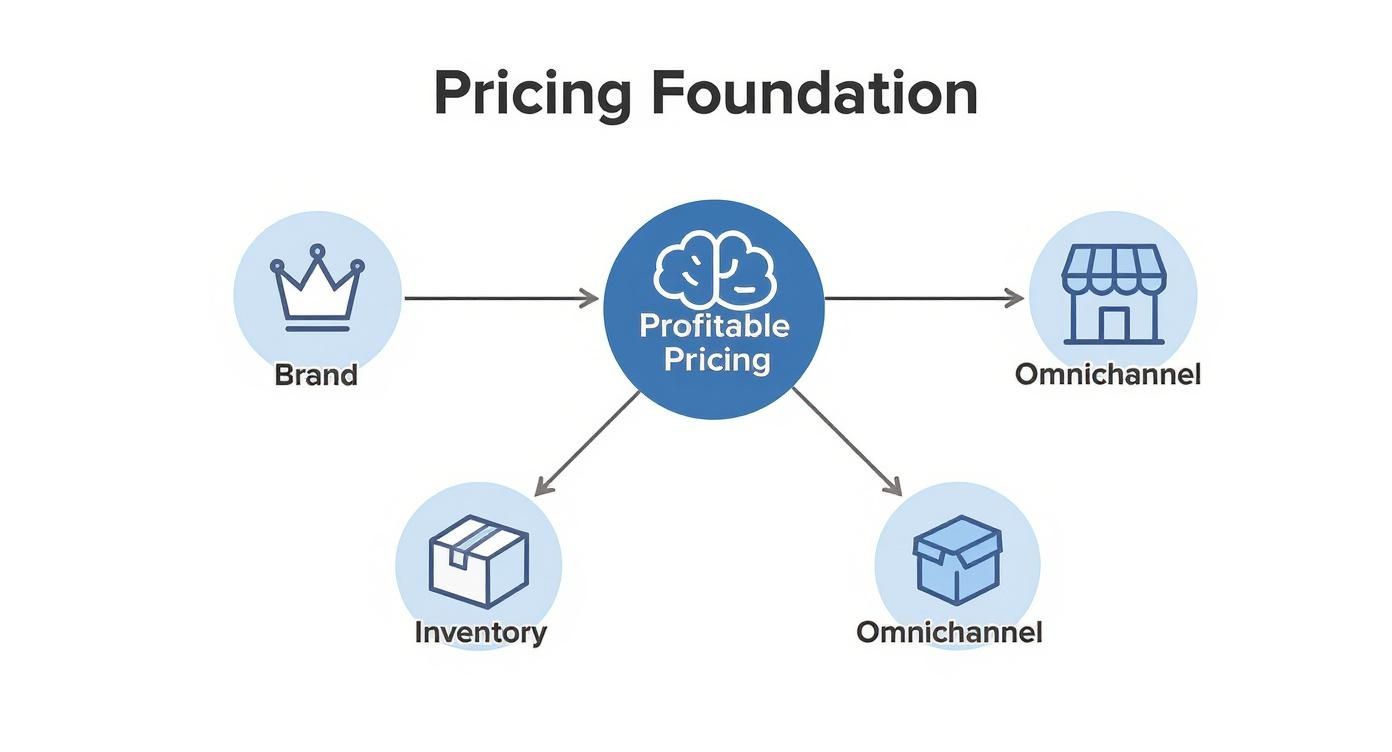
As you can see, pricing isn't an isolated decision made in a vacuum. It’s the central hub that influences—and is influenced by—every part of your retail operation, both online and offline.
First up is Cost-Plus Pricing, the most straightforward approach. You simply calculate your total cost per unit—including manufacturing, shipping, FBA fees, and ad spend—and then add a fixed percentage or dollar amount on top. This sets your profitability baseline, guaranteeing you achieve a specific margin on every sale.
This method is ideal for private label brands or sellers with unique products where direct competition is minimal. It’s your financial safety net, ensuring you never sell at a loss.
On the other hand, Competitive Pricing is all about positioning your product against others on a crowded digital shelf. With this strategy, you set your price based on what key competitors charge for similar items. The goal is often to win the Buy Box by pricing at, slightly below, or even slightly above the competition, depending on factors like your seller metrics and fulfillment method. This is the go-to strategy for most resellers in saturated categories.
Value-Based Pricing shifts the focus from your costs or competitors to your customer. Here, the price is determined by the perceived value your product delivers. A premium brand with excellent reviews, compelling A+ Content, and strong brand recognition can command a higher price because customers believe it’s worth more.
This strategy works exceptionally well for differentiated brands that have invested in building a strong reputation and a unique value proposition.
Your price tells a story about your brand. Value-based pricing ensures that story is about quality and customer benefit, not just being the cheapest option on the page.
Then there’s Dynamic Pricing, which leverages automation and speed, typically powered by repricing software. It uses algorithms to make thousands of micro-adjustments to your price based on real-time market data. The software reacts 24/7 to competitor actions, inventory levels, sales velocity, and Buy Box ownership—a task no human could manage. This is essential for sellers with large catalogs in fast-moving markets where manual adjustments are impractical.
For brands that sell through multiple channels, MAP-Compliant Pricing is non-negotiable. MAP, or Minimum Advertised Price, is a policy set by a brand to prevent resellers from advertising a product below a certain price. Adhering to MAP protects your brand's perceived value and maintains healthy relationships with brick-and-mortar retail partners, which is critical for omnichannel growth.
Finally, we have Psychological Pricing, which taps into human behavior to influence purchase decisions. This isn’t about drastic price cuts, but about making subtle changes that make a price feel more attractive.
These small tweaks can have a surprisingly large impact on conversion rates without requiring you to sacrifice your core margin. The real power comes from combining these strategies to build a plan that is both profitable and highly adaptable.
While foundational strategies set your floor, dynamic pricing is where modern brands gain their competitive edge. It's the single most powerful tool for reacting to the market in real time. Instead of making manual price changes once a day or week, this approach uses automated software to make thousands of tiny adjustments around the clock.
Think of an automated repricer as your personal algorithmic trader for Amazon. It constantly watches the market, tracking competitor prices, monitoring inventory levels, and analyzing who owns the Buy Box. Based on the rules you set, it executes price adjustments to capitalize on opportunities 24/7—a velocity no human team can match.
This isn't about blindly slashing prices. It's about smart, controlled automation that works toward your business goals, protecting margins while maximizing sales velocity.
When exploring repricing tools, you'll find two main types: rule-based and AI-powered. Understanding the difference is key to choosing the right one for your business.
A rule-based repricer follows simple, direct "if-then" commands you create. For example: "If an FBA competitor with a 95%+ seller rating has the Buy Box, set my price $0.01 below theirs, but never drop below my floor price of $19.95." This approach gives you direct, granular control over every pricing action.
An AI-powered repricer, in contrast, uses machine learning to analyze vast datasets and make more predictive decisions. It goes beyond what competitors are doing right now to identify patterns in sales velocity, demand, and profitability. Its goal is to find the "sweet spot"—the highest possible price that can still win the Buy Box without leaving margin on the table.
The best Amazon pricing strategies use automation not just for speed, but for intelligence. The goal is to let technology handle the tedious adjustments so you can focus on the bigger picture of brand growth and profitability.
To make either strategy work, you need a constant stream of real-time competitive data. For those interested in the technical side, you can learn more about Scraping Amazon Product Prices. This data is the fuel that runs the entire repricing engine.
The biggest fear sellers have with automation is that it will trigger a price war, dragging profits down until no one makes money. It’s a valid concern, but it’s completely avoidable with the right safeguards. The focus must be on profit-driven repricing, not just winning the Buy Box at any cost.
Here are the essential rules to protect your margins:
This level of automation is what you’re competing against. Amazon’s own dynamic pricing algorithm is one of the most advanced in the world, capable of updating prices every 10 minutes by analyzing over 2.5 million variables. Adopting an equally smart, data-driven approach isn't optional—it's essential for any seller who wants to scale.
A brilliant strategy is just a good idea on paper. The real value is created when you bring it to life, and that means translating your pricing plan into action and then obsessively tracking the data to measure its impact.
This is where theory becomes practice. You move from simply setting prices to actively managing them for growth, transforming educated guesses into a repeatable, data-driven process.
The first step is to stop guessing and start knowing. You must understand every single cost that impacts your revenue. You cannot possibly price for profit if you don't have a crystal-clear picture of your true margin on every SKU.
Profitability on Amazon is about much more than your cost of goods. The platform has a complex web of fees that will quietly erode your margins if you aren't tracking them meticulously.
A small miscalculation can turn what looks like a winning product into a loss leader. Before you set a price, you need a complete accounting of every expense tied to that unit.
Your all-in cost per unit must include:
Once you have this number, you’ve found your breakeven point. This is your absolute price floor. Anything lower, and you're paying customers to take your product. This figure is the bedrock of your entire pricing strategy.
With your cost foundation solid, it's time to measure what matters. While sales volume and revenue look great on a chart, they don't tell the whole story.
A high-revenue product could be barely breaking even, while a lower-volume item might be a major profit driver. The right Key Performance Indicators (KPIs) provide a complete picture of your pricing strategy's health and its impact on your business.
A winning pricing strategy isn't just about driving sales; it's about driving profitable sales. The right KPIs keep your eyes on the metrics that directly impact your bottom line and long-term brand health.
Tracking these numbers creates a real-time feedback loop. You see the immediate impact of your pricing decisions, allowing you to fine-tune your approach on the fly instead of waiting for a quarterly report to discover a problem.
Here are the essential KPIs to track when evaluating your Amazon pricing strategies. Monitoring these weekly is a practical way to spot trends before they become issues.
| Metric | What It Measures | Why It Matters |
|---|---|---|
| Buy Box Percentage | The percentage of time your offer is featured in the Buy Box when customers view the product page. | This is the king of Amazon metrics. A higher percentage directly translates to more sales and is the ultimate test of your price competitiveness and account health. |
| Session Conversion Rate | The percentage of shoppers who buy after visiting your product page (Orders ÷ Sessions). | This shows how effective your price and listing are at turning browsers into buyers. A sudden drop may indicate your price is out of sync with perceived value. |
| Gross Margin | The percentage of revenue left after subtracting all associated costs. | This is your true profitability metric. It ensures your pricing strategy is delivering healthy margins, not just empty revenue. |
| Unit Session Percentage | The number of units sold for every 100 sessions on your product detail page. | Often more insightful than conversion rate, this clarifies how many items are purchased per visit, which is crucial for products bought in multiples. |
Consistently watching these KPIs creates a powerful cycle of improvement. You can test a price change, observe its effect on your Buy Box win rate and conversion for a week, and then decide with confidence whether to keep it or pivot. This is what active, intelligent price management looks like.

Here's a critical truth: your Amazon pricing strategy is never just about Amazon. Every price change on the platform sends ripples across your entire business, influencing your direct-to-consumer (DTC) website, your relationships with brick-and-mortar partners, and overall brand perception.
This is the Amplification phase. It’s where you move beyond simply setting prices on one channel and start aligning your Amazon strategy to boost your brand’s value and drive integrated growth everywhere you sell.
A disconnected approach creates channel conflict. If a customer sees your product for $25 on Amazon but finds it for $35 on your website, you aren’t just losing a DTC sale. You’re training them to see your site as the more expensive, less favorable option. Over time, this erodes trust and can permanently damage your brand equity.
The goal is to transform your channels from competitors into a unified growth engine. Your Amazon presence should complement your other channels, not cannibalize them.
Price parity means keeping your pricing consistent for the same product across all sales channels. It sounds simple, but it requires discipline, especially when the Amazon marketplace constantly pressures you to lower prices to remain competitive.
Ignoring parity is a fast track to serious business challenges. Retail partners may drop your products if they feel you're constantly undercutting them on Amazon. Meanwhile, building a loyal customer base on your own website becomes nearly impossible if everyone knows they can get a better deal elsewhere.
So, how do you create this harmony?
A smart omnichannel strategy means the customer gets a seamless brand experience. Whether they’re scrolling on Amazon, browsing your website, or walking into a physical store, the messaging and pricing should feel consistent and trustworthy.
Instead of seeing Amazon as a competitor to your other channels, view it as your brand’s most powerful discovery and data-gathering tool. The insights you gain from Amazon can directly fuel and improve your entire business strategy.
This integrated approach is the foundation of a resilient brand. For sellers looking to build this kind of synergy, our omnichannel retail strategy guide offers a deeper framework for driving sales across every single touchpoint.
Amazon is also a fantastic, low-risk testing ground. Before rolling out a new product line across your entire retail network, you can test different price points on Amazon to gauge demand and find the optimal price. The data you get back—on conversion rates, customer feedback, and price sensitivity—is invaluable for making smarter decisions on your DTC site and with wholesale partners.
Ultimately, a strong amplification strategy ensures every pricing move on Amazon is a strategic one that supports your brand's long-term health. It transforms your Amazon store from a siloed sales channel into the powerful core of a thriving, interconnected retail ecosystem.
Navigating Amazon's pricing landscape requires vigilance. One wrong step, and even a well-designed strategy can send profits tumbling. Common traps can quickly unravel your hard work and damage your brand.
One of the biggest mistakes sellers make is having a narrow view of costs. It’s easy to focus only on the cost of goods, but on Amazon, that’s just the beginning. FBA fees, storage costs, referral commissions, and ad spend are all chipping away at your margins. Without careful tracking, a product that looks profitable on paper can actually lose you money on every sale.
Another classic pitfall is getting drawn into a race to the bottom. When a competitor drops their price, the gut reaction is to undercut them. But this almost always triggers a price war where the only winner is the customer. Meanwhile, you and your competitors watch your profits evaporate.
Automated repricers are powerful tools, but they aren't a "set it and forget it" solution. Treating them as such is a recipe for disaster. If not configured correctly and monitored regularly, they can drive your prices straight to your minimum floor and leave them there. You might win the Buy Box, but you'll be sacrificing every cent of potential profit to do so.
The purpose of automation is to make intelligent optimizations, not just blind reactions. Your repricer should be an extension of your strategy, always seeking the highest possible price that still secures the sale.
This means you need to review your rules, adjust your price floors and ceilings, and ensure the automation is serving your larger business goals—like protecting your brand's value across all sales channels.
Finally, many sellers overlook how their pricing decisions affect their overall account health. Amazon's algorithms are sensitive to what they perceive as pricing errors. A sudden, drastic price change—even for a legitimate flash sale—can trigger a Potential High Pricing Error.
When that happens, your listing gets suppressed, and your sales grind to a halt until you fix it. A simple mistake can cost you days of revenue and kill your product's ranking momentum. It's crucial to keep a close eye on your Account Health Dashboard for these alerts.
Similarly, while aggressive discounts are effective for boosting sales, they must be managed with precision. The data is clear: as discounts increase, so do sales. This is supported by a statistical analysis of over 166,000 product samples, which you can explore in this full research paper on discount effectiveness. However, you must balance these promotions against your margin goals to ensure you’re driving profitable growth, not just empty revenue.
Even with a solid plan, questions about Amazon pricing will inevitably arise. The marketplace moves at lightning speed, and what worked last month might not be effective today. Here are straightforward answers to the questions we hear most often from sellers.
The honest answer is: it depends on the competitive intensity of your product category.
If you’re in a highly competitive space battling for the Buy Box, using an automated repricer is almost a necessity. These tools can make adjustments multiple times a day to keep you competitive. On the other hand, if you're selling a private label product with less direct competition, weekly or bi-weekly manual adjustments in response to market shifts might be sufficient.
The key is to be proactive and let data guide your frequency, rather than reacting only when sales dip.
A poorly configured repricer absolutely can. It can tank prices faster than you can react. But a smart, profit-driven repricing strategy is designed to do the opposite.
Modern tools allow you to set a non-negotiable floor price to ensure you never sell at a loss. More importantly, you can build sophisticated rules like pricing slightly above the lowest competitor or automatically raising your price the moment a competitor goes out of stock.
The goal isn't to be the cheapest seller on the platform—it's intelligent, profitable repricing. Smart automation works to find the highest price you can achieve while still winning the sale.
It has a massive impact. Modern shoppers are experts at comparing prices online. If you're selling a product for significantly less on Amazon than on your own DTC site, you are training your customers to devalue your primary sales channel. You're effectively cannibalizing your own higher-margin sales.
Maintaining price parity is essential for building a healthy, trustworthy omnichannel brand. Your Amazon data is a goldmine for planning promotions across all channels, but you must avoid creating large, permanent price gaps. That inconsistency devalues your brand and can damage relationships with retail partners. Getting this alignment right is a critical part of scaling your brand's growth.
Navigating the complexities of omnichannel pricing is a challenge, and it helps to have a partner who has guided brands through it all. The team at RedDog Group has spent two decades turning pricing strategies into measurable, profitable growth for brands just like yours. Let's Talk Growth.
Leave a comment: