
Published: March 2020 | Last Updated:February 2026
© Copyright 2026, Reddog Consulting Group.

Revenue attribution is more than just marketing jargon—it’s an operational tool for measuring your contribution margin. It answers a simple, critical question: which marketing dollars are actually driving profitable sales, and which are just making noise? This isn't about chasing top-line growth; it's about connecting every ad dollar directly to your bottom line.
For a CPG operator wrestling with inventory pressure, fee compression, and channel trade-offs, revenue attribution isn't about marketing. It's about financial discipline.
Think of it like tracking your cost of goods sold (COGS). You’d never produce a product without knowing the exact cost of every ingredient, the packaging, and the labor. If you did, setting a profitable price would be guesswork.
Revenue attribution applies that same rigor to your marketing spend. It treats every touchpoint—a Google Ad, an Amazon DSP banner, an influencer post—as an "ingredient" in the final sale. The goal is to calculate the true cost to land that customer and determine if the sale actually improved your contribution margin.
Too many brands measure a channel's success by top-line revenue alone. They see a jump in Amazon sales after launching a new ad campaign and call it a win. But without proper attribution, you could be celebrating a victory that's quietly bleeding you dry.
For example, a Sponsored Products campaign with a high ACOS might drive impressive revenue, but once you factor in FBA fees, referral fees, and the ad spend itself, you could be looking at a negative contribution margin. Good attribution makes this painfully clear.
For an operator, the core function of revenue attribution is to protect margin. It forces you to stop asking "Did we make a sale?" and start asking, "Was that sale profitable after factoring in all acquisition costs?"
Let's say you sell a snack product across three channels: your DTC Shopify store, Amazon FBA, and Walmart Fulfillment Services (WFS). You’re running campaigns on Meta, Google, and Amazon's ad platform. Without attribution, your P&L might look decent, but you have no idea which levers to pull to grow profitably.
A solid attribution model could uncover insights like these:
Getting a handle on these dynamics is the difference between scaling profits and just scaling costs. This all starts by building a solid data Foundation, which allows you to properly Optimize your spend and later Amplify what's working. It’s a structured approach that moves you beyond guesswork. To get a better handle on your numbers, you can learn more about how to build a robust retail profit margin calculator.
Picking an attribution model is an operational decision, not just a marketing one. The model you choose directly shapes how you value each channel, which then dictates where your money goes. If you get it wrong, you’ll end up starving the channels that actually feed your business while pouring cash into the ones that only look good on paper.
To really get a handle on revenue attribution, it helps to first understand the bigger picture of marketing attribution. From there, we can dive into the practical models that CPG operators use to measure performance and protect their margins.
This flow chart shows the simple path from spending marketing dollars to making a profitable sale—the ultimate goal of any smart attribution strategy.
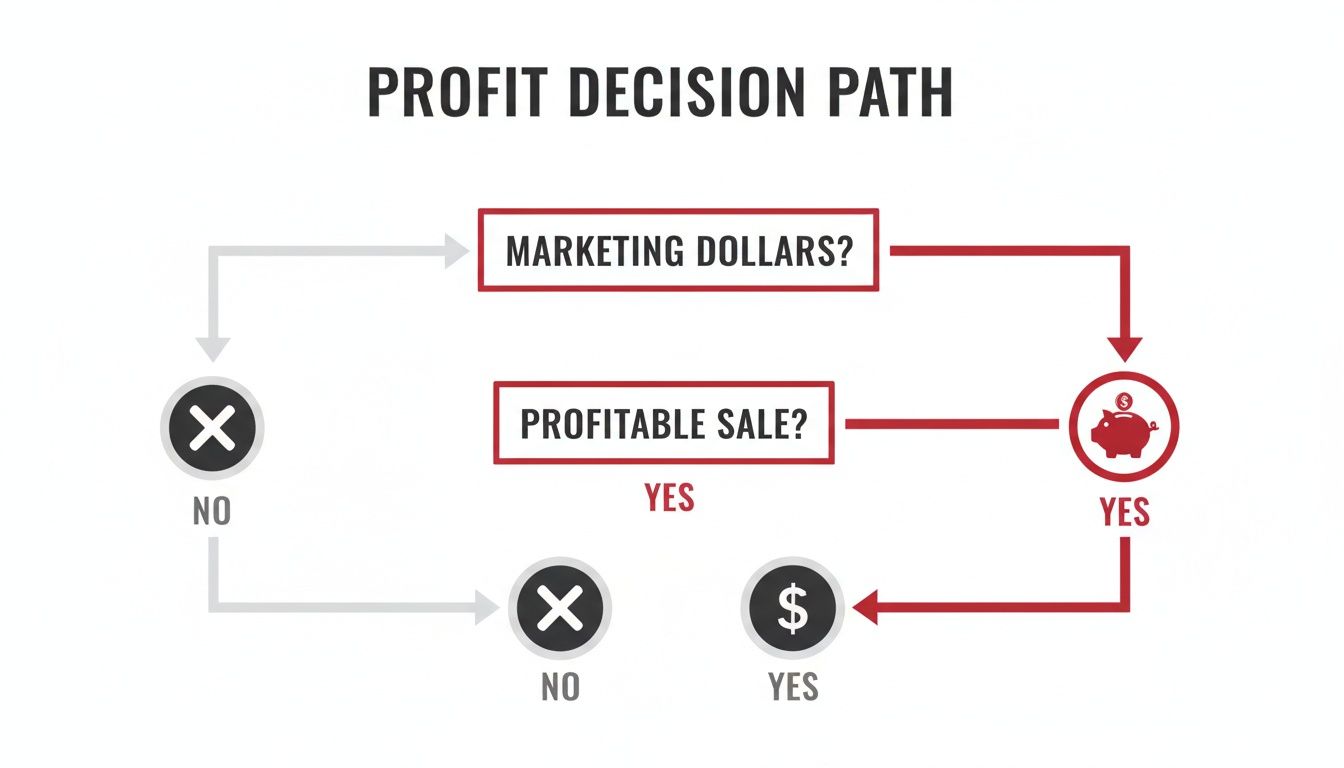
This decision tree perfectly illustrates the fundamental question every operator asks: did our spend lead to a sale that actually improved our bottom line?
The most common—and frankly, most dangerous—model is Last-Touch Attribution. It gives 100% of the credit for a sale to the final click a customer made before buying. So, if a shopper clicks an Amazon Sponsored Product ad and converts, that ad gets all the glory. It’s simple, clean, and dangerously misleading for any brand selling across multiple channels.
Imagine this scenario: a customer sees your new snack bar on a Meta ad, searches for it on Google a week later, reads a review on a blog, and then finally buys it through a branded search ad on Amazon. In a last-touch world, that Amazon ad gets 100% of the credit. You might look at your report and conclude that Meta and Google are worthless, then slash their budgets. A month later, you’re left wondering why your Amazon sales have mysteriously dried up.
This model completely ignores the customer's journey, rewarding only the "closer" while assigning zero value to the channels that built awareness and consideration in the first place. For omnichannel brands, relying on last-touch is a massive operational blind spot that leads to disastrous budget cuts.
Multi-touch models are designed to fix this problem by distributing credit across several touchpoints. They give you a much more realistic view of how your channels work together to drive a sale. While they’re not perfect, they move you from a flat, one-dimensional view to a more complete picture of your channel economics.
To make this clear, let's compare the most common attribution models side-by-side. Each one tells a different story about how your marketing efforts contribute to a sale, and the model you choose can drastically change your spending decisions.
| Attribution Model | How It Works | Best For... | Biggest Risk |
|---|---|---|---|
| Last-Touch | Gives 100% credit to the final touchpoint before a sale. | Quick, simple analysis for short sales cycles. | Completely ignores top-of-funnel efforts, leading to poor budget decisions. |
| First-Touch | Gives 100% credit to the very first touchpoint a customer interacts with. | Understanding which channels are best at generating initial awareness. | Undervalues channels that are critical for closing the sale. |
| Linear | Spreads credit evenly across all touchpoints in the customer journey. | A balanced starting point when you're unsure which touchpoints are most valuable. | Assumes all interactions are equally important, which is rarely true. |
| Time-Decay | Gives more credit to touchpoints closer to the time of conversion. | Brands with longer consideration cycles where later touchpoints are more influential. | Can still undervalue critical brand-building activities at the top of the funnel. |
| U-Shaped | Gives 40% credit to the first touch, 40% to the last touch, and splits the remaining 20% among the middle touches. | Valuing both brand discovery and conversion drivers in a balanced way. | The fixed percentages are arbitrary and may not reflect your unique customer journey. |
As you can see, there’s no single "best" model. The right choice depends entirely on what you're trying to achieve and what your customer's path to purchase actually looks like.
Choosing an attribution model isn’t just some academic exercise; it has real-world consequences for your budget and strategy. A U-shaped model might be great for understanding brand discovery, but if your immediate goal is to liquidate excess inventory on Amazon, a last-touch or time-decay model might align better with that short-term objective.
The key is to match your model to your business goal. Are you trying to improve your break-even ACOS, increase inventory velocity, or grow your new-to-brand customer base? Each goal may require a different lens. For brands operating across different retailers and their own DTC site, understanding omnichannel attribution is the logical next step.
The push for better models is undeniable. In the world of revenue attribution, North America commands over 40-42% of the global market share, with the Retail & E-commerce sector making up 31% of mobile attribution spend in 2023. This investment is driven by the urgent need for sellers on platforms like Amazon and Walmart to move beyond simplistic tracking. That's especially true when a staggering 41% of marketers still default to last-click models despite knowing their flaws. This data highlights a critical shift: as channels multiply, so does the need for a more nuanced understanding of what truly drives a profitable sale.
It’s one thing to understand attribution models in theory, but it’s a whole different ballgame when you try to apply them to the messy reality of marketplace and DTC channels. Knowing what a U-shaped model is doesn't help much when Amazon’s walled data garden hides half the customer journey.
A smart attribution strategy does more than just track clicks. It deciphers the complicated dance between all your channels, answering the tough questions that directly impact your contribution margin and how fast your inventory moves.
Before you can Optimize spend or Amplify campaigns, you need a solid data Foundation. Without it, you’re just guessing, making decisions based on signals that are incomplete at best and flat-out wrong at worst.
Amazon is famously protective of its customer data, which creates a massive blind spot for most brands. You get to see what happens inside Amazon’s world—clicks on Sponsored Products, views on a DSP ad, and the final sale—but you’re left in the dark about what brought that shopper to Amazon in the first place.
This leads to the classic attribution dilemma. A customer sees your product in a Meta ad, gets curious, and two days later searches for your brand on Amazon to buy it. Amazon’s ad console will proudly report this as a "branded search" conversion, giving its own platform 100% of the credit. But we know the truth: your Meta ad did the heavy lifting.
To get around this, you have to look for clues and connect the dots yourself:
If you don't do this kind of proxy analysis, you risk cutting the very channels that are secretly feeding your Amazon sales engine.
Walmart presents a similar, yet distinct, challenge. While Walmart Connect is getting better, it’s still tough to track a customer from an off-site ad all the way to a final purchase on Walmart.com. The data streams aren't as neatly integrated as Amazon's, forcing you to rely more on directional insights than perfect one-to-one tracking.
Think about this common scenario: a customer sees your product in a physical Walmart store, then goes home and buys it online for convenience. How do you attribute that sale? The honest answer is you often can't with perfect precision. But you can model the relationship between your in-store presence and your online sales velocity.
The real puzzle appears when you run top-of-funnel ads designed to lift all your channels at once.
A successful DSP campaign shouldn't be judged solely on its direct return on ad spend (ROAS). Its true value is measured by the total lift it provides across your entire ecosystem—a spike in DTC revenue, an increase in branded Amazon searches, and higher organic ranking on Walmart.
Ultimately, the whole point is to connect your attribution data back to your channel-specific P&L. A truly sophisticated attribution model doesn't just assign revenue; it assigns contribution margin.
Let's break it down with a practical example:
Now, let's say a Google Ads campaign costs $15 to acquire that customer. On your DTC channel, that’s a profitable sale with a $10.50 net margin. But on Amazon, you just lost money (-$1 net margin).
Understanding this difference is everything. It shapes not just your ad budget but also your inventory allocation, your pricing strategy, and your entire promotional calendar across all the places you sell.
Moving toward a data-driven attribution model is a smart goal, but the path is littered with traps that can cost you time, money, and focus. Many operators underestimate how complex and expensive it really is, getting bogged down long before they see a return.
Knowing these pitfalls isn’t about avoiding attribution. It’s about chasing it with a clear-eyed, practical strategy that protects your margins from the start. The pull of perfect data is strong, but the reality is that chasing it can lead to massive operational drag. Before you sink a dime into new software, you need to understand the hidden costs that trip up even the savviest brands.
The first surprise for many brands is that the sticker price of attribution software is just the beginning. The real cost comes from implementation and maintenance. These platforms don’t just plug in and work; they demand a ton of technical resources to connect your different data sources—Shopify, Amazon Seller Central, your 3PL, your ERP, and every ad platform you use.
This integration process can easily become a multi-month project that pulls your team away from their real jobs. The hidden costs start piling up:
You could spend $20,000-$50,000 on a software license only to realize you need a dedicated analyst or developer just to make it useful. That’s how the total cost of ownership balloons.
The second major pitfall is "analysis paralysis." Once you finally get all the data into one place, it's dangerously easy to get lost in an endless sea of dashboards and reports. You can spend weeks slicing data by channel, campaign, and SKU, trying to unearth that one perfect insight.
All the while, your inventory is aging, and your competitors are making moves.
The goal of revenue attribution isn’t to create perfect reports; it’s to make faster, more profitable decisions. If your data isn't driving action in a reasonable timeframe, it's a cost center, not a growth driver.
This is where a structured approach becomes critical. Instead of trying to analyze everything at once, focus on answering one specific operational question at a time. For example: "Which of our top three ad channels delivers the highest contribution margin on our flagship product?" Answering that one question is far more valuable than building a dozen dashboards nobody ever looks at.
Even with clean data and a clear focus, misinterpreting what you see is a constant risk. A classic mistake is cutting the budget for a channel that looks like it's underperforming based on a simplistic attribution model.
For instance, your report might show that your Meta ads have a terrible last-touch ROAS. The knee-jerk reaction is to kill that spend.
But what if that Meta campaign is the primary way new customers discover your brand in the first place? Without it, the branded searches on Amazon that convert so well might just dry up. You cut the "underperforming" channel and inadvertently starve your most profitable one. This is exactly why a foundational understanding of your customer journey has to come before any tool or model.
The demand for this kind of clarity is why the global marketing attribution software market is projected to more than double from USD 4.74 billion in 2024 to USD 10.10 billion by 2030. As 73% of customers now use multiple touchpoints, brands are desperate to connect spend to revenue across a fragmented landscape. You can learn more about these market trends and their implications for CPG brands. This explosion in spending proves the need is real, but it also increases the risk of making expensive mistakes if you don't have the right operational framework in place first.
Smart revenue attribution doesn’t start with a five-figure software investment. The real work happens long before you sign a contract for a flashy platform. Building your attribution Foundation is all about getting your data and discipline in order so you can generate reliable insights, even if your first tool is just a well-organized spreadsheet.
This first phase is about creating a single source of truth you can actually trust. Without it, any later attempts at Optimization or Amplification are just expensive guesses built on a shaky base. The process is straightforward and focuses on three core operational steps.

Your first mission is to enforce ruthless consistency in how you tag every single URL you put out into the world. UTM (Urchin Tracking Module) parameters are the simple tags added to the end of a URL that tell your analytics exactly where a visitor came from. If your tagging is sloppy, your data becomes messy and useless.
Establish a clear, documented naming convention for your entire team and stick to it religiously.
google, meta, klaviyo).cpc, email, social).q4-holiday-sale, new-product-launch).video-ad-1, header-link).An operator's view on UTMs: This isn't just a marketing task; it's an inventory management system for your traffic. Think of every click as a unit of inbound data. If you don't tag it correctly at the source, it gets lost in the warehouse.
Once your incoming data is clean, the next step is to bring it all together. This doesn't require an expensive data warehouse right away. It can start with something as simple as a Google Sheet or an Airtable base that pulls data via API connectors or scheduled CSV exports.
Your goal is to get the following data streams into one dashboard:
This creates a unified view where you can finally connect ad spend to actual channel profitability. As you lay this groundwork, looking into business process automation can help streamline your data collection and reporting, saving you time and reducing errors.
With clean, centralized data, you can start testing the impact of your marketing channels without needing perfect, end-to-end tracking. This involves running controlled "lift" tests to measure clear cause-and-effect relationships.
Example: A Snack Brand Testing Influencer Impact
A snack brand wants to know if its influencer marketing is actually driving sales on Amazon, but they can't track a customer from an Instagram story directly to an Amazon purchase.
Here’s the operational workaround:
This method isn’t perfect, but it provides strong, directional data. A 30% lift in sales velocity paired with a jump in branded searches gives you a clear, defensible signal that the campaign worked. This is how you build a practical attribution model—one grounded in operational reality, not theoretical perfection.
Having clean data and a solid attribution model is a great start, but they’re worthless until you use them to make tough, profitable decisions. This is where the real work begins, moving from setting the Foundation to active Optimization and Amplification.
Attribution data isn’t just for building pretty reports. It’s for driving real operational changes that directly improve your contribution margin.
The insights you get should force you to question everything. Is that high-ACOS Sponsored Brands campaign actually profitable once you factor in all the Amazon fees, or is it just generating empty revenue? Does your DTC channel’s customer acquisition cost justify holding more inventory in your 3PL versus sending it into FBA?
These aren't just marketing questions—they're core operational trade-offs. Good attribution gives you the numbers to answer them with confidence.
The real value of attribution shows up when it starts shaping your budget, pricing, and inventory strategy. It’s about moving capital from inefficient activities to those with the highest margin impact.
Here are a few concrete examples of decisions driven by sound attribution:
The ultimate goal is to create a direct feedback loop between your marketing spend and your P&L. Every dollar spent should have a clear, measurable impact on contribution margin, not just top-line sales.
This disciplined approach is a proven profit driver. Adopting advanced revenue attribution isn't just a trend; it's a financial lever. Case studies show it can lead to 20-40% ROI increases and 5% average conversion uplifts.
Brands like Bose used multi-touch models to surge e-commerce sales by 81% and overall revenue by 35%. Meanwhile, HelloFresh saw a 10% gain in conversions. These are the kinds of numbers that show why savvy operators are rapidly adopting these tools. Discover more insights about the impact of attribution on brand growth at snsinsider.com.
Figuring out your revenue attribution isn't just a marketing task—it's a core discipline for building a profitable CPG brand. It helps you look past vanity metrics like top-line sales and zero in on the number that actually matters: contribution margin. With the right attribution, you get the clarity to make tough but essential trade-offs, making sure every dollar spent on ads, promos, and channel fees is working for your bottom line.
But while the idea is powerful, putting it into practice means digging through a messy and often disconnected data landscape. It's all about connecting the dots between your spending and your profits across Amazon, Walmart, and your own DTC store. This is how you build a durable, scalable business.
This is the critical step that shifts a brand from chasing random sales spikes to building sustainable channel economics. The goal isn't to find one perfect answer, but to create a framework that helps you make consistently smarter decisions. It's how you go from just selling products to strategically building a brand with long-term value.
If you're ready to get a clear, unbiased view of your channel economics and find opportunities to boost your margins right away, let's talk. We help CPG operators connect attribution data directly to P&L impact.
Book a complimentary 30-minute strategy session with an operator. We’ll dive into your channel profitability and build a practical plan to improve your contribution margin. No sales pitch, just a working session.
Leave a comment: