
Published: March 2020 | Last Updated:February 2026
© Copyright 2026, Reddog Consulting Group.

Running a successful Consumer Packaged Goods brand in Texas means keeping up with shoppers who expect fast, seamless experiences across every channel. As online sales grow, the pressure to manage complexity and protect margins gets real. Headless commerce offers a way to break free from rigid platforms and create flexible digital storefronts that adapt to customer needs while supporting efficient operations. Explore how this approach can help Texas brands innovate, personalize, and grow across multiple touchpoints.
| Point | Details |
|---|---|
| Headless Commerce Flexibility | CPG brands can achieve rapid frontend customization without disrupting backend systems, allowing for adaptive customer experiences. |
| Technological Advantages | Leveraging APIs and modular architectures enables easier integration, scalability, and innovation across digital channels. |
| Operational Efficiency | Headless commerce reduces development costs and speeds up the time-to-market for new features, enhancing profitability. |
| Implementation Challenges | Brands must address potential skill gaps and technical complexities to successfully transition to headless commerce solutions. |
Headless commerce represents a transformative approach to digital retail architecture that allows Consumer Packaged Goods (CPG) brands unprecedented flexibility in creating customer experiences. At its core, headless commerce decouples the frontend presentation layer from the backend commerce functionality, enabling brands to build and modify customer-facing interfaces without disrupting core transactional systems.
This innovative architecture fundamentally changes how CPG brands manage e-commerce platforms by providing several critical advantages:
For CPG brands specifically, headless commerce offers strategic benefits that go beyond traditional e-commerce models. By leveraging REST APIs, companies can create tailored experiences across multiple digital touchpoints - from mobile apps to smart device interfaces - while maintaining a consistent backend infrastructure.
The technical framework allows businesses to innovate faster and respond more dynamically to changing consumer expectations. Unlike monolithic platforms that require comprehensive system overhauls, headless architectures enable targeted updates and experiments with minimal operational disruption.
Key Technical Components:
Pro tip: Start small by identifying one specific customer experience you want to enhance, and use headless commerce as a strategic, incremental approach to digital transformation.
Headless commerce relies on a sophisticated technological ecosystem that enables unprecedented digital flexibility for modern businesses. Core technologies driving this innovative architecture include REST APIs, microservices, cloud-native infrastructure, and modular design principles that transform how brands manage digital commerce experiences.
The foundational technology powering headless commerce is the API-first approach, which allows seamless communication between frontend and backend systems. This architectural strategy provides several critical technological capabilities:
MACH architecture represents the most advanced implementation of headless commerce technologies. This framework encompasses four key technological principles:
Headless commerce technologies enable brands to create dynamic, adaptable digital experiences that can rapidly evolve with changing market demands.
For CPG brands, these technological innovations mean the ability to experiment, personalize, and optimize digital touchpoints without massive system redesigns. The modular nature of headless architectures allows targeted improvements and rapid feature deployments across multiple consumer interaction channels.

Pro tip: Conduct a thorough audit of your current e-commerce infrastructure to identify specific integration points where headless technologies could provide immediate operational benefits.
Digital platforms fundamentally transform commerce interactions by breaking down linear transaction models that dominated traditional retail ecosystems. Unlike traditional commerce platforms with rigid, monolithic architectures, headless commerce introduces unprecedented flexibility and adaptability for modern businesses.
Key differences between traditional and headless commerce platforms include:
Traditional commerce platforms typically operate with these fundamental limitations:
Headless commerce represents a paradigm shift from transactional limitations to dynamic, ecosystem-driven digital experiences.
For Consumer Packaged Goods (CPG) brands, the transition from traditional to headless platforms means dramatically reduced technical complexity and accelerated market responsiveness. The modular nature of headless commerce allows brands to experiment, personalize, and optimize digital touchpoints without massive infrastructure investments.
Here’s a concise comparison of traditional vs. headless commerce platforms for CPG brands:
| Aspect | Traditional Commerce | Headless Commerce |
|---|---|---|
| Flexibility | Limited to preset flows | Custom interfaces allowed |
| Channel Expansion | Single or few channels | Easy multichannel growth |
| Update Speed | Slow and costly | Fast, low disruption |
| User Experience | Generic, less tailored | Highly personalized |
| Integration Effort | Complex and high | Modular, more manageable |
Pro tip: Evaluate your current e-commerce platform’s flexibility by mapping out potential customer experience improvements and assessing the technical complexity required to implement them.
Operational advantages in headless commerce represent a transformative approach to reducing costs and accelerating digital innovation for Consumer Packaged Goods (CPG) brands. By decoupling frontend and backend systems, businesses can dramatically reduce development complexity and create more agile, responsive digital experiences.
Key margin and operational benefits include:
The financial implications of headless commerce for CPG brands are significant:
Headless commerce transforms technological constraints into strategic competitive advantages by enabling unprecedented operational flexibility.
For brands seeking to optimize their digital commerce strategy, headless architectures provide a powerful mechanism to reduce operational friction. The ability to independently modify frontend experiences without disrupting backend systems means faster experiments, more personalized customer interactions, and ultimately, improved profit margins.
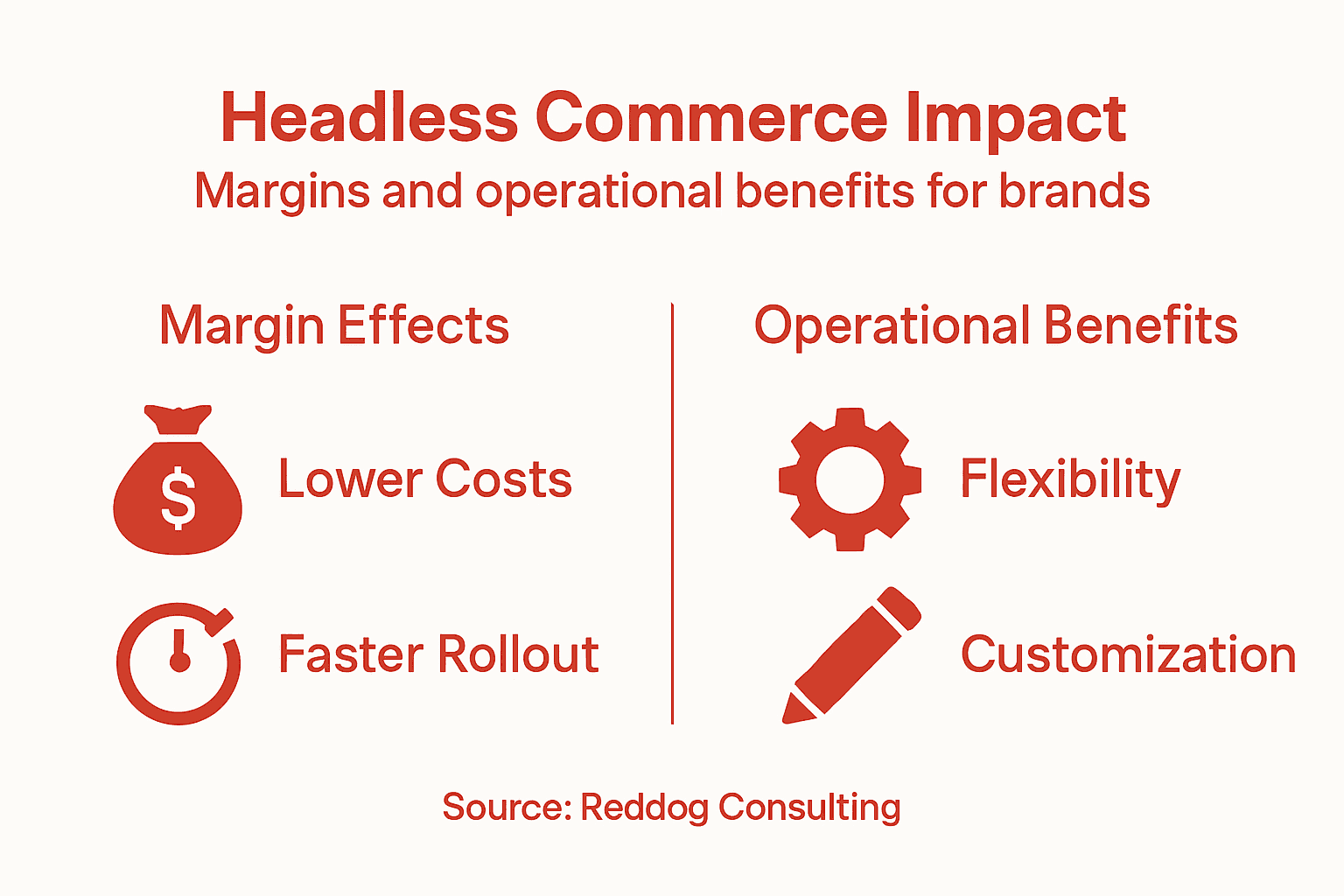
Summary of operational advantages headless commerce offers CPG brands:
| Advantage | Impact on Operations | Financial Effect |
|---|---|---|
| Rapid prototyping | Faster innovation cycles | Lower development spend |
| Scalable architecture | Easy to add new sales channels | Reduced expansion costs |
| Independent updates | Minimal downtime during changes | Faster go-to-market |
| Modular structure | Simpler resource allocation | Better ROI on tech spend |
Pro tip: Conduct a comprehensive audit of your current e-commerce infrastructure, identifying specific bottlenecks where headless technologies could streamline operations and reduce technical complexity.
Common challenges in headless commerce adoption represent significant technological and operational barriers for Consumer Packaged Goods (CPG) brands. These hurdles require strategic planning, technical expertise, and a nuanced understanding of digital transformation complexities.
Key implementation challenges include:
The most prevalent implementation pitfalls for CPG brands emerge in these critical areas:
Successful headless commerce implementation demands a strategic, phased approach that prioritizes technological compatibility and organizational readiness.
For brands considering this transformation, understanding potential roadblocks is crucial. The architectural shift requires not just technological investment, but a comprehensive reimagining of digital commerce capabilities, including robust API management, frontend flexibility, and continuous skill development.
Pro tip: Conduct a thorough skills assessment of your current technical team, identifying specific training needs and potential knowledge gaps before initiating a headless commerce migration.
Navigating the complex landscape of headless commerce can be overwhelming for Consumer Packaged Goods (CPG) brands seeking to scale profitably across diverse channels such as Amazon, Walmart, and DTC. The challenges of managing rapid frontend customization, seamless multichannel expansion, and margin optimization require expert guidance tailored to marketplace economics and operational clarity. At RedDog Group, we specialize in helping emerging and growth-stage CPG brands overcome these hurdles by combining a margin-focused strategy with deep insights into retail expansion readiness.
Discover how our Digital & Business Consulting Services by Reddog Consulting empower brands to leverage headless commerce advantages while minimizing technical complexity and operational friction. Act now to transform your e-commerce infrastructure and optimize contribution margins with our proven approach. Start your journey today by exploring our dedicated growth offer at RedDog Group’s CPG Retail Growth Offer and see how we bridge digital innovation with wholesale and distribution execution.
Headless commerce is a digital retail architecture that separates the frontend user interface from the backend commerce functionalities, allowing brands to create and customize customer experiences without altering core systems.
Headless commerce provides CPG brands with enhanced flexibility in customization, seamless multichannel product distribution, a more personalized shopping experience, and reduced technical complexity, allowing for faster innovation and adaptation to consumer demands.
Key technologies include REST APIs, microservices, cloud-native infrastructure, and modular design principles, which together enable real-time data exchange, independent scalability, and rapid iterations in digital experiences.
Common challenges include high development costs, technical complexity, integration difficulties with legacy systems, and the need for specialized skills in API management, which can pose significant barriers for brands transitioning to a headless architecture.
Leave a comment: