
Published: March 2020 | Last Updated:October 2026
© Copyright 2026, Reddog Consulting Group.

A distributor gets access to your Walmart Seller Center. An agency connects to Amazon Brand Registry. A marketplace integration starts syncing inventory. Then pricing changes without warning, a promotion consumes more stock than planned, or a partner can see customer information that has nothing to do with its job.
The damage rarely appears as a line item called “authorization failure.” It shows up as lower contribution margin, avoidable stockouts, stale listings, missed orders, fee leakage, or a channel relationship that becomes difficult to unwind. Third party authorizations are operational controls, not paperwork filed once during onboarding.
A common failure starts innocently. A brand gives a distributor broad access because the distributor needs to update listings and monitor orders. The distributor's team then changes pricing to improve sell-through, adjusts inventory settings, or launches marketplace promotions without understanding the brand's contribution margin requirements.
The product may sell faster, but the economics deteriorate. A lower price combines with marketplace fees, fulfillment costs, advertising spend, returns, and distributor deductions. The brand sees higher volume and weaker cash contribution. If the inventory plan wasn't aligned with the new demand, the next result may be a stockout and lost ranking momentum.
That's why authorization belongs in the same operating conversation as price floors, replenishment, and advertising efficiency. OAuth 2.0 established a model in which an application can receive limited access to protected resources without receiving the user's password. The framework separates the resource owner, client, authorization server, and resource server, allowing the owner to approve defined scopes and the service to validate an access token before releasing data. The IETF's OAuth 2.0 history and RFC 6749 record documents that foundation.

Tokenization provides a useful commerce benchmark. Visa reports that token-based transactions produce an average 30% reduction in online fraud compared with transactions using the primary account number, alongside a 4% increase in authorization rates. Visa also reports a 4.6% global authorization-rate lift for card-not-present token transactions and notes that payment problems can contribute to as much as 44% of digital shopping abandonment. Those figures come from Visa's Intelligent Data Exchange API information, and they concern payment tokens rather than every type of third party authorization.
The broader lesson still matters to CPG operators. Controlled access can protect revenue while reducing unnecessary exposure. Uncontrolled access creates the opposite trade-off. A partner may execute faster, but the brand gives up visibility into who changed the offer, which system triggered the update, and whether the action supported profitable growth.
Operator rule: If a third party can change price, inventory, content, advertising, payouts, or customer data, its authorization is part of your profit model.
The useful question isn't “Do we trust this partner?” It's “What exact business result does this partner need to produce, and what is the smallest permission set that lets it produce it?”
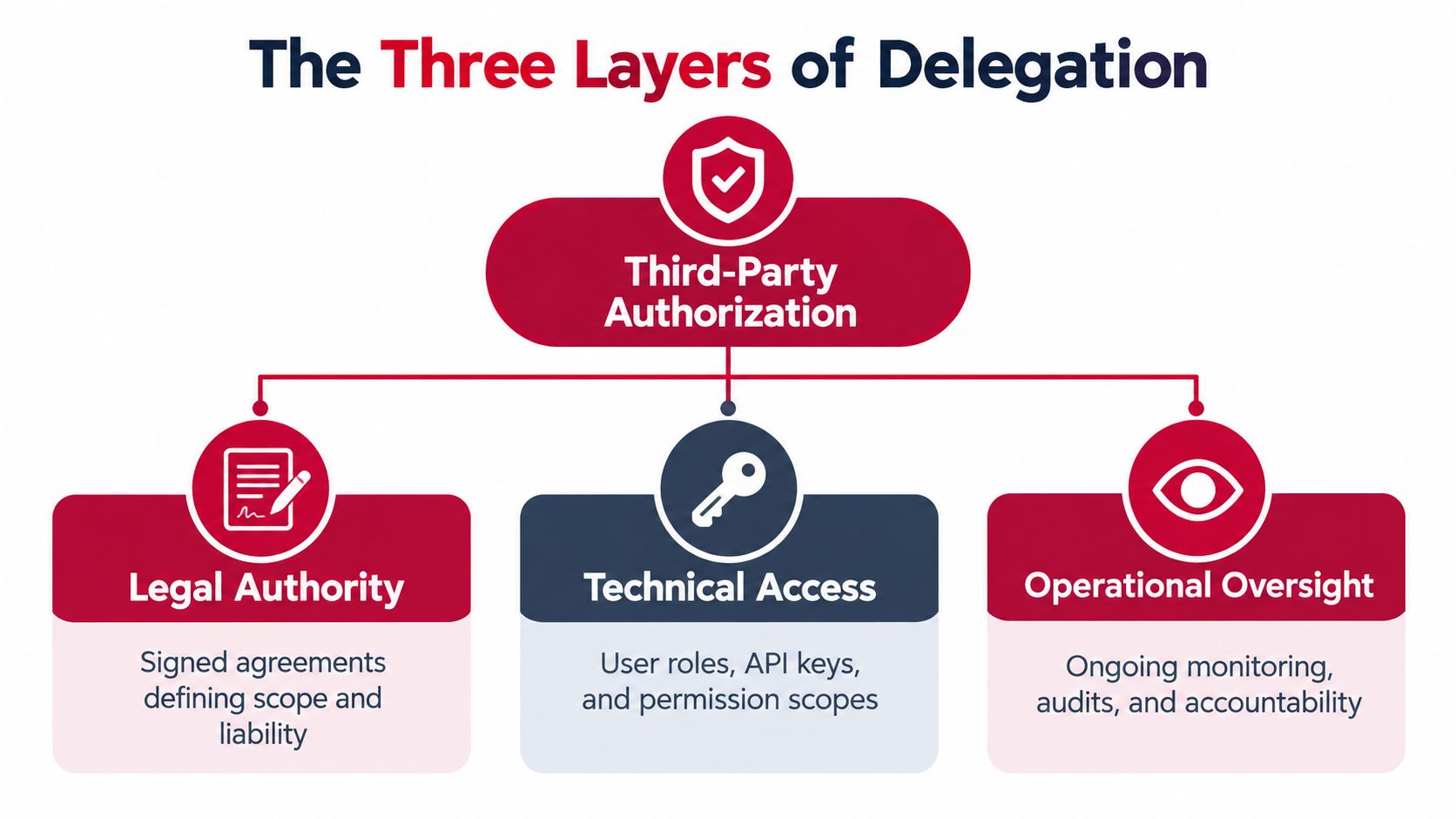
A durable authorization program has three separate layers. Treating them as one creates gaps that are difficult to see until a marketplace dispute, data incident, or margin problem forces an investigation.
Legal authority answers who has the right to sell, represent, or act for the brand. A distributor may have permission to resell a product but no authority to edit the brand's trademarks or approve new marketplace sellers. An agency may manage advertising but have no right to use customer data for its own purposes.
Walmart's Marketplace Retailer Agreement requires sellers to have a legal right to sell listed products and maintain processes to verify that products are authentic, authorized, and not stolen, counterfeit, illegal, or misbranded. It also addresses the right to use product content. The Walmart Marketplace Retailer Agreement is a useful reminder that resale authority and content authority may need separate treatment.
Technical access is how the partner acts. It may involve a marketplace user role, an API connection, an OAuth token, or a brand account invitation. Technical access should map to a defined workflow, not to a person's seniority or a partner's general importance.
A 3PL might need inventory and order visibility. An advertising agency might need to manage campaigns but not change bank details or product compliance information. A catalog specialist may need content permissions without access to refunds or payouts.
For an internal owner, an Amazon account manager resource can help clarify how marketplace responsibilities should be divided before access is granted. For execution-heavy teams, businesses may also hire a virtual assistant, but the role still needs narrowly defined permissions and a named internal owner.
Contracts define what happens when the partner makes a mistake, changes its personnel, uses a subcontractor, or stops working with the brand. They should identify permitted activities, data handling, approval rights, incident reporting, ownership of marketplace content, and the offboarding process.
The three layers must agree. A distributor with a valid resale agreement shouldn't automatically receive administrator access. A technically approved application shouldn't be allowed to process data for a purpose the customer never accepted. A contract that promises control is ineffective if the brand can't identify or revoke the actual account permissions.
The right document depends on the action the third party needs to perform. A single broad authorization letter may feel efficient, but it often leaves the operating team guessing about the partner's specific permissions.
API access suits repeatable workflows such as inventory synchronization, order retrieval, listing updates, and reporting. The authorization record should name the application, account owner, requested scopes, business purpose, approval date, review date, and revocation method.
Keep read access separate from write access. A reporting connection that only reads sales and inventory shouldn't also be able to change price, delete listings, issue refunds, or alter fulfillment settings. Access tokens should be short-lived where the platform supports it, while refresh tokens should receive stronger protection because they can obtain new access tokens. The NIST guidance on OAuth scopes and refresh tokens supports this least-privilege approach.
Marketplace user roles are appropriate when a person needs to work directly in Seller Central, Seller Center, or a brand-management portal. Create a role around the job:
Document the named users, not just the agency or distributor. When a partner changes personnel, remove the former user rather than allowing a shared login to remain active.
A distributor agreement should identify the products, territories, permitted channels, pricing responsibilities, inventory ownership, returns process, and brand assets the distributor may use. A resale certificate or authorization letter may support the relationship, but it shouldn't replace the operating detail.
For delegated legal authority outside marketplace operations, teams can use a resource such as this Florida power of attorney sample and instructions to understand how authority documents describe principals, agents, and permitted acts. Marketplace authorizations still need platform-specific language and should be reviewed by qualified counsel where the commercial stakes are material.
The practical test is simple. Could a new operations manager read the file and determine who may sell the product, who may edit the listing, who owns the customer relationship, and who must approve a price or inventory decision? If not, the documentation is incomplete.
A CPG brand can lose margin through a permission that looks harmless. An Amazon agency user may change brand content without controlling ownership, while a Walmart integration may push the wrong inventory or price data. “Marketplace access” is not one control. Each platform ties authorization to different operational risks.
Amazon Brand Registry places the trademark owner at the center of enrollment. Amazon states that the trademark owner must enroll the brand, then add an authorized agent as an additional Brand Registry account user. An agency, distributor, or consultant should not enroll the client's brand as though it owns the trademark. The Amazon Brand Registry guidance describes this owner-agent relationship. Keep ownership with the brand, then give the partner only the access needed to execute approved work.
Walmart Marketplace uses a different model for approved third-party applications. The seller signs in to Seller Center, connects an approved solution provider, reviews the requested permissions, and authorizes the application through OAuth 2.0. Walmart states that access tokens expire after 15 minutes, so the integration must refresh them. The Walmart OAuth authorization documentation explains this token-based model.
| Platform | Authorization Model | Key Requirement | Token or Access Duration |
|---|---|---|---|
| Amazon Brand Registry | Owner-controlled account user delegation | The trademark owner enrolls the brand and adds the authorized agent | Platform user access, duration not specified in the cited guidance |
| Walmart Marketplace applications | OAuth 2.0 connection to an approved solution provider | Review requested permissions before authorizing the application | Access tokens expire after 15 minutes, per Walmart's published OAuth documentation. |
Amazon's main exposure is ownership confusion. An agency may manage content every day, but the brand owner should retain enrollment control and the ability to remove users. That separation protects the account if the relationship ends, while still allowing the partner to keep listings accurate and conversion-focused.
Walmart's exposure often sits in the integration's permission scope and data behavior. Excessive access can let a feed alter inventory, pricing, listings, or orders beyond the intended workflow. Insufficient access can leave stock updates incomplete, increasing overselling risk, missed orders, and avoidable margin loss. Review permissions against the actual workflow, not the vendor's broadest available package.
Teams that need a plain-language view of the wider account environment can review what Amazon Seller Central is. The practical control is a platform-specific onboarding checklist that records ownership, user roles, integration permissions, and commercial consequences. That checklist helps teams protect channel sustainability without slowing routine execution.
Authorization should follow the product lifecycle of a channel relationship. A partner may begin with reporting, move into execution, and later lose access when the brand changes distributors. Your controls need to accommodate those changes without relying on memory.
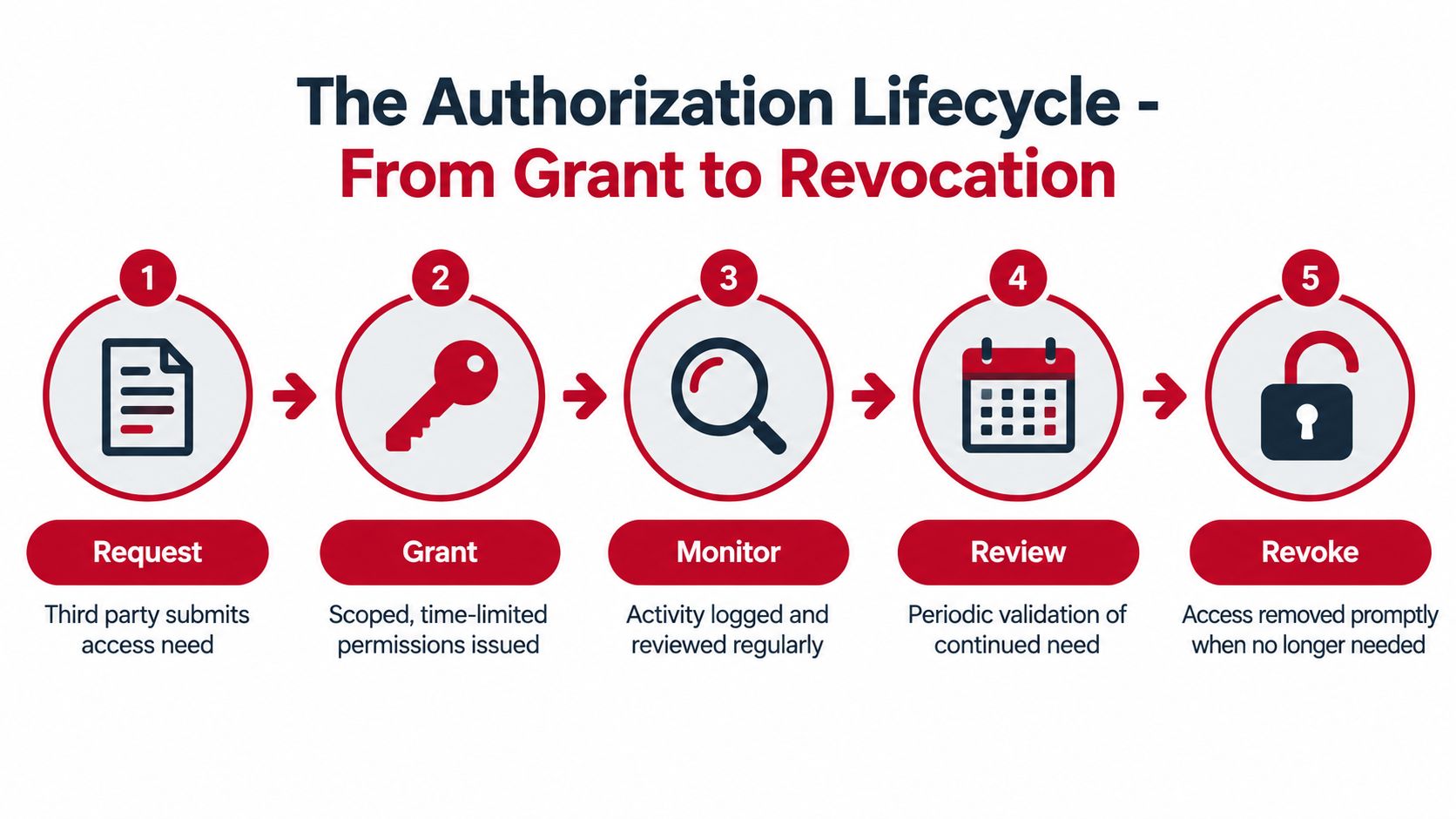
Start with a written access request. The request should state the workflow, systems, data categories, requested actions, business owner, and reason the work cannot be completed with a narrower permission.
The approving owner should test the request against commercial exposure. Can the requested access change a price floor? Can it consume inventory? Can it expose personal information? Can it affect a payout or customer promise? Those questions turn a technical request into a channel-risk decision.
Grant the minimum required permissions, preferably with an expiration or scheduled review. A read-only connection should remain read-only. A write permission should have a documented owner and a defined change process.
Maintain an authorization inventory as the single source of truth. Useful fields include:
Review privileged access monthly and lower-risk access quarterly when those cadences fit the business's risk profile. Log grants, token use, administrative actions, failed authentication, and revocations so the team can compare system activity with promotions, inventory events, and operational changes.
Offboarding begins when the contract ends, a person changes roles, or the partner no longer needs the permission. Remove platform users, revoke application connections, rotate affected credentials, disable refresh tokens where supported, and confirm that delegated access no longer works.
A revocation checklist should include marketplace accounts, API connections, shared files, reporting tools, advertising platforms, and third-party support systems. An account can appear closed while a forgotten integration continues pulling orders or changing listings.
Use Amazon account suspension guidance as a reminder that access governance belongs in account-health planning, not only in an IT handoff.
The most expensive misconception is that a signed agreement creates safe delegation. A contract can define responsibilities, but it doesn't automatically restrict a Seller Center role, reduce an API scope, or remove a former employee. Legal permission and technical permission must be reconciled.
Another misconception is that broad access saves time. It may reduce onboarding friction, but it also increases the number of actions a partner can take without a second review. A distributor that needs to retrieve orders doesn't need authority to modify bank details. An advertising agency that manages campaigns doesn't need customer profiles or catalog deletion rights.
The EU Data Act requires data holders to provide user-requested data to an authorized third party and says that third party may process the data only for purposes agreed with the user. Onward sharing requires the user's agreement. The EU Data Act text supports a more precise approach to purpose and downstream use.
A customer may authorize an intermediary to submit a privacy request without authorizing that intermediary to receive a complete customer profile. California allows a consumer to authorize another person or a registered business entity to submit a privacy request on the consumer's behalf. The California Attorney General's CCPA guidance provides the relevant consumer and authorized-agent context.
That distinction matters for CPG brands using agencies, distributors, customer-service vendors, and 3PLs. Verify the principal, verify the agent's authority, disclose only the fields needed for the stated action, and log the disclosure.
Walmart requires disclosure when a marketplace seller uses a third party to fulfill an item purchased on Walmart.com. The seller must provide Walmart and/or consumers with that third party's name and contact information, and failure to respond to inquiries can lead to consequences up to marketplace-account pause or suspension. The Walmart business information policy makes clear that delegation can affect customer-facing accountability.
That creates a practical operating question: who owns the customer relationship, returns, product complaints, and inventory promise? If the brand, distributor, 3PL, and marketplace seller each assume another party is responsible, a technically valid authorization can still produce a poor customer experience and costly remediation.
A secure framework should make growth easier, not bury every channel decision in approvals. The right design lets a partner execute routine work quickly while reserving high-impact decisions for the people who understand pricing, inventory, cash flow, and brand risk.
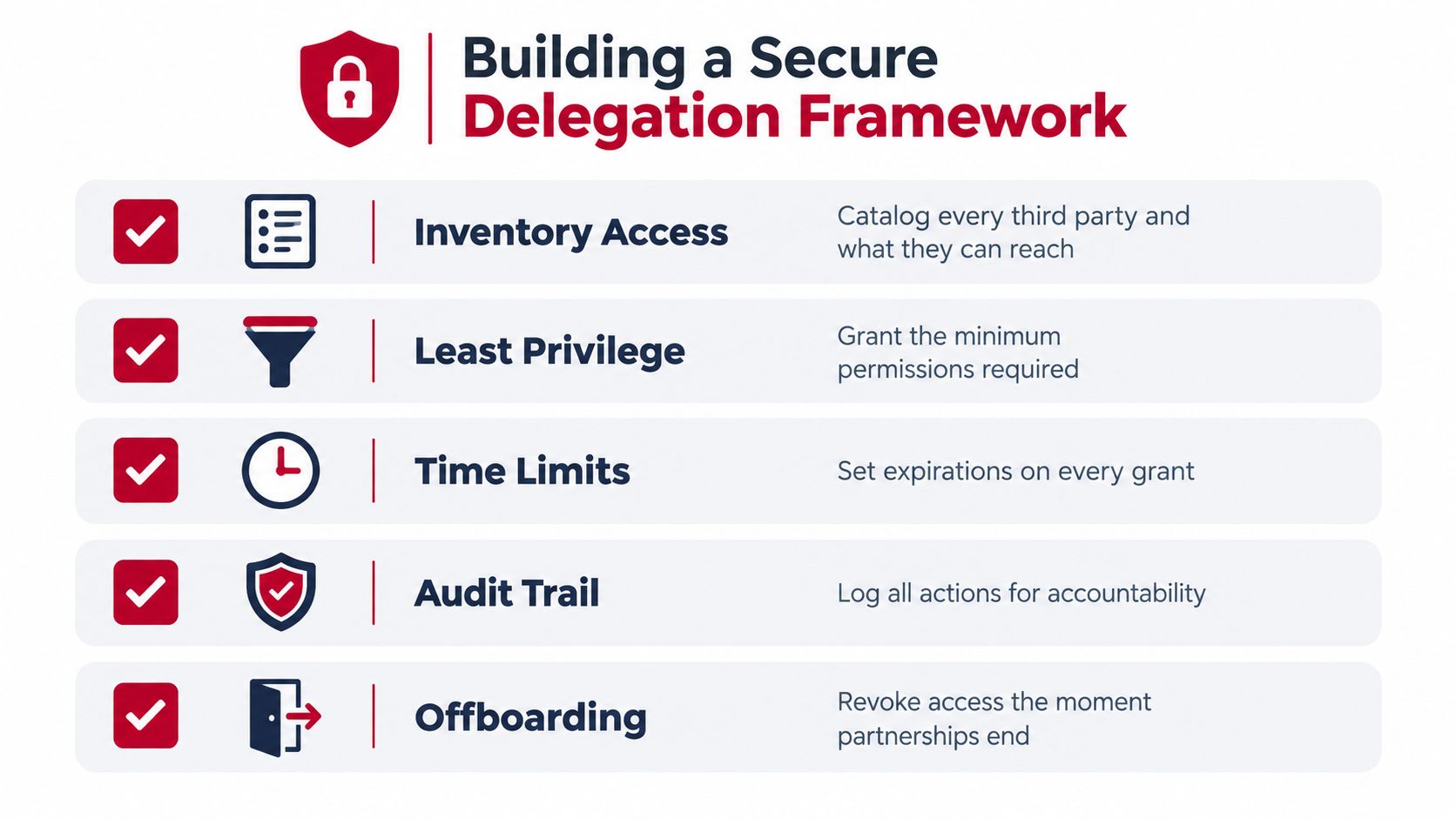
Start with an inventory of every external party, application, user, channel, and permission. Then separate roles by business function. Read-only reporting, content management, advertising execution, order operations, and financial administration shouldn't collapse into one administrator profile.
The approving employee should use MFA, while the external party receives a role aligned to its job rather than a shared administrator account. CISA identifies multi-factor authentication and role-based access control as measures that mitigate unauthorized remote access. Its guidance on visibility, control, remote access, and zero-trust practices also supports documented access policies, reporting structures, change management, and incident handling.
Once access is inventoried, compare each permission with the work performed. Remove unused scopes, split combined roles, and require separate approval for high-impact actions such as changing bank details, deleting catalog data, or modifying user permissions.
Connect authorization reviews to the same operating rhythm used for contribution margin, in-stock performance, pricing, and advertising. If a partner's access changes, the commercial owner should know. If the assortment expands, the brand should confirm that the partner's legal authority and content rights cover the new products and channels.
Automation and additional marketplace partners can improve inventory velocity, but they also multiply the consequences of a bad permission. Add channels only after the brand can identify who owns each listing, feed, order queue, customer interaction, and revocation path.
A defensible third-party authorization program combines technical access controls, contractual governance, and continuous offboarding. Maintain the authorization inventory, review it on a fixed cadence, and revoke access immediately when a contract or role ends. That discipline protects the Foundation, makes Optimization measurable, and gives Amplification a stable operating base instead of adding speed to an uncontrolled system.
Book a free 30-minute working session through the CPG retail growth offer to review how third party authorizations affect margin, marketplace performance, and channel planning. You can also visit Reddog Consulting Group if you want an operator-focused assessment rather than a generic access checklist.
Leave a comment: