
Published: March 2020 | Last Updated:October 2026
© Copyright 2026, Reddog Consulting Group.

PPC management typically costs $500 to $10,000+ per month as a retainer, or 10% to 20% of monthly ad spend. That's only the entry cost, before creative, catalog work, tracking, fulfillment, storage, marketplace fees, and the operational overhead required to turn advertising into profitable sales.
The popular advice is to compare agency rates and choose the lowest percentage. That approach breaks down quickly for CPG brands. A campaign can produce attractive sales while fulfillment charges, referral fees, discounts, returns, inventory aging, and management fees consume the contribution margin underneath those sales.
For an Amazon or Walmart operator, the practical question isn't “What percentage will the agency charge?” It's “What can this catalog afford to pay for profitable demand?”
| Pricing model | How the fee is calculated | Where it helps | Main risk |
|---|---|---|---|
| Flat retainer | Fixed monthly amount | Predictable budgeting | Scope may become too narrow or too expensive as needs change |
| Percentage of ad spend | Share of monthly media investment | Scales with budget | Agency revenue can rise faster than operational workload |
| Performance-based | Fee tied to an agreed outcome | Aligns payment with results | Attribution and external factors can make outcomes difficult to verify |
| Hybrid | Base fee plus variable component | Balances stability and flexibility | More complicated contracts and reporting |
The management fee and the advertising budget are separate costs. Amazon Sponsored Products uses a cost-per-click auction, where sellers set a maximum click bid and a daily budget. Amazon's own example shows that a $100 daily budget could generate up to $3,100 in clicks during a 31-day month, although actual spend depends on traffic and auction activity (Amazon Sponsored Products).
That distinction matters because an agency invoice can look reasonable while the total acquisition cost is not. A brand might pay a retainer, fund Amazon or Walmart media, produce new creative, update product feeds, improve listings, and absorb marketplace deductions before it knows whether an order generated enough contribution to support the whole system.
For smaller accounts, current benchmarks commonly show a fixed management fee of approximately $500 to $2,000 per month, or a recurring charge of approximately 10% to 20% of monthly ad spend (AgencyAnalytics PPC pricing benchmarks). AgencyAnalytics also reported average small and medium-sized business Google Ads spending of $500 to $10,000 per month, while its January 2025 dataset of more than 7,000 users showed median monthly platform spend of $1,024.79 on Google Ads, $353.76 on Microsoft Ads, $784.33 on Meta Ads, and $734.53 on LinkedIn Ads (AgencyAnalytics PPC pricing benchmarks).
At $1,024.79 in monthly Google Ads spend, a 10% to 20% management charge produces only approximately $102 to $205 in agency revenue (AgencyAnalytics PPC pricing benchmarks). That amount may not cover search-term analysis, bid changes, budget pacing, reporting, conversion tracking, testing, and account administration.
This is why a minimum retainer isn't automatically unreasonable. The problem starts when the minimum fee is presented without a clear scope. A small Amazon account may need more work than a larger, stable account if the catalog has poor margins, weak conversion data, inconsistent inventory, or badly structured campaigns.
Practical rule: Price the management relationship against the complexity of the work and the contribution margin available, not against media spend alone.
Initial costs also deserve scrutiny. A historical survey of nearly 200 paid-search agencies found that 64% charged setup fees, with setup commonly covering account creation, tracking configuration, campaign architecture, and onboarding (WordStream agency pricing survey). Catalog cleanup, feed work, listing coordination, creative production, and marketplace reporting may sit outside the recurring fee.
Before comparing proposals, ask for a full monthly cost-of-ownership schedule:
For a useful comparison of how service providers can present paid media costs, review the Nereo pricing plans, then compare the included scope rather than the headline number. RedDog's analysis of the cost of Amazon advertising follows the same principle: media cost is only one part of the economics.
A flat retainer is the easiest model to budget. You pay the agreed amount whether the account spends modestly or materially more, provided the scope stays within contract limits. That predictability helps a growing CPG brand protect cash flow during slower months, especially when inventory purchases and retailer deductions already create uneven working capital.
The weakness is capacity. A fixed fee can become too low for a launch involving new SKUs, multiple marketplaces, new creative, and complicated reporting. It can also become expensive when the account stabilizes and requires less intervention.
Percentage-of-spend pricing is more elastic. A 15% management fee on $20,000 in monthly media equals $3,000, excluding advertising costs (AgencyAnalytics PPC pricing benchmarks). The agency's revenue increases as the budget increases, which can make sense when campaign volume, testing, reporting, and marketplace coordination expand with the account.
The conflict is obvious. If the agency earns more whenever the brand spends more, the contract must define profitability guardrails. More impressions and more attributed revenue don't automatically justify more media if contribution per order is falling.
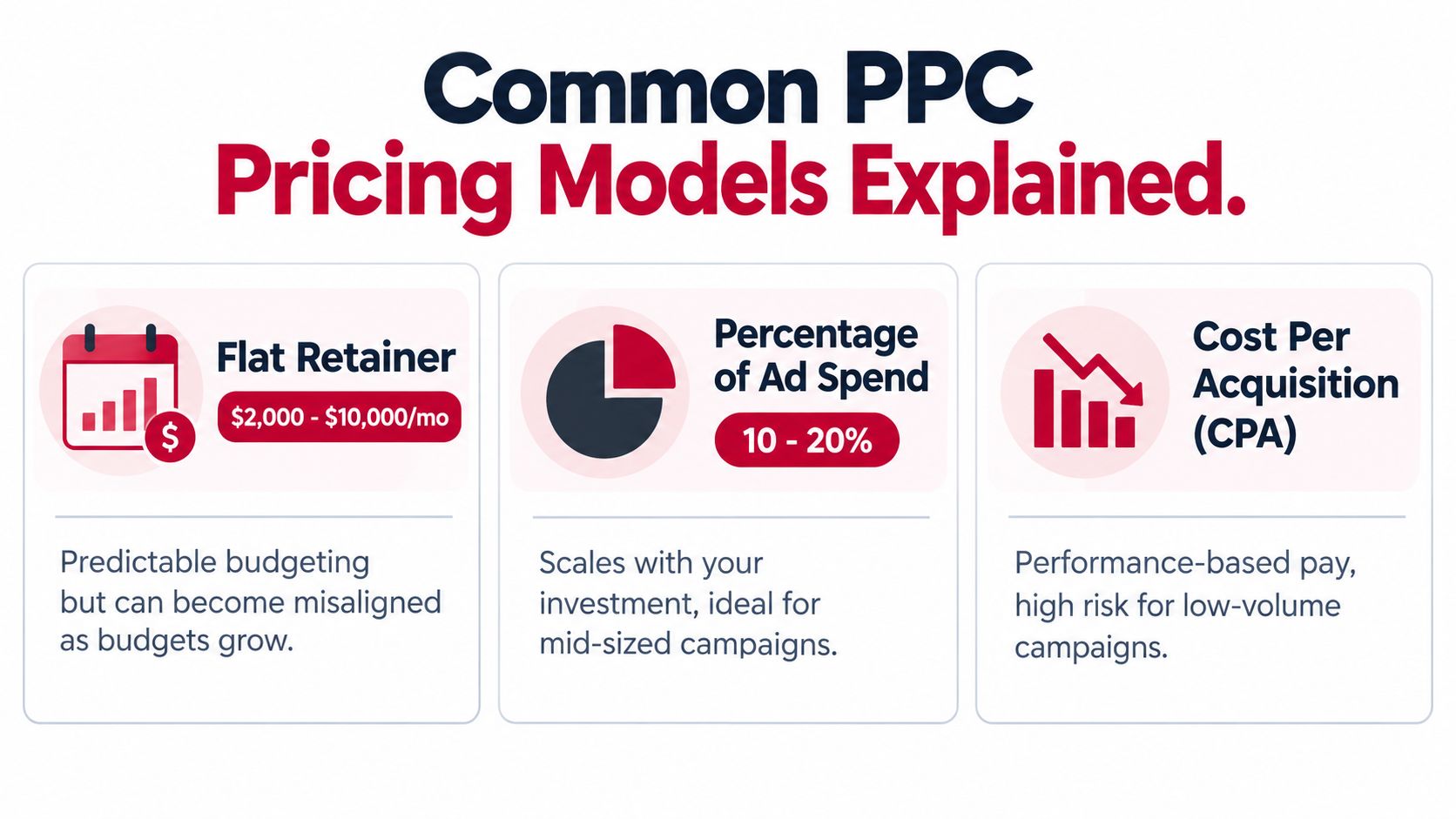
Performance-based pricing ties the fee to an outcome such as qualified sales, profitable orders, or an agreed acquisition event. It sounds attractive because the brand pays for results, but marketplace attribution rarely provides a complete view of profitability by itself.
Amazon may report a sale connected to an ad, while the brand absorbs product cost, referral fees, FBA fulfillment, storage, promotions, returns, and management overhead. Walmart and DTC channels can also apply different attribution windows and reporting rules. A performance contract must define the source of truth, the measurement period, exclusions for stockouts, and how discounts or returns affect the result.
Cost per acquisition can work for a high-volume, well-measured catalog. It's less suitable for low-volume launches where a small number of orders can distort the month. A product can also hit an acquisition target while generating insufficient contribution.
Hybrid pricing combines a stable base with a variable component. For example, the base can cover campaign governance, reporting, and account administration, while a defined variable fee covers incremental marketplace scopes or agreed profitable growth milestones. This structure usually provides more room to separate execution from higher-value work.
A hybrid agreement should never use “performance” as a substitute for scope. Specify who owns listing conversion, inventory planning, pricing, creative testing, retail coordination, and attribution.
For another example of how pricing pages frame service scope, review the NotFair pricing page. The useful comparison isn't the amount alone. It's whether the proposed service includes the work your Amazon and Walmart accounts require. RedDog's overview of PPC advertising management services is relevant for the same reason, because campaign execution is only one part of paid retail growth.
A marketplace campaign reaches break-even only after every meaningful deduction has been accounted for. ACOS is useful for managing media, but it doesn't tell you whether the order produced cash contribution after COGS, referral fees, fulfillment, storage, discounts, returns, and management.
Amazon FBA fulfillment fees vary by product category, size, and weight. Storage is charged monthly according to the daily average cubic-foot volume occupied by inventory, and Amazon applies an aged-inventory surcharge to units stored for 181 days or longer (Amazon selling fees and FBA charges).
That creates different advertising limits for different SKUs. A compact replenishment product priced at $25 with strong inventory velocity may support a higher advertising cost of sale than a bulky item whose fulfillment and storage charges consume a larger share of selling price. Both products could show the same revenue growth while producing very different contribution.
For each advertised product, calculate contribution per order in this sequence:
That figure should determine allowable ACOS and bid limits. An account-wide target can conceal a profitable hero SKU subsidizing several products that lose money with every attributed order.
Low-priced CPG products need a separate pricing model. For products priced below $10, Amazon's 2026 Low-Price FBA program provides fulfillment rates $0.86 lower than rates for products priced at $10 or more. Amazon's published small-standard example lists a 2-ounce-or-less product at $2.43 under one rate and $2.62 under the higher rate (Amazon Low-Price FBA fee guidance).
Crossing that price threshold can help fulfillment economics, but lowering price can reduce gross contribution and change perceived value. A product selling at $10.49 with $3.00 of pre-ad contribution before fulfillment would lose $0.50 in revenue if reduced to $9.99. The $0.86 fulfillment advantage must be weighed against the price reduction, any referral-fee change, promotion funding, and demand response (Amazon Low-Price FBA fee guidance).
Fast velocity can support amplification because the brand has evidence of demand and a reasonable path to replenishment. Slow velocity demands caution. PPC can move units, but it can also hide weak organic demand until discounts, liquidation, or aged-inventory charges damage the result.
Fee changes make the model even more important. Amazon announced that, beginning April 17, 2026, a 3.5% fuel and logistics-related surcharge would apply to FBA fulfillment fees in the United States and Canada, including specified remote-fulfillment programs. Amazon also stated that standard-size products priced between $10 and $50 would see an average $0.08-per-unit fulfillment-fee increase in 2026 (Amazon 2026 FBA fee changes).
If a product contributes $4.00 before advertising, an $0.08 fee increase reduces contribution before bids change. At 50,000 monthly units, that equals $4,000 less monthly contribution if the fee applies uniformly (Amazon 2026 FBA fee changes). The right response might involve pack-size changes, pricing, freight, inventory positioning, conversion improvements, or selective media cuts. It shouldn't be an automatic increase in ad spend.
The right pricing structure depends on the brand's operating stage, not just its advertising budget. A small brand usually needs cash-flow stability and a defined amount of hands-on work. A growth-stage brand needs flexibility across marketplaces, SKUs, promotions, creative tests, and inventory constraints.
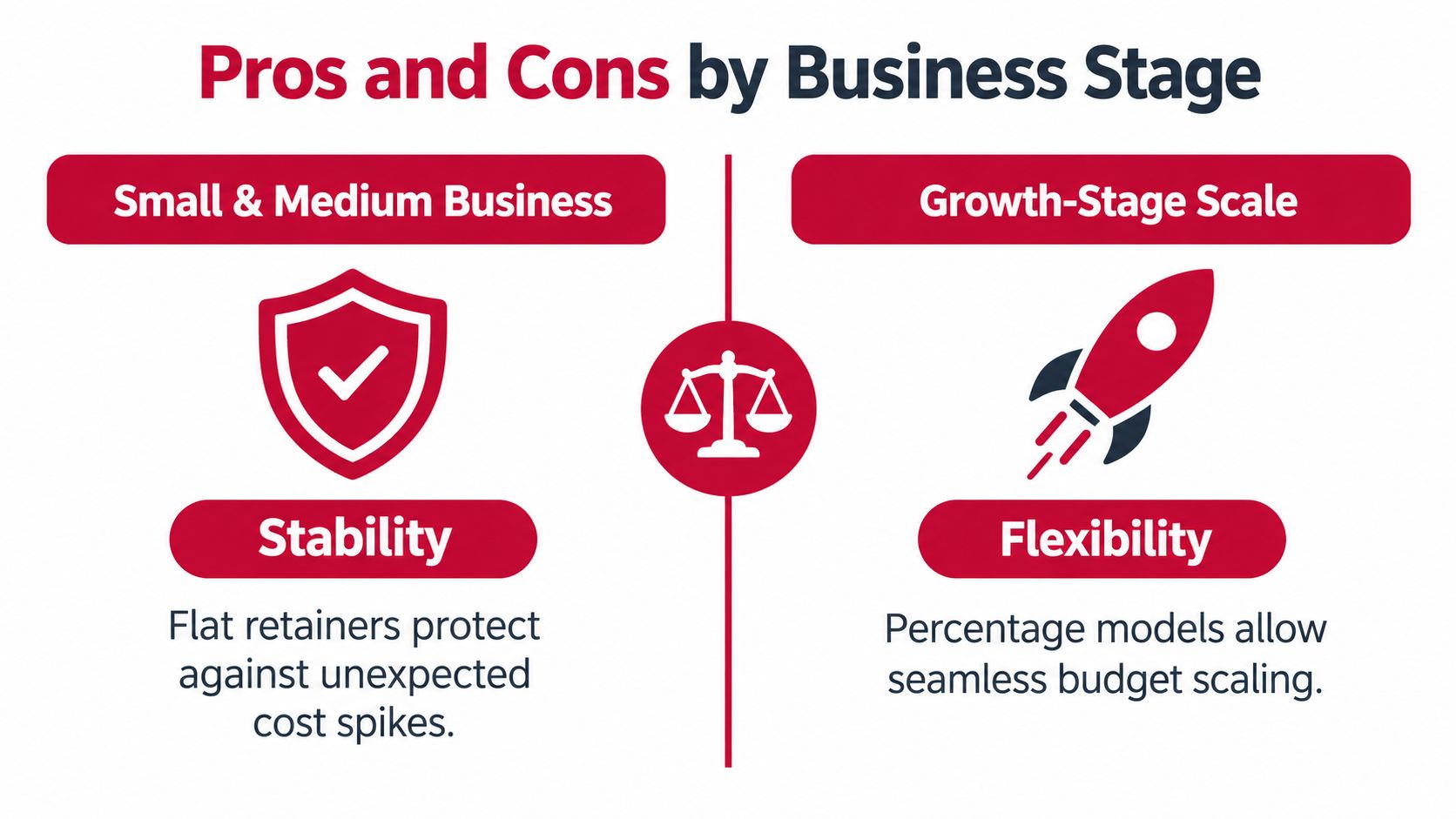
A flat retainer can protect a smaller operator from unexpected cost spikes during a launch or seasonal push. The brand knows the management charge before it commits media and can reserve cash for inventory, creative, and marketplace obligations.
The trade-off is that a low fixed fee may exclude the work the account needs. If the contract covers campaign edits but not feed work, listing coordination, margin analysis, or reporting, the brand may save on the retainer while paying through add-on charges and internal labor.
Percentage pricing can be difficult at low spend. The fee may not fund enough attention for the provider, so the account receives minimal strategic work. A minimum commitment can solve that problem, but only when the minimum includes a clear list of deliverables and a review point.
Percentage pricing gives a growth-stage operator a simple way to expand management as media investment rises. It can support more frequent testing, additional marketplaces, and greater reporting depth without renegotiating every small scope change.
The risk is disproportionate cost. Media can increase because inventory is available or a retailer requests support, while the actual management workload stays relatively stable. A percentage fee then becomes a tax on budget growth, not payment for additional value.
Performance pricing becomes more credible when the brand has reliable SKU economics, clean attribution, stable conversion history, and sufficient inventory coverage. It becomes less credible when returns arrive late, stockouts are frequent, retail promotions change the selling price, or Amazon and Walmart report sales under different rules.
| Business condition | Usually helpful | What to protect against |
|---|---|---|
| Limited catalog and uneven cash flow | Flat fee with defined scope | Add-ons that make the real fee unpredictable |
| Several active SKUs and regular testing | Hybrid fee | Variable charges tied only to spend |
| Multi-marketplace expansion | Base fee plus scoped projects | Treating catalog and retail coordination as free |
| Mature measurement and stable inventory | Performance component | Paying for attributed revenue that isn't profitable |
Creative output is another overlooked trade-off. Fee compression can force the provider to reduce testing, reporting depth, or account attention during the exact period when a brand needs more of each. The cheapest contract may therefore produce a narrower growth system, not a more efficient one.
A good negotiation starts by separating execution, analysis, and accountability. Ask the provider to describe each category in writing.
Execution might include campaign builds, bid adjustments, negative targeting, budget pacing, and routine maintenance. Analysis might include search-term reviews, SKU-level contribution reporting, retail-media comparisons, and inventory-aware recommendations. Accountability means the provider has agreed to evaluate decisions against a business outcome, not merely report platform metrics.
Ask specific questions:
Then negotiate the fee mechanics. A flat retainer should have a review trigger tied to meaningful scope changes, not an automatic increase whenever media rises. A percentage model should include a cap, a defined spend base, and an explanation of whether marketplace media across Amazon and Walmart is combined or billed separately.
A hybrid contract can protect both sides. The base covers ongoing account management, while variable compensation applies only to a clearly defined scope or milestone. Don't tie the variable portion to gross sales alone. Use contribution after agreed marketplace and product costs where reliable data exists.
Ask this directly: “Which decisions are you accountable for, and which costs remain outside your control?”
Contract flexibility matters during slow months. Negotiate a mechanism for temporary budget reductions, seasonal pauses, and inventory-driven changes rather than accepting an inflexible minimum that keeps billing active while campaigns are constrained.
Finally, establish an exit process. The contract should address account access, campaign history, reporting files, creative ownership, tracking assets, and transition support. A provider who manages the account well should also be able to explain how another operator could take over without losing the operating record. For a practical view of the human role behind marketplace advertising, see how an Amazon account manager supports campaign operations.
Pricing should change as the account becomes more measurable and operationally stable. A new catalog doesn't have enough evidence to support aggressive performance compensation. A mature catalog shouldn't keep paying a blank-check percentage for work that hasn't expanded with the budget.
The Foundation phase is about making the account governable. That means clean campaign structure, conversion tracking, SKU-level margins, current marketplace fees, budget controls, and enough catalog information to distinguish profitable demand from expensive volume.
A predictable fee generally works better here. The brand needs to know what it will spend while it establishes architecture and fixes data quality. Setup, tracking, catalog expansion, and onboarding should be priced explicitly instead of hidden inside an ambiguous monthly promise.
The operator should also document the economic baseline for every important SKU. This includes product cost, referral fees, fulfillment, storage, promotions, returns, inventory coverage, and the maximum allowable advertising cost.
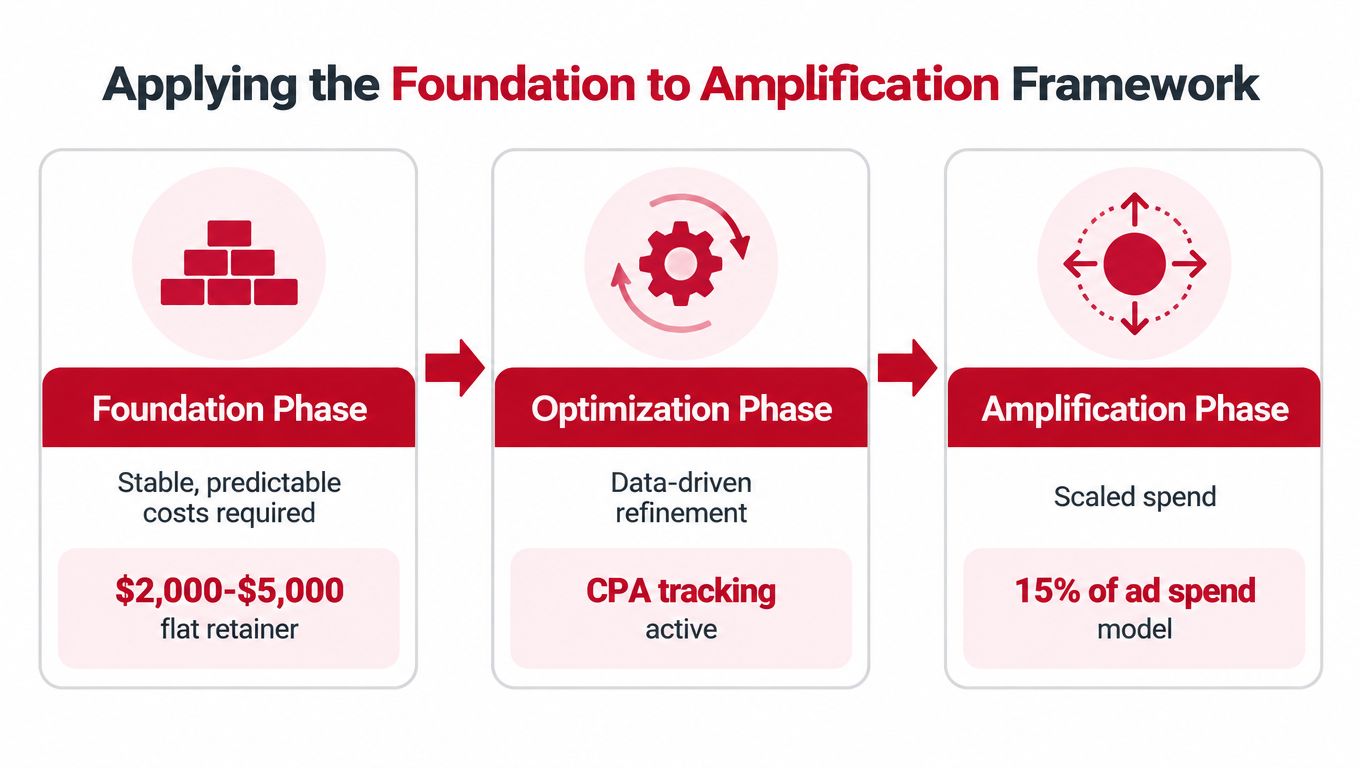
Optimization begins when the account has enough usable data to make controlled decisions. Search-term performance, placement economics, branded and nonbranded demand, category targeting, product targeting, and conversion changes can then guide budget shifts.
This phase benefits from flexible scope more than automatic fee escalation. The provider may need to run tests, revise bids, improve product pages, adjust promotions, or change targets by SKU. A hybrid agreement can fund that work without making the brand pay a larger fee merely because media increased.
The commercial test is whether each change improves profitable contribution, not whether it raises a platform dashboard metric. If fulfillment costs rise or inventory becomes constrained, allowable ACOS may need to fall even when campaigns are converting.
Amplification comes after conversion, margin, and supply conditions support additional traffic. At this stage, a variable model can make sense if the contract measures the right outcome and excludes factors the provider cannot control.
The brand should still protect against automatic scaling. Additional spend must pass three checks:
A percentage-of-spend model may be workable here, but it should remain connected to scope and accountability. More budget doesn't automatically mean more strategy. If the provider adds marketplaces, expands the catalog, develops reporting, or takes responsibility for forecasting, the contract can price those scopes directly.
The framework is a reassessment cycle. Review the pricing arrangement when the catalog expands, a marketplace is added, inventory economics change, attribution improves, or the provider's responsibilities materially increase. Don't wait for the invoice to reveal that the commercial model no longer matches the work.
PPC management pricing should be evaluated as part of a marketplace profit system. The useful working session isn't a rate-card review. It's a review of contribution margin, fulfillment exposure, inventory velocity, channel economics, campaign scope, and the level of accountability your operator or agency agreement provides.
Qualified CPG founders and operators can use a free 30-minute call to identify where management fees, marketplace deductions, or media allocation are compressing profitable growth. Bring your current fee structure, major SKUs, marketplace mix, and recent advertising results so the discussion stays practical.
Reddog Consulting Group helps CPG brands connect PPC management with marketplace performance, contribution analysis, inventory planning, and growth decisions across Amazon, Walmart, DTC, and wholesale. Visit Reddog Consulting Group to book a free 30-minute strategy call focused on your margin model and next growth constraint, not a sales pitch.
Leave a comment: