
Published: March 2020 | Last Updated:October 2026
© Copyright 2026, Reddog Consulting Group.

A ranking drop can happen while your sales team is still hitting its weekly unit target. So why does the product become harder to find, and why does adding more advertising often fail to restore profitable visibility?
That question matters to CPG operators because Amazon ranking isn't an isolated SEO metric. It affects inventory velocity, advertising efficiency, contribution margin, reorder planning, and the amount of working capital tied up in stock. The seller community calls Amazon's evolving search system the Amazon A10 algorithm, but the useful question isn't whether Amazon officially calls it A10. The useful question is which customer and commercial signals now determine durable visibility.
Why does a product lose visibility after sales have appeared stable, and why can higher bids fail to restore profitable growth?
A common CPG pattern starts with strong organic placement for primary terms. Sales remain steady, so the team builds a purchase order around that demand. Then visibility softens. Organic units decline, paid impressions become more expensive, and the brand responds by increasing bids or broadening match types.
That response may produce a short-term traffic lift, but it can also conceal the operating issue. If shoppers click without converting, the listing attracts the wrong audience, or the product goes out of stock during the recovery effort, the brand spends more while weakening the economics supporting its ranking.

Amazon's Amazon A10 algorithm is best understood as the seller community's label for an evolution of Amazon search, not as an official Amazon product name. Amazon has never publicly used the term, as Feedvisor's analysis of Amazon search evolution notes. Neutral analysis places the transition across the 2020 to 2023 period, with the system moving beyond a simple sales-velocity model toward a broader intent-and-satisfaction model involving customer behavior, seller authority, and external traffic.
For a CPG brand, that distinction changes the response. A ranking decline does not automatically justify more advertising. It may indicate:
Practical rule: Do not treat a ranking drop as recoverable until you know whether the product can convert profitably and remain in stock.
A CPG operator has to protect more than revenue. Each unit carries product cost, freight, marketplace fees, fulfillment expense, promotional cost, and advertising allocation. If visibility improves only because the brand is buying unprofitable demand, reported growth can rise while cash available for the next production run falls.
The evolved system favors durable demand quality over isolated traffic spikes. That makes operational discipline part of search performance. Pricing, pack architecture, replenishment timing, review quality, and external demand all affect whether a listing can turn attention into repeatable sales.
Inventory velocity also changes the decision. A ranking recovery that exhausts available stock may create a brief lift followed by lost sales, weaker customer experience, and another visibility problem. Conversely, protecting stock without checking contribution margin can tie up working capital in demand that advertising cannot profitably support.
Amazon SEO therefore belongs in the same operating review as contribution margin, break-even ACOS, and replenishment planning. A brand that diagnoses ranking through those measures has a better chance of fixing the underlying problem than one that just raises its daily budget.
Amazon A10 visibility is shaped by conversion rate, sales velocity, click-through rate, reviews, inventory stability, seller authority, and external traffic. Analysts commonly place conversion rate, sales velocity, and CTR among the strongest signals, while seller performance and traffic from outside Amazon receive more attention in newer discussions. The Stacc's guide estimates that external traffic contributes roughly 15–20% of ranking influence in the evolved system. The Stacc's guide to Amazon SEO provides that estimate and its broader ranking framework.
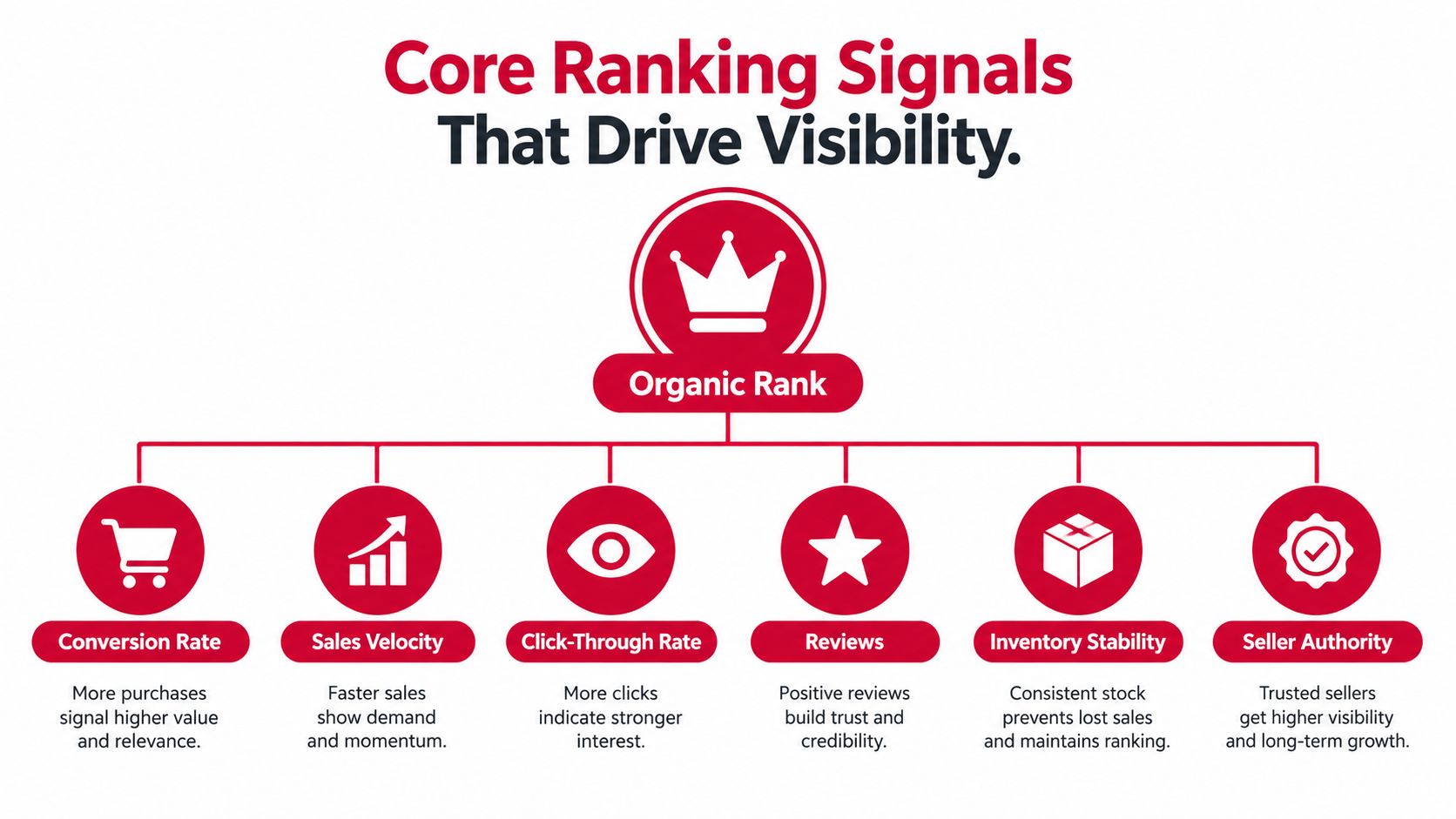
Conversion rate is the ranking signal most closely tied to unit economics. It shows whether the listing satisfies the shoppers it attracts, while also changing the cost of every traffic source. A higher conversion rate can support a healthier break-even ACOS because advertising expense is spread across more completed orders. If conversion improves only after a discount that removes contribution margin, the ranking gain may not justify the cost.
Sales velocity still matters, but operators should evaluate it as a sustained pattern rather than a single-day target. Seller Sprite's analysis discusses sales velocity across 7-day, 30-day, and 90-day windows, giving brands a way to separate a short promotion from a more durable demand base. Seller Sprite's analysis of the Amazon A10 algorithm also connects ranking evaluation with broader customer and listing behavior.
A product can sell quickly during a discount, then stall when the offer ends. That pattern may create temporary momentum while weakening contribution margin and distorting the demand forecast. Steadier organic sales, reliable availability, and healthy conversion give Amazon stronger evidence that the offer deserves continued visibility.
Click-through rate links search-result presentation to detail-page traffic. Main image quality, title clarity, price positioning, review presentation, and search-result relevance all influence whether shoppers click. High click volume alone does not prove quality. Poorly matched traffic can increase visits without producing orders, leaving advertising and inventory costs with little return.
Reviews affect initial trust and the customer feedback loop. Review sentiment and freshness help indicate whether the product continues to satisfy buyers. For consumables, dissatisfaction can reduce repeat purchases, increase returns or complaints, and force the brand to replace lost demand through paid traffic. That pressure can push actual ACOS above the level the product can support.
External traffic may come from search, social content, email, affiliates, or influencers. The operating test is whether those visitors arrive with a clear product need and convert without an uneconomic discount. External sessions that produce profitable orders can support both ranking and inventory velocity. Traffic that requires heavy incentives may improve visibility while consuming cash needed for replenishment.
Inventory stability affects ranking and cash planning at the same time. A stockout interrupts sales velocity, wastes advertising momentum, and leaves the next forecast based on a distorted sales history. Overstock creates the opposite problem by tying up working capital and potentially forcing markdowns that weaken price architecture. Replenishment timing therefore belongs in the ranking review, especially for products with long production or freight lead times.
Seller authority reflects the confidence Amazon can place in the seller and offer. Fulfillment consistency, customer experience, account performance, listing accuracy, and Buy Box strength depend more on execution than on keyword research. A ranking plan that ignores these controls can generate traffic the operation cannot serve reliably.
Seller Sprite's analysis identifies natural-language relevance, review sentiment and freshness, FBA fulfillment, in-stock consistency, and engagement signals such as time on page, scroll depth, image zooms, and video views as part of the evaluation. Its findings are useful when auditing a listing beyond keyword fields.
For a broader explanation of how ranking connects with seller performance, see Amazon seller ranking and marketplace visibility. The practical conclusion is straightforward: review search signals alongside conversion, break-even ACOS, contribution margin, and inventory velocity before increasing traffic or promotional spend.
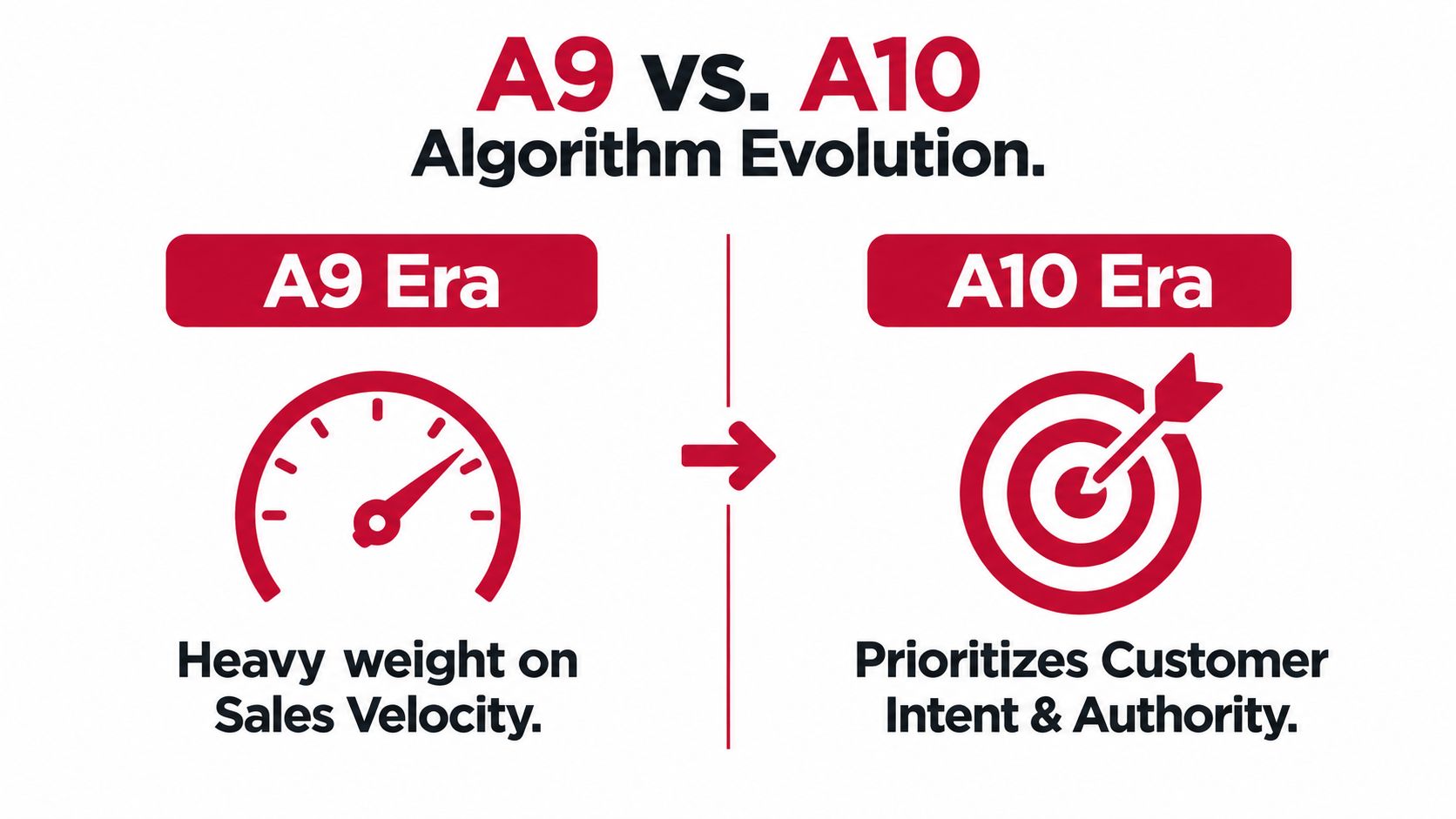
The older A9 model is commonly described as heavily centered on sales velocity. That shorthand encouraged a familiar playbook: generate sales through advertising, increase velocity, gain organic placement, and use the stronger placement to generate more sales.
The A10 label describes a broader system. It still values sales, but it places more emphasis on why the sale happened, how well the product satisfied the shopper, whether the seller can fulfill demand, and whether demand exists beyond paid placement.
| Operating question | A9-era assumption | A10-era implication |
|---|---|---|
| What creates momentum? | Sales velocity was treated as the dominant lever. | Sales still matter, but conversion quality, customer behavior, and demand durability carry more weight. |
| How do ads help? | Paid sales could be used to build ranking momentum. | Paid traffic can support discovery, but it can't replace organic demand and efficient customer behavior. |
| What role does external traffic play? | Traffic outside Amazon was often treated as separate from marketplace SEO. | External visitors who convert can contribute to marketplace visibility. |
| How is the seller evaluated? | Product-level sales performance received most attention. | Seller authority, fulfillment, reviews, and account-level confidence matter more. |
| What happens when conversion weakens? | More traffic and more bids were common responses. | More traffic can intensify the problem if the offer fails to satisfy shoppers. |
A separate 2026 industry guide states that organic sales now carry more ranking weight than ad-driven sales, meaning paid traffic alone isn't enough to sustain organic visibility. The same guide identifies external traffic, seller authority, CTR, conversion rate, review quality, and inventory consistency as meaningful signals. Feedvisor's product search analysis supports that distinction.
That doesn't make PPC irrelevant. It changes the job PPC has to perform. Paid media should help capture profitable demand, test search terms, support launches, defend important placements, and create qualified traffic. It shouldn't be expected to permanently compensate for weak content, poor pricing, low review confidence, or an unreliable supply position.
A CPG brand that maintained rank through aggressive advertising may see organic visibility weaken when the budget is reduced. The issue isn't just that spend stopped. The issue is that the paid activity wasn't generating enough durable customer behavior to support the listing without it.
A shopper who clicks an attractive image but discovers an unsuitable pack size, unclear ingredients, or a price that doesn't match expectations may leave without purchasing. That click can increase traffic while doing little for conversion or margin.
The A10-era operating question is therefore more demanding: Does the listing attract the right shopper and give that shopper a credible reason to buy now? CPG brands need to align the title, images, bullets, product facts, price, reviews, and fulfillment promise around that answer.
This is also why external traffic has a trade-off. A creator, email list, or social campaign can generate qualified demand, but a poorly matched audience can produce clicks without purchases. External traffic works best as an extension of product-market fit, not as a substitute for it.
A practical Amazon growth program should follow a sequence: Foundation, Optimization, then Amplification. The order protects margin and inventory before the brand increases demand.
Start with the listing and the offer. Confirm that the product is indexed for relevant natural-language searches, that the main image communicates the product immediately, and that the detail page answers the questions that stop a shopper from buying. A content audit should cover titles, bullets, images, A+ modules, variation structure, attributes, and compliance.
Amazon's current ranking inputs include natural-language keyword relevance and on-page engagement, so stuffing synonyms into a title isn't a substitute for clear product communication. Amazon listing optimization guidance is a useful reference for reviewing the page as a selling asset rather than a keyword container.
Then stabilize the commercial basics:
Once the foundation is stable, test the elements most likely to improve conversion. Start with the main image and price because shoppers encounter both before reading the full page. Then test image sequencing, use-case photography, comparison content, product education, and A+ modules.
The break-even ACOS calculation should sit beside every advertising decision:
Break-even ACOS = contribution dollars available for advertising divided by attributed sales revenue.
Contribution dollars should account for product cost, freight, marketplace fees, fulfillment, discounts, returns, and other variable costs. If the brand calculates ACOS against revenue while ignoring those costs, it can mistake unprofitable volume for growth.
A conversion improvement can make the same advertising program more efficient, but only if the additional orders remain contribution-positive. Don't approve a discount or creative test because it raises conversion in isolation. Check whether the resulting order economics support replenishment, retailer pricing, and cash flow.
External traffic belongs after the listing can convert. Use social content, email, creator partnerships, affiliate activity, and brand-owned audiences to introduce qualified shoppers to the product. Give each source a clear measurement plan and compare traffic quality, conversion, net contribution, and organic movement.
The operating dashboard should include:
Amplification works when the business can turn qualified attention into repeatable, profitable demand. If the external campaign requires permanent discounts or creates a stockout, it may improve a ranking report while weakening the business.
The most expensive A10 mistake is treating visibility as the objective instead of treating profitable demand as the objective. A brand can increase impressions, clicks, and attributed sales while losing money on every order after fulfillment, fees, discounts, and advertising.

PPC is useful, but a brand that relies on it for every unit is exposed. If paid traffic stops converting efficiently, the team may raise bids to preserve placement. That can produce more expensive sales without repairing the listing or strengthening organic demand.
The better test is to separate paid contribution from organic contribution. Review whether organic units hold when bids normalize, whether conversion remains healthy without a promotion, and whether the product has enough review confidence to earn clicks at its price.
A discount can improve conversion and inventory velocity, but it reduces realized revenue per order. In CPG, the impact can extend beyond Amazon. A lower marketplace price may complicate wholesale relationships, retailer negotiations, or the brand's direct-to-consumer price architecture.
Before using a promotion to influence ranking, calculate the full contribution outcome. Include the discount, fulfillment cost, marketplace fees, advertising, returns, and the potential cost of pulling demand forward from a future purchase. A promotion that clears inventory can be rational. A permanent discount used to disguise a weak offer is usually harder to defend.
Maintaining availability across Amazon, Walmart, DTC, wholesale, and distribution creates allocation trade-offs. Sending every available unit to Amazon may protect ranking while leaving another channel unable to fulfill orders. Holding too much stock in FBA may protect availability but increase storage exposure and working-capital pressure.
FBA and WFS can also produce different break-even calculations because fulfillment, storage, referral, and service costs vary by marketplace and product configuration. Don't compare the headline fee alone. Model the complete order-level cost, then assess how each channel affects velocity, margin, customer ownership, and replenishment risk.
Growth that cannot be replenished is not a strategy. It's a temporary demand event.
A contribution-margin-first approach doesn't reject growth. It identifies which growth the supply chain and income statement can support.
Ranking health needs a dashboard that connects visibility to cash generation. Weekly reporting should focus on movement and exceptions. Track target keyword rank, organic impressions, CTR, conversion rate, paid and organic unit share, advertising spend, ACOS, contribution margin after advertising, in-stock status, and inventory velocity.
Monthly reporting should answer the larger questions: Is the product gaining durable organic demand? Is repeat purchase behavior improving? Are promotions creating profitable customers or just shifting timing? Is the channel producing acceptable margin after fees, fulfillment, discounts, returns, and media?
Impressions and clicks are useful diagnostic metrics, but they aren't business outcomes. The value metrics are conversion rate, contribution margin, repeat purchase rate, net margin after fees, and inventory turnover. A product can lose impressions and still improve if it attracts fewer, more qualified shoppers at a stronger margin. It can also gain visibility while becoming less profitable.
For teams that need a clearer way to consolidate SEO and visibility reporting, a SEO reporting tool can help organize trend data alongside marketplace metrics. The tool doesn't replace contribution analysis, but it can reduce the gap between ranking observations and operating decisions.
Use Amazon ranking tracking for omnichannel growth as a starting point for connecting marketplace visibility with broader channel planning.
If a product is ranking but losing money, the problem is economic. If it has healthy margin but inconsistent availability, the problem is operational. If both are sound but visibility remains weak, return to relevance, conversion, reviews, and qualified traffic before increasing spend.
Reddog Consulting Group helps qualified CPG founders and operators review Amazon performance through the lens of contribution margin, inventory velocity, ranking health, and channel economics. Book a free 30-minute strategy call with Reddog Consulting Group for a working session focused on marketplace performance, margin improvement, or practical growth planning, not a sales pitch.
Leave a comment: