
Published: March 2020 | Last Updated:January 2026
© Copyright 2026, Reddog Consulting Group.

An Amazon suspension feels like the floor has dropped out from under your business. One minute you're selling, the next your revenue is frozen and your entire omnichannel operation grinds to a halt. The key to getting back online is a calm, methodical response—panicked, emotional appeals almost never work. Your first and only goal is to diagnose what went wrong, secure your data, and build a rock-solid, fact-based case for your appeal.
That "Your Amazon.com selling privileges have been removed" email can stop your heart. Before you do anything else, breathe. A knee-jerk reaction, like firing off a furious email or trying to open a new account, will only dig a deeper hole. Your path to reinstatement begins with a calm, deliberate process in the first 60 minutes. This is the Foundation phase of your recovery, and it sets the stage for every step that follows.

First things first: open that suspension notification and read it. Then read it again. And a third time, just to be sure. Amazon's language can be frustratingly vague, but the clues are in there. Your mission is to identify the general category of the violation.
Does the notice mention specific metrics like Order Defect Rate (ODR) or Late Shipment Rate (LSR)? That's a clear sign you're dealing with a performance issue.
If it brings up intellectual property (IP) complaints, product authenticity, or restricted products, you're looking at a policy violation. The third common reason is a related account suspension, where Amazon's bots have linked you to another suspended seller. Pinpointing which of these buckets you fall into is your first critical step.
Before you even think about drafting an appeal, you need to stop the bleeding and gather your evidence. This checklist protects your business and sets you up for the deep dive required to build a winning Plan of Action (POA).
Here's what to do in that first hour:
A hasty, poorly researched appeal is the fastest way to get a permanent "no." The time you invest right now in methodical diagnosis and evidence gathering will directly impact the success of your reinstatement.
For a bird's-eye view of the entire reinstatement journey, check out a comprehensive guide to Amazon Seller Account Reinstatement. This initial legwork lays the foundation for a persuasive appeal that addresses the specific failures Amazon cares about.
Amazon’s suspension notice is rarely the full story. Think of it as a symptom, not the disease. Your job is to play detective and trace that symptom back to its true origin. This investigation is the absolute Foundation of a successful appeal. Amazon doesn’t want apologies; they want proof you’ve found a systemic failure and have implemented a measurable fix.
Generally, suspensions fall into three buckets: performance metrics, policy violations, or the dreaded "related accounts." A vague, one-size-fits-all POA that misdiagnoses the problem is a fast track to a final denial.
To get started, it helps to know what Amazon's automated systems are looking for. These are the tripwires that most often lead to an account review or outright suspension. The table below breaks down the most common triggers and the thresholds you need to stay under.
| Suspension Category | Specific Trigger | Amazon's Threshold | Example Scenario |
|---|---|---|---|
| Performance Metrics | Order Defect Rate (ODR) | > 1% | A seller receives multiple A-to-z claims and negative reviews in a short period, pushing their ODR to 1.5%. |
| Performance Metrics | Late Shipment Rate (LSR) | > 4% | A 3PL partner experiences delays, causing a seller to miss shipment confirmation deadlines for 50 out of 1000 orders. |
| Performance Metrics | Valid Tracking Rate (VTR) | < 95% | A seller manually enters tracking numbers and makes typos, causing Amazon's system to mark them as invalid. |
| Policy Violations | Inauthenticity Complaints | Zero Tolerance | A customer complains a product "doesn't seem real," triggering a request for invoices, even if the item is genuine. |
| Policy Violations | Intellectual Property (IP) Complaints | Zero Tolerance | A brand owner files a complaint alleging a seller is using their trademarked images or brand name without permission. |
| Related Accounts | Linked to a Suspended Account | Zero Tolerance | A seller logs into their account from a shared office Wi-Fi that was previously used by another, now-suspended seller. |
Understanding these triggers is your first step. It helps you focus your investigation on the areas that matter most to Amazon's performance teams. Don't just assume—use these metrics as a guide to start digging into your data and operations.
If the notice mentions things like Order Defect Rate (ODR), Late Shipment Rate (LSR), or Valid Tracking Rate (VTR), your investigation starts with customer data. Don't just glance at the numbers on your Account Health Dashboard. You need to get your hands dirty.
Export the raw data and start looking for patterns. We always recommend pulling everything into a spreadsheet—all negative feedback, A-to-z claims, and return comments from the last 90 days.
We once saw a seller’s ODR spike. They assumed a general quality issue, but a deep data dive revealed 80% of complaints were for a single ASIN, all mentioning "broken safety seals." The root cause wasn't poor quality; it was a specific packaging failure. That's the level of detail Amazon needs.
When a suspension is for an inauthenticity claim or another policy violation, your focus shifts from customers to your supply chain. You have to prove, beyond a shadow of a doubt, that your products are legitimate and that you have the right to sell them.
This means a full-scale audit of your paperwork. Most suspensions today are tied to documentation. Consulting teams report that inauthenticity and IP complaints remain the single largest cause of suspensions, beating out pure performance failures. One firm analyzing its own data noted over 600 successful account reinstatements, with a huge share tied to sellers who couldn't provide Amazon-compliant invoices—only retail receipts. You can read more about the leading causes of account suspensions.
This shows a brand can be 100% legitimate yet still be suspended because its documentation fails Amazon’s strict standards.
Gather every invoice for the ASINs in question and check them against Amazon’s list of requirements:
Submitting retail receipts or pro-forma invoices is a fatal mistake. Amazon sees them as invalid. You absolutely need legitimate wholesale invoices from verifiable suppliers to prove your supply chain is clean.
A "related account" suspension is often the most frustrating because Amazon rarely explains the connection. It's on you to retrace every digital and physical step your business has taken.
Grab a whiteboard and start brainstorming every possible link, no matter how tiny it seems:
We once worked with a seller who was suspended because their VA also worked for another banned account. The link was the VA's IP address. It was only by meticulously reviewing who had account access that they could identify the connection and explain it to Amazon. This kind of deep, honest investigation is non-negotiable for getting your suspended Amazon account back online.
Your Plan of Action (POA) is the single most important document you'll create to get your Amazon account back. Forget long apologies or emotional pleas—this isn't the place for them. Think of it as a formal business case for your reinstatement. It needs to be a sharp, professional, and easily scannable document that proves you know exactly what went wrong and have built a system to prevent it from ever happening again.
The biggest mistake sellers make is grabbing a generic template off the internet. Amazon’s review teams see thousands of these, and a copy-paste POA is a surefire way to get rejected. A powerful appeal is built from the ground up, using the data you uncovered during your diagnosis to create real, systemic solutions. This is where you Optimize your appeal for the best shot at success.
The first step is always diagnosis. You have to figure out why you were suspended before you can even think about writing. Were you hit for performance metrics, a policy violation, or a related account issue?
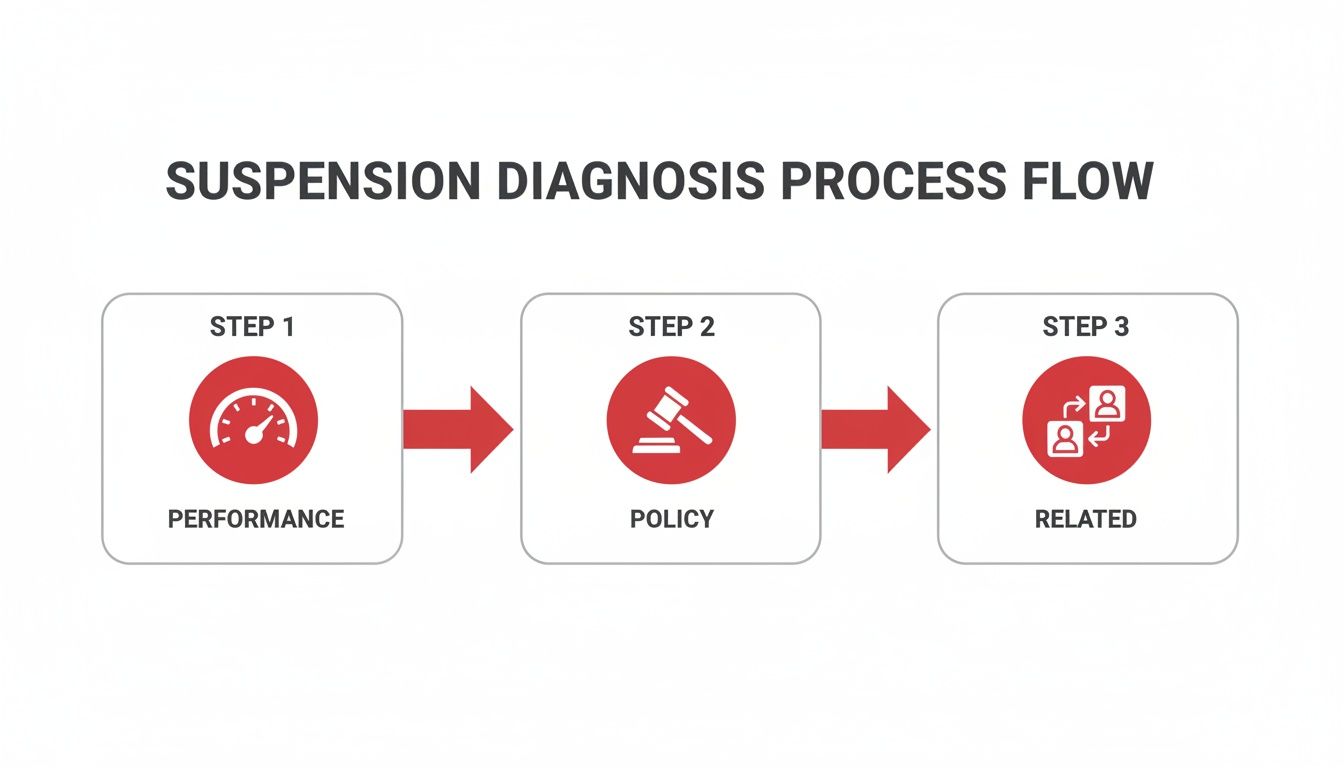
This process shows that a successful POA must directly address the specific suspension category. After all, the fixes for a high Order Defect Rate are completely different from the solutions for an intellectual property complaint.
Every successful POA we've ever seen, regardless of the suspension reason, is built on the same rock-solid foundation. You absolutely must structure your appeal into three distinct, clearly labeled sections. This format isn't just a suggestion; it’s what Amazon investigators are trained to look for. It makes it dead simple for them to find the information they need to approve your reinstatement.
Using this structure signals to Amazon that you understand their process and respect their time. Anything else is likely to get your appeal tossed aside without a full read-through. It’s a non-negotiable framework.
This is where most sellers get it wrong. Vague admissions like "we made a mistake" are worthless to an Amazon investigator. You have to prove you’ve done a deep dive into your operations and found the exact systemic failure that led to the suspension.
Weak Root Cause Example
"We realize our Order Defect Rate was too high because of some negative customer feedback."
This tells the reviewer nothing they don't already know. It demonstrates low effort and a lack of accountability.
Strong Root Cause Example
"The root cause of our elevated Order Defect Rate (exceeding the 1% target) was negative feedback on ASIN B012345XYZ. After investigating customer comments from May 1 to June 15, we identified that 75% of complaints for this SKU mentioned 'arrived with broken safety seal,' which points to a critical packaging failure in our outbound fulfillment process."
The strong example is data-driven, specific, and identifies a precise operational breakdown. It proves you’ve actually done the work.
Once you've nailed down the root cause, you have to show Amazon you’ve already cleaned up the mess. This section isn't about what you plan to do; it’s about what you have already completed. Always write in the past tense here.
The strong examples are active, detailed, and even provide verifiable proof, like that removal order ID. They show you took decisive action to solve the problem for every customer who was affected.
Finally, you need to convince Amazon that this problem is history. This section is all about the future. It must detail the new processes, tools, or training you’ve implemented to make your business more resilient. This is your chance to show you’ve made real, systemic upgrades.
A common mistake here is making vague promises. For instance, instead of just saying, "I will monitor my account health more closely," get way more specific.
"To prevent future performance notifications, we have implemented a mandatory daily check of our Account Health Dashboard. This task is scheduled for 9 AM EST each morning and assigned to a specific team member, whose performance will be reviewed weekly."
Think about how you can build a truly bulletproof operation.
Your goal is to leave the reviewer with zero doubt. They need to walk away confident that you’re a professional seller who has taken this issue seriously and built a better, more compliant business as a result. If you’re dealing with a complex case and aren’t sure how to build this kind of argument, exploring professional Amazon reinstatement services can provide the expert guidance needed to craft a POA that gets results.
Submitting your Plan of Action is a huge step, but it’s often just the start of the conversation with Amazon. The waiting game that comes next can be one of the most stressful parts of getting your account back. Knowing what to expect—and how to respond—is everything.
Once you hit "Submit," your POA goes into a queue for Amazon’s Seller Performance team. There's no secret timeline here. You can usually expect an initial response within a few days to a week, but don't be surprised if complex cases take much longer.
The absolute worst thing you can do right now is bombard Seller Support with follow-up emails. Every new message can reset your spot in the queue, pushing you to the back of the line. Patience is your best friend here. Trust that you’ve done the work and wait for their official response.
Amazon’s replies are notoriously brief and can feel cryptic. They generally fall into one of three buckets: reinstatement, denial, or a request for more information.
If Amazon asks for more information, your next move is critical. Don't just tweak a few words in your original POA and send it back. You need to draft a clear, targeted addendum that directly answers their questions.
For example, if they want more detail on your preventative measures, you need to go deep. Revise that section to be painfully specific, adding new processes or tools you’ve put in place since your first submission. This proves you’re engaged, responsive, and taking their feedback seriously.
So, what happens if your revised POA also gets denied? This is where many sellers give up, but it’s often the point where you need an escalation strategy. It's time to get your case in front of the right decision-makers.
If you find yourself stuck in a loop of automated replies or getting nowhere with the initial support teams, it might be time to escalate. This involves reaching out to specialized internal teams at Amazon—the ones with more authority to review and overturn decisions.
An effective escalation isn't about spamming more emails. It’s a strategic move. It requires a clear, evidence-based argument and a solid understanding of how Amazon’s internal structure works. You’re showing them that the initial review missed key facts or that your case deserves a higher-level look.
This has become more common as Amazon’s enforcement gets more complex. We’ve seen suspensions increasingly influenced by macro events and policy crackdowns. Beyond the pandemic-era chaos, legal experts report a rise in Section 3 “bad actor” and compliance suspensions, which often demand video verification and multi-step appeals.
To give you an idea of how high-stakes these cases have become, one law firm recently handled 100+ escalations to specialized Amazon teams, 51 pre‑arbitration letters, and 31 formal legal letters. You can discover more insights about the complexities of Amazon suspensions.
Navigating this path on your own is tough. For many brands, this is the moment to bring in a professional who understands these channels. It can truly be the difference between getting reinstated and a permanent ban.
Getting your suspended Amazon account back is a huge relief, but it’s a fire you never want to have to put out again. The real win isn’t just reinstatement; it’s building an operation so tight that you never have to write another Plan of Action. This is your chance to Amplify your brand by turning a painful lesson into a powerful long-term advantage.
A healthy account isn't just about avoiding trouble. It's the bedrock of sustainable growth, giving you the confidence to scale your omnichannel strategy without constantly looking over your shoulder. Now is the time to fortify every process and make your brand resilient.

The best way to dodge a suspension is to see it coming. This means your Account Health Dashboard can no longer be a place you only visit when things go wrong. It needs to become a daily checkpoint—your brand’s command center.
Amazon's enforcement works at a massive scale, with reports of over 600,000 seller accounts suspended globally in a single year. Most of these suspensions boil down to three main areas: performance, policy violations, and related accounts. The performance metrics are especially unforgiving. An Order Defect Rate over 1%, a Late Shipment Rate over 4%, or a Pre-fulfillment Cancel Rate creeping past 2.5% can all put your account on the chopping block.
A daily 10-minute review of this dashboard is a non-negotiable part of a healthy operation. If you see any metric trending in the wrong direction, jump on it immediately. Don't wait for the warning banner to turn from yellow to red.
Inauthenticity claims are one of the fastest ways to get shut down, even if your products are 100% genuine. The problem, more often than not, isn't your product—it's your paperwork. To truly bulletproof your supply chain, your documentation has to meet Amazon's exact, and often frustratingly specific, standards.
Get organized now. Create a digital, cloud-based folder for every single supplier you work with. Each folder should contain:
Having this system in place means you can respond to an Amazon request for documentation in minutes, not days. It projects professionalism and compliance.
A suspension is a harsh but effective teacher. The brands that emerge stronger are the ones that use the experience to audit every process, from sourcing to shipping, and replace weak links with ironclad systems.
Account health is a team sport. Every single person who touches your Amazon business—from customer service reps to your warehouse crew—needs to be trained on Amazon’s constantly changing policies. Hold quarterly refreshers on the policies most relevant to their roles to keep everyone sharp.
Beyond training, you need to set up your own early-warning system using technology.
This proactive approach completely changes the game. Instead of waiting for Amazon to flag a problem, you’re identifying and solving it yourself—long before it ever hits their radar. This is the heart of effective Amazon account management and the key to long-term, uninterrupted growth.
When that suspension notice hits your inbox, it's natural for your mind to start racing. Your revenue is on hold, your inventory is stranded, and the next steps feel like a total mystery. Let's cut through the noise and tackle the most common questions we hear from sellers in your exact situation.
There’s no magic number here. The timeline depends entirely on the complexity of the issue that led to the suspension.
For simpler issues, like a minor dip in performance metrics addressed with a solid Plan of Action (POA), you might get reinstated in as little as 24-48 hours.
But if you're dealing with something more serious—like intellectual property (IP) complaints, inauthenticity claims, or a related accounts flag—be prepared for a longer process. These cases can easily drag on for weeks, and sometimes even months. The single biggest factor that speeds things up is getting your first appeal right. A clear, honest, and thorough POA from the start makes all the difference.
Let me be crystal clear: absolutely not. Trying to open a new seller account to sidestep a suspension is one of the fastest ways to get permanently banned from the platform.
Amazon is incredibly good at connecting the dots. They use hundreds of data points to link accounts, from the obvious stuff like bank details and IP addresses to more subtle things like device IDs and user permissions. If they catch you, they won't just shut down the new account; they'll almost certainly ban the original one for good. Don't do it. Your only path forward is to focus on appealing the existing suspension.
The language Amazon uses is important, and it's critical to know where you stand. Each term means something very different for the future of your brand on the platform.
If your account is permanently banned, Amazon typically holds your funds for 90 days. This buffer period is used to cover any potential A-to-z claims, chargebacks, or customer refunds that might arise after they've shut you down.
Once that 90-day window closes, you can usually request a disbursement of your remaining balance. But there's a huge catch: if you were suspended for illegal activity, like selling counterfeit products, Amazon can and will withhold your funds permanently.
A suspended Amazon account feels like a crisis, but it doesn't have to be the end of your brand. With a calm, methodical approach and the right expertise, getting back online is entirely possible. The team at RedDog Group lives and breathes this stuff. We know how to dig into the root cause, write an appeal that gets Amazon’s attention, and help you rebuild your account health for good.
If you’re staring at a suspension notice and aren't sure what to do next, Let’s Talk Growth.
Leave a comment: