
Published: March 2020 | Last Updated:January 2026
© Copyright 2026, Reddog Consulting Group.

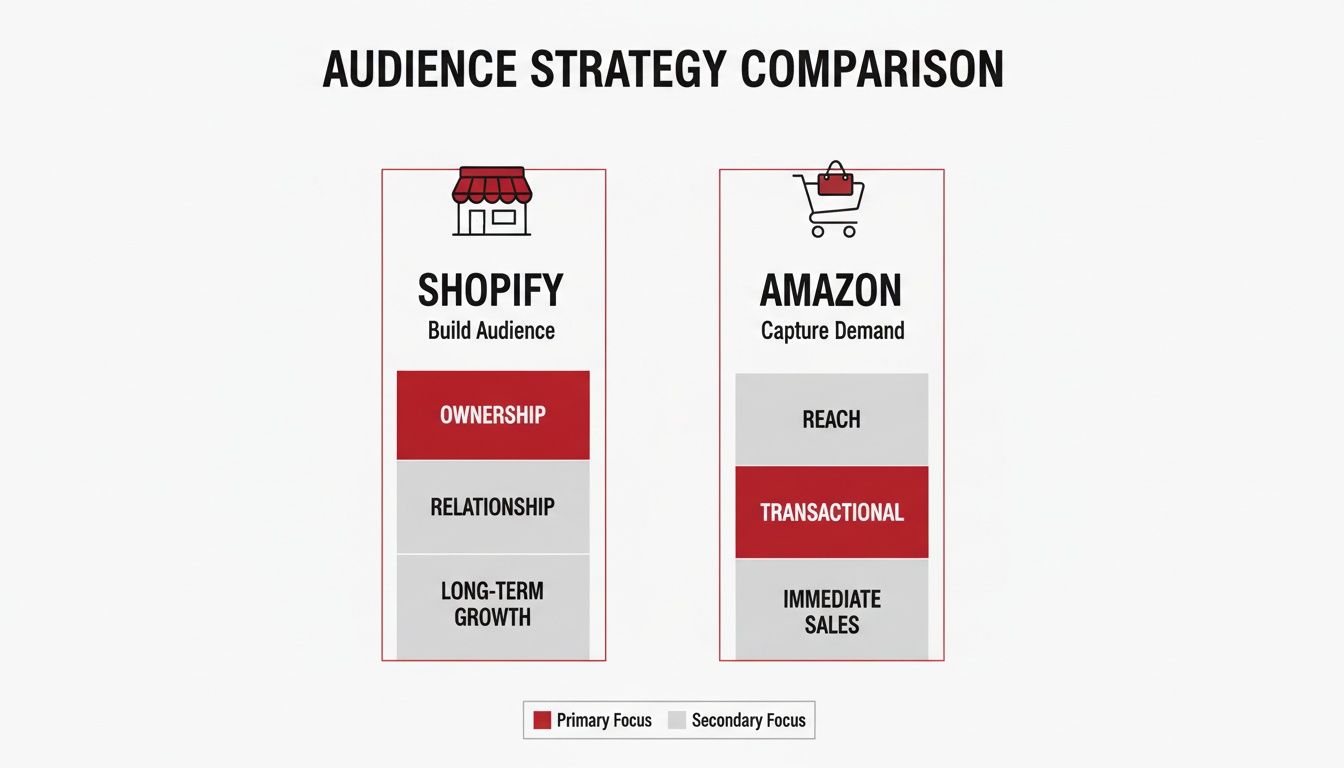
The Shopify vs. Amazon debate boils down to a critical strategic question: do you want to build a brand asset you own, or rent access to a massive audience that belongs to someone else?
Think of Shopify as the foundation for building your own branded ecosystem, where you forge direct, profitable relationships with customers. In contrast, Amazon is a powerful channel for capturing existing, high-intent demand on the world's largest marketplace. For ambitious brands, the answer isn't "either/or"—it's about leveraging both to create a powerful growth engine.
Choosing between these two platforms isn't just a technical decision; it's a fundamental choice that shapes your entire growth strategy.
Imagine Shopify as building your flagship store. You own the property, design the layout, and control every aspect of the customer experience. You're responsible for driving every visitor through the door, but the long-term value you create—customer data, brand equity, and direct relationships—is yours to keep. This is the Foundation of a resilient brand.
Selling on Amazon is like opening a pop-up shop inside the Mall of America on Black Friday. You get immediate access to millions of shoppers ready to buy, but you're renting the space. You must follow the mall's rules, and you have limited opportunity to build a lasting connection with your buyers. It's a powerful tool for Amplification and capturing transactional demand.
This distinction is central to how you'll scale. Your choice here sets the trajectory for your brand's profitability and long-term value.
The right path depends on your priorities: brand control, customer data ownership, or immediate sales velocity. Do you want to own the entire customer journey or simply the transaction?
Before we dive deeper, here’s a high-level look at how these two platforms stack up from an omnichannel growth perspective.
| Key Factor | Shopify: The Brand Builder | Amazon: The Demand Capturer |
|---|---|---|
| Primary Goal | Build a long-term brand asset and own the customer relationship. | Capture immediate sales from a massive, high-intent audience. |
| Customer Data | Full ownership of customer data for retargeting, email marketing, and LTV analysis. | Very limited access; Amazon owns the customer relationship and data. |
| Brand Control | Complete control over branding, website design, and the customer experience. | Restricted branding within Amazon's template-driven product pages. |
| Traffic Source | You are responsible for generating all of your traffic (SEO, PPC, social media). | Tap into Amazon's built-in traffic of over 310 million active customers. |
Deciding where to focus your resources is a major decision with long-term financial implications. For a more detailed breakdown of the numbers, check out our guide on whether is it worth selling on Amazon.
To truly understand the Shopify vs. Amazon financial model, you have to look beyond the monthly subscription fee. The real story lies in the total cost of operation and how each platform's fee structure impacts your margins. It's a classic trade-off: predictable overhead versus variable, transaction-based costs.
When you sell on Amazon, you’re paying for access to its massive built-in audience, and that access comes with a complex web of fees that can quickly erode profitability. These aren't minor cuts; for many brands, Amazon's fees can consume 25-40% of total revenue, making margin management a constant battle.
The primary costs on Amazon extend far beyond the monthly seller fee. You need to budget for several layers of charges applied to every transaction.
This visual from Amazon gives a glimpse into the complexity of calculating FBA fees, which are influenced by every product's dimensions and weight.
The key takeaway is that every operational decision—from product packaging to inventory turnover—has a direct and immediate financial impact within the Amazon ecosystem.
Shopify’s cost structure is more straightforward, but it requires a different kind of investment—primarily in your own marketing and technology stack. Your costs are less about paying per transaction and more about funding the growth of your brand asset.
The core economic difference is control. With Amazon, fees are a variable cost of goods sold. With Shopify, marketing spend is an investment in acquiring a customer asset you own forever.
Your main expenses on Shopify typically include:
A critical point in the Shopify vs. Amazon choice is the pure economics of fees and margin control. Amazon’s Professional seller plan is about $39.99 a month, but with referral fees between 8% to 15% and FBA costs piling on top, your margins get squeezed. A brand doing $1 million a year in DTC revenue on Shopify could see tens, or even hundreds, of thousands of dollars in extra margin compared to a pure-play Amazon strategy.
Furthermore, owning your platform allows for strategic Optimization. For instance, you can turn Shopify support from a cost to a growth driver, transforming a reactive cost center into a proactive tool for retention and LTV growth—an advantage unique to the Shopify ecosystem.

Beyond fees, the single most significant difference between Shopify and Amazon lies in one question: who owns the customer relationship? This isn't just a philosophical point—it directly impacts your ability to build a sustainable, high-margin business. Your choice here defines whether you’re building a sales channel or a long-term brand asset.
Amazon provides incredible access to a massive audience of motivated buyers, but this access comes with a major trade-off. When a customer buys your product on Amazon, they are, first and foremost, Amazon's customer. The platform acts as a strict gatekeeper, controlling the data, communication, and overall experience.
Selling on Amazon means operating within a tightly controlled ecosystem. Your ability to express your brand’s unique identity is severely limited, pushing you toward a transactional relationship with buyers, not a relational one.
Here’s what that looks like in practice:
These constraints make it nearly impossible to build a direct line to your audience. You can't easily run retargeting campaigns, build an email list, or foster a community—all core activities that drive repeat business and maximize customer lifetime value (LTV). While programs exist to protect your brand, understanding what Amazon Brand Registry is and how it works is key to clawing back some control.
Shopify flips this model entirely. It provides the infrastructure to build your own digital storefront, putting you in complete control of every part of the customer journey. You are responsible for generating traffic, but every interaction becomes an opportunity to build brand equity.
With a Shopify store, you own the entire process from acquisition to post-purchase. This is where the platform's true power lies for ambitious direct-to-consumer (DTC) brands aiming for resilient, long-term growth.
The most valuable asset in modern retail isn't just your product; it's the first-party data you collect from your customers. Shopify lets you build this asset, while Amazon lets you borrow its audience.
This ownership translates into tangible, measurable advantages:
The contrast in the Shopify vs. Amazon debate is clearest here. As of 2025, Amazon commands an estimated 37.6% of the US ecommerce market, giving you access to hundreds of millions of shoppers. However, Shopify empowers you to own your traffic, customer data, and storefront—the cornerstones of building a resilient DTC business. This control is fundamental for executing an effective Optimization → Amplification strategy.
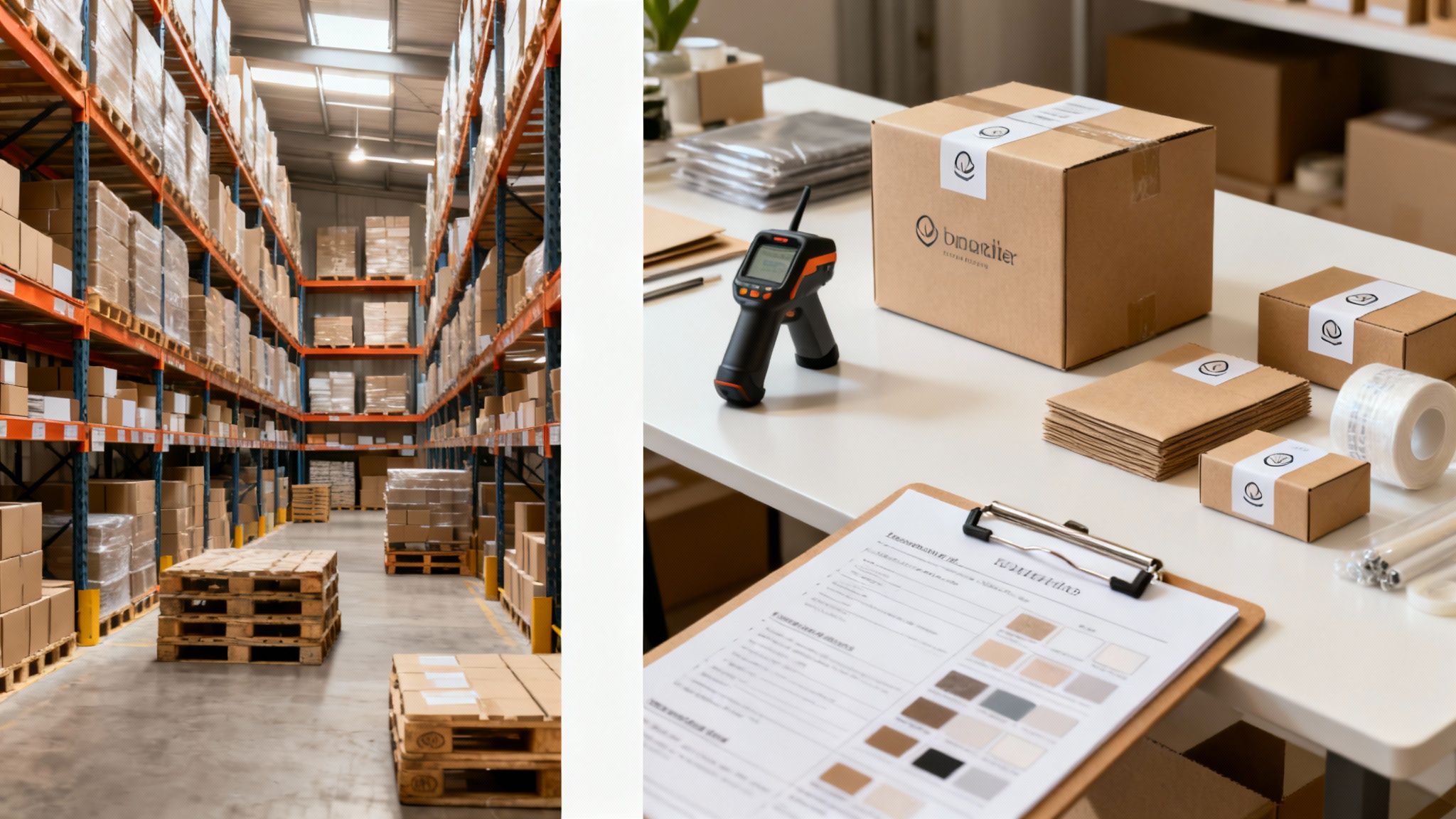
A robust omnichannel strategy is built on more than just clever marketing—it relies on seamless, reliable operations. How you deliver products to customers is a critical part of your brand promise. In the Shopify vs. Amazon comparison, this comes down to a fundamental choice: do you leverage Amazon’s world-class logistics machine, or do you build a more flexible, brand-centric fulfillment network?
This isn’t just about putting items in boxes. It's a strategic decision that shapes your costs, customer experience, and ability to scale. The right path depends on whether you prioritize turnkey convenience over brand expression at every touchpoint.
Fulfillment by Amazon (FBA) is an incredibly powerful, all-in-one logistics solution. You ship your inventory to an Amazon warehouse, and they handle everything else—storage, picking, packing, shipping, and even customer service for fulfillment-related issues.
The biggest benefit is access to the coveted Prime badge, a massive conversion driver. Amazon shoppers expect fast, free shipping, and FBA is the most direct way to meet that expectation. In fact, FBA sellers have a significant advantage in winning the "Buy Box," where over 80% of Amazon sales occur.
But this convenience comes with significant trade-offs:
Shopify operates on a different principle, offering strategic freedom instead of a one-size-fits-all solution. There is no mandatory fulfillment service. Instead, Shopify connects you to a vast ecosystem of third-party logistics (3PL) partners and fulfillment apps through its Shopify Fulfillment Network and app marketplace.
This approach puts you firmly in control. You can select a 3PL partner that specializes in your product category, whether it's apparel, perishable goods, or heavy furniture.
The core difference in logistics is control versus efficiency. FBA offers unmatched operational efficiency at the cost of brand control. A 3PL through Shopify allows you to design a fulfillment process that reinforces your brand identity from checkout to unboxing.
Choosing a 3PL partner in the Shopify ecosystem unlocks several brand-building advantages that are impossible with FBA:
Ultimately, the choice between FBA and a Shopify-centric 3PL model depends on your brand’s priorities. FBA is an incredible tool for capturing demand and leveraging Amazon's operational scale. A custom 3PL setup is an investment in building a brand experience you own from end to end, aligning perfectly with the Foundation → Optimization stages of omnichannel growth.
Once your brand enters the Amplification stage, the focus shifts from optimizing channels to scaling them. International expansion is a logical next step, but your approach will define your speed, costs, and brand control in new markets.
The Shopify vs. Amazon debate for global expansion presents two distinct philosophies. The choice isn't just about entering new markets; it's about deciding how your brand appears on the world stage. Do you leverage an existing logistics network for a rapid launch, or do you build a custom, localized experience from the ground up?
Amazon Global Selling is the express lane for testing and entering international markets with minimal upfront risk. It allows you to plug into Amazon’s established marketplaces across Europe, Asia, and beyond, providing immediate access to its massive customer base and trusted logistics network.
The primary advantages are speed and simplicity. With Amazon’s infrastructure, you can:
However, this speed comes at the cost of brand ownership. You remain a seller in Amazon's ecosystem, with little to no access to customer data, limited branding, and no direct communication channels. It’s an excellent tool for validating a new market but a poor one for building deep, lasting brand equity abroad.
For brands serious about building a durable global presence, Shopify Plus is the enterprise-grade solution designed for control and customization. Instead of just listing products in a new country, it provides the tools to create a fully localized and branded shopping experience for each target market.
This screenshot from the Shopify Plus features page highlights its focus on enterprise-level control, from customizable checkouts to dedicated expansion stores.
This platform is engineered for brands that need to manage complexity at scale, offering a level of deep customization that Amazon simply cannot match.
When you expand with Amazon, you're a guest in their international house. When you expand with Shopify Plus, you're building your own global network of flagship stores.
With Shopify Plus, you can build a sophisticated global architecture with features like:
A modern global strategy rarely treats Shopify vs Amazon as an either-or decision. The smartest brands use them together, creating a powerful synergy. This blended approach is becoming the standard, especially as global ecommerce is projected to hit 20.5% of worldwide retail sales in 2025 and climb to 22.5% by 2028.
For a partner like RedDog, this macro shift means brands targeting 25%+ year-over-year growth win by using Amazon for demand capture and trust, while using Shopify as the control center for brand equity, customer data, and cross-channel profitability. Learn more about these global ecommerce trends.
This hybrid model allows you to use Amazon Global Selling as a low-risk tool to test product-market fit. Once you’ve validated demand and gathered initial sales data, you can launch a dedicated Shopify Plus store for that region to begin building direct customer relationships and maximize long-term growth.
The Shopify vs. Amazon debate doesn't have a universal winner because they aren't direct competitors—they are different tools for different jobs in an omnichannel strategy.
The right choice depends on your business model, goals, and current stage of growth. Instead of a generic summary, let’s use a practical framework to determine the best path for your brand. This approach focuses on strategic fit to ensure your platform choice aligns with your long-term vision.
Shopify is the undisputed champion for brands focused on building a durable, long-term asset. It’s the platform you choose when your primary objective is to own the customer relationship and maximize lifetime value (LTV).
You're a Shopify-first brand if you:
For a Shopify-first brand, the platform isn’t just a sales channel; it's the central hub for your entire brand ecosystem. It’s the foundation you build and amplify your customer relationships on.
Amazon is the ideal launchpad for brands that need to validate demand quickly without a massive upfront investment. It’s the right move when speed to market and instant access to a huge, high-intent audience are more critical than deep brand building from day one.
For a deeper dive into the specific features and trade-offs, you can find a helpful resource in this article on Shopify vs Amazon: Which Platform Fits Your Store Best?.
You're an Amazon-first brand if you:
The most successful brands don't just pick one; they use both strategically. This omnichannel approach creates a powerful growth loop that leverages the strengths of each platform.
Here’s a simple, practical playbook for how it works:
This hybrid model allows you to leverage Amazon's massive reach for customer acquisition while using Shopify to build the profitable, long-term relationships that define a truly resilient brand.
Ready to build your own growth loop? Let’s Talk Growth.
When weighing Shopify against Amazon, a handful of practical questions always come up. We hear them all the time from brands trying to nail down their strategy, so we’ve answered the most common ones right here.
This is a classic apples-and-oranges question because you're dealing with two completely different search engines.
With Shopify, you’re playing the long game with traditional SEO. Your job is to get your own website to rank on Google. It takes time and effort, but every bit of progress builds a valuable brand asset that drives organic traffic straight to your digital storefront. You own the traffic, you own the customer.
On Amazon, the game is all about Amazon SEO, which means mastering its A9 algorithm. You're optimizing product listings with keywords, killer images, and glowing reviews to climb the rankings inside Amazon’s search results. While Amazon’s massive domain authority gives you a shot at visibility, you’re essentially renting space in their world—not building your own search equity.
Yes, and it’s a popular strategy, but you need to get the execution right. Some people try retail arbitrage—buying products cheap on Amazon and reselling them on Shopify for a markup—but that's rarely a sustainable model.
A much smarter approach is to use Amazon’s Multi-Channel Fulfillment (MCF) service. This lets you store your inventory in Amazon’s warehouses and have them pick, pack, and ship orders that come from your Shopify store. You get to tap into FBA’s world-class logistics for your own DTC channel, but keep in mind, your customers will still get their orders in an Amazon-branded box.
Hands down, the single biggest challenge with Shopify is generating traffic.
Amazon comes with a built-in audience of over 310 million active customers ready to buy. A brand-new Shopify store, on the other hand, starts with zero visitors. You are 100% responsible for driving every single click to your site, whether it's through paid ads, content marketing, social media, or SEO. This demands a serious, ongoing investment of time, money, and marketing expertise—a hidden cost that catches too many new brands by surprise.
Ready to build a powerful omnichannel strategy that leverages the best of both platforms? The team at RedDog Group has two decades of experience turning marketplace presence and DTC channels into measurable revenue. Let's Talk Growth.
Leave a comment: