
Published: March 2020 | Last Updated:September 2026
© Copyright 2026, Reddog Consulting Group.

Only about 30% to 50% of products that reach the market fail commercially, so a retail launch should begin with contribution-margin validation, not a broad channel rollout. Retail entry is an operations discipline, and brands that scale before proving inventory control, fees, pricing, and repeat demand can grow revenue while weakening cash flow.
What does your retail market entry strategy optimize for, top-line reach or the amount left after product cost, fulfillment, platform fees, and advertising? Most founders start with branding, listings, and buyer conversations. Those matter, but fragmented inventory visibility, missing tax and entity setup, customs gaps, and weak channel economics can derail a launch before the customer ever sees the product.
The practical answer is a controlled learning loop. Pick a narrow beachhead, model the contribution margin, prepare the operating system, run a limited pilot, and expand only when the evidence supports it.
Retail entry is often treated as a marketing exercise. The team develops positioning, builds retailer presentations, prepares product content, and assumes demand will expose any remaining problems. In practice, the launch usually fails somewhere less visible. Inventory sits in disconnected systems, the legal entity isn't ready, customs documentation is incomplete, or the channel forecast doesn't match the purchase order cycle.
Historical retail shifts show why format and channel decisions can reshape markets quickly. By the 1970s, discount department stores and shopping centers were estimated to represent 35% of the entire U.S. retail market, according to Lumen's history of retail market changes/01:_Introduction_to_Retailing/1.07:_Historical_Changes_in_Retail). Supermarkets emerged in the early twentieth century, discount stores followed in the 1960s, and Amazon's first online book sale in 1995 marked the beginning of digital retail entry at scale. The lesson isn't that every brand needs every format. It's that the operating model must fit the channel.
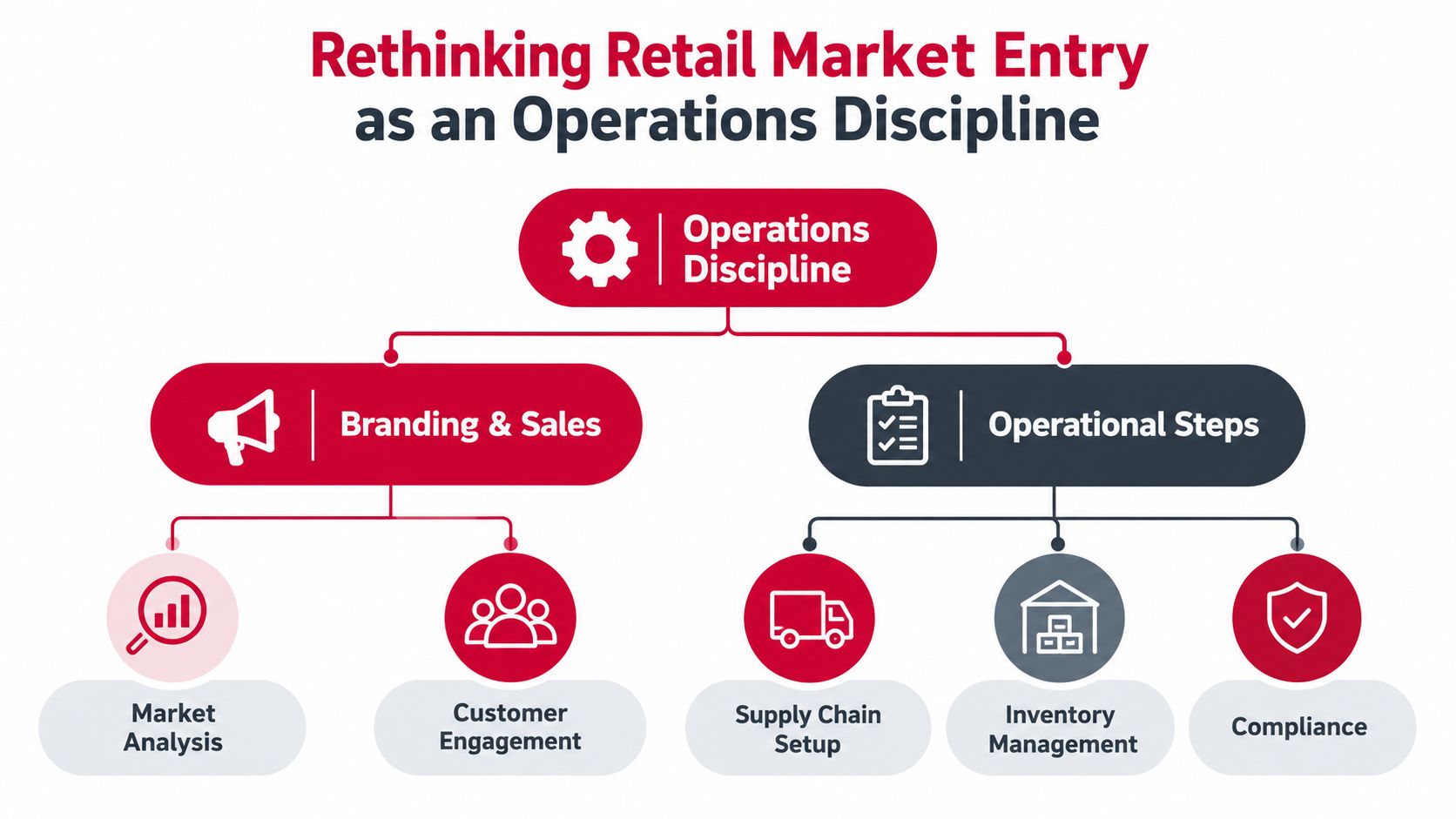
A marketplace launch can pull demand faster than the supply chain can replenish it. If factory inventory, freight-forwarder stock, warehouse availability, and channel dashboards don't share a reliable view, the team may oversell during a launch spike. When demand shifts, the same fragmented systems can encourage overbuying because each stakeholder sees only part of the picture.
Entity formation and compliance create similar exposure. A launch-ready U.S. sequence may require entity formation, sales tax registration, insurance, HTS classification, customs bonds, GS1 prefixes, and channel applications. A 2026 U.S. market-entry playbook from PI Commerce highlights these operational requirements and describes how split inventory data can produce both stockouts and excess inventory.
Practical rule: Don't approve a channel launch until one owner can reconcile purchase orders, inbound units, available inventory, committed inventory, fees, and cash impact from a single operating view.
The pilot shouldn't be a smaller version of a full rollout. It should answer specific questions with limited exposure:
Research on hard-discounter entry found that incumbent retailers within 3 to 5 km of the entrant experienced sales increases of approximately 2.0%, showing that entry can increase local traffic while intensifying competition. The same retail entry research recorded 119 completed entries and a 14.4% hit rate in a separate transition-economy dataset. These findings reinforce a useful operating principle: entry effects aren't uniform, and timing, proximity, and execution shape outcomes.
Build predefined gates before launch. If sell-through, contribution, repeat purchase, or inventory aging misses the threshold, optimize the offer or stop the rollout. A Foundation phase establishes the data and operating controls, Optimization improves the economics, and Amplification expands only after the first two phases have earned the right to scale.
Which channel can support the product's contribution margin after the work of selling and fulfilling it? That question should come before audience size, retailer prestige, or projected revenue. Amazon, Walmart, DTC, and wholesale can all create demand, but each assigns different costs, service requirements, and inventory risks to the brand.
Amazon offers reach and fulfillment infrastructure. FBA economics remain sensitive to unit size, weight, storage duration, referral fees, returns, and advertising. Amazon's U.S. 2026 fee update says FBA fees will rise by an average of $0.08 per unit sold, described as less than 0.5% of an average item's selling price, effective January 15, 2026. The Amazon FBA fee update shows why a small per-unit increase can matter when a SKU already operates close to its contribution ceiling.
Walmart uses a different fulfillment structure. WFS fulfillment fees start at $3.45 for items weighing 1 lb or less, with higher weight bands charging more, according to Walmart's WFS pricing. Packaging that moves a product into a higher weight band can remove the margin that looked available before fulfillment. Storage duration and aged inventory can create additional pressure, so slow-moving stock requires explicit modeling.
| Channel | Main economic advantage | Main operating pressure |
|---|---|---|
| Amazon | Demand access and established fulfillment | FBA, referral, storage, returns, and advertising costs |
| Walmart | Marketplace reach with WFS fulfillment | Weight bands, storage duration, and aged inventory exposure |
| DTC | Greater control over pricing, customer data, and merchandising | Brand-funded acquisition, fulfillment, service, and retention |
| Wholesale | Larger purchase orders and retailer distribution | Wholesale pricing, deductions, rebates, payment timing, and sell-through risk |
The channel choice also depends on execution capacity. A brand with fragmented inventory, weak replenishment controls, or an incomplete selling entity setup can lose contribution before demand becomes the problem. DTC may avoid marketplace fees, but acquisition, fulfillment, customer service, and retention still consume cash. Wholesale can simplify customer acquisition while introducing deductions, rebates, payment delays, and sell-through exposure.
Use this guide to calculating contribution margin to structure the comparison. Include landed product cost, channel fees, fulfillment, returns, discounts, rebates, and advertising. Model each channel at the SKU level, then test whether the team can replenish without creating excess stock or funding gaps.
A marketplace with attractive reach is not automatically the right first channel. The strongest beachhead is the one where pricing, fulfillment, inventory visibility, and cash collection can be controlled closely enough to produce reliable learning. Valtech's 2026 retail outlook points to tighter margin control and a shift from AI experimentation toward operational deployment. Apply that discipline before expanding into additional channels.
What remains after every cost required to make, sell, and deliver a SKU? Build that answer before choosing a channel. Revenue and gross margin can look healthy while advertising, prep, packaging, fulfillment, storage, and returns consume the contribution that funds operations.
Start with realized selling price, not list price. Subtract product cost, inbound freight, applicable duties, platform fees, fulfillment, prep, packaging, refunds, discounts, rebates, and retailer deductions. The result is contribution before advertising. Model each SKU under conservative, expected, and downside assumptions for price, order mix, fulfillment cost, and inventory velocity.
Use the contribution margin calculation guide to keep channel comparisons consistent. A positive base case is insufficient if replenishment requires more cash than the business can supply or if slower sell-through creates excess stock.
Break-even ACOS is calculated as:
Contribution before ads ÷ ad-attributed revenue × 100
The break-even ACOS formula starts with product cost, platform fees, shipping, prep, packaging, and other order costs removed. Contribution margin therefore sets the maximum advertising spend an order can absorb before becoming unprofitable.
If a product sells for $20 and non-ad order costs leave $6 before advertising, break-even ACOS is 30%. That is a ceiling, not a target. Spending at that level uses the entire contribution and leaves no room for overhead, working capital, returns, price movement, or attribution error. Set the operating target below the ceiling.
Walmart's WFS pricing starts at $3.45 for items weighing 1 lb or less. See the WFS weight-band pricing in the Channel Selection section for the complete fee schedule. The retail profit margin calculator is useful only when the model reflects the shipped unit, not the product specification alone.
A SKU measured at 0.9 lb can enter a higher fulfillment band after adding its carton, insert, protective material, or bundled component. If the packaged unit moves from the 1 lb band to the 2 lb band, the fulfillment charge changes the contribution on every order. That shift can make a single unit unattractive and make a multipack more viable, provided customers accept the pack structure and inventory turns remain healthy.
Track these fields at SKU level:
Approve expansion only after stress-testing lower realized price, slower sell-through, higher fulfillment weight, and increased advertising. The Foundation phase is complete when the team knows the break-even point and the operating conditions that would invalidate the launch.
Could the first demand wave expose an operational gap rather than validate the product? Entity setup, inventory control, and fulfillment testing should be ready before campaign assets go live. These checks determine whether early orders create useful evidence or expensive service failures.
Set up the commercial structure first. Confirm the selling entity, sales tax registration, insurance, banking, payment ownership, and each target channel's requirements. For imported products, verify HTS classification, customs bonds, product documentation, and broker responsibilities before inventory leaves the factory. Secure GS1 prefixes and submit channel applications early enough to resolve catalog or compliance issues without delaying the launch.

Inventory should reconcile across the factory, freight forwarder, 3PL, fulfillment network, and marketplace dashboard. Track produced, allocated, in-transit, received, available, reserved, damaged, and quarantined units. Give every partner the same definition of available-to-sell inventory, or forecasts will diverge and replenishment decisions will become unreliable.
A pre-launch review should assign owners to four control areas:
Excess inventory in a fulfillment network can create storage and aged-inventory charges. Review the Walmart WFS storage rates and aged-inventory surcharges cited earlier, then set replenishment quantities against expected sell-through rather than launch optimism.
The same discipline applies to a warehouse, 3PL, or physical operating site. A Front Range property buying checklist offers a useful framework for checking the asset, documentation, and operating risks before committing resources.
Use the product launch checklist template to assign an owner and evidence to each gate. Test receiving, inventory updates, order routing, returns, and exception handling before the launch date. If entity setup, inventory reconciliation, compliance, or fulfillment testing remains unresolved, move the date. Preventable execution errors consume working capital and staff capacity that small brands rarely have to spare.
The first 90 to 180 days should be managed as three operating phases, not one extended launch campaign. Each phase has a different job. Validation asks whether the offer works. Optimization improves the economics. Amplification increases controlled demand only after the system can support it.
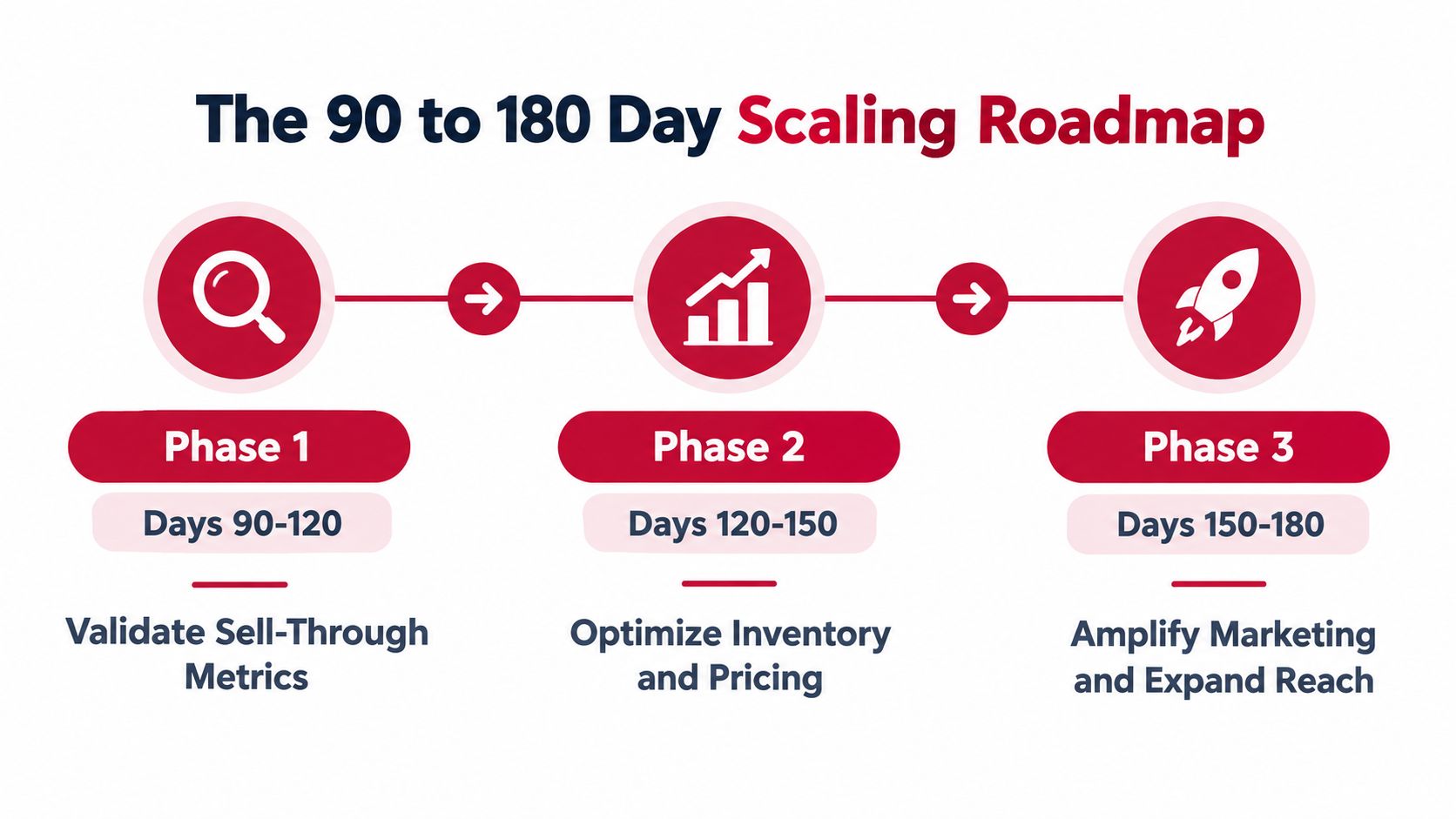
During days 90 to 120, focus on whether the pilot produces reliable customer and inventory signals. Track sell-through by SKU and location, realized price, stockout days, return reasons, contribution before ads, ad-attributed revenue, and repeat purchase behavior. Don't treat impressions, clicks, or gross order volume as proof of product-market fit.
Separate demand problems from execution problems. A weak sales period may reflect poor content, unavailable inventory, a missing variation, an uncompetitive price, or low visibility. The operator's job is to identify the constraint before changing the entire strategy.
During days 120 to 150, adjust replenishment, pack architecture, price, promotions, and advertising based on the pilot evidence. Build an inventory velocity model that distinguishes baseline demand from launch-driven demand. If a promotion creates a temporary spike, don't convert that spike directly into a permanent purchase commitment.
Retailer-specific pricing and rebate systems deserve their own review. Wholesale economics can deteriorate through deductions, promotional funding, chargebacks, or payment timing even when the invoice price appears acceptable. Document the net realized revenue and reconcile it to the original model.
Operating test: Expand only when the SKU can absorb normal price and demand variation without turning advertising or inventory into a cash drain.
During days 150 to 180, add reach only where the operating system has capacity. That may mean expanding a proven marketplace assortment, opening a second channel, increasing retail distribution, or adding advertising against products with sufficient contribution headroom. It doesn't mean turning on every channel simultaneously.
Use a simple expansion gate:
The framework is Foundation, Optimization, then Amplification in practice. The sequence prevents a common mistake: using more advertising to conceal weak pricing, slow inventory, or unresolved fulfillment costs.
Before committing inventory or opening a new channel, verify the following:
A practical retail market entry strategy doesn't ask how many channels the brand can enter. It asks which channel can generate dependable learning without damaging contribution margin or inventory velocity. Build the Foundation, use Optimization to remove friction, and reserve Amplification for the parts of the system that have already proven themselves.
Reddog Consulting Group helps CPG founders and operators review marketplace performance, contribution margin, inventory velocity, and channel expansion decisions in a focused working session. Visit Reddog Consulting Group to book a free 30-minute strategy call, structured around your margin model and retail entry plan rather than a sales pitch.
Leave a comment: