
Published: March 2020 | Last Updated:November 2025
© Copyright 2026, Reddog Consulting Group.

Let’s get straight to the point: Amazon does not offer a traditional price match policy for customers.
Unlike retailers like Target or Best Buy, you can't show Amazon a lower price from a competitor and get a refund for the difference. The company officially ended its price protection guarantee back in 2016.
So why did the world's largest online retailer ditch a seemingly customer-friendly policy? The answer lies at the core of its omnichannel growth strategy.
Instead of reacting to individual customer requests, Amazon built a system designed to proactively set the most competitive price from the start. This represents a fundamental shift from a manual, reactive process to a powerful, automated pricing engine. For brands, understanding this shift is critical to success.
Amazon operates on a sophisticated dynamic pricing algorithm that executes millions of price adjustments every single day. This system constantly scans competitor prices, inventory levels, customer demand, and sales velocity to keep its listings aggressively competitive. The goal is to win the sale before a customer even thinks to look for a price match.
This automated approach isn't just a feature; it's the foundation of Amazon's operational dominance. It provides a competitive edge at a scale that manual price matching could never achieve. For brands selling on the platform, mastering this concept is the first step toward growth. The game is no longer about reacting to price drops—it’s about strategically managing your brand within this automated ecosystem.
This concept is essential for any brand managing its presence through Seller Central, where pricing is one of the most powerful levers for driving measurable results.
The move away from price matching wasn't a reduction in service; it was an upgrade in competitive strategy. Amazon chose automated, proactive pricing over manual, reactive adjustments because it's faster, more efficient, and infinitely more scalable.
To fully grasp the difference, let’s compare Amazon’s method to the policies at traditional brick-and-mortar stores. The contrast highlights why brands need a completely different playbook for Amazon.
The table below breaks down the fundamental differences between how Amazon approaches pricing versus its major retail competitors.
| Feature | Amazon | Traditional Retailers (e.g., Target, Best Buy) |
|---|---|---|
| Policy Type | Automated Dynamic Pricing | Manual Price Match Guarantee |
| Initiation | Proactive (System-driven) | Reactive (Customer-initiated) |
| Scope | Millions of daily price changes | Matches on specific, requested items |
| Goal | Win the sale automatically | Retain a sale upon request |
As you can see, Amazon isn't playing the same game. While traditional retailers wait for a customer to bring them a better price, Amazon’s system is already working to ensure its price is the most compelling one online.
Amazon doesn’t "price match" in the traditional sense. Instead of reacting to customer requests, its pricing engine works proactively, constantly adjusting prices based on real-time market data.
Think of it less like a store clerk matching a competitor's flyer and more like the stock market, where prices shift based on supply, demand, and countless other data points. This is dynamic pricing, and it's the engine that powers Amazon’s retail dominance.

This automated system is infinitely more scalable than relying on human adjustments. Amazon's algorithms monitor competitor sites, inventory levels, sales velocity, and even individual shopper behavior to make millions of price changes daily. For brands, this means the old "set it and forget it" pricing model is no longer viable.
Amazon's market leadership is directly tied to this technological advantage. The system doesn't just analyze today's prices; it leverages historical data to forecast trends, identify promotional opportunities, and stay one step ahead of the competition.
In 2023, Amazon commanded a staggering 37.6% of the US e-commerce market. That level of dominance is fueled by aggressive, data-driven pricing that analyzes shifts over days, months, and years to find the optimal price point for maximizing sales.
This massive data operation creates a hyper-competitive environment where a proactive pricing strategy isn't just an advantage—it's essential for survival. Understanding how this system operates is the first step (Foundation) toward building a pricing strategy that can compete and win.
Given the sheer scale of Amazon's marketplace, a traditional price match policy would be a logistical nightmare, creating impossible operational bottlenecks.
Dynamic pricing is the solution. It automates competitiveness by constantly analyzing key factors to set the right price at the right time.
Here’s a look at what the system crunches in real-time:
The sophisticated algorithms driving this rely heavily on predictive analytics in retail to anticipate market shifts. For sellers, success on Amazon requires more than just listing products; it demands a deep understanding of how to operate within this automated ecosystem. To learn more, see our guide on developing winning Amazon pricing strategies for sellers.
Since Amazon’s pricing is a proactive, dynamic system, your brand strategy must work with its algorithms to protect margins while capturing sales. This is the Optimization phase of your growth journey.
The most powerful tool for this is an automated repricer. However, using one without a clear plan often leads to a "race to the bottom," where sellers continuously undercut each other until no one is profitable. The goal isn't just to be the cheapest—it’s to present the most compelling offer to win the Buy Box.
Effective repricing is built on intelligent rules that balance aggressive positioning with profit protection. This is how you translate pricing theory into measurable results. Your repricing software must allow you to set firm boundaries.
Here are the essential rules to establish:
A well-defined pricing strategy isn't about constant discounting. It's about setting intelligent guardrails that allow automation to capture sales opportunities without sacrificing your brand's financial health.
Let's see how this works in practice. Imagine a consumer electronics brand selling popular headphones. They can use time-based repricing rules to optimize performance throughout the day.
This simple, automated adjustment keeps the brand competitive when it matters most and profitable when the opportunity arises. It’s a core component of effective marketplace management, where every decision is data-driven.
Of course, your strategy must comply with Amazon's policies. It's crucial to understand Amazon's Fair Pricing Policy for Sellers to avoid any issues. By integrating these strategies, you build a pricing model that is both resilient and flexible—a solid foundation for growth.
A price drop on Amazon is never just a price drop on Amazon. It sends shockwaves across the entire retail ecosystem, impacting your brand’s value everywhere. In today’s integrated omnichannel environment, a single online pricing decision can devalue products on physical store shelves.
Imagine an unauthorized third-party seller on Amazon slashes your product’s price to liquidate inventory. Within hours, repricing algorithms at major retailers like Walmart and Target detect the drop. Their systems, designed to compete with Amazon, automatically match the new, lower price.
Suddenly, your product's perceived value has plummeted nationwide—all because of one rogue seller. This domino effect strains relationships with your retail partners, who are now forced to match a price that destroys their margins. It also trains customers to expect discounts, eroding your brand equity.
The most effective defense against this race to the bottom is a Minimum Advertised Price (MAP) policy. A MAP policy is a formal agreement between your brand and its retailers that establishes the lowest price they can publicly advertise your product for. It’s not about price-fixing; it’s about controlling the advertised price to protect brand integrity and ensure a level playing field for all retail partners.
Implementing a clear and enforceable MAP policy is a foundational step. Without it, you are left defending against price wars you cannot win.
The process is straightforward: set the rules, automate monitoring, and protect your profits.
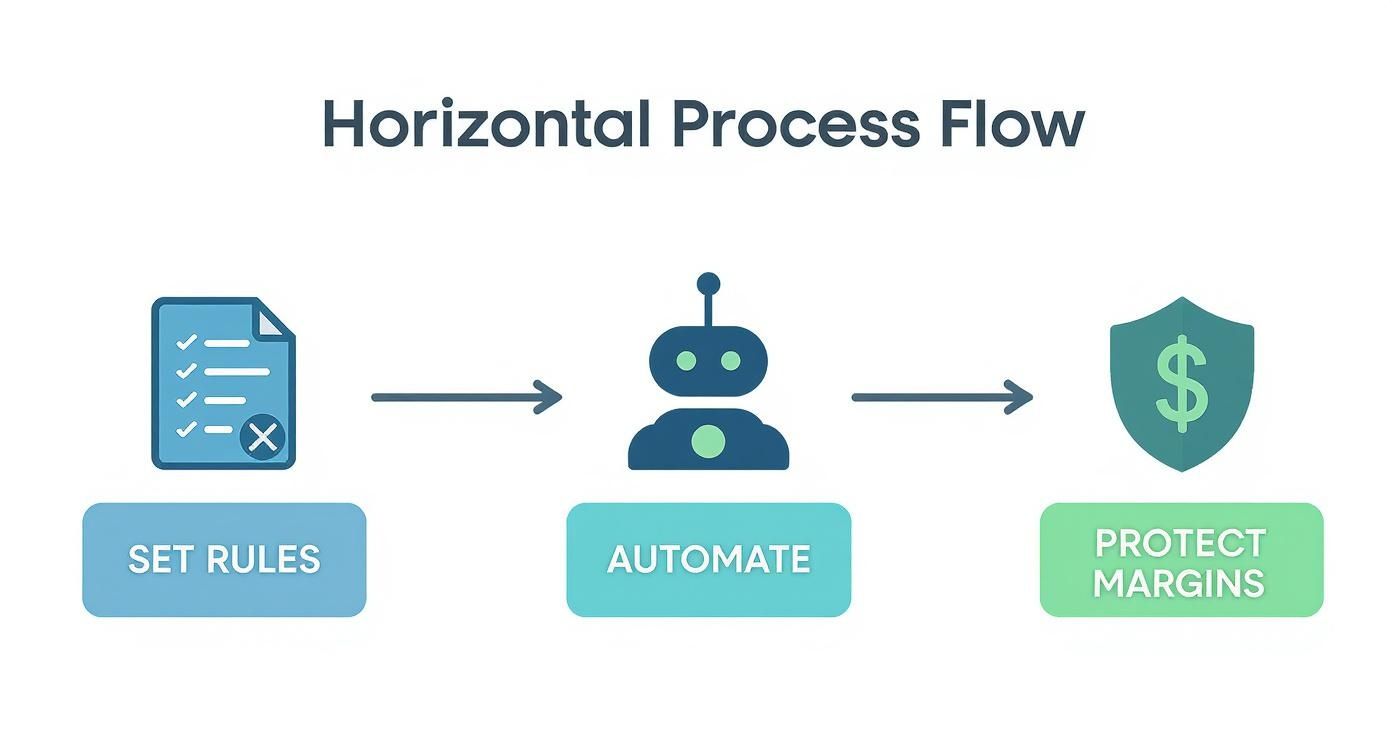
This flow illustrates the process. First, establish clear pricing rules with a MAP policy. Second, use automation to detect violations. Third, take consistent action to protect your margins and brand equity across all channels.
A policy is useless without enforcement. A "paper tiger" policy does nothing to deter rogue sellers. You need a practical, step-by-step framework to put your MAP policy into action and defend your brand’s value.
Here’s a clear checklist for identifying and managing MAP violations effectively.
| Step | Action | Key Objective |
|---|---|---|
| 1. Identify Violators | Use monitoring software to scan marketplaces and websites for your SKUs. | Automate the detection of any advertised prices that fall below your MAP. |
| 2. Document Everything | Take time-stamped screenshots of the violation. | Create undeniable proof, including the seller name, URL, price, and date. |
| 3. Issue a Formal Warning | Send a written notice to the violator referencing your MAP policy. | Formally notify the seller of their violation and provide an opportunity to comply. |
| 4. Escalate Consequences | If violations persist, follow through with penalties outlined in your policy. | Enforce consequences, from withholding shipments to terminating their reseller agreement. |
This checklist provides a clear, repeatable process for holding retail partners accountable.
MAP enforcement isn’t about being punitive—it's about consistency. When all partners know the rules are enforced fairly, it builds trust and fosters a healthier, more profitable retail ecosystem for your brand.
Mastering your Amazon presence isn't just about defense—protecting margins and enforcing MAP policies. The ultimate goal is to Amplify your success by turning your pricing strategy into a powerful engine for omnichannel growth.
Think of your Amazon data as a live market research lab. Every price adjustment, competitor reaction, and customer purchase provides a wealth of data. This intelligence is too valuable to remain siloed; it should inform your entire omnichannel strategy, from your direct-to-consumer (DTC) site to your brick-and-mortar partnerships.
When you shift from defense to offense, you begin building a cohesive brand experience everywhere a customer interacts with you. This is the final step: using Amazon insights to amplify growth across every channel.
Your Amazon data is a direct pipeline to understanding market dynamics. It reveals customer price sensitivity for your products and your competitors'. You can leverage these insights to make smarter decisions across all sales channels.
For example, did a 10% price drop on Amazon lead to a 50% increase in sales velocity during a key holiday? That's not just an Amazon win; it's a powerful piece of market intelligence. It can inform promotions on your DTC site, influence BOGO offers with retail partners, and strengthen your negotiating position with distributors.
This creates a powerful feedback loop where insights from one channel inform the others. You’re no longer just reacting to Amazon—you’re proactively using it to define your brand's value perception across the entire retail landscape.
A unified pricing strategy gets every channel working in concert. You can use Amazon's dynamic marketplace to test promotional concepts before committing to a large-scale in-store campaign with a partner like Target or Walmart.
Ultimately, controlling your pricing narrative on Amazon is about more than winning the Buy Box. It’s about building long-term brand equity and establishing a scalable foundation for growth. When your pricing is consistent and strategic, it builds trust with both customers and retail partners.
This consistency helps you achieve key business objectives:
By moving from a defensive posture to an offensive strategy, you transform your Amazon presence from a simple sales channel into a strategic growth engine. That’s how you build a brand that not only survives but thrives in today's competitive retail world.
Ready to build your growth strategy? Let’s Talk Growth.
Amazon's pricing can be a moving target for shoppers and brands alike. To summarize the key takeaways, let's address the most common questions about price adjustments, refunds, and how to compete effectively in this dynamic environment.
These practical answers reinforce the core concepts of this guide.
For most products, the official answer is no. Amazon eliminated its price protection policy in 2016. Unlike many big-box stores that offer a price adjustment window, the price you pay on Amazon is typically final at the moment of purchase.
The only well-known exception is for televisions. For any other item, your only recourse is to return the product (if eligible) and repurchase it at the lower price—a process that is often more hassle than it's worth.
Winning on Amazon is not about having the absolute lowest price; it's about presenting the most compelling offer to win the Buy Box. A "race to the bottom" is a short-term tactic that erodes margins and devalues your brand.
Smarter, more sustainable success comes from strategic repricing. Here’s how successful sellers do it:
The winning strategy is to compete on total customer value—fast shipping, excellent service, and a quality product—not just on being the cheapest option.
Yes, absolutely. This is one of the most significant omnichannel challenges for modern brands. Major retailers like Target, Best Buy, and Walmart use sophisticated software to monitor Amazon's prices in real time.
When an unauthorized seller violates your MAP policy and drops your product’s price on Amazon, other retailers' systems often match it automatically. This triggers a domino effect, devaluing your brand across all channels and damaging relationships with your valued retail partners. The only way to prevent this widespread margin erosion is through consistent and firm MAP policy enforcement.
At RedDog Group, we help brands transform pricing complexity into a competitive advantage. Our team builds and executes omnichannel strategies that protect your margins, win the Buy Box, and fuel integrated growth across all your sales channels. If you’re ready to stop playing defense and start driving measurable results, let's connect.
Leave a comment: