
Published: March 2020 | Last Updated:January 2026
© Copyright 2026, Reddog Consulting Group.

Amazon listing optimization is the process of refining your product pages to rank higher in search, attract more clicks, and ultimately, drive measurable sales growth. It's a strategic blend of data-driven SEO and persuasive copywriting, designed to win over both Amazon's A9 algorithm and your target customers.
Think of it as securing the digital equivalent of prime shelf placement in a physical retail store. It's the critical first step in building a successful brand on the world's largest marketplace.
Before spending a single dollar on ads, your product listing must be built on a solid foundation. This isn’t a suggestion—it's the non-negotiable first pillar of our omnichannel growth framework: Foundation → Optimization → Amplification. Your listing is your digital storefront. It's your primary sales tool for converting browsers into buyers and the single most critical asset you control on the platform.
A strong foundation starts with understanding how Amazon’s A9 algorithm works. At its core, this powerful search engine prioritizes two key factors:
To succeed, you must satisfy both the algorithm and the shopper. Your listing must first convince the A9 algorithm that you are relevant enough to be displayed in search results. Then, it must persuade the customer to make a purchase. These two goals are completely intertwined.
Before diving deeper into the Amazon ecosystem, it’s helpful to have a broader perspective. For brands balancing multiple sales channels, understanding the broader e-commerce landscape by comparing Amazon with Shopify can clarify how a marketplace strategy fits into your overall omnichannel growth plan.
This flowchart illustrates the critical journey from your listing, through the algorithm, and finally to the customer.
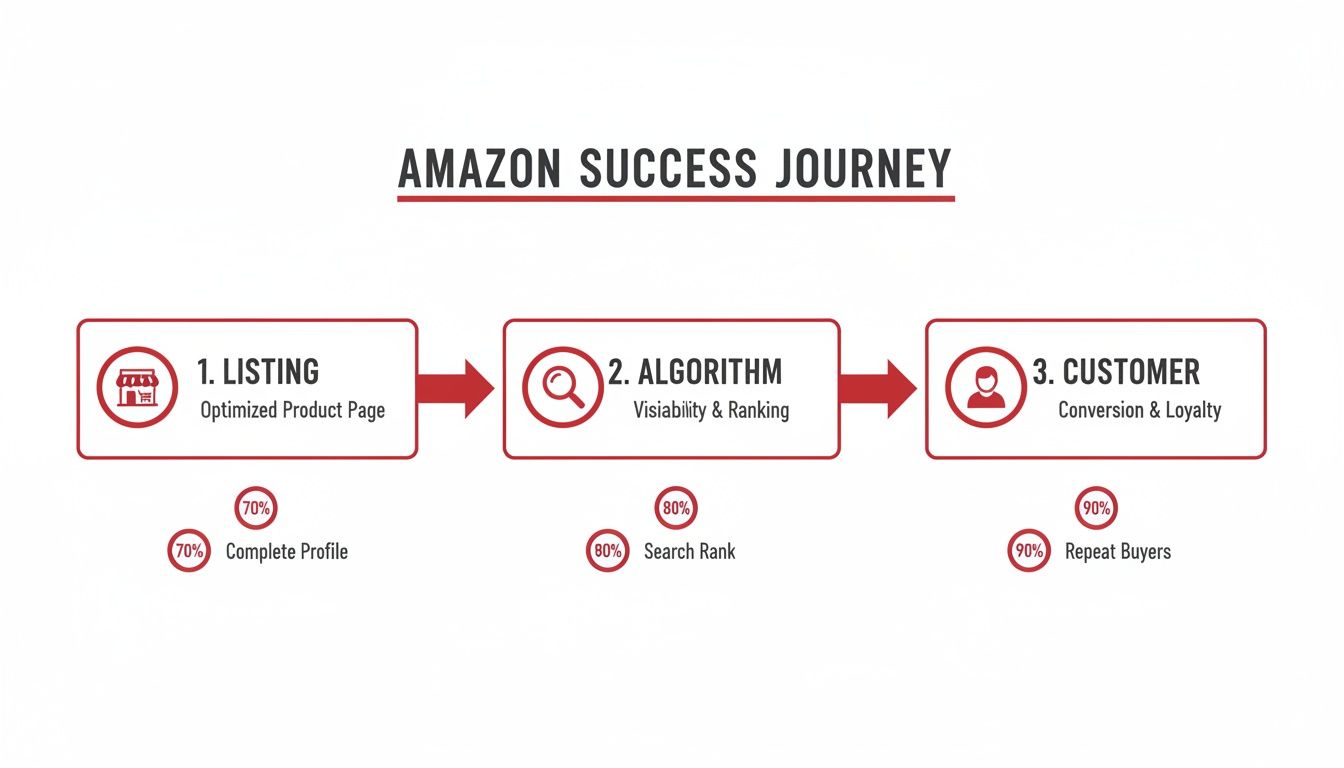
As you can see, a well-constructed listing is the starting point for all growth. It directly impacts algorithmic visibility, which determines whether you even get the opportunity to connect with a customer. Every element we'll cover—from keyword research to A+ Content—is about strengthening this fundamental connection.
When you focus on building this solid base, you create a powerful flywheel effect: increased visibility drives sales, and consistent sales drive even more visibility.
With a solid foundation in place, the next step is ensuring discoverability. This involves connecting your product to the exact words and phrases customers are using in Amazon's search bar. The goal is to move beyond obvious, high-competition keywords to uncover high-intent phrases that signal a customer is ready to buy.
Here, you're achieving two objectives simultaneously: satisfying the A9 algorithm with precise relevance and persuading a human shopper with clear, benefit-driven language. Think of your listing's text as your 24/7 salesperson—it must be intelligent enough to get found and compelling enough to close the sale.
Your product title is the most valuable piece of real estate on your entire listing. It carries immense weight for keyword indexing with the A9 algorithm and is the first thing a shopper sees. A great title must be packed with information without becoming a jumbled, unreadable mess.
A perfectly crafted title accomplishes three things at once:
For example, a title like "Yoga Mat" is a missed opportunity. A stronger, optimized title would be: "ProBalance Extra-Thick Yoga Mat for Women & Men - 6mm Non-Slip TPE Material, Eco-Friendly, for Pilates, Floor Exercises & Hot Yoga (Ocean Blue)".
The difference is clear. This version includes the brand, key features, materials, use cases, and color—all valuable keywords that real customers are searching for, leading to more qualified traffic and higher conversion rates.
Practical Takeaway: Your title is your primary SEO tool. Integrate your top 3-5 most important keywords, front-loading the most critical phrase. While the character limit is 200, the sweet spot for readability and mobile viewing is often closer to 150.
If the title earns the click, your bullet points do the heavy lifting of selling. This is your chance to expand on the features mentioned in the title and translate them into tangible benefits for the customer. A common mistake is "keyword stuffing"—unnaturally repeating keywords. Instead, weave them into statements that solve a customer's problem.
Focus on answering the customer's unspoken questions: How will this improve my life? What problem does it solve? Why is this a better choice than the other options available? Each bullet point should address a key feature and its corresponding benefit.
For instance, instead of a feature-focused bullet like:
Frame it as a solution-oriented benefit:
This approach speaks directly to the customer's needs for stability and comfort while naturally incorporating keywords like "non-slip," "TPE material," and "cushioning."
To ensure your copy covers all the bases, use this checklist as a guide.
| Listing Element | Optimization Goal | Best Practice Example |
|---|---|---|
| Title | Maximize SEO visibility & inform shoppers instantly | Brand Name + Main Keyword + Top 2 Features + Use Case + Size/Color |
| Bullet 1 | Hook the reader with the most compelling benefit | PROBLEM SOLVED: Start with the primary benefit that addresses a customer pain point directly. |
| Bullet 2 | Highlight a key feature and its practical advantage | SUPERIOR MATERIALS: Explain why your material is better (e.g., more durable, safer, eco-friendly). |
| Bullet 3 | Build trust and differentiate from competitors | DESIGNED FOR YOU: Detail a specific design choice that sets your product apart. |
| Bullet 4 | Address a secondary use case or benefit | VERSATILE & MULTI-USE: Broaden the appeal by showing how it can be used in different scenarios. |
| Bullet 5 | Overcome an objection & offer a guarantee | RISK-FREE PURCHASE: Include warranty information or a satisfaction guarantee to close the sale. |
| Description | Tell a brand story & provide rich detail | Use short paragraphs and storytelling to connect emotionally with the shopper. |
This framework ensures you're hitting key persuasive points while feeding the algorithm the keywords it needs to rank your product effectively.
The product description is your opportunity to tell a richer brand story. While many shoppers skim the bullet points, highly engaged buyers will scroll down for more detail. Use this space to reinforce your brand voice, address potential objections, and provide deeper specifications. For brands with a direct-to-consumer (DTC) presence, this is the perfect place to align your omnichannel messaging and create a consistent brand experience from your website to your Amazon listing.
To build a compelling narrative, you have to understand how to write product descriptions that not only inform but also convert. This is your chance to share your brand's mission, detail the unique craftsmanship of your product, or paint a picture of how it fits into your customer's life.
On a marketplace of this scale, every word counts. In 2023, Amazon's net sales revenue hit an astounding $574.78 billion globally. With 63% of shoppers beginning their product search on Amazon and a staggering 70% never scrolling past the first page, your copy must be flawless. A strategic, customer-focused approach is non-negotiable for capturing market share.
Once your keywords and copy are dialed in, it’s time to focus on what stops the scroll: your visuals.
In eCommerce, your product photos, videos, and A+ Content are more than just decoration; they are your most effective salespeople. They must bridge the gap between a digital screen and a tangible product, answering a customer's unspoken questions and building desire before they read a single bullet point.
A strong visual strategy is a core part of the Optimization pillar in our growth framework. It’s how you transform a well-indexed listing into a high-converting asset that drives measurable results.
Shoppers on Amazon can't touch your product, feel its quality, or test it out. Your images have to do that heavy lifting. A complete image stack is a curated gallery designed to educate, build trust, and overcome any purchase hesitation.
A winning image strategy includes a mix of the following:
Your objective is to use every available image slot to tell a complete and compelling story. For a deeper dive into creating images that sell, explore our full guide on product photography for Amazon.
For brand-registered sellers, A+ Content is one of the most powerful tools in your optimization toolkit. It allows you to replace the plain-text product description with a rich, module-based layout of high-quality images, custom copy, and comparison charts. This is where your brand story truly comes to life.
Think of A+ Content as your custom in-store display on the Amazon platform. It’s your opportunity to control the narrative, reinforce your brand's unique value, and guide the shopper's journey toward the "Add to Cart" button.
According to Amazon, well-executed A+ Content can boost conversion rates by 3-10%. It elevates your listing from a simple product page to an immersive brand experience, building the trust and credibility that separate top-tier brands from generic resellers.
Don't just fill the space with random modules; design your A+ Content with a clear purpose. A strategic layout takes the customer on a deliberate journey.
Here’s a proven, effective structure:
Competition on Amazon is intense, making every optimization critical. In 2023, U.S. third-party sellers sold over 4.5 billion items—approximately 8,600 every minute. To stand out, brands must focus on what moves the needle. A+ Content is a proven tool for lifting engagement and is an essential component of any serious Amazon growth strategy.
You’ve captured their attention. Your visuals and copy have stopped the scroll and sparked interest. Now comes the moment of truth. This is where pricing and social proof work together to seal the deal, converting a curious browser into a confident buyer.
These elements are powerful conversion signals that the A9 algorithm monitors closely. By leveraging psychology and data, you can build the trust and sales velocity needed to climb the rankings. Great copy gets the click, but a smart pricing strategy and glowing reviews are what close the sale.
One of the biggest myths in listing optimization for Amazon is that the lowest price always wins. That's a race to the bottom that erodes margins and devalues your brand. Strategic pricing isn’t about being the cheapest—it’s about finding the sweet spot that maximizes both sales velocity and profitability.
Amazon’s A9 algorithm rewards conversion. A product priced at $24.99 that converts consistently will almost always outrank a similar one priced at $19.99 with poor sales. Your price communicates value. Set it too low, and shoppers may perceive your product as low-quality. Set it too high without clear justification, and you’ll lose to competitors.
To find your pricing sweet spot, analyze these factors:
Don't forget to test. Small price adjustments, coupons, or limited-time promotions can provide invaluable data on customer price sensitivity without permanently damaging your margins.
Reviews are the currency of social proof on Amazon. A high star rating and a significant number of reviews are often the single biggest factor in a shopper's purchase decision. They signal to both customers and the algorithm that your product is trusted and delivers on its promises.
Data-Driven Insight: Over 90% of consumers read reviews before making a purchase. A listing with zero reviews is a major red flag, while one with hundreds of positive ratings feels like a safe, vetted choice. This creates a powerful flywheel: more sales lead to more reviews, which boosts your rank, resulting in more visibility and even more sales.
Generating authentic reviews requires a careful, compliant approach. Amazon has strict policies against incentivizing reviews, and violating them can put your account at risk.
The right way to encourage reviews is proactive and customer-centric:
By sticking to these compliant strategies, you can steadily build a foundation of genuine social proof that transforms your listing into a conversion machine.
An optimized listing is a powerful conversion engine, but it needs fuel to reach its full potential. This is where we enter Amplification—the third pillar of our growth framework. Amplification turns your solid foundation into a scalable sales machine by leveraging the strategic relationship between your organic listing optimization (SEO) and paid advertising (PPC).
Think of SEO as building the perfect storefront in a developing neighborhood. It’s beautifully designed and stocked with what customers want, but it needs help getting discovered. PPC acts as the digital billboards and targeted flyers that drive immediate, high-intent traffic directly to your door.
When used together, SEO and PPC create a powerful feedback loop that accelerates growth far beyond what either could achieve alone.

The relationship between Amazon PPC and SEO isn't just complementary; it's a flywheel. While paid ads don't directly boost your organic rankings, the sales they generate send a powerful performance signal to the A9 algorithm. This is especially critical for new products with no sales history.
Here’s how this dynamic works:
This feedback loop is the core of a sophisticated listing optimization Amazon strategy. PPC data refines your SEO, and a stronger organic rank reduces your reliance on ads, ultimately lowering your blended Advertising Cost of Sale (ACoS) and increasing overall profitability.
A common mistake is running PPC campaigns in a silo, disconnected from an organic keyword strategy. To make every ad dollar work harder, your campaign structure should directly reflect your SEO goals. This ensures you’re not just chasing clicks but building a long-term, profitable presence.
For DTC brands, aligning your paid media strategy is essential for maintaining a consistent omnichannel experience. You can gain deeper insights into campaign effectiveness through comprehensive Amazon ads management, ensuring your efforts on and off the platform work in concert for maximum brand growth.
Organizing your campaigns with specific, measurable goals tied to your keyword strategy is key to success.
Campaign Types and Their Goals:
| Campaign Type | Primary Goal | Keyword Strategy |
|---|---|---|
| Discovery (Auto) | Uncover new, high-converting customer search terms. | Let Amazon's algorithm find relevant keywords based on your listing content. |
| Ranking (Manual) | Aggressively target your top 3-5 "hero" keywords to drive sales velocity and improve organic rank. | Exact and Phrase match for your most important, high-volume keywords. |
| Protection (Manual) | Defend your brand and capture high-intent shoppers by bidding on your own brand name and product terms. | Exact match for your brand name, product names, and variations. |
| Expansion (Manual) | Target long-tail keywords and competitor ASINs to capture market share and find new customer segments. | Broad match for long-tail phrases and Product Targeting for competitor listings. |
This tiered approach allows you to control your ad spend with precision, allocating more budget to proven winners while constantly exploring new opportunities for growth.
The synergy between paid and organic efforts is crucial. In 2023, 59% of sellers used paid search to get ahead. With third-party sellers now accounting for 60% of all sales, an integrated PPC strategy is no longer optional for brands serious about growth.
For general SEO strategies that can complement your Amazon efforts, exploring tools like the Rank Math SEO plugin can also provide valuable insights.
Navigating Amazon's ever-changing algorithm brings up many questions. As you move from building a solid listing foundation to the ongoing work of optimization and amplification, clear answers are essential. Here are some of the most common queries we hear from brands, with practical, straightforward advice.
This is the most common question, and the honest answer is: it depends. You will often see initial movement in keyword indexing within a few days to a week, as the A9 algorithm quickly picks up changes to your title or backend fields.
However, measurable improvements—such as higher organic rank, increased sales velocity, and a better conversion rate—typically take 30-90 days of consistent effort. Factors like category competitiveness, advertising budget, and the rate at which you acquire new reviews all play a significant role in this timeline.
If you have to focus your energy on one thing, make it the title. While every element of the listing is important, the title carries the most weight with Amazon's algorithm for keyword relevance and ranking. It’s also the first thing a customer sees in search results.
A well-crafted title packed with your most valuable keywords can dramatically boost your visibility. If your title is weak, your brilliant images and A+ Content won't matter because shoppers will never find your product in the first place. For the effort involved, optimizing the title delivers the biggest impact.
A title isn’t just a label; it’s your primary SEO tool. Getting it right can be the difference between page-one visibility and being buried on page ten.
You can, but you shouldn't. Repeating the same keywords across your title, bullet points, and backend fields is a common mistake. Amazon's algorithm only needs to index a keyword once per listing; repetition doesn't provide any extra "ranking juice" and wastes valuable character space.
Instead, use your backend search term fields as a repository for keywords you couldn't fit naturally into your front-end copy. This is the perfect place for:
This strategy allows you to cast a wider net, maximizing the total number of unique search terms your listing can rank for.
Your Amazon listing is not a "set it and forget it" asset; it's a living document that requires regular monitoring and refinement. Plan for a significant update whenever new data reveals an opportunity, such as discovering a high-converting keyword from your advertising campaigns.
Beyond major overhauls, you should monitor performance weekly. The key is to test one major change at a time to accurately measure its impact. For example, update your main image and wait a week to see how it affects your click-through rate before you rewrite a bullet point. The goal is continuous, data-driven improvement.
Optimizing your Amazon listings is a continuous cycle of building a foundation, optimizing for performance, and amplifying your reach. When you’re ready to move from tactical tweaks to a fully integrated omnichannel growth strategy, the team at RedDog Group is here to help you scale.
Leave a comment: