
Published: March 2020 | Last Updated:February 2026
© Copyright 2026, Reddog Consulting Group.

If you're evaluating Amazon as a sales channel, the first question is always: "How much is this really going to cost?" Let's get straight to it. The answer isn't a single number; it's a stack of variable and fixed fees that can easily consume 20% to 40% of your revenue before you see a dime of contribution margin.
For CPG brands, these costs fall into two main buckets: fees to list products and fees to get them into customers' hands. You’re looking at a monthly subscription, a commission on every sale (the referral fee), and—if you use Fulfillment by Amazon (FBA)—charges for picking, packing, shipping, and storage.
For any CPG brand, understanding how much Amazon charges means looking past top-line revenue and getting laser-focused on contribution margin.
Your profitability on Amazon hinges entirely on how well you model and manage this layered fee structure. Get it right, and the channel scales profitably. Get it wrong, and you're just buying revenue at a loss.
To simplify, let's break the fee structure down.
Before we dive deep, here’s a quick overview of the main fees.
| Fee Type | What It Covers | Typical Cost Structure | Impact on Margin |
|---|---|---|---|
| Subscription Plan | The right to sell on the platform | Flat monthly fee ($39.99 for Professional) | Fixed cost; lower impact as sales grow |
| Referral Fees | Amazon's commission for each sale | 8-15% of the total sale price, varies by category | Major variable cost; directly reduces per-unit profit |
| Fulfillment Fees (FBA) | Picking, packing, and shipping your orders | Per-unit fee based on item size and weight | Significant variable cost; essential for Prime eligibility |
| Storage Fees | Storing inventory in Amazon's warehouses | Per cubic foot, per month; higher in Q4 | Ongoing cost; can escalate with slow-moving inventory |
| Advertising (PPC) | Promoting products via Amazon Ads | Pay-per-click; varies by keyword and competition | Variable cost; necessary for visibility but impacts TACoS |
| Return & Removal Fees | Processing customer returns or disposing of inventory | Per-unit fees for returns, removals, or disposals | Unpredictable costs that can erode profitability |
This table provides a high-level view, but the real impact is in the details. Let's start with the one fee you can't escape.
Referral fees are your single largest variable cost on Amazon and are unavoidable. Think of it as Amazon's commission for every sale you make on their platform.
These fees typically range from 8% to 15% of an item's total sale price, and the exact percentage depends on your product category. For a CPG brand selling a $20 pack of protein bars, that's $1.60 to $3.00 per unit going straight to Amazon. That bites into your contribution margin right off the top.

Your product’s category dictates your starting margin before you even factor in fulfillment or ad spend. For many brands, this calculation is the first real test of is it worth selling on Amazon for their specific products.
To get a true handle on "how much does Amazon charge to sell," you must break down the foundational costs hitting every unit. These are the non-negotiable fees baked into the platform's economics, starting with your selling plan. Amazon offers two options, but for a CPG brand focused on growth, there's really only one.
The Individual Plan costs $0.99 per item sold. The Professional Plan is a flat $39.99 per month, regardless of unit volume.
A simple break-even analysis shows that if you sell more than 40 units a month, the Professional plan is the more economical choice. For any scaling CPG brand, the decision is obvious. But this is about more than cost savings.
Choosing the Professional plan isn’t about pinching pennies; it’s about unlocking the tools required to operate a real business on Amazon. Without it, you’re flying blind.
The Professional plan grants access to:
The Individual plan only makes financial sense at a hobbyist level. For an operator building a sustainable channel, the $39.99/month is a foundational operating expense. Understanding the tools and data available in what is Amazon Seller Central is the first step.
After your subscription, the most significant core cost is the referral fee. It's Amazon's commission on every sale, calculated as a percentage of the total sales price—what the customer actually pays, including shipping.
This fee is non-negotiable and varies significantly by product category. For CPG brands, this is often where profitability is won or lost before a product leaves the warehouse. Mis-categorizing a product can quietly bleed your margin on every sale.
For an operator, the referral fee isn't just a line item; it's a critical variable in your pricing strategy. You must build this percentage directly into your unit economics from day one to ensure your products are viable on the channel.
Here’s a look at common CPG categories and their referral fees:
This structure has a massive impact on your contribution margin. A high-volume, low-price grocery item at 8% has completely different economics than a premium supplement at 15%. This is a perfect example of why getting the Foundation phase of our growth framework right is so critical. Nailing product data and categorization from day one prevents the painful margin compression that sneaks up during scaling.
Beyond your plan and referral fees, the next major cost is fulfillment. This is where your operational choices directly impact your profit margin, forcing a decision between Fulfillment by Amazon (FBA) and Fulfillment by Merchant (FBM).
This isn't just about who puts a product in a box. Your choice defines daily operations, customer experience, and whether you earn the all-important Prime badge. For CPG brands, the FBA vs. FBM calculation is the bedrock of the entire Amazon financial model.
One path outsources logistics to Amazon for a per-unit fee. The other keeps it in-house, swapping Amazon's fees for your own warehouse, labor, and shipping costs. Neither is automatically superior—the right choice depends on your products, operational capabilities, and growth velocity.
With FBA, you hire Amazon as your warehouse and shipping department. You send inventory to their fulfillment centers, and they handle storage, picking, packing, and shipping for every order. In return, you pay a Fulfillment Fee for each unit they handle.
This fee is a calculated cost based on your product’s size tier and shipping weight. Amazon slots every product into a tier (e.g., Small Standard, Large Standard) with corresponding weight brackets.
A small, lightweight item might cost only a few dollars to fulfill. A larger, heavier product can incur a hefty fee that carves a serious slice out of your margin. You can dive into the operational mechanics in our guide explaining what is FBA.
The most common trap for brands is getting blindsided by dimensional weight. Amazon charges based on whichever is greater: the item's actual weight or its "dim weight" (a formula based on package volume). A product that seems light but is bulky—like a bag of chips or a box of paper towels—can get hit with surprisingly high FBA fees. If you don't model this, your margins are at risk.
Choosing FBM means you run the logistics. When an Amazon order comes in, you or your team must pick, pack, and ship it directly to the customer from your own warehouse or a 3PL partner.
On the surface, it seems like an easy way to dodge Amazon's fees. While you skip the FBA fulfillment fee, the costs don't disappear—you just trade them for a different set of line items:
That last one is the real challenge. It’s nearly impossible for an individual seller to negotiate shipping rates that compete with Amazon's massive volume. Amazon’s own data suggests that shipping with FBA can cost 70% less per unit than comparable premium services from major US carriers.
The image below compares the two main seller plans—a choice that precedes the FBA vs. FBM decision.
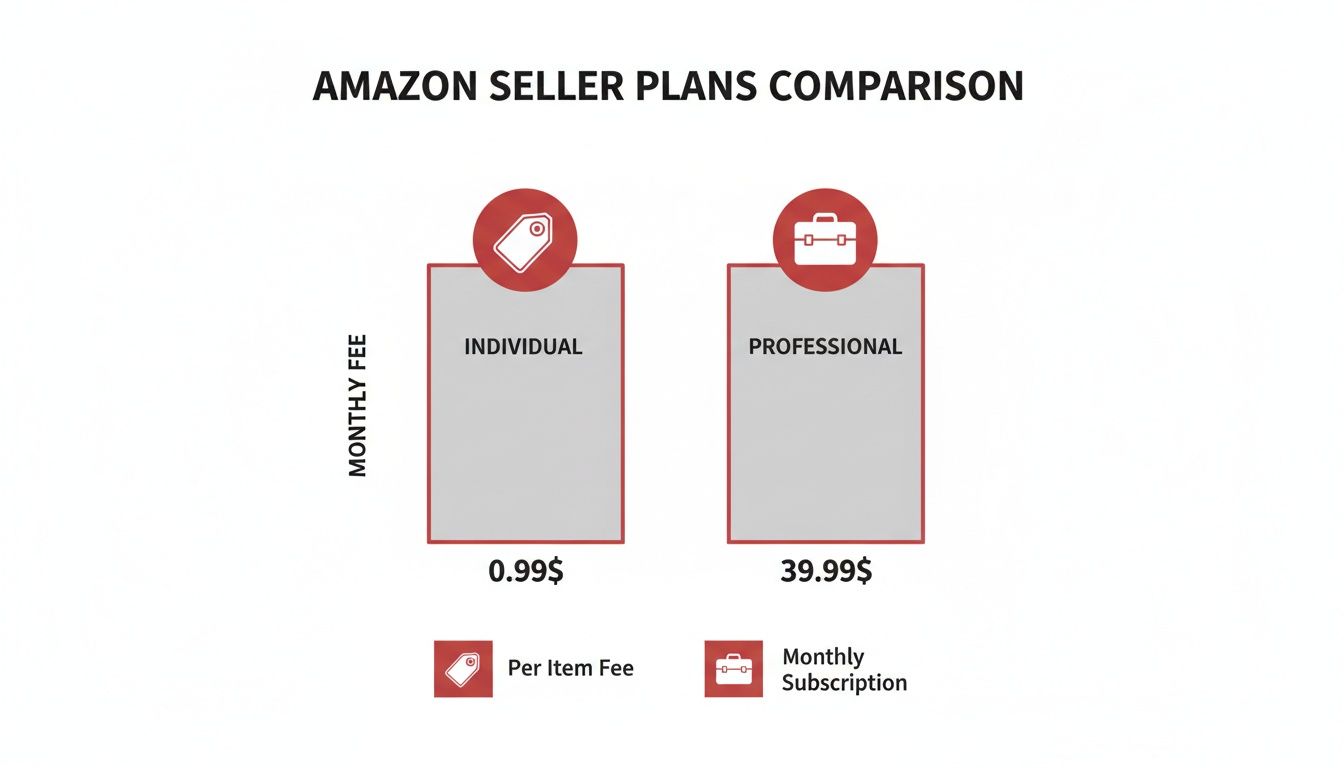
For any serious CPG brand selling over 40 units a month, the Professional plan is a non-negotiable cost of doing business.
Let's run a practical scenario. Imagine selling a standard CPG item for $25 that weighs 1.5 lbs.
| Cost Component | Fulfillment by Amazon (FBA) Cost | Fulfillment by Merchant (FBM) Cost |
|---|---|---|
| Amazon Fulfillment Fee | $5.66 | $0.00 |
| Warehousing/Labor (Estimate) | Included in FBA Fee | $2.50 |
| Packing Materials (Estimate) | Included in FBA Fee | $0.75 |
| Carrier Shipping (Estimate) | Included in FBA Fee | $7.50 |
| Total Per-Unit Fulfillment Cost | $5.66 | $10.75 |
In this scenario, FBA is dramatically cheaper on a per-unit basis. FBM only becomes viable at massive scale, where you can secure rock-bottom carrier rates and run a hyper-efficient warehouse.
But the biggest factor isn't even on this spreadsheet: Prime eligibility. FBA products automatically get the Prime badge, a powerful conversion driver. To get it with FBM, you must qualify for Seller Fulfilled Prime (SFP), a program with incredibly strict performance metrics that is often closed to new sellers.
For most brands, FBA isn't just a fulfillment choice; it's a strategic necessity to earn the Prime badge and drive the sales velocity required to win on Amazon.
A healthy top-line revenue figure can mask serious profitability issues. If you aren't paying close attention to Amazon's ancillary fees, you could be overlooking major margin erosion. These are the costs that catch sellers by surprise, popping up on settlement reports and quietly eating away at your bottom line.
Mastering these "hidden" costs is the difference between building a profitable business and just spinning your wheels. The core issue often comes down to inventory velocity. Stock that sits isn't just tying up cash—it's actively costing you money every day it occupies shelf space in an Amazon fulfillment center.
When you use FBA, you're not just paying for a pick, pack, and ship service. You're renting warehouse space, and Amazon charges you for every cubic foot your products occupy.
These monthly storage fees are based on your daily average volume. From January to September, the cost averages around $0.87 per cubic foot. During the Q4 holiday season, it skyrockets to $2.40 per cubic foot. That seasonal jump is predictable, but the real financial pain comes from inventory that doesn't sell.
This is where poor inventory planning directly hits your P&L. Amazon penalizes slow-moving products through its aged inventory surcharge (formerly long-term storage fees).
Once your units sit for more than 180 days, you start getting hit with hefty monthly penalties on top of standard storage fees. For items collecting dust for over a year, that penalty can reach an eye-watering $6.90 per cubic foot. It's a rate designed to force you to clear out dead stock.
Here's how this appears inside Seller Central, where Amazon breaks down inventory by age.
The takeaway is simple: Amazon's system rewards sellers who move products quickly. Stale inventory is a red flag for poor channel management and directly guts the profitability of every unit you eventually sell.
Storage costs are just the start. A handful of other fees can appear on your statements, each representing a small leak in your boat. Ignore them, and you'll eventually sink.
Here are a few every brand operator needs to monitor:
And while Amazon handles most sales tax collection, the ultimate responsibility for sales tax compliance remains yours. This can be another complex and hidden cost that eats into margins if you're not prepared.
These extra charges highlight a fundamental truth about selling on Amazon: success isn't just about driving sales—it's about meticulous operational planning. Every decision, from your initial inventory forecast to how you handle a return, has an immediate financial consequence. Letting an extra 5-10% of your margin disappear due to poor planning is an unforced error.
Theory is one thing; your P&L is what matters. Let’s build a realistic unit economics model for a common CPG product to connect every charge to a single sale and get a clear view of your channel's profitability.
We’ll break down the numbers for a hypothetical bottle of supplements, a popular product in a competitive category. This provides a practical template you can apply to your own products.
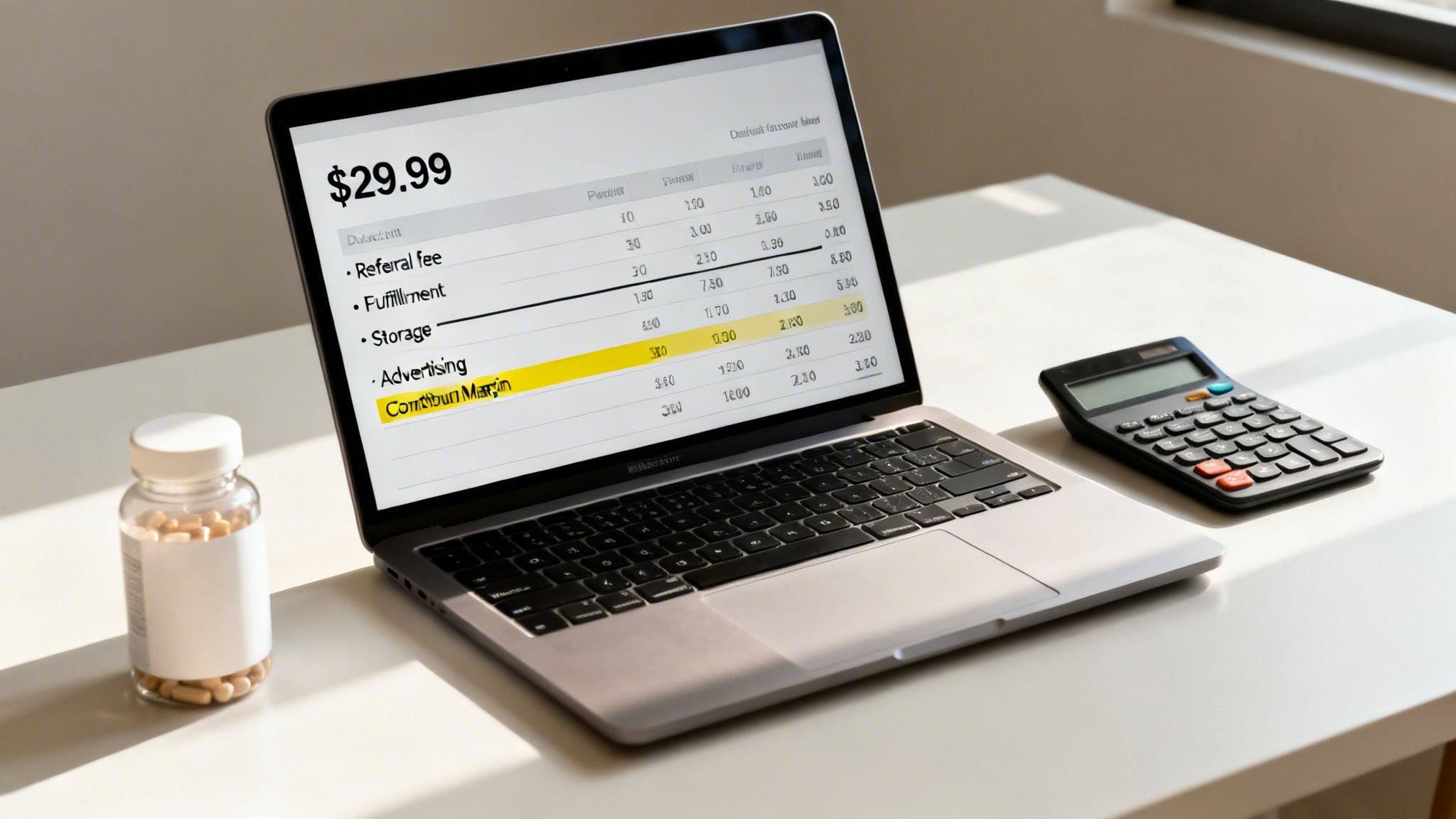
Assume our product is a standard-size item weighing under one pound, placing it in a favorable FBA tier.
Retail Price: $29.99 This is our top-line revenue for a single sale.
Landed Cost of Goods Sold (COGS): ($7.50) This is the cost to produce and ship one unit to an Amazon warehouse. We'll use a 25% COGS as a baseline.
Amazon Referral Fee (15%): ($4.50) For the Health & Personal Care category, Amazon takes a 15% cut. This is their non-negotiable commission.
FBA Fulfillment Fee: ($4.00) Based on current rates for a small, standard-size product (8-12 oz), this fee covers pick, pack, and ship operations.
Estimated Monthly Storage: ($0.05) Assuming good inventory velocity (under 60 days), the monthly storage cost per unit is minimal. This number balloons if inventory sits.
Advertising Cost (25% ACoS): ($7.50) We’ll budget for a 25% Advertising Cost of Sale (ACoS). This means for every $29.99 sale from ads, we spend $7.50 on the click. When modeling profitability, it's critical to understand not just Amazon's direct fees but also what is Cost Per Acquisition (CPA) for your total sales effort.
Now for the moment of truth. Let's subtract all costs from the retail price to find our per-unit profit.
$29.99 (Retail Price) - $7.50 (COGS) - $4.50 (Referral Fee) - $4.00 (FBA Fee) - $0.05 (Storage Fee) - $7.50 (Ad Spend) = $6.44 Net Contribution Margin Per Unit
This yields a 21.5% contribution margin. This is the real number that indicates your Amazon channel's health. It’s the cash generated by each sale to reinvest into growth or take as profit.
This model instantly reveals the trade-offs. A higher ACoS to drive initial sales velocity will directly squeeze this margin. An unexpected FBA fee increase could erase a dollar or more. This is why building a solid financial foundation and constantly optimizing costs are non-negotiable for sustainable growth.
Once you dig into Amazon's fee structure, real-world questions arise. Let's tackle the most common ones.
This is critical. Amazon calculates referral fees on the total sale price—what the customer actually pays. That includes the item price plus any shipping or gift-wrapping charges.
If you run a coupon or promotion, the fee is calculated on the final discounted price. This is a key detail when modeling promotion profitability. While your fee decreases slightly with the discount, your revenue and margin take a much bigger hit. Always model promotions against your net profit per unit, not just the potential sales lift.
Good news: Amazon’s marketplace facilitator program automatically calculates, collects, and remits sales tax for you in almost every state.
You never touch the sales tax money yourself; it's collected and sent directly to tax authorities. Therefore, sales tax doesn't directly eat into your take-home pay. Your main job is to ensure your product tax codes are set correctly in Seller Central to maintain compliance. A mistake there won't change your fees, but it can create a massive accounting headache.
If Amazon suspects your product's dimensions or weight are wrong, they will pull a unit for a "cubiscan" to get exact measurements. If they find a discrepancy, they will immediately update your FBA fulfillment fee.
This is where sellers get blindsided. You might see sudden, sometimes retroactive, fee increases on your payment reports. An unexpected jump from a 'Small Standard' to a 'Large Standard' size tier can wipe out your profit margin overnight. This is why it's crucial to be precise with your product data from day one and regularly audit your FBA fee statements.
For virtually all sellers, the answer is no. Amazon's referral fees are non-negotiable. They are set by category and applied uniformly.
While a nine-figure brand might have a unique arrangement, it's not an option for sellers on Seller Central. Your energy is better spent on variables you can control: pricing strategy, fulfillment method, inventory velocity, and ad efficiency. That’s where you find room to protect your margins.
The biggest risk for CPG brands isn't a single fee, but the slow, almost unnoticeable "fee creep" that erodes margins over time. Amazon's costs are not static. FBA fees, storage surcharges, and even referral fee structures change annually, and sometimes more often. A product that was profitable last year might be a break-even or loss-leader today.
Operators often build their financial models once, during the "Foundation" phase, and then fail to revisit them. This is a critical mistake.
The trade-off is clear: you must dedicate operational resources to constantly monitor your unit economics. This isn't a "set it and forget it" channel. Ignoring fee changes is a direct path to unprofitable growth, where your top-line revenue climbs while your bank account shrinks.
Navigating Amazon's fee maze to protect your margins demands an operator's mindset. At RedDog, we build contribution-margin-first growth strategies for CPG brands. This isn't a sales pitch; it's a working session to get under the hood of your channel's health and pinpoint immediate ways to improve your bottom line.
Leave a comment: