
Published: March 2020 | Last Updated:January 2026
© Copyright 2026, Reddog Consulting Group.

Let's get straight to the point: the question isn't "how many keywords should I use," but "how focused is my strategy?" For any single page on your site, you should lock in on one primary keyword and about three to five closely related secondary keywords. Think of it as giving each page a specific job—it keeps your message crystal clear for both your customers and the search engines trying to understand your brand.
The days of cramming as many keywords as possible onto a page are long gone. That old-school tactic, known as "keyword stuffing," doesn't just create a terrible reading experience; it's a surefire way to get penalized by Google. Modern SEO is a game of precision, not volume. The real goal is to match a user's search intent with focused, genuinely helpful content. A huge part of this is understanding keyword search volume—a metric that tells you which terms are actually worth your time.
This shift wasn't random. It was a direct response to search engines getting much, much smarter.
Back in 2010, SEO was a wild west of stuffing pages with keywords to dominate the rankings. Then, Google's Panda update in 2011 changed everything. Sites that were cramming in 5-10% keyword density saw their rankings tank overnight. Today, the best practice is a natural-sounding density of just 1-2%.
This evolution forces us to think like our customers. Instead of asking, "How many keywords can I fit in here?" we now have to ask, "What is this page really about, and what other terms help support that main idea?"
To put this change in perspective, let's look at how the game has changed.
| Strategy Element | The Old Way (Pre-Panda Update) | The Modern Way (Effective Best Practice) |
|---|---|---|
| Primary Goal | Rank for as many keywords as possible on a single page. | Match a specific user intent with highly relevant content. |
| Keyword Focus | Quantity over quality. Stuff keywords wherever they fit. | One clear primary keyword per page, supported by related terms. |
| Keyword Density | High, often 5-10% or more. Sounded robotic. | Low and natural, around 1-2%. Reads like a human wrote it. |
| Content Quality | Secondary to keywords. Content was often thin or unhelpful. | The top priority. Content must be valuable and answer questions. |
| User Experience | Awful. Pages were unreadable and designed for bots. | Critical. A good experience keeps users engaged and signals quality. |
This table highlights the move from a brute-force approach to a more thoughtful, user-centric one. Winning at SEO today means earning your rank, not tricking the system.
Your approach should always start with a solid foundation built on clarity and a laser focus on the user. Here’s what that looks like in practice:
This method gives you a clear blueprint for your content, ensuring every page serves a distinct purpose in your broader strategy. It’s the first step—the Foundation—toward building an SEO machine that drives measurable growth. You can discover more about current SEO statistics and ranking factors to see just how much the field has evolved.
If you want your SEO strategy to deliver measurable results, you need a rock-solid Foundation. That means it’s time to stop chasing individual keywords and start building topic clusters. It’s a smarter way to organize your content that establishes your brand as an authority, making it easier for both search engines and customers to understand your expertise.
Think of it like setting up a physical retail store. You wouldn't dump all your products in a pile on the floor. You’d create clear aisles—like "Men's Footwear" or "Women's Apparel"—and then neatly organize products within them. Topic clusters do the exact same thing for your website.
Let's say you're an eCommerce brand selling running shoes. Your main topic, or "pillar," might be "running shoes." Instead of pouring all your effort into ranking one page for that hyper-competitive term, you build a universe of content around it.
The topic cluster model works around a central "pillar" page—in this case, your main category page for "running shoes." This page then links out to more specific "cluster" pages, each targeting a more focused, long-tail keyword that solves a specific customer problem.
For example, your cluster content could include:
Each of these pages is laser-focused on its own primary keyword, but they all link back to the main "running shoes" pillar page. This interconnected structure signals to search engines that you have deep expertise on the entire subject, not just a shallow understanding of a single term. This is an essential step in creating a scalable and effective SEO content strategy.
This diagram breaks down the simple but powerful structure of a keyword cluster for a single page.
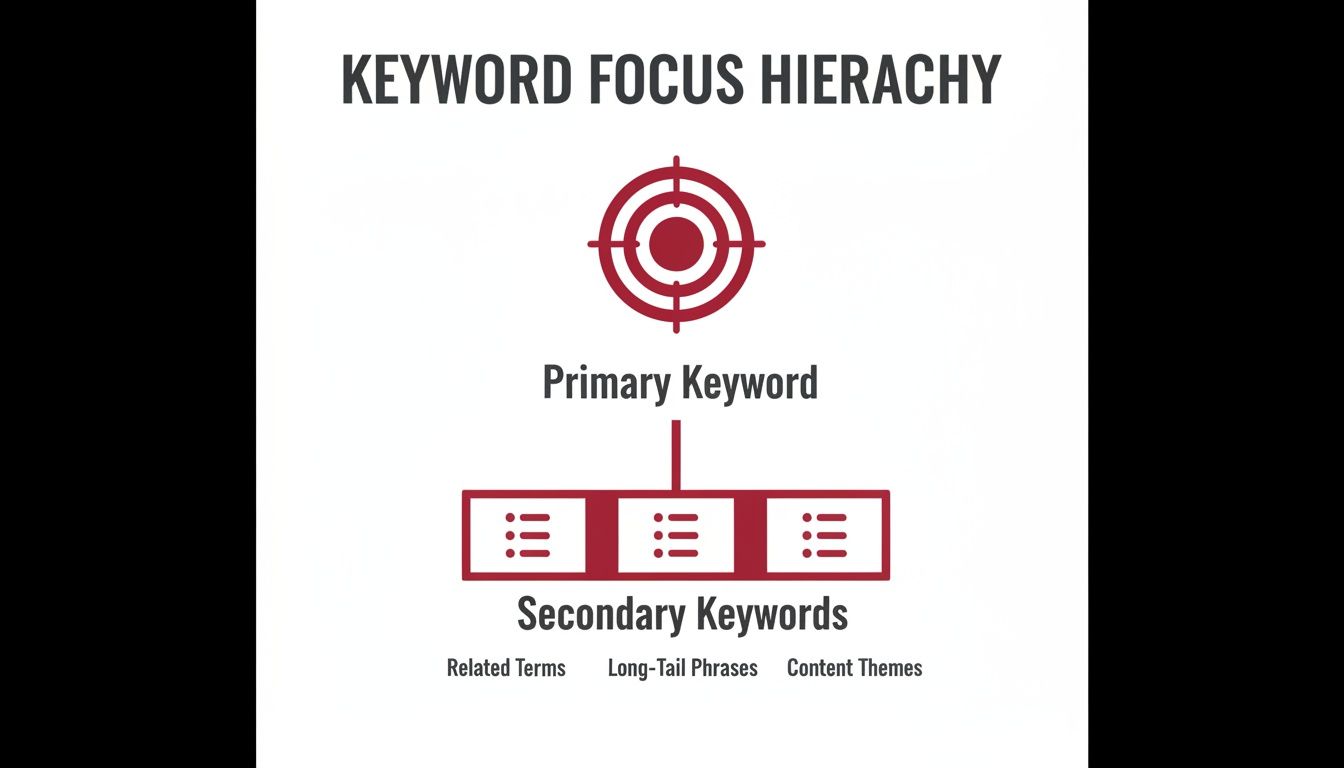
As you can see, every page should have one main goal (the primary keyword) that's supported by a handful of closely related terms (the secondary keywords).
Once you’ve defined your topics, the next step is keyword mapping. This is simply the process of assigning a primary keyword to a specific URL on your website. The goal is to ensure every important page has a unique job, which prevents your own pages from competing against each other for the same traffic—a frustrating issue known as keyword cannibalization.
By assigning a unique primary keyword to each product, category, and blog page, you create clear pathways for search engines. This tells them which page is the most authoritative answer for a specific query, preventing confusion and strengthening your overall rankings.
This foundational work isn’t just about SEO; it’s about creating a better customer journey. When your site is structured logically by topic, shoppers can easily find what they’re looking for, whether they're browsing on a desktop at home or on their phone inside one of your physical stores. That seamless experience is where true omnichannel growth begins.
Once you have a solid keyword map, it’s time for Optimization. This is where you strategically weave your keywords into your page so naturally that they’re invisible to readers but crystal clear to search engines. The goal here is relevance, not just repetition.

Think of it like merchandising a display in a retail store. You wouldn’t just dump products on a shelf. You’d put your best-seller at eye level and surround it with related items that tell a story. On-page SEO follows the exact same logic.
It stops being about "how many keywords" and starts being about placing them in the right spots to send the strongest signals.
To make a real impact, your primary keyword and its closest variations need to appear in a few key, high-visibility places on the page. These are the first places Google’s crawlers look to understand what your content is about.
Here’s where to focus:
Think of these placements as signposts. Getting them right confirms your page's topic, builds trust with users, and has a direct impact on click-through rates and rankings.
For more hands-on tactics, check out our guide on 10 eCommerce SEO best practices for measurable growth.
Let’s make this practical. Say you’re selling a "men's waterproof trail running shoe"—that’s your primary keyword. Your secondary keywords could be "lightweight hiking sneakers," "all-weather running shoes," and "outdoor athletic footwear for men."
Here’s how you’d optimize that product page:
See how methodical that is? This simple, structured approach is incredibly effective. For example, pages with keyword-optimized URLs get a 45% higher click-through rate on average. That’s a measurable lift. By nailing these on-page fundamentals, you give yourself a much better shot at cracking the top spots, where the top 3 results get 36% of all clicks.
Of course, placement is only half the battle. You still need to understand how to write SEO articles that consistently rank to truly win in the long run.
Once you’ve nailed your core keywords, it’s time for Amplification. This isn’t about shouting louder than the competition; it’s about having smarter conversations with the customers who are ready to buy. This is where long-tail keywords really shine.
A broad, short-tail keyword like "men's shirts" is a battlefield—incredibly competitive and hard to win. But a long-tail phrase like "breathable cotton polo shirt for summer" is different. It’s specific, signals exactly what the shopper wants, and is far easier to rank for.
For retailers managing huge product catalogs, these super-specific phrases are a goldmine for driving qualified, ready-to-buy traffic straight to product pages.
Long-tail keywords are the backbone of any scalable SEO strategy, especially for eCommerce brands juggling multiple marketplaces. For brands we partner with at RedDog Group, managing 30,000+ SKUs across giants like Amazon and Walmart, zeroing in on these niche terms isn't just a tactic—it's essential. The data backs this up: long-tail keywords (phrases with four or more words) make up a huge slice of all search activity. You can see more on this by exploring the latest SEO statistics on keyword trends.
While these longer phrases have lower search volumes individually, they convert at a much higher rate because they perfectly match a customer's specific need. A search for "shoes" is someone just browsing. A search for a "size 11 wide-fit waterproof hiking boot" is a mission.
Capturing traffic from long-tail keywords means you’re meeting customers at the final stage of their buying journey. You’re cutting out friction, boosting conversion rates, and creating a direct line between their problem and your product’s solution.
The secret is to get inside your customer's head. What specific questions are they asking? What features are non-negotiable? You can uncover these valuable phrases by:
For brands selling on major marketplaces, understanding how people search on that specific platform is critical. To get a head start, dive into our guide on the most searched keywords on Amazon and start applying those insights. By prioritizing these high-intent, low-competition keywords, you can drive significant, scalable growth in both organic traffic and sales, turning niche searches into real revenue across all your channels.
Launching your keyword strategy is a great start, but the real growth happens when you consistently measure what’s working and make adjustments based on data. An SEO plan isn’t a "set it and forget it" task. It’s a living part of your omnichannel strategy that needs to evolve with performance data and market shifts.

You don’t need a suite of expensive tools for this. For most brands, Google Search Console provides everything you need to track performance and make smart decisions. It’s built to help you answer the most critical questions: Are my pages ranking for my target keywords? And is that traffic turning into sales?
To get a clear picture of keyword performance, focus on a few core metrics. These numbers tell a story about how real people find and interact with your brand, both online and offline.
These key performance indicators (KPIs) are the vital signs of your SEO health. Understanding them helps you connect SEO efforts directly to business results.
| Metric | What It Measures | Why It's Important for Your Brand |
|---|---|---|
| Keyword Rankings | Your page's position in search results for specific target keywords. | This is a direct measure of your visibility. Higher rankings mean more eyes on your products. |
| Organic Traffic | The number of visitors coming to your site from unpaid search engine results. | A steady increase shows your strategy is successfully attracting more potential customers. |
| Click-Through Rate (CTR) | The percentage of people who see your page in search results and click on it. | A high CTR means your title tags and meta descriptions are compelling enough to win the click. |
| Conversions | The ultimate goal: an online sale, a lead form submission, or a store visit. | This metric ties your SEO work directly to revenue and proves your strategy is profitable. |
Paying attention to these metrics helps you move beyond guesswork. Instead of wondering if your keywords are working, you'll know for sure and be able to make informed decisions to drive more growth.
Monitoring these metrics together is crucial. High rankings are great, but if they don't lead to traffic that actually converts, your strategy is falling flat. The end goal is to drive profitable customer action, not just chase vanity metrics.
To keep your strategy sharp, set up a simple quarterly review process. This rhythm gives your SEO efforts enough time to generate meaningful data while being frequent enough to correct course before underperforming pages drag you down.
During each review, ask these critical questions:
This continuous cycle of measuring and refining transforms your SEO from a guessing game into a reliable growth engine. It ensures your answer to "how many keywords should I use" is always backed by real-world performance data.
Alright, let's put this theory into practice. This is your cheat sheet for turning everything we’ve covered into a simple, step-by-step plan you can start using today. This is how you stop guessing and start building a keyword strategy that turns clicks into customers.
This framework walks you through the entire process, from initial research to ongoing refinement, following our core pillars for sustainable growth.
First, create a plan for every page. Before you write a single word, decide what each page is trying to rank for. This simple step prevents you from competing with yourself (keyword cannibalization) and tells Google exactly what your content is about.
With your keywords chosen, it’s time to put them to work. This is where you connect your keyword list to your website’s structure, ensuring everything flows logically for both search engines and customers.
A keyword strategy is useless if you don't know whether it's working. Setting up basic tracking isn't optional—it's how you spot opportunities, refine your approach, and drive continuous growth.
Even with a solid plan, a few questions always pop up. Here are quick, practical answers to the common keyword strategy questions we get from clients.
No, not in the old-school "stuff your keyword in 5 times" way. That strategy is long dead. Today, it’s all about relevance and writing for humans.
Instead of obsessing over a magic percentage, focus on using your primary keyword and its variations where they fit naturally—in your main heading (H1), the first paragraph, and maybe an image alt text. Modern search engines are smart enough to understand your page's topic without you sounding like a broken record.
Let's break it down with a simple retail analogy.
Your primary keyword is the star of the show. It's the main topic of your page, the big-ticket phrase you're aiming to rank for, like "men's trail running shoes."
Secondary keywords are the supporting cast. They add depth and context. Think of related terms like "waterproof hiking sneakers for men," synonyms, or long-tail questions like "best shoes for rocky trails." Weaving these in helps you create richer content that answers a wider range of search queries and signals your expertise to search engines.
This is a big one, especially for brands with large product catalogs. When two or more of your pages are fighting for the same main keyword, they end up hurting each other's chances to rank. That’s keyword cannibalization.
The fix is surprisingly simple: good keyword mapping. Assign one unique primary keyword to each dedicated page. This simple discipline stops your pages from competing and sends a clear signal to Google about which page is the definitive answer for a specific search. According to the latest SEO statistics, cleaning up cannibalization issues often leads to significant ranking improvements.
A structured map ensures every page has a distinct job, building a stronger, more organized site that performs better across the board.
Ready to build a keyword strategy that drives revenue, not just clicks? At RedDog Group, we specialize in turning search data into measurable growth.
Leave a comment: