
Published: March 2020 | Last Updated:January 2026
© Copyright 2026, Reddog Consulting Group.

Scaling omnichannel sales feels complex when each marketplace and sales channel pulls your attention in a different direction. With the U.S. Census Bureau and the International Trade Administration both emphasizing how e-commerce performance and growth can vary by platform, knowing where you stand has never mattered more. Get ready to uncover practical ways to assess, optimize, and connect your current e-commerce channels for smarter growth and stronger marketplace results.
| Key Point | Explanation |
|---|---|
| 1. Assess channel performance thoroughly | Audit all sales channels, gathering sales data to identify strengths and weaknesses for informed scaling decisions. |
| 2. Optimize listings for target platforms | Tailor product listings to match each marketplace’s rules and audience expectations to improve conversion rates. |
| 3. Integrate inventory and order systems | Ensure real-time communication between inventory and order management systems to prevent overselling and stock discrepancies. |
| 4. Implement targeted marketing campaigns | Define audience segments and use data-driven advertising to efficiently reach potential customers on various platforms. |
| 5. Monitor analytics and adapt strategies | Establish key performance metrics to regularly assess and adjust strategies, leveraging performance data for continual growth. |
Before you can scale, you need a clear picture of where you stand right now. This step involves auditing which channels you’re currently selling through and understanding how each one is performing. You’ll gather data, identify your strongest performers, and spot the gaps holding you back.
Start by listing every platform where your products appear. Are you selling on your own website? Amazon? Marketplace platforms? Social commerce channels? Physical retail locations feeding into your online operation? Write them all down. The goal isn’t just to document what exists, but to understand how each channel contributes to your bottom line. U.S. e-commerce market forecasts show that different channels grow at vastly different rates, so knowing your current mix matters more than you might think.
Next, pull your sales data from each channel for the past 12 months. Break it down by channel, product category, and if possible, by customer type. Look at revenue, order volume, average order value, and profit margins channel by channel. This isn’t busywork, it’s the foundation of your scaling strategy. You’ll spot which channels are printing money and which ones are just taking up shelf space in your operations.
Compare your channel performance against historical e-commerce data to see where industry trends are moving. If marketplace sales are growing 40% year over year across your industry but you’re only seeing 15%, that’s a signal. That gap represents opportunity or warns you about execution issues. Calculate your conversion rate, customer acquisition cost, and lifetime value for each channel so you can see the real profitability picture beyond gross revenue.
Once you’ve gathered the numbers, identify patterns. Which channels drive repeat customers? Where do you lose money on shipping? Which platforms have the highest return rates? Understanding these dynamics helps you decide where to invest your scaling efforts and which channels need operational fixes before they’re worth expanding.
Here’s how key ecommerce performance metrics reveal business insights:
| Metric | Reveals | Common Issue Detected |
|---|---|---|
| Revenue by Channel | Top-earning platforms | Overreliance on one channel |
| Order Volume | Sales activity level | Low engagement on slow channels |
| Profit Margin | Channel profitability | Unsustainable fulfillment costs |
| Conversion Rate | Effectiveness of listings | Poor product-market fit |
| Customer Acquisition Cost | Efficiency of marketing | Overspending on ads |
| Return Rate | Product satisfaction | High defect or mismatch rate |
| Average Order Value | Up-sell/cross-sell success | Missed bundling opportunities |
| Lifetime Value | Retention and loyalty | Ineffective retention efforts |
Pro tip: Create a simple spreadsheet comparing the last three quarters of performance for each channel, including growth rate and profit margin, so you can quickly spot trends and make faster decisions about where to focus your scaling budget.
Now that you understand your current performance, it’s time to make your products shine on every platform you sell through. Each marketplace has its own rules, buyer behaviors, and algorithm preferences. Optimizing your listings for each one is how you turn browsers into buyers and climb those ranking charts.

Start by researching what makes listings convert on each platform. Amazon buyers scan differently than Walmart buyers. Instagram shoppers behave differently than those on your own website. Study your top competitors on each marketplace and note what they’re doing right. Look at their product titles, descriptions, keywords, images, and pricing. You’re not copying them, you’re understanding what the algorithm rewards and what customers expect to see.
Prioritize your product attributes and benefits based on what matters most to buyers on that specific platform. Tailoring product listings to marketplace features means highlighting different angles for different audiences. On Amazon, keyword density and search volume matter. On your website, storytelling and brand voice matter more. On social commerce, visual appeal and authenticity dominate. Adapt your messaging accordingly while keeping your core product story intact.
Incorporate product quality standards into your listing descriptions where relevant. Quality assurances, certifications, and durability claims build trust with potential customers. If your product is handmade, eco-friendly, or built to last, say it clearly. Buyers want to know what they’re getting, and platforms reward listings that address customer concerns upfront.
Test different variations of your listings on each platform over 4 to 6 weeks. Change one element at a time, track your conversion rates and click through rates, then keep what works. This iterative approach beats guessing every time. Some titles will perform better with keywords first, others with benefit first. Only data tells you which one wins on your specific marketplace.
Pro tip: Use a spreadsheet to track which keywords, images, and pricing strategies work best on each marketplace, then build a template system so updating listings across platforms takes hours instead of days.
The table below summarizes optimization tactics for four major ecommerce marketplaces:
| Platform | Optimization Focus | Customer Expectation | Key Success Factor |
|---|---|---|---|
| Amazon | Keywords and search ranking | Speed, trust, value | Algorithm-friendly listings |
| Walmart | Competitive pricing | Deals and reliability | Price plus product quality |
| Visual storytelling | Inspiration, authenticity | High-quality images | |
| Own Website | Brand voice and content | Deep product detail | Unique value proposition |
Your inventory and order systems need to talk to each other in real time. When they don’t, you oversell on one channel, understock on another, and frustrate customers. This step connects your systems so every sale updates your stock instantly across all platforms.
Start by auditing your current setup. Are you managing inventory in a spreadsheet while orders come through five different platforms? That’s a recipe for disaster. You need a single source of truth for stock levels. Whether you use your existing e-commerce platform’s built in features or invest in dedicated inventory software, the goal is the same, one number for inventory across all channels.
Choose software that integrates with your sales channels. Most modern systems connect to Amazon, Shopify, WooCommerce, marketplace platforms, and physical Point of Sale systems simultaneously. When someone buys your product on Instagram, that same SKU’s inventory decreases on Amazon and your website at the same moment. Real time inventory tracking prevents the nightmare of promising stock you don’t actually have.
Set up automated order routing and fulfillment workflows. Once you integrate your systems, you can automate which warehouse fulfills which order based on location, stock availability, and speed. This saves your team hours every day and reduces shipping costs because orders go out faster. Database design for inventory systems enables you to automate these processes at scale without manual intervention.
Test the integration thoroughly before going live. Place test orders across all your channels simultaneously and confirm that inventory updates correctly everywhere. Check that orders flow to the right fulfillment location. Verify that your reports show accurate stock levels. Catch problems now, not when a customer receives a cancellation email three days after ordering.
Monitor your system daily for the first two weeks after launch. Watch for syncing delays, missing orders, or inventory discrepancies. Fix issues quickly. Once everything runs smoothly, you’ll see your operations efficiency jump significantly and your customer satisfaction improve.
Pro tip: Set up automated daily inventory reports that flag any discrepancies between channels, so you catch problems before they become customer headaches.
You’ve optimized your listings and integrated your systems. Now it’s time to drive traffic and customers to those listings. Targeted digital marketing campaigns reach the right people at the right time with the right message. This is how you turn your omnichannel setup into actual revenue growth.
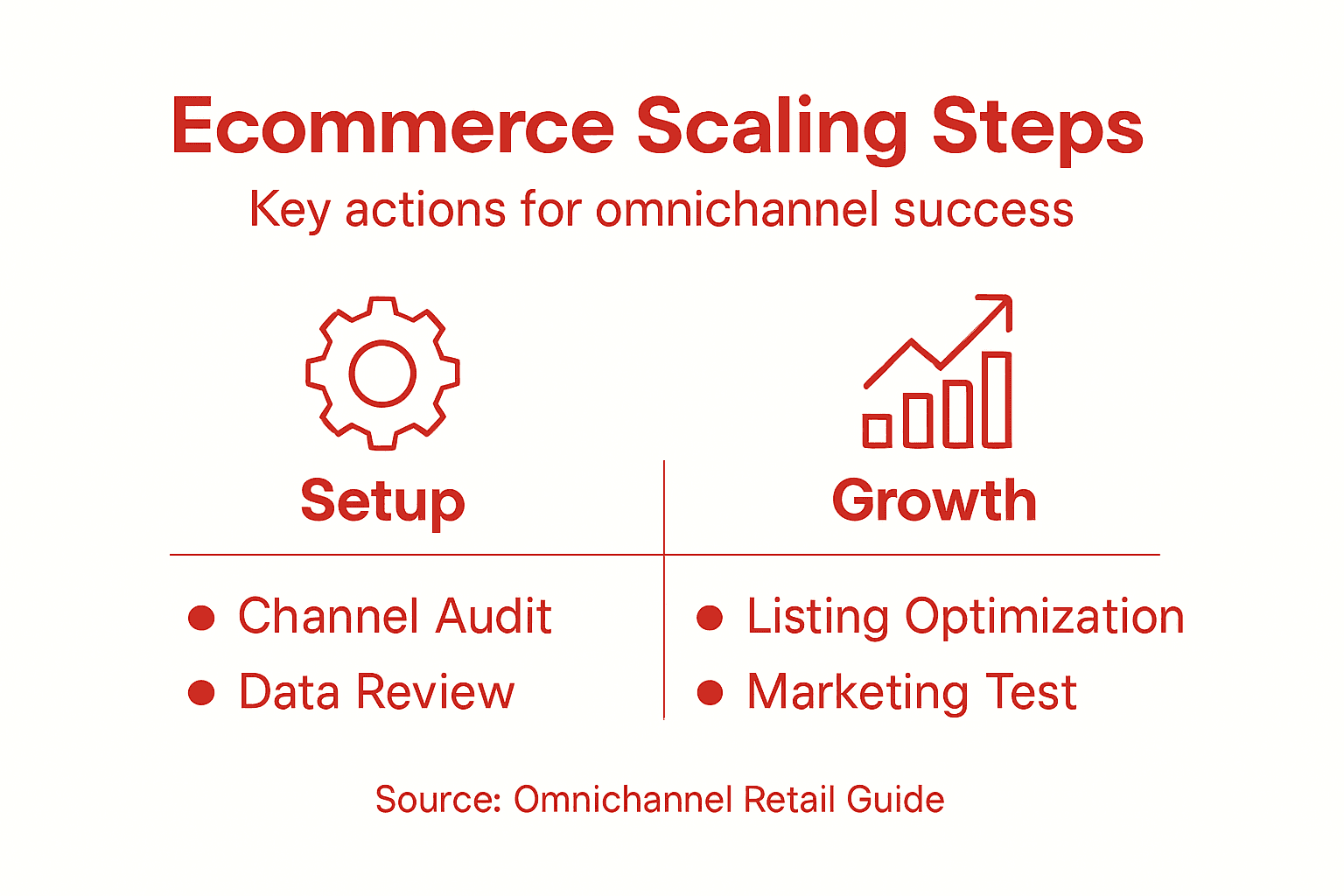
Start by defining your audience segments. Who buys your products? What are their pain points, interests, and online behaviors? Create detailed buyer personas for each segment. A budget conscious parent shopping for back to school supplies behaves completely differently than a professional buying office equipment. Your marketing messages need to reflect those differences. The more specific you are about who you’re targeting, the better your campaigns perform.
Use targeted advertising with data analytics to reach customers across multiple channels simultaneously. Facebook and Instagram ads can reach people by interests and behaviors. Google Shopping ads show your products to people actively searching for what you sell. Email campaigns can re engage past customers. Each channel serves a different purpose in your customer journey. Run campaigns that complement each other rather than compete.
Test different ad creatives, messaging, and audience combinations. Run one campaign emphasizing your product’s durability, another highlighting price, a third focusing on fast shipping. Track which combination generates the lowest cost per acquisition for each customer segment. After two to four weeks, pause the underperformers and increase budget on the winners. This data driven approach beats guessing every single time.
Measure what actually matters. Track your return on ad spend, not just clicks or impressions. Know your customer acquisition cost for each campaign and compare it to the lifetime value of customers from that campaign. If a Facebook campaign costs you fifty dollars to acquire a customer but that customer spends three hundred dollars over their lifetime, that’s a winning campaign worth scaling.
Pro tip: Build separate campaigns for new customer acquisition and existing customer re engagement, since they require completely different messaging and audience targeting strategies.
Your systems are running, your listings are optimized, and your marketing campaigns are live. Now comes the part that separates successful scaling from flat growth. You need to watch your data constantly and adjust your strategy based on what you learn. This is where real growth happens.
Set up dashboards that show you the metrics that actually matter. Revenue by channel. Conversion rate by platform. Customer acquisition cost by campaign. Average order value trends. Return rate by product category. Inventory turnover by SKU. You don’t need hundreds of metrics, you need the right ones. Pick eight to twelve that directly impact your bottom line and monitor them weekly.
Use data-driven decision making to diagnose what’s working and what isn’t. If your Amazon conversion rate dropped 15 percent last month, dig into why. Did your listing change? Did competitors lower their prices? Did your shipping time increase? Understanding the cause lets you fix the actual problem instead of guessing. Compare your performance across channels to spot patterns. Maybe Facebook ads work great for one product category but fail for another.
Schedule a monthly review where you sit down with your data and make strategic changes. Look at what improved and what declined. Celebrate wins but don’t get complacent. Winners can plateau fast in e-commerce. Look at what’s underperforming and decide whether to invest more time to fix it, adjust your approach, or cut it loose. Sometimes the right move is stopping something that drains resources without returning profit.
Test changes methodically. If you adjust your pricing strategy, run it for four weeks before deciding if it worked. If you pause a marketing channel, wait six weeks to measure the impact on repeat customer revenue. Avoid changing too many things at once or you’ll never know what actually caused your results. One change per month lets you understand causation clearly.
Pro tip: Set up automated weekly emails that show your top five metrics, so you stay informed without spending hours digging through dashboards.
Scaling ecommerce for omnichannel success can feel overwhelming when juggling multiple sales channels, optimizing product listings, and managing inventory in real time. This article highlights the critical challenges you face including boosting conversion rates, streamlining inventory management, and launching targeted marketing campaigns to grow revenue sustainably. If you want to move beyond guesswork and guess the impact of each channel, you need a proven strategy that connects data insights with execution.
Reddog Group’s Digital & Business Consulting Services by Reddog Consulting specialize in tackling exactly these pain points. Our experts harness years of experience managing over 50 brands and thousands of SKUs through marketplace mastery, Amazon FBA, and integrated online and offline sales. 
Ready to transform your ecommerce operations and scale confidently across every channel? Visit our Home page to discover customized solutions that improve product listings, synchronize your inventory systems, and implement data-driven marketing campaigns. Don’t wait to fix inefficiencies that limit your growth. Visit https://reddog.group now and start winning in omnichannel retail today.
To assess your current ecommerce channels, begin by auditing where you sell your products and gathering sales data from each channel over the past 12 months. Track key metrics such as revenue, order volume, and conversion rates to identify your strongest performing channels and any gaps you need to address.
To optimize product listings, research what works best for each platform and tailor your listings according to specific marketplace behaviors. Focus on keywords, visuals, and messaging that resonate with the audience of each channel, making iterative changes based on performance over 4 to 6 weeks.
Integrate your inventory and order management systems by choosing software that connects simultaneously with all your sales channels to provide real-time stock updates. Test the integration thoroughly to ensure accuracy and monitor for discrepancies daily to maintain efficient operations.
Effective digital marketing campaigns should be targeted based on detailed customer segments that reflect their specific needs and behaviors. Use a mix of platforms and continually test different creatives and messages to see which generates the lowest customer acquisition cost while tracking return on ad spend.
Set up dashboards to track critical metrics like revenue by channel and customer acquisition cost, reviewing them weekly to spot trends. Adjust strategies methodically based on your analytics, making one change at a time to measure effectiveness clearly, and schedule monthly reviews to assess overall performance.
Leave a comment: