
Published: March 2020 | Last Updated:January 2026
© Copyright 2026, Reddog Consulting Group.

Every Ecommerce Manager knows the frustration of watching interested shoppers abandon their carts just before checkout. Understanding what drives visitors toward or away from a sale is vital for small and medium businesses in the United States competing online. This guide shares practical ways to assess current conversion performance, sharpen product messaging, and upgrade site usability, giving you the tools to turn more browsers into loyal customers while strengthening every stage of the multichannel journey.
| Key Insight | Explanation |
|---|---|
| 1. Assess Your Conversion Rate | Calculate your conversion rate to benchmark against industry standards for improving store performance. |
| 2. Optimize Product Listings | Create impactful product descriptions with clear titles and benefits, utilizing high-quality images. |
| 3. Enhance Site Usability | Streamline navigation and improve mobile responsiveness to reduce customer frustration and bounce rates. |
| 4. Implement Targeted Marketing | Use customer segmentation to tailor marketing messages for improved engagement and conversion rates. |
| 5. Verify Changes Through Testing | Conduct A/B testing to evaluate the effectiveness of changes and refine strategies based on data. |
Gauging your current conversion performance starts with a comprehensive diagnostic of your online store’s metrics. Small to medium sized businesses need a systematic approach to understanding how effectively their website transforms visitors into paying customers. By analyzing customer behavior patterns, you can uncover critical insights into your conversion funnel.
To begin, gather key performance indicators including total website visitors, total transactions, conversion rate percentage, average order value, and cart abandonment rate. Most ecommerce platforms provide built-in analytics dashboards that track these metrics automatically. Focus on calculating your baseline conversion rate by dividing total completed purchases by total website visitors and multiplying by 100. Industry standards suggest that a conversion rate between 2-5% is typical for online retail, though top performing stores can achieve rates up to 10%. Predictive analytics techniques can help you understand not just current performance but potential future conversion improvements.
Examine your conversion data across different traffic sources, device types, and customer segments to identify specific areas for optimization. Look for patterns in where potential customers drop off in the purchasing process, such as product pages, cart abandonment rates, or checkout complexity.
Pro tip: Create a conversion performance dashboard that tracks your key metrics weekly, allowing you to quickly spot trends and take immediate action on improving your online store’s effectiveness.
Here is a summary of key ecommerce metrics and their role in conversion success:
| Metric | What It Measures | Why It Matters |
|---|---|---|
| Conversion Rate | Sales vs. Visitors | Identifies store effectiveness |
| Average Order Value | Average spend per purchase | Reveals upsell and pricing opportunities |
| Cart Abandonment Rate | Unfinished transactions | Flags friction in checkout process |
| Traffic Source Analysis | Where visitors originate | Pinpoints high-quality, converting traffic |
| Device Type Distribution | Usage across devices | Guides mobile and desktop optimizations |
Transforming your product listings into powerful conversion tools requires strategic refinement of every visual and textual element. Small and medium businesses can dramatically improve their online sales by leveraging language model techniques to create compelling product descriptions that resonate with potential customers.
Focus on crafting clear product titles that include key search terms, highlighting unique value propositions within the first few words. Your product descriptions should go beyond basic features by explaining specific benefits and solving customer pain points. High resolution images that showcase products from multiple angles remain critical visual components drive conversions. Include precise measurements, color variations, and context that helps buyers understand exactly what they are purchasing.

Ensure your product messaging addresses potential customer questions proactively. Use bullet points to break down technical specifications, highlight shipping details, and communicate return policies transparently. Incorporate customer reviews and social proof elements that build trust and credibility for your offerings.
Pro tip: Regularly update your product listings with seasonal keywords and current market language to maintain relevance and improve search visibility.
Improving your ecommerce website’s usability is crucial for keeping potential customers engaged and reducing bounce rates. User-centered interface design plays a critical role in creating a smooth, intuitive shopping experience that guides visitors seamlessly toward making a purchase.
Start by streamlining your website navigation with clear, logical menu structures that allow customers to find products quickly. Implement a clean search function with robust filtering options that enable shoppers to narrow down selections by price, category, size, color, and other relevant attributes. Your main navigation should be simple and consistent across all pages, with dropdown menus that are easy to read and understand. Mobile responsiveness is non negotiable modern online stores must provide equally smooth experiences on smartphones and tablets.
Focus on reducing friction in the user journey by minimizing the number of clicks required to reach product pages and complete purchases. Use clear call to action buttons with contrasting colors, ensure text is readable, and maintain plenty of white space to prevent visual overwhelm. Implement breadcrumb navigation that shows users exactly where they are within your site structure, and provide multiple paths to key product categories.
Pro tip: Conduct regular user testing and analyze website heat maps to identify and eliminate navigation obstacles that might be secretly preventing conversions.
Compare website usability strategies and their effect on user experience:
| Usability Strategy | Description | Impact on Conversions |
|---|---|---|
| Streamlined Navigation | Clear, consistent menus | Faster product discovery |
| Robust Filtering Options | Filters for price, category, size | Reduces searching time |
| Mobile Responsiveness | Optimized for smartphones/tablets | Captures mobile sales |
| Clear Call-to-Action Buttons | Prominent purchase prompts | Increases checkout starts |
| Breadcrumb Navigation | Shows user’s location in site | Lowers confusion, reduces exits |
Targeted marketing campaigns transform how small businesses connect with potential customers by delivering personalized messaging that resonates directly with specific audience segments. Customer segmentation techniques enable you to craft precise marketing strategies that dramatically improve engagement and conversion rates.
Begin by analyzing your existing customer data to create detailed buyer personas representing different customer groups. Segment your audience based on demographics, purchasing behavior, browsing history, and previous interactions with your brand. Use these insights to develop tailored marketing messages that speak directly to each group’s unique needs and preferences. Implement multichannel marketing approaches that include email campaigns, social media advertising, retargeting ads, and personalized product recommendations.
Leverage automation tools to deliver timely and relevant content across different platforms. Set up triggered email sequences that respond to specific customer actions, such as abandoned cart notifications or personalized product suggestions based on past purchases. Track campaign performance meticulously, measuring key metrics like click through rates, conversion rates, and return on ad spend to continuously refine your marketing approach.
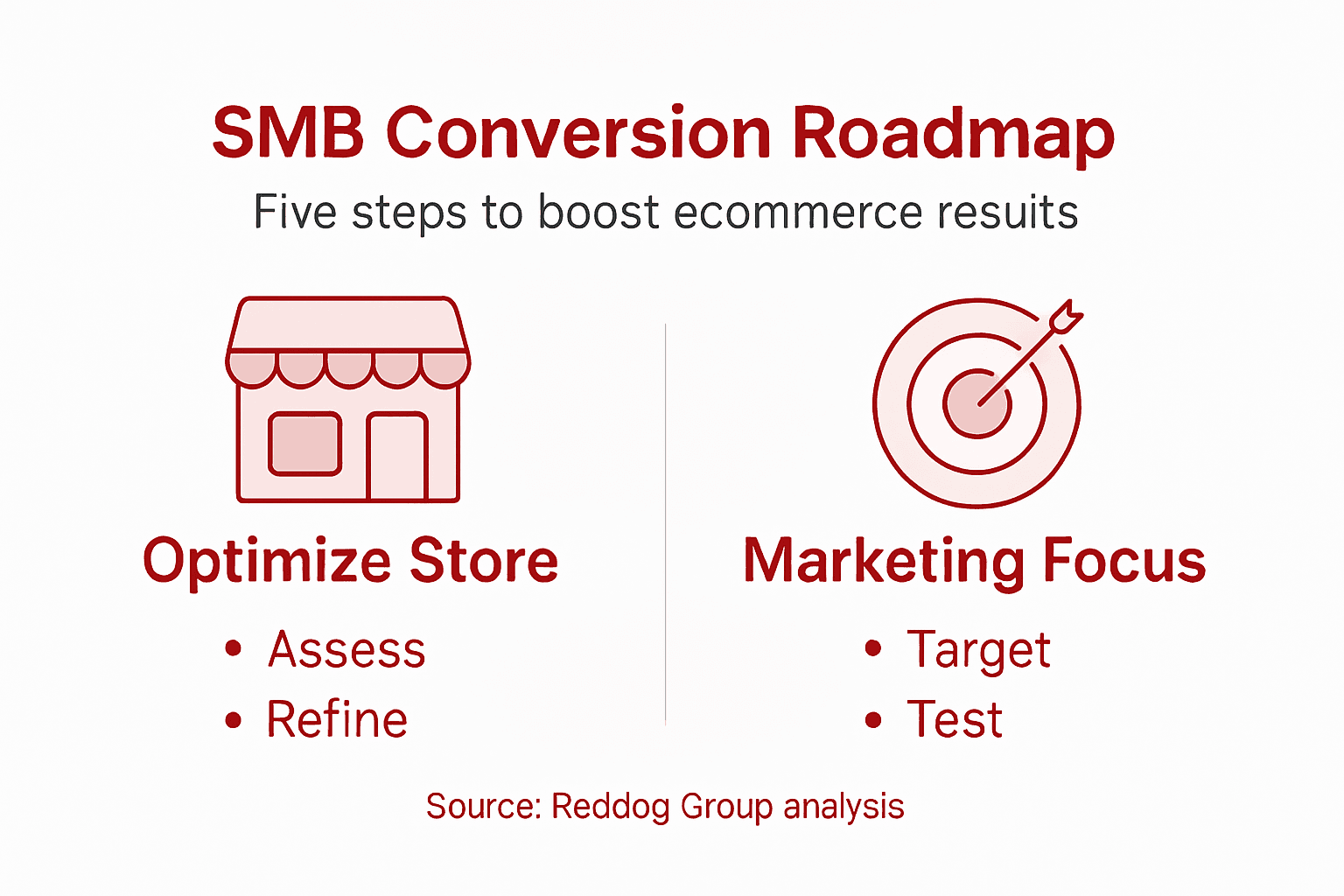
Pro tip: Create a centralized dashboard that tracks marketing campaign performance across all channels, allowing you to quickly identify and double down on the most effective strategies.
Transforming your ecommerce performance requires a systematic approach to measuring experimental results. Rigorous testing provides concrete evidence of what strategies actually improve your conversion rates, moving you beyond guesswork and into data driven optimization.
Implement A/B testing methodologies that compare different versions of your website elements like product pages, checkout processes, and marketing messages. Create controlled experiments where you test one variable at a time such as button colors, headline text, image placement, or pricing structures. Utilize statistical significance calculations to ensure your results are not random occurrences. Track key metrics including conversion rate, average order value, bounce rate, and customer engagement to comprehensively evaluate each test’s impact.
Establish a continuous testing cycle that constantly refines your approach. Use analytics tools to segment your test results by different customer groups, identifying which changes produce the most significant improvements for specific audience segments. Document each experiment meticulously, maintaining a knowledge base of insights that can inform future optimization strategies. Remember that conversion rate optimization is an ongoing process of incremental improvements.
Pro tip: Develop a standardized testing template that captures hypothesis, methodology, results, and actionable insights for each experiment, enabling systematic learning across your organization.
Struggling to turn website visitors into loyal customers is a common hurdle for small and medium-sized businesses aiming to grow online. This article highlights key challenges like pinpointing drop-off points in the purchase funnel, optimizing product listings with clear messaging, and enhancing site usability to reduce cart abandonment. If boosting your conversion rate and creating a seamless shopping experience feels overwhelming, you are not alone. Understanding metrics such as average order value and customer segmentation can open the door to targeted strategies that drive meaningful results.
At Reddog Group, we specialize in helping SMBs conquer these exact challenges with tailored Digital & Business Consulting Services by Reddog Consulting. Our proven expertise in omnichannel retailing, marketplace management, and product listing optimization empowers brands to unlock faster growth and increase online sales.
Ready to transform your ecommerce conversion performance? Visit our Home page to explore how our comprehensive solutions can give your business the edge it needs. Act now and partner with Reddog Group at reddog.group to start turning browsers into buyers and drive sustainable revenue growth.
To assess your current conversion performance, start by gathering key metrics such as total website visitors, total transactions, conversion rate percentage, and cart abandonment rate. Create a conversion performance dashboard that tracks these metrics weekly to identify trends and areas for improvement.
To optimize product listings, focus on creating clear product titles that include key search terms and crafting detailed descriptions that address customer pain points. Enhance visual elements by using high-resolution images and including essential information like measurements and color variations.
To improve site usability, streamline your website navigation with clear menus and implement a robust search function with filtering options. Ensure your site is mobile responsive and reduce the number of clicks needed to complete a purchase to enhance the overall shopping experience.
For targeted marketing campaigns, analyze customer data to create detailed buyer personas and segment your audience based on demographics and behavior. Develop tailored messages and utilize multichannel marketing approaches, like email campaigns and social media advertising, to resonate with each segment effectively.
To verify improvements in conversion rates, implement A/B testing to compare different website elements systematically. Track key metrics, such as conversion rate and average order value, to gauge the impact of changes, and establish a continuous testing cycle to refine your strategies over time.
Leave a comment: