
Published: March 2020 | Last Updated:December 2025
© Copyright 2026, Reddog Consulting Group.

Think of a freight forwarder for Amazon FBA as your brand's logistics quarterback. They are the strategic partner managing the complex journey of your products from a factory floor, across an ocean, and right to Amazon's warehouse doors. In simple terms, they handle the critical details of international shipping, customs clearance, and ensuring your inventory meets Amazon’s notoriously strict receiving requirements.
For any global eCommerce brand, mastering this process is essential for scalable, profitable growth.

Let's be clear: a top-tier freight forwarder isn't just a "shipping company." They are the foundation of a resilient, omnichannel supply chain. For any Amazon seller sourcing products overseas, logistics is far more than moving boxes; it's a high-stakes process of navigating customs regulations, complex paperwork, and razor-thin delivery windows.
Getting this wrong can cripple your growth.
Imagine launching a new product line sourced from Asia. Managing the logistics solo exposes your brand to significant risk. You could face unexpected customs holds, delays from incorrect paperwork, or a missed FBA delivery appointment—a direct path to stockouts, lost sales velocity, and diminished brand trust.
A skilled freight forwarder transforms that potential chaos into a smooth, predictable operation that fuels growth.
The right partner does more than book space on a container ship. They actively manage your inventory flow, ensuring it arrives on time and is 100% compliant with Amazon's evolving rules. This is the operational difference between brands that thrive and those constantly putting out supply chain fires.
This isn't a niche service. Over 82% of Amazon's active sellers use Fulfillment by Amazon (FBA), making specialized freight forwarders non-negotiable for feeding inventory into the system. This massive adoption proves how vital FBA benefits like Prime eligibility are to a brand's bottom line. You can find more insights on Amazon seller trends over at forceget.com.
At RedDog, we see logistics as a core component of our growth framework: Foundation → Optimization → Amplification. A rock-solid logistics foundation allows you to optimize your inventory and amplify your brand, confident that your supply chain can support your success. It's a direct investment in measurable, predictable growth.
Selecting the right freight forwarder is one of the most critical decisions for your Amazon FBA business. This isn't about finding the lowest shipping rate; it's about securing a logistics partner who acts as an extension of your team. The right choice directly impacts your profitability, inventory health, and ability to scale.
Think of it this way: a great partner is your supply chain advantage. They spot and sidestep costly mistakes before they happen, ensuring your products move seamlessly from factory to fulfillment center. A poor choice, however, can trigger a cascade of issues—shipments stranded in customs, surprise fees that erode your margins, and stockouts that tank your sales rank.
Many sellers focus on basic questions like, "What's your price?" While cost is a factor, it reveals very little about a forwarder's competence within the Amazon ecosystem. To distinguish generalists from FBA specialists, you must dig deeper.
A true FBA expert provides sharp, confident answers to process-specific questions. Their responses will be detailed, demonstrating a practical understanding of Amazon's strict inbound rules and operational nuances.
Here are the questions that truly matter:
The goal is to find a partner who thinks ahead. An experienced freight forwarder for Amazon FBA won't just react to problems—they'll have systems in place to prevent them. That proactive mindset is the foundation of a supply chain built for growth.
Clear communication, modern tracking technology, and a detailed grasp of Amazon's receiving process are non-negotiable. When vetting potential forwarders, use a structured approach to compare them objectively. For a more detailed guide, see our article on how to choose a freight forwarder for Amazon FBA and build a resilient supply chain.
Using a framework helps you make a data-driven decision instead of defaulting to the cheapest option.
Use this checklist to compare potential partners on the criteria that directly impact an FBA business.
| Service/Attribute | What to Look For | Why It Matters for FBA |
|---|---|---|
| FBA Expertise | Verifiable experience with Amazon FBA shipments, including deep knowledge of Carrier Central and delivery appointment scheduling. | Amazon has unique, non-negotiable receiving requirements. Failure to comply leads to rejected shipments, chargebacks, and costly delays. |
| Communication | A dedicated point of contact who gives you proactive, clear updates. Quick response times are an absolute must. | When your inventory is halfway around the world, you need clear, consistent communication to manage stock levels and customer expectations. |
| Technology | A modern, user-friendly portal for real-time shipment tracking, document management, and communication. | Visibility is everything. You need to know exactly where your inventory is at all times to make smart stocking and marketing decisions. |
| Transparent Pricing | All-inclusive DDP quotes with no hidden fees. Every single potential charge should be outlined upfront. | Unexpected fees for customs, duties, or port storage can instantly destroy the profitability of a shipment. |
This checklist forces you to look beyond the surface-level price quote and evaluate a forwarder on their ability to navigate the complexities of Amazon's supply chain.
It’s easy to get lost in the details of moving products from an overseas factory to an Amazon fulfillment center. A top-notch freight forwarder for Amazon FBA does more than just transport your inventory; they orchestrate a complex global process, ensuring every step is executed correctly and on time.
The process begins the moment your goods are packed and ready at your manufacturer's facility. This first leg, often called the "first mile," immediately involves a critical decision: your Incoterms. These are the standardized trade terms that define who is responsible for the shipment at each stage of its journey.
You'll most frequently encounter two Incoterms: EXW (Ex Works) and FOB (Free On Board). Understanding the difference is fundamental to controlling your costs and minimizing surprises.
For most sellers, choosing FOB is the smarter move. Local suppliers are typically better positioned to handle domestic transport and export paperwork more efficiently and cost-effectively than an outside party.
This simple visual breaks down the core of how to approach finding the right logistics partner.

It boils down to a structured, three-step method: ask the right questions, compare what you're offered, and then select the partner that truly fits your needs. This is the bedrock of a solid logistics strategy.
Once your shipment is moving, whether by sea or air, it enters the main transit phase. Your forwarder’s tracking technology is invaluable here, providing visibility into your cargo’s global journey. However, this is also where delays often occur.
Recent data highlights the challenge: shipping delays have significantly impacted Amazon FBA sellers, with the average holdup increasing by 37% compared to pre-pandemic levels. That can add an extra 23 days to transit times. A major contributor is port congestion, which now averages 8.3 days at major hubs.
When your shipment arrives at its destination port, it faces the next hurdle: import customs clearance. Your forwarder's expertise is critical here. They manage all necessary documents—like the Commercial Invoice, Packing List, and Bill of Lading—and ensure all duties and taxes are paid correctly.
A customs bond is a mandatory part of this process. It acts as an insurance policy for U.S. Customs and Border Protection (CBP), guaranteeing that all required duties and fees will be paid. Your forwarder typically handles this, preventing your goods from getting stuck in customs.
After clearing customs, the shipment moves to "last-mile" delivery to the Amazon FBA warehouse. Your forwarder books a specific delivery appointment through Amazon's Carrier Central portal, ensuring your shipment arrives on schedule and meets all of Amazon's strict receiving requirements.
If you’re sourcing from Asia, our guide on how to ship from China to Amazon FBA dives deeper into that specific route. For a broader view, understanding the components of international supply chain management can provide a real strategic advantage.
Amazon's fulfillment centers are marvels of automation, but they operate on a foundation of strict, non-negotiable rules. Errors in prep, labeling, or packaging aren't minor issues; they are operational roadblocks that can halt your inventory, incur costly fees, and stall your growth before your products even become available for sale.
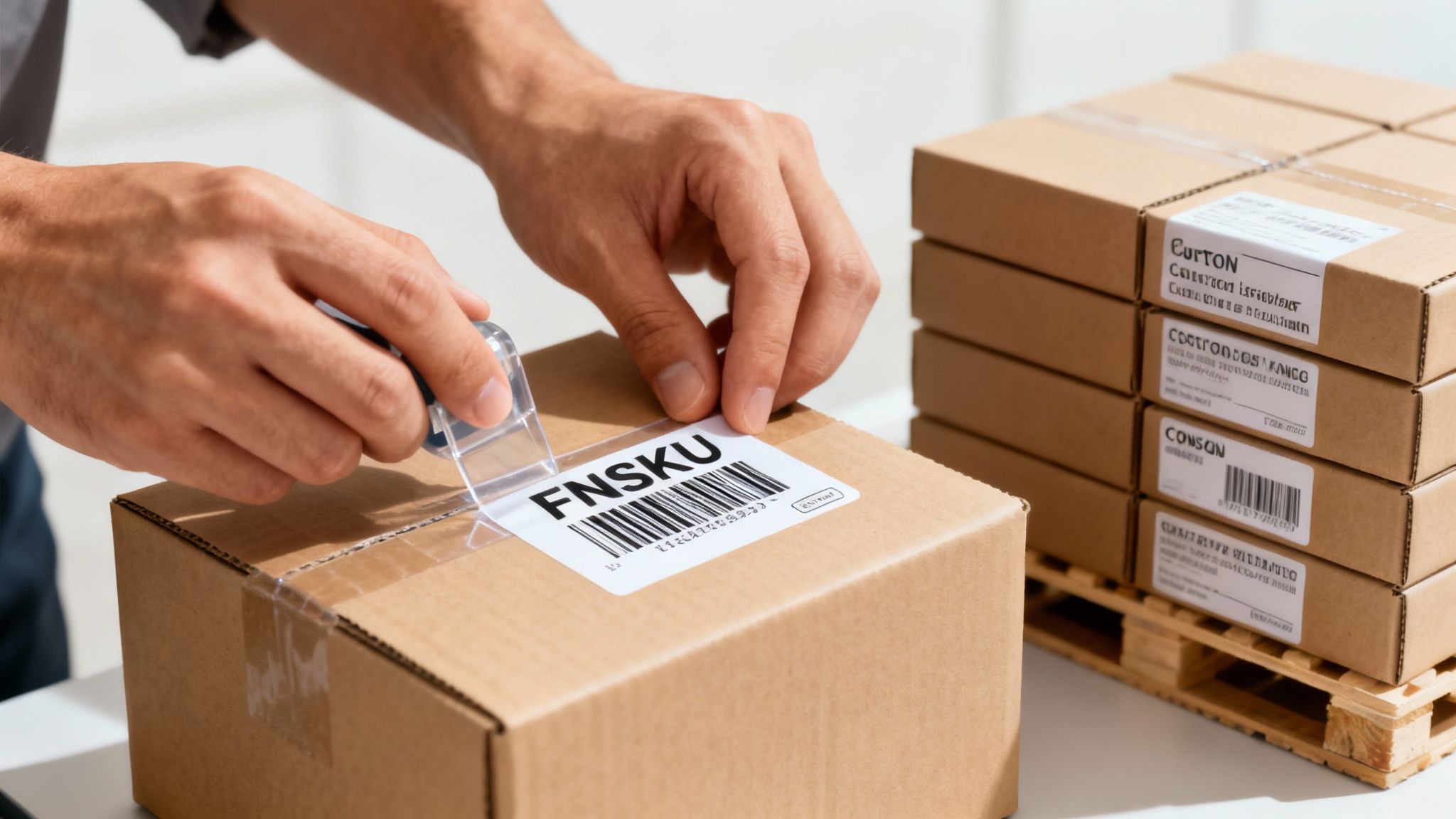
Think of these rules as the language of Amazon’s warehouses. If your shipment arrives with unreadable labels or incorrect packaging, it gets set aside, creating a logistical bottleneck for you and Amazon.
This is precisely why a competent freight forwarder for Amazon FBA or a dedicated prep center is your best defense against these preventable and costly mistakes.
Compliance is a multi-layered process where every detail matters. Small errors can have a massive ripple effect, leading to check-in delays that can last for weeks and directly impact your cash flow and sales.
Here are the core components you must get right:
We have seen real-world examples of costly errors. One brand accidentally applied the FNSKU for their blue product variant to a batch of red ones. The result was thousands of dollars in incorrect orders, a flood of negative reviews, and a painful, expensive recall. This is the type of foundational mistake a specialized forwarder’s prep service is designed to prevent.
Getting the prep and labeling stage right is a key operational optimization. It ensures your inventory flows from truck to fulfillment center with maximum efficiency, making your products available for sale faster and improving your cash flow.
Your freight forwarder is more than a transport provider; they are your quality control checkpoint before your inventory reaches Amazon. A good partner will either offer in-house FBA prep services or work with a trusted prep center to manage these critical final steps.
They understand the nuances, like ensuring pallet labels are placed on all four sides or that "Sold as Set" labels are applied to bundled products. This expertise transforms the complex FBA inbound process into a streamlined, hands-off operation for you.
If you're new to the ecosystem, our guide on what is FBA provides a great overview of the entire model. Ultimately, leveraging your forwarder’s expertise here is a direct investment in operational stability and predictable growth.
Once your logistics foundation is in place, it's time to optimize. Moving beyond simply getting products from point A to B is where savvy FBA sellers gain a competitive advantage. Smart shipping isn't just about the lowest rate; it's a powerful lever for boosting profitability and protecting your brand from supply chain disruptions.
This requires making calculated decisions that balance speed, cost, and risk. For example, you might use faster (and more expensive) air freight for a new product launch to capture early market share. Then, once sales stabilize, you can switch to slower, more cost-effective sea freight for routine replenishment.
Reducing shipping costs is an active, ongoing process. It's about more than comparing quotes; it's about understanding the mechanics of freight pricing to eliminate inefficiencies and avoid surprise fees. A great freight forwarder for Amazon FBA should be your partner in this, actively helping you find these savings.
A few practical moves you can make include:
This kind of fine-tuning has a direct, measurable impact on your bottom line. It frees up capital that can be reinvested into brand growth initiatives like marketing and product development.
A cheap shipment that ends up lost, damaged, or stuck in customs for six weeks isn't a cost saving—it's a disaster. Managing risk is just as crucial as managing costs.
The first step is securing comprehensive cargo insurance. This isn't optional; it's a non-negotiable safety net that protects your business from a total financial loss if the unexpected happens.
Beyond insurance, you can build resilience into your supply chain with key practices:
Building a Buffer: Always maintain a buffer of safety stock, either at a 3PL warehouse or at Amazon's fulfillment centers. This protects you from unforeseen production or shipping delays, preventing the stockouts that can destroy your sales rank.
To hedge against financial loss, it’s also smart to get familiar with carrier liability rules. This includes understanding regulations like the Carmack Amendment, which governs how interstate cargo claims are handled.
Finally, vet your suppliers thoroughly. A partner who consistently misses production deadlines creates a domino effect of problems that even the best freight forwarder cannot solve. In a system as vast as Amazon's—where Amazon Logistics alone handled 6.3 billion U.S. deliveries last year—every detail in the supply chain matters.
As you scale your brand, logistics questions are inevitable. Getting clear, accurate answers is the only way to build a reliable operation. Here are a few of the most common questions we hear from FBA sellers.
This is a frequent and critical question.
DDP (Delivered Duty Paid) means your freight forwarder handles every single cost to get your products to their final destination. This includes shipping, insurance, customs clearance, and all import duties and taxes. They manage the entire process until your goods are safely delivered to the Amazon fulfillment center.
DDU (Delivered Duty Unpaid) means your forwarder handles the shipping, but you are responsible for paying the import duties and taxes upon arrival in the destination country.
For any freight forwarder Amazon FBA shipment, DDP is non-negotiable. Amazon will not act as the Importer of Record and will reject shipments that arrive with duties and taxes unpaid. Choosing DDP prevents a massive operational and financial headache.
Using your supplier’s recommended forwarder can seem convenient, but this ease often comes with hidden costs and a loss of control. Your supplier’s primary loyalty is to their existing relationships, not to securing the best rate or service for your brand.
We always recommend sourcing your own independent freight forwarder, particularly one specializing in Amazon FBA. With your own partner, you get:
In logistics, last-minute planning is a recipe for disaster.
For sea freight, you should plan at least 60-90 days before you need the inventory checked in and available for sale. This timeline provides a realistic buffer for production, booking vessel space, transit time (which can be 25-40+ days), port delays, customs, and final truck delivery to Amazon.
For air freight, the timeline is much shorter, but you should still plan for 2-3 weeks. Always build extra time into your forecast, especially before the Q4 holiday season. Proactive planning is the best way to protect your business from a costly stockout.
At RedDog Group, we help brands build resilient supply chains that fuel predictable growth. If you’re ready to move from simply shipping products to strategically managing your inventory flow, we're here to help. Let's Talk Growth.
Leave a comment: