
Published: March 2020 | Last Updated:October 2026
© Copyright 2026, Reddog Consulting Group.

Your hero ASIN is selling, but an unfamiliar offer appears at a lower price and takes the Buy Box before your team catches it. You can lose contribution margin even when the product page, advertising, and inventory are all in good shape. Brand gating on Amazon can restrict who lists selected products, but it isn't a pricing policy or a one-time approval win. It's a channel-control process with paperwork, upkeep, and inventory risks that need to earn their place in your economics.
The practical question isn't whether you can get an ASIN gated. It's whether restricting offers addresses the specific problem you have, and whether the margin you recover pays for the ongoing work.
An unauthorized seller lists your hero ASIN, undercuts your price, and takes the Buy Box before anyone notices. Brand gating is the restriction intended to screen sellers before they can list a selected product. It changes the offer model: instead of multiple sellers attaching offers to one detail page as usual, sellers attempting to list the gated ASIN may need to submit invoices or other authorization evidence for review.
But enrolling in Brand Registry doesn't automatically turn on gating. Brand Registry verifies ownership and gives rights owners tools to manage product detail pages and report suspected infringement. Amazon applies gating separately to selected ASINs, so check the restriction status in Seller Central before assuming you've limited access. Amazon's Brand Registry information also connects enrollment to product identity: the brand name or logo must be permanently affixed to the product or packaging, with supporting images.
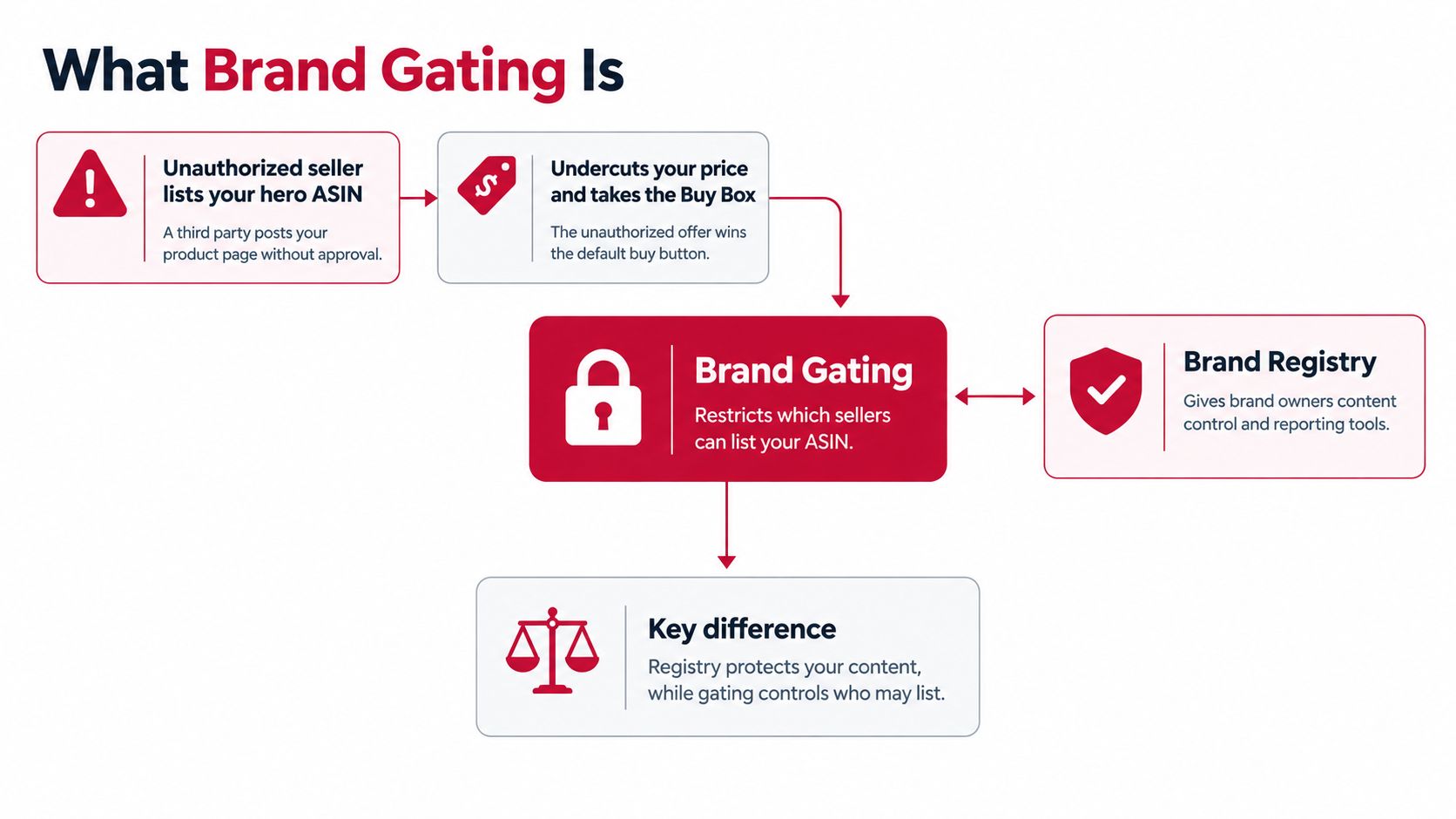
The four layers solve different problems. Registry protects brand rights and listing control; gating restricts who can list an ASIN; Transparency checks product units; Project Zero provides rights owners with counterfeit-removal tools and serialization. Amazon's Project Zero overview lists a Brand Registry account in which the seller is the rights owner of a registered trademark as an eligibility requirement.
| Layer | What It Controls | Core Requirement | Operational Burden | Best Fit |
|---|---|---|---|---|
| Brand Registry | Verified brand ownership, listing tools, and infringement reporting | Active or pending trademark; brand name on product or packaging | Free to enroll; ongoing listing and reporting work | Any brand selling under its own name |
| Brand gating per ASIN | Who can list a selected ASIN, based on submitted evidence | Registry enrollment plus Amazon review of the specific ASIN | Document upkeep for every approved seller; status can change | Brands with resellers, distributors, or repeated unauthorized offers |
| Transparency | Unit-level validation through a unique code on every unit | Registry, GTIN, and the ability to code every manufactured unit | Coding in production and packaging; traceability across partners | High-value or counterfeit-prone SKUs |
| Project Zero | Fast removal of suspected counterfeit listings, plus serialization | Registry account as rights owner of a registered trademark | Program terms and cost must be confirmed per account | Brands facing repeated counterfeit listings |
Before treating a gated ASIN as protected, ask who can list it today, what proof a seller must submit, and what it costs to maintain that status. Gating doesn't enforce minimum advertised pricing or stop distributor diversion on its own. For a plain-language overview of the ownership layer, see this guide to Amazon Brand Registry for omnichannel growth.
Start with the failure mode, not the program. If the problem is that sellers can attach offers to a selected ASIN, gating addresses access. If the concern is whether a unit is authentic, Transparency adds a unit-level check. If your team needs to establish brand rights, manage detail-page content, or report infringement, start with Brand Registry. These tools aren't interchangeable, and joining one doesn't automatically remove unauthorized offers or counterfeits.
Amazon reports that more than 1.6 billion product units have been protected through Transparency, and its global-selling page reports more than 88,000 participating brands, according to its Brand Registry and protection-program information. Those figures describe program reach, not a promise that serialization makes sense for every SKU. The right decision turns on your ASIN's problem and the cost of addressing it.
| Situation | Main Problem | Best First Layer | Why It Fits |
|---|---|---|---|
| Brand sells direct with no resellers | Low unauthorized offers | Brand Registry only | Gating adds review work without a leak to stop |
| Counterfeit listings on a hero ASIN | Counterfeit units and lost Buy Box | Transparency on that SKU, then gating | Serialization validates units; gating stops new unauthorized listings |
| Authorized distributors leak to Amazon at lower prices | Price erosion from unauthorized sellers | Gating on the ASIN with a documented authorization chain | Limits who can list; doesn't stop diversion by itself |
| Multiple suppliers under different legal entities | Repeated document rejections | Entity cleanup and SKU-to-invoice mapping before gating | Paperwork can fail even when the product is legitimate |
| Thin-margin SKU with low unit price | Compliance cost exceeds recovered margin | Brand Registry and monitoring only | Per-unit coding or document work can erase the gain |
Score each ASIN on its failure mode and contribution cost, trademark readiness, packaging changes, per-unit economics, and country-specific eligibility and workload. Packaging can create a real constraint: adding a code or changing how the brand appears isn't just a marketplace task if the product is already in production.
A sensible sequence is to settle trademark, packaging, and legal-entity details first; apply gating where unauthorized offers create measurable losses; then consider Transparency for SKUs where counterfeits remain a problem. Gating can reduce offer competition, but it may complicate legitimate wholesale and distributor relationships if authorization records aren't maintained. A margin-first channel review should identify which SKUs leak, what each leak costs in contribution, and which control addresses that loss.
Before pursuing ASIN-level restrictions, establish the Brand Registry foundation. Amazon's Brand Registry requirements call for an active registered trademark or, in eligible countries and circumstances, a pending application. Pending applications are not accepted everywhere, so check eligibility for the trademark office and Amazon store involved.
Prepare these prerequisites before assembling the rest of the evidence:
Packaging decisions affect readiness. If inventory is already in production, changing the brand presentation or adding a required mark can delay a launch and add cost. For an ASIN restriction request, keep the evidence focused on who is selling, how the units trace to an authorized source, and whether the photos match the listed product. Approval is only useful if the documentation can be maintained as suppliers, sellers, and packaging change.
| Seller Type | Evidence Usually Requested | Gap That Causes Rejection | Typical Situation |
|---|---|---|---|
| Brand owner or manufacturer | Registry proof, production or supplier invoice, packaging photos showing the brand | Registry entity differs from invoicing entity | Brand selling its own product direct |
| Authorized distributor | Brand letter of authorization, invoices tracing units to the brand, packaging photos | Letter is expired or doesn't name the seller | Distributors and wholesale partners |
| Authorized reseller | Invoice chain from brand or authorized distributor to the seller, letter of authorization | Missing link in the invoice chain | Retailers buying through wholesalers |
| Closeout or parallel importer | Written brand authorization; lot-level invoices where available | Units can't be traced to an authorized source | Liquidation and gray-market sourcing |
| Unknown or unbranded supply source | Brand authorization is required | No authorization from the brand | Sourcing from unknown suppliers or open marketplaces |
Three mismatches commonly weaken otherwise reasonable submissions: the Brand Registry entity differs from the invoicing entity; an authorization letter has expired or names another company; or packaging photos show an old version that no longer matches the ASIN. Reconcile legal names, seller identity, product identifiers, invoice lines, and current packaging before submitting. If the supply route cannot be documented, the seller may have difficulty demonstrating authorization, even when the goods are genuine.
This paperwork is an ongoing channel-governance cost, not just a hurdle before approval. Keep authorization and product records current as inventory moves through the supply chain. The effort pays off only when the contribution margin protected by restricting unauthorized offers outweighs the cost of maintaining compliant records.
Once the protection layer fits the ASIN and the evidence is ready, treat the request as a document-matching exercise. A concise, consistent packet is more useful than a folder full of files that don't line up with the seller, product, or supply route.
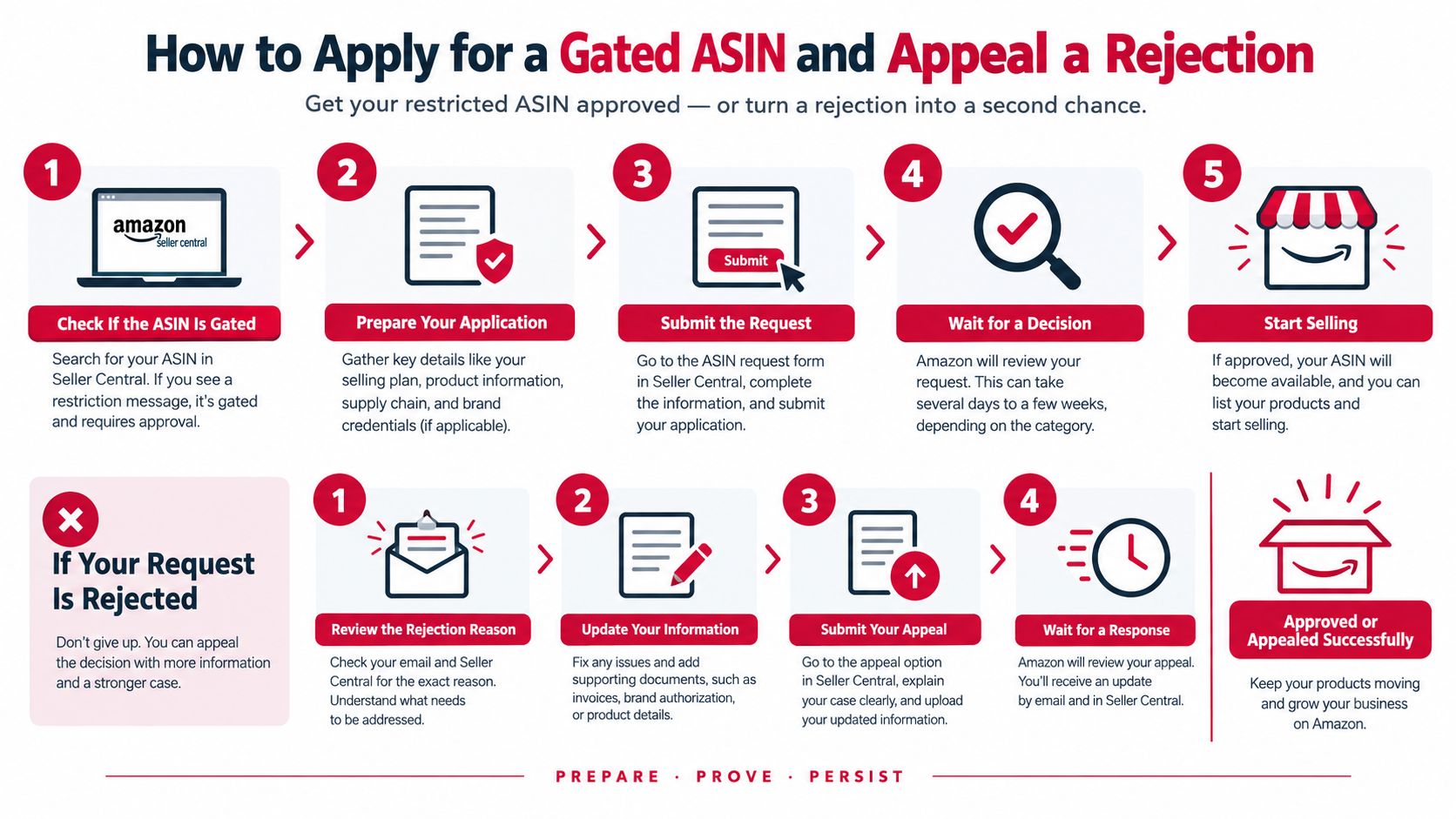
If a request is denied, keep the response tied to the evidence Amazon asked for. For example, a letter naming a distributor doesn't resolve a missing invoice link to the specific seller. Replace or supplement the document that fails to establish that link.
Review times vary, so don't ship inventory on the assumption that a first submission will be approved before the listing needs to go live. Leave room in the launch calendar for a second review round, and keep stock flexible until the ASIN's status is clear.
Consider one hero SKU with a $24.99 selling price and $9.00 contribution per unit at full price, holding landed cost, fees, and freight fixed. These are illustrative assumptions, not category benchmarks. They let you isolate the effect of a lower offer and see whether recovered contribution could fund the control.

At 1,000 units per month, the full-price baseline produces $9,000 in contribution. If 300 units sell through offers priced at $19.99, and the $5.00 price gap comes directly out of contribution, the blended result falls by $1,500 per month. The remaining contribution is $7,500, or $7.50 per unit across all units.
| Scenario | Units on Undercut Offers | Result |
|---|---|---|
| Full price, no undercut | 0 | $9,000 monthly contribution baseline |
| Undercut at $19.99, no gating | 300 | $1,500 lost per month |
| Gated, 300 units recovered at full price | 0 | $1,500 recovered before costs |
| Gated, net of upkeep and coding | 0 | $990 net monthly contribution gain |
Suppose gating removes the lower offers and the brand recovers those units at full price. The gain is $1,500 a month before costs. In this illustration, six hours of document upkeep at an internal rate of $60 an hour costs $360, while Transparency coding at $0.15 for 1,000 units costs $150. After the combined $510 cost, the modeled gain is $990 a month. At a $5.00 contribution gap, about 102 recovered units a month cover those costs.
For a separate view of where competing offers may come from, a practical introduction to retail arbitrage can help frame the sourcing route behind a low offer. Approved sellers keep their listings; unapproved sellers may lose the ability to list, while stock already in fulfillment may need removal. The brand may see fewer offers and a steadier Buy Box, but gating doesn't set price. Keep monitoring offers, and rebuild the model using your actual landed cost, fees, price gap, and realistic recovery rate.
Approval isn't permanent. Amazon may change restrictions after a seller has already been approved, which can make a listing unavailable and leave inventory that must be removed. That risk turns a gating decision into an inventory-planning decision, particularly when stock is already in fulfillment.
Transparency adds another point where a legitimate product can fail operationally. Amazon describes validating the serial number when a unit is sold, before shipment, to verify authenticity, as outlined in its Transparency guide. A genuine unit without the required code, or with a code that can't be validated, may not pass the process. Authenticity of the product doesn't by itself establish that the unit meets the program's requirements.
A control intended to block counterfeits can also make genuine stock unsellable if the supply route breaks unit-level traceability.
The hidden costs aren't limited to code application. They include packaging and production work, distributor replenishment that introduces non-compliant units, less flexibility for closeouts and liquidation, time spent on support and appeals, and wholesale relationships that become harder to scale when authorization records lag behind the business.
Build controls around the physical flow of inventory:
Treat these checks as standing costs, not launch paperwork that disappears after approval. The test is whether the ASIN's recovered contribution covers upkeep, coding, and the risk of stock getting stranded. If it doesn't, stronger restrictions can create more work without improving the channel's economics.
Start with the ASIN. Business Reports by ASIN can show its Featured Offer percentage; an offer-tracking tool can help count competing sellers and compare prices. Account-level totals may hide an ASIN losing the Buy Box while the rest of the catalog performs normally.
Before applying, test the economics:
Estimate how many units gating could recover, the likely price gap, and the ongoing upkeep. Compare that contribution with the costs, including the possibility of stranded inventory. Use a retail profit margin calculator to organize the assumptions. Apply gating only when expected recovered contribution exceeds the ongoing cost with room to spare. A result that barely clears break-even isn't a strong margin case.
Treat gating as a Foundation task for ASINs that carry margin, then move into Optimization and Amplification only when the economics support continued investment. Approval may restrict offers, but it does not guarantee recovered sales or fix weak unit economics. The control has to keep earning its place in the channel.
RedDog Consulting Group helps CPG brands connect marketplace performance, inventory decisions, and channel economics. Qualified founders and operators can visit Reddog Consulting Group to discuss ASIN leakage, contribution margin, and marketplace growth planning.
Leave a comment: